122 St. Anthony’s Fire
This disease is generally associated with ergotism, a disease resulting from the ingestion of the ergot fungus that grows on rye. Most authorities assume that the name St. Anthony’s fire refers to St.
Anthony the Great, a third-century A.D. hermit and founder of Christian ascetic monasticism. This saint renounced the world for the deserts of Egypt and, according to hagiographers, there combatted the devil numerous times. His visions of the devil took the form of worldly pleasures, seductive women, dragons, banquet tables, and the like. However, St. Anthony of Padua, born in the late twelfth century, may also be connected to the name of the disease. This saint was a noted preacher, popular for his ability to exorcise demons. He was also known for restoring the insane to health, and was credited with miraculously healing an individual whose limb had been amputated.Supposedly the “fire” part of the name refers to the painful skin infections, gangrene, and neurological disturbances that occur with ergot poisoning. Thus, in France north of the Loire where rye was a traditional staple grain, attributing most cases of mal des ardents to ergotism has seemed reasonable to historians. Sufferers there reportedly lost limbs, attributable to the gangrenous form of ergotism, if they survived both the initial inflammatory process and the generalized famine that accompanied epidemics of the disease. On the other hand, it is also quite possible that erysipelas and other bacterial skin infections were at the root of the symptoms mentioned, for these diseases also flourish under conditions of famine.
The disease we think of as St. Anthony’s fire was commonly described in western Europe from 900 to 1700. During the eleventh century, recurrences of the “sacred fire” (usually associated with erysipelas in classical medicine) led to the creation of hospitals and also to an appeal to many different interceding saints, of whom Anthony was only one.
In the Dauphine region of France, however, Count Gerlin II acquired the relics of St. Anthony the Great and returned them in 1070 to Vienne (on the Rhone River). By 1090 healing miracles were being attributed to the bones, and local nobles helped a small group of lay hospitalers to form a pilgrimage site for sufferers of “fire.” By the twelfth century, this hos-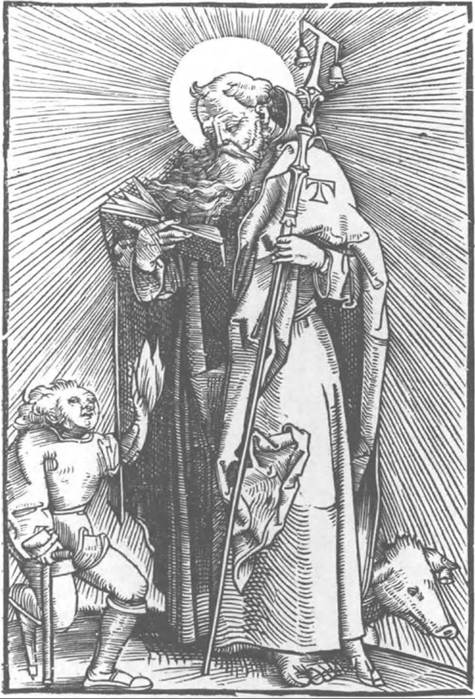
Figure VIII. 122.1. Woodcut of St. Anthony by Johannes Wechtlin. (From Hanns von Gersdorff. 1517. Feldtbuch de Wundartznev. Strassburg, by courtesy of the Lilly Library, Bloomington, Indiana.)
pice was run by regular clergy, calling themselves “friars of the blue Tau,” for the large Greek letter that came to symbolize Anthony Iconographically. Wine or water steeped in the bones of the saint was offered sufferers as the miraculous cure; however, additional food supplements at the hospices of St. Anthony may have arrested ergot intoxication.
During the later Middle Ages, the cult of St. Anthony spread well beyond the regions of southern France and Savoy, where it had gained rapid popularity, into central Europe as far east as Russia. There the people often commemorated cures with votive art that has come to symbolize the disease to posterity. For example, in Figure VIII. 122.1, a victim stretches his fiery hand toward the saint for help.
The earliest unambiguous references to the ergot fungus occur in the late sixteenth century; by the late seventeenth century, ergotism was described independently of the popular attribution to St. Anthony. The older name - perhaps the older “disease” as well - rapidly disappeared from learned descriptions, in part because of the association of ergot fungus on rye and other grains with epidemics of convulsive and other neurological disorders, rather than with the skin infections and subsequent gangrene that characterized “St. Anthony’s fire.”
Ann G. Carmichael
Bibliography
Barger, George. 1931. Ergotand ergotism. London. Bovd, Frank, J. 1970. The story of ergot. Basel, N.Y.
Carbonelli, G. 1920. Del fuoco di S. Antonio e due documenti iconografici del XV secolo. Bolletino di Istituto Storico, Italiano dell’Arte Sanitaria 19: 144—53.
Chaumartin, Henry. 1946. Le Mal des ardents et Ie feu Saint Antoine: Etudes historique, medicales, hagio- graphiques et Iegendaire. Vienne.
Dotz, Warren. 1980. St. Anthony’s fire. American Journal OfDermatopathology 2: 249—53.
Frey, Emil F. 1979. Saints in medical history. Clio Medica 14: 35-70.