Africa
Two major originating centres of food production lay in Africa, one in the far eastern Sahara and the other far to the west, in West Africa, along with a probable third centre in the southwestern Ethiopian highlands.
With the end of the Younger Dryas, rainfall and climatic belts in Africa south of the Sahara shifted rapidly northward. In the wake of this shift of seasonal rain regimes, tropical steppe and dry savanna vegetation followed northwards into the centre of what previously had been a hyper-arid Sahara. At the same time a countervailing shift of Mediterranean climate took subtropical steppe and grassland southwards, with the two climatic zones meeting midway through the Sahara.[72] In the eastern Sahara, new directions of change first took shape after 8500 bce, as the delayed spread northwards of tropical steppe flora and fauna reached the middle of the Sahara. In West Africa the first signs of a new human response to these environmental shifts appeared even earlier, by 9500 bce, in the areas south of the great bend of the Niger.In the eastern Sahara, two groupings of peoples, the Nilo-Saharans and the Cushites, were primary actors in the transition to herding and cultivation. Unusually in world history, the adoption of livestock-raising preceded crop cultivation among the peoples of these areas. The archaeology and linguistics accord in this implication for the Nilo-Saharans, and the lexical histories indicate the same progression for the Cushites. In the separate West African centre, the prime movers in the changeover spoke languages of the Niger-Congo family, and cultivation preceded the raising of animals.
The Nilo-Saharan linguistic record
The lexicons of subsistence in the first several periods in the history of the Nilo-Saharan language family reveal an extended, stage-by-stage history of shift from food collection to food production.
What makes possible the reconstruction of Nilo-Saharan lexical histories is our possession of an extensive, systematic linguistic reconstruction of this family, including morphological aspects as well as phonology.[73] [74]The family descent tree of the Nilo-Saharan family (Figure 3.1) lays out the succession of language and societal divergences down through the history of the family. Together the lines of linguistic descent identify the major lines of historical transmission of language and culture leading from earlier Nilo-Saharan societies down to the great variety of Nilo-Saharan societies in existence today.11
A family tree, like that of Nilo-Saharan, constitutes a relative chronology of language and societal history. To link the chronology to an absolute timescale, one seeks correlative calendar dates, wherever possible, for key nodes on the tree. For early periods the best basis for this kind of correlation is to identify an archaeological sequence in which the developments in material culture parallel in detailed fashion the succession of developments in a linguistically reconstructed history. In Figure 3.1 the calendar dates from 10,500 to 6000 bp (before the present), given along the righthand margin for several early nodes on the family tree, rest on just such parallel archaeological and linguistic sequences.[75] We begin with the linguistically attested sequence and then consider the archaeology.
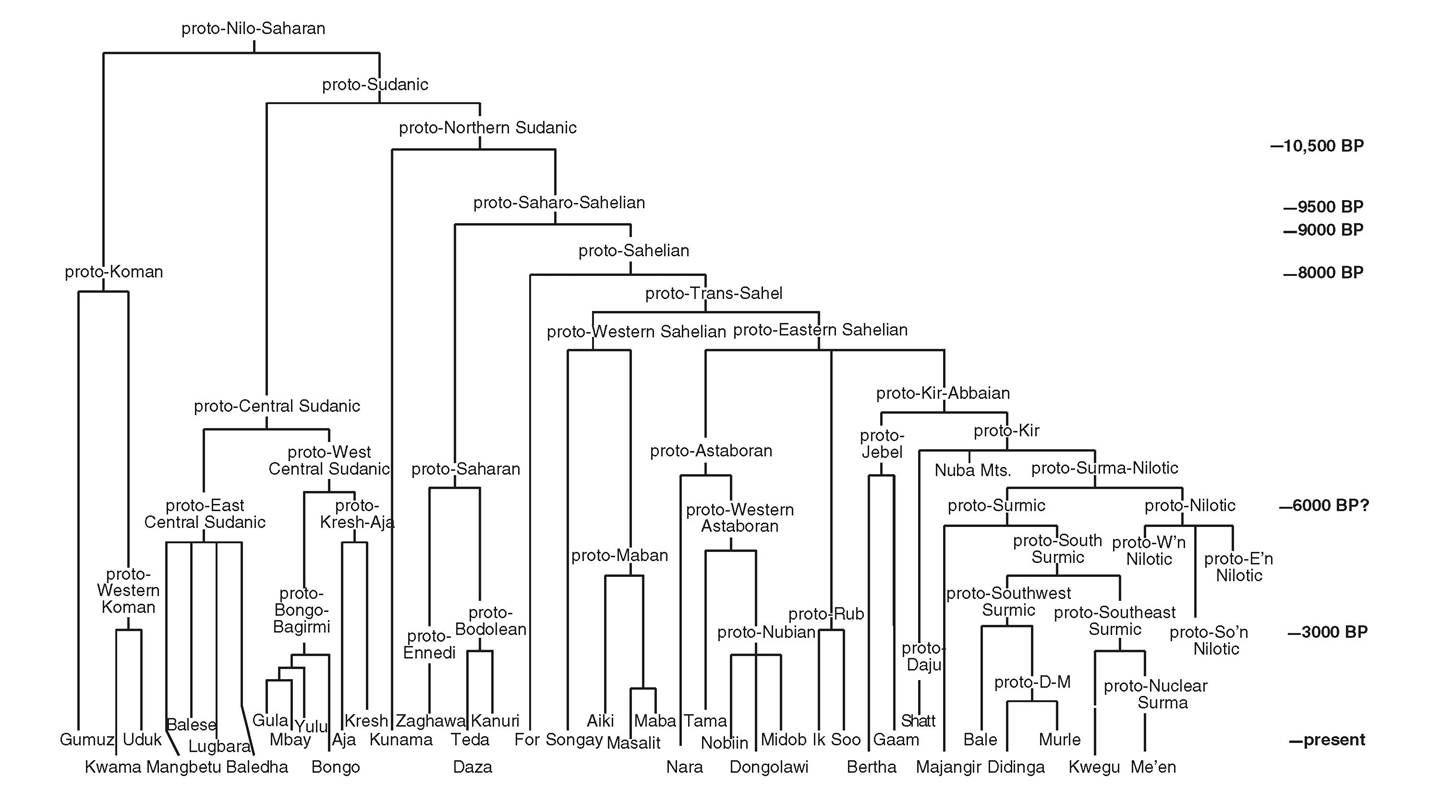
Figure 3.1 Nilo-Saharan linguistic stratigraphy. BP = before the present.
Through the first two periods in the stratigraphic tree, Nilo-Saharan peoples were still food collectors in their economy. The earliest vocabulary indicative of the deliberate manipulation and tending of food resources occurs at the proto-Northern Sudanic node in the tree - in historical terms, during the period represented by the proto-Northern Sudanic stratum in the Nilo-Saharan stratigraphy.
The lexical reconstructions have been published previously.[76] But in visualizing how one determines which kinds of word meaning are actually diagnostic of food production and which are not, it may be helpful to look at the relevant reconstructed subsistence lexicon traceable to the proto-Northern Sudanic stratum. Here are those root words, grouped according to what each implies about subsistence:Proto-Northern Sudanic subsistence lexicon, not by itself diagnostic of food production
1. *yaayr ‘cow' [adds Nilo-Saharan *r noun suffix to earlier PNS
*yaay ‘meat']
2. *way or *'way ‘grain' [not yet known earlier in the family]
3. *keen ‘ear of grain' [not yet known earlier in the family]
4. *p'εl ‘grindstone' [not yet known earlier in the family]
Proto-Northern Sudanic lexicon diagnostic of livestock-raising
5. *yaat ‘to (drive to) water (animals)' [earlier proto-Nilo-Saharan (PNS)
*yaa ‘drink' plus PNS *t causative suffix, changing ‘drink' to ‘cause to drink']
6. *syuuk ‘to drive (animals, to pasture)' [earlier PNS *syuu ‘lead off, start
out' plus PNS *k causative suffix, changing ‘start out' to ‘cause to start out']
7. *ndyθw ‘to milk' [PNS *ndyθ ‘to squeeze' plus PNS *w, focused action
suffix]
8. *oroh ‘thornbush pen' [noun not yet known earlier in the family]
Other proto-Northern Sudanic new lexicon of material culture
9. *ted ‘to make a pot' [verb not yet known earlier in the family] Root word 1, for cow, is not in itself diagnostic of food production because wild cattle lived in the early Holocene in the parts of the Sahara inhabited by the Northern Sudanians. Root words 2-4 in similar fashion are not diagnostic of cultivation because they are words just as necessary in a wildgrain-collecting economy as in a grain-cultivating one. Roots 5-8, in contrast, are diagnostic of food production. The first two are verbs for actions explicitly directed at tending and looking after animals.
Root 7 connotes an activity possible only with animals that are at least partially tamed and that are used to being in close contact with humans; and root word 8 names a structure in which to keep animals at night to protect them from predators.[77]So while the word for cow does not by itself require the deliberate tending of livestock, root words 5-8 do. The existence of a word for cow in protoNorthern Sudanic, but no word for any other domestic animal, does, however, identify cows as the animals that the Northern Sudanians had begun to tend. The Northern Sudanians utilized grains for food and ground them into flour, although evidence is lacking that they cultivated the grains. Most interesting for archaeological correlation, they were the possessors and makers of ceramic wares.
In the next two periods in the linguistic stratigraphy, the proto-Saharo- Sahelian and proto-Sahelian eras, additional bodies of root words diagnostic of livestock-raising, and specifically of the raising of cattle, came into use. To the proto-Saharo-Sahelian period can be traced nouns for ‘bull' and ‘heifer'. A breeding taxonomy, and especially one that distinguishes young female animals that have not yet borne young, is a conclusive diagnostic marker of livestock-raising. An additional noun for the thornbush livestock pen, along with a general verb for the activities of herding animals and an additional verb with the meaning ‘to milk', also date to this period.
To the same proto-Saharo-Sahelian period can be dated a major development in residential patterns. Several new nouns in the proto-Saharo-Sahelian language - for an open area within a settlement, for an enclosed yard of a homestead, for round houses, and for a granary - reveal the emergence of larger, sedentary settlements.
By the close of the proto-Sahelian period, the next era in the linguistic stratigraphy, terms for a castrated steer and for a young bull had also become part of the breeding taxonomy, along with a noun that may have applied originally to an outlying cattle encampment, a feature possibly indicative of seasonal transhumance.
A striking new feature in lexical history at the proto-Sahelian stage was an added new field of livestock meanings. For the first time, terminology relating to both goats and sheep, including generic as well as breeding terms for both animals, came into use. Goats and sheep were not indigenous wild animals of the regions of early Nilo-Saharan peoples, but were domesticated in the Middle East. The presence of terms for these animals indicates that the herding of both of them spread to the Nilo- Saharans at least as early as the proto-Sahelian node in the linguistic stratigraphy. It comports, as well, with the inference that these peoples had begun to domesticate cattle in the previous two eras and thus that the protoSahelian communities incorporated sheep and goats into an already evolving pastoral economy (see also Chapter 18).The linguistic geography of the early stages of Nilo-Saharan divergence, depicted on the family tree (Figure 3.1), favours a location for the protoNorthern Sudanic society in the southern half of the eastern Sahara. On through the proto-Saharo-Sahelian period, these communities mostly likely occupied a wide but still relatively restricted zone of settlement, in areas extending westwards from the Nile towards the Tibesti Range. Following the proto-Sahelian era, however, a vast spreading out of the daughter languages of proto-Sahelian took place, reaching the western edge of the Ethiopian highlands in the east to as far west as modern-day Mali.
These linguistic findings fit in striking detail with the early Holocene archaeological succession of the southern half of the Sahara:[78]
1. 8500-7500 bce: Pottery-making peoples, who apparently tended cattle in some fashion and lived in relatively ephemeral sites, inhabited parts of the southern eastern Sahara. The best-known finds come from Nabta Playa at the farthest south of modern-day Egypt, but this population also inhabited areas, as yet poorly known, further south and west in northern parts of Sudan and far southeastern Libya.
2. 7200-7000 bce: A new stage in these developments appears in the same areas, with more significant evidence of cattle and more sedentary, larger settlements with, among other features, granaries and round houses.
3. 6400-6000 bce: The first remains of goats and sheep appear in sites of the region.
4. 6000-4500 bce: This pastoral economy spreads across a vast expanse of the southern half of the Sahara and the adjacent Sahel zone, extending from the edge of the Ethiopian highlands to as far west as the Hoggar mountains and the great bend of the Niger River in Mali.
Figure 3.2 summarizes the point-for-point fit of the lexical reconstruction of this economic and population history with the Saharan archaeological record.
Recent archaeological work adds a further point of potential correlation. Chemical studies of residues in pots from southern Libya from around 5000 bce reveal the by-products of processed milk.[79] The lexical histories of terms in Nilo-Saharan for processing milk into ghee or butter place this development in the period following the breakup of the proto-Sahelian society,[80] and thus a date of 5000 bce is quite in keeping with the milk evidence from pottery in the Sahara. The presence earlier in time of verbs for ‘to milk' suggests that milking itself goes back to still earlier stages in the adoption of pastoral pursuits by Northern Sudanian peoples. And that finding raises the question of whether or not milk residues might also be found in eastern Saharan pottery from the eighth millennium, if archaeologists were to undertake this kind of investigation.
Reconstruction of the early Nilo-Saharan subsistence lexicons raises a further issue for future archaeological investigation: the timing of the transition from solely plant food collecting to crop cultivation. The proto-Northern Sudanic language had terms for the utilization of grains as food, but, as far as is known, no terms diagnostic of cultivation. Root words specifically diagnostic of, at the least, protecting and looking after the growth of plant food sources occur for the first time at the next historical stage, in the proto- Saharo-Sahelian language. These include three verbs that always refer to cultivation activities in all later periods in the language family, along with a noun for a cultivated plot (Figure 3.2).[81] The major residential shift to more complex, more sedentary settlements in the later eighth millennium is in keeping with a history in which the first steps towards cultivation took place in that era. The presence of granaries in those sites, along with the occurrence
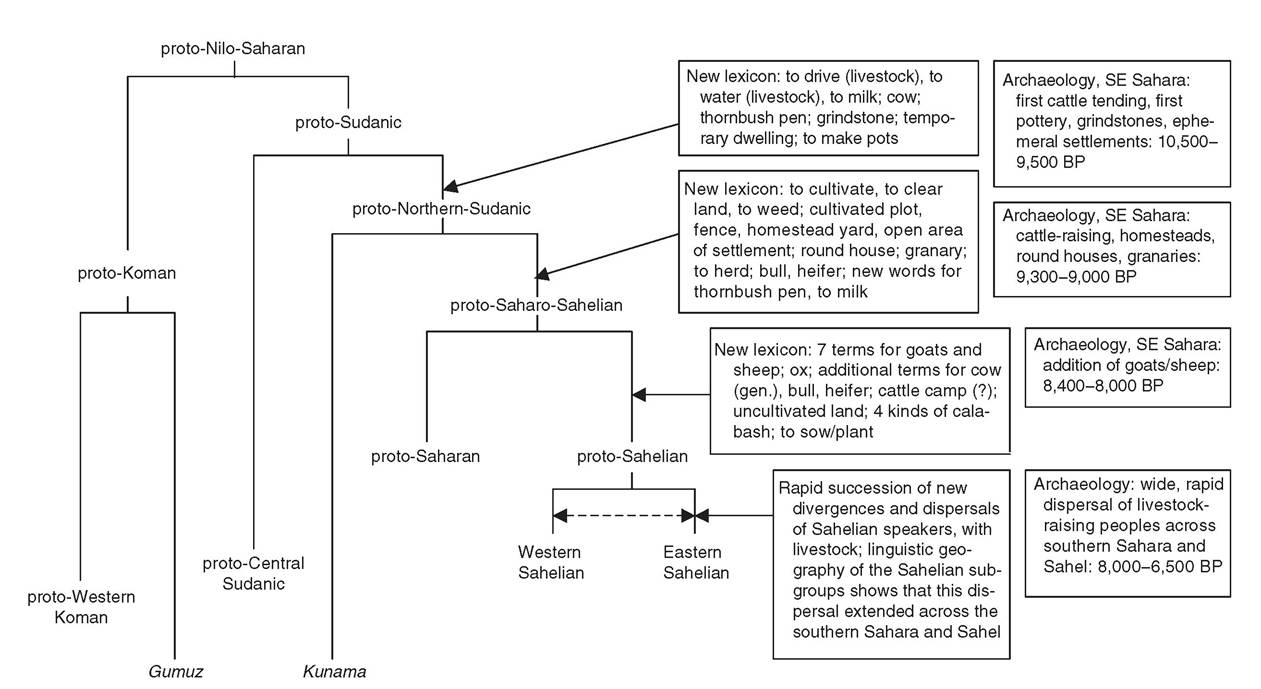
Figure 3.2 Nilo-Saharan family tree: new subsistence lexicon, from proto-North Sudanic to proto-Sahelian periods.
for the first time in the proto-Saharo-Sahelian language of a root word for granary, also favours at least incipient cultivation - although the collection of wild grains, if carried on intensively enough, might also have encouraged the building of granaries.
On the other hand, the available direct evidence from archaeobotany is as yet non-determinative. Archaeologists have recovered sorghum seeds from the late eighth millennium at Nabta Playa, but they are not distinguishable from those of wild sorghum.[82]
Two more verbs for the deliberate tending of plant foods reconstruct to the next stratum in Nilo-Saharan, the proto-Sahelian era. The presence of words for sheep and goats in the proto-Sahelian language dates this period to around 6400-6000 bce (Figure 3.2). The proto-Sahelian language also had four different terms for melons and gourds.[83] The reconstruction of a cluster of terms for this related set of plants suggests that the plants were culturally salient to the proto-Sahelians and that the first stages in the domestication of this particular suite of crops, botanically of Sudanic African origin, may date to that period also. Thus far, however, direct archaeobotanical evidence confirming or disconfirming these propositions is lacking.
Herding and cultivation in northeastern Africa
The second major grouping of peoples who participated in the development of food-producing ways of life in the southern eastern Sahara were the early speakers of languages of the Cushitic branch of the Afroasiatic language phylum. The lands of the proto-Cushitic society most probably lay in the mountainous and hilly country of the southern eastern Sahara, east of the Nile and inland from the Red Sea, sometime before 6500 bce. Following the breakup of the proto-Cushitic society, Cushitic speakers carried their ways of life south and southeastwards, first into Eritrea and along the northern fringes of the Ethiopian highlands and then, following the Ethiopian Rift Valley, southwards through the highlands, with their farthest south outlier, the Southern Cushites, moving into northern Kenya around or just before 3000 bce.[84] The reasons behind the proposed dates and lands in which this history took place will become clearer once we have considered the lexical evidence for the proto-Cushitic economy.
The proto-Cushites were already herders of livestock. Their lexicon included two verbs for the herding of animals (*galaal- and *der-) and a noun for a thorn-fenced pen (*dall-), along with terms for cow (*sa?-), bull (*yaw-), and bull-calf (*leg-). It possessed, as well, a collective term for goats and sheep (*2ayz-) and a word for goat (*anaa?-) as well as terms for ram/he- goat (*2org-), kid/lamb (*2aff-), and young female sheep or goat (*rangan-). Both these sets of evidence, because they include breeding terms and verbs for herding, are directly diagnostic of livestock-raising. In addition, the protoCushites possessed a word for the donkey (*ħarle-). But since the Red Sea hills were the ancient heartland of the wild range of donkeys, and because in a few Cushitic languages this term refers to wild equines, it is likely that the proto-Cushites had not yet begun the domestication of the donkey.
Were the proto-Cushites also cultivators of crops? Grains were clearly important in their subsistence: they had two words for sorghum varieties (*?ag- and harr-), two words for other grains, as yet of uncertain species (*?ayl-, possibly a Panicum species, and *ma?aar-), and a term for grain prepared as food (*dif-). On the other hand, no terms diagnostic of cultivation have yet been traced back to the proto-Cushitic language, and so for now it seems probable that the proto-Cushites were still collectors of wild grains.[85]
Diagnostic lexical indicators of cultivation turn up, however, at the second node in the Cushitic family tree, proto-Agaw-East-South Cushitic - specifically verbs for cultivating (*?ibr-/*?abr-) and weeding (*2arum-) and a noun for a cultivated field (*baayr-). Two new grain terms came into use in that period as well, one apparently for finger millet (*dangaws-/*dingaws-) and the other for tef (*tl'eff-). The fact that both are indigenously domesticated crops of the Ethiopian highlands indicates that adoption of these crops may have proceeded in tandem with the switchover from collection to cultivation of grains. Also, from this period onwards in Cushitic history, terms specifically and always referring to domestic donkeys came into use, suggesting that the domestication of donkeys began also in this era. Figure 3.3 gives the family tree of the early stages of Cushitic divergence and depicts the stratigraphy of the lexical evidence.
When did these stages of agricultural history unfold in the Horn of Africa? Because the archaeology of the crucial regions is as yet little known, there
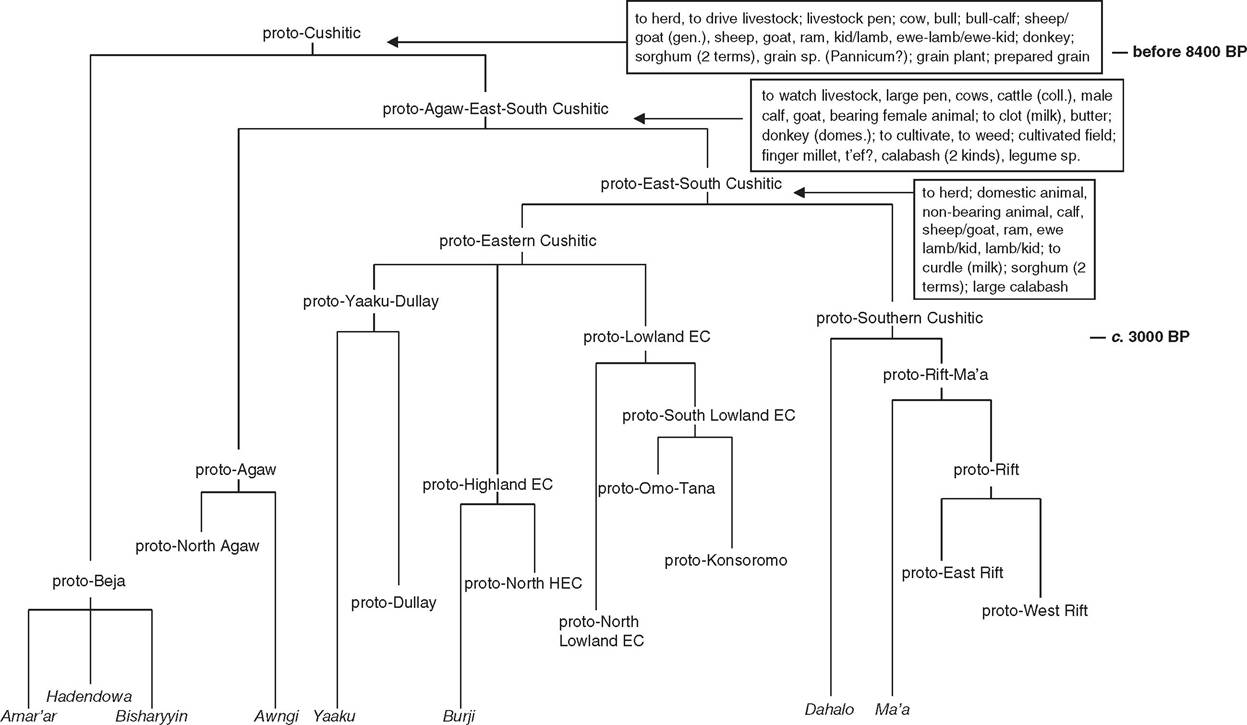
Figure 3.3 The family tree of the early stages of Cushitic divergence.
exist currently just two nodes in the linguistic stratigraphy of Cushitic to which we can assign very rough calendar dates. The more recent dating relates to the history of the Southern Cushites. The early Southern Cushites are generally accepted to have been the makers of the various facies of an archaeological tradition of Kenya known as the Savanna Pastoral Neolithic.[86] The earliest sites of the Savanna Pastoral Neolithic, found in northern Kenya, date to before and around 3000 bce,[87] thus providing a terminus ante quem for the spread of Cushitic peoples southwards through the Rift Valley region of the Ethiopian highlands.
The second Cushitic correlation relates to a much earlier point on the timeline, and it rests on a correlation of archaeological findings with the word histories of two terms for small livestock. Nilo-Saharan peoples, as we discovered from the lexical evidence, fully adopted the raising of goats and sheep by the proto-Sahelian period (see Figure 3.2). The first certain archaeological evidence of the arrival of these animals in the eastern Sahara dates to the centuries 6400-6000 bce. When the proto-Sahelians began to keep sheep and goats, they adopted their two primary terms for goat, *ay and *nay, from a Cushitic language. Evidently the early Cushites were the intermediaries in the spread of the animal to the Nilo-Saharans.
The sources of those proto-Sahelian words were the two proto-Cushitic root words already cited, *?ayz- ‘goat, sheep' and *anaa?- ‘goat'. Now, the salient point here is that the borrowed forms of both terms trace, not to proto-Cushitic itself, but to a particular, very early daughter language of proto-Cushitic. The reconstructed proto-Sahelian root word *ay ‘goat' derives ultimately from proto-Cushitic *2ayz-; but its pronunciation reflects the Northern Cushitic version of that root, as attested in the one Northern Cushitic language, Bedauye, that is still spoken today. In ancient Northern Cushitic, proto-Cushitic *z became *y, yielding the modern-day Bedauye general term for small stock, ay ‘goat, sheep', and thus *ay in the borrowed proto-Sahelian version of the root. Similarly, proto-Sahelian *nay ‘goat' shows the phonological changes also seen in Bedauye's regular reflex, na?i ‘goat', of proto-Cushitic *anaa?-.[88]
The adoption of generic terms for goat by the proto-Sahelians from early Northern Cushitic speakers has two implications, one geographic and the other chronological:
1. The early Northern Cushitic descendants of the proto-Cushites, by the time of the first certain presence of goats and sheep in the eastern Sahara, 6400-6000 bce, lived nearby to the areas in which the Nilo-Saharan livestock-raisers of that era resided, most probably in the areas extending eastwards from the Nubian Nile to the Red Sea hills.
2. The divergence of the Northern branch of Cushitic from the rest of Cushitic therefore began no later than the first half of the seventh millennium bce and very possibly earlier than that, in the eighth millennium.
Goats and sheep, these findings imply, spread from the Middle East south into the regions east of the Nubian Nile, still almost unknown archaeologi- cally, in the first half of the seventh millennium or before.
Historical background of agriculture in West Africa
Far to the west in Africa lay another major centre of early agricultural innovation. The historical actors in this region spoke languages of the Niger-Congo family, now vastly spread across two thirds of sub-Saharan Africa.[89] Although the full phonological reconstruction of proto-Niger- Congo is a project still in progress,[90] the strength of the lexical and grammatical evidence across the family is such that scholars have no doubts about its validity.[91] The subclassification of the Niger-Congo family (Figure 3.4) reveals that the expansion of the peoples of this family took place over three extended historical stages.
During the first period of expansion, the early descendant societies of the proto-Niger-Congo people spread out across an east-west span of savanna and steppe environments, between roughly 15° n and 20° n, centring on
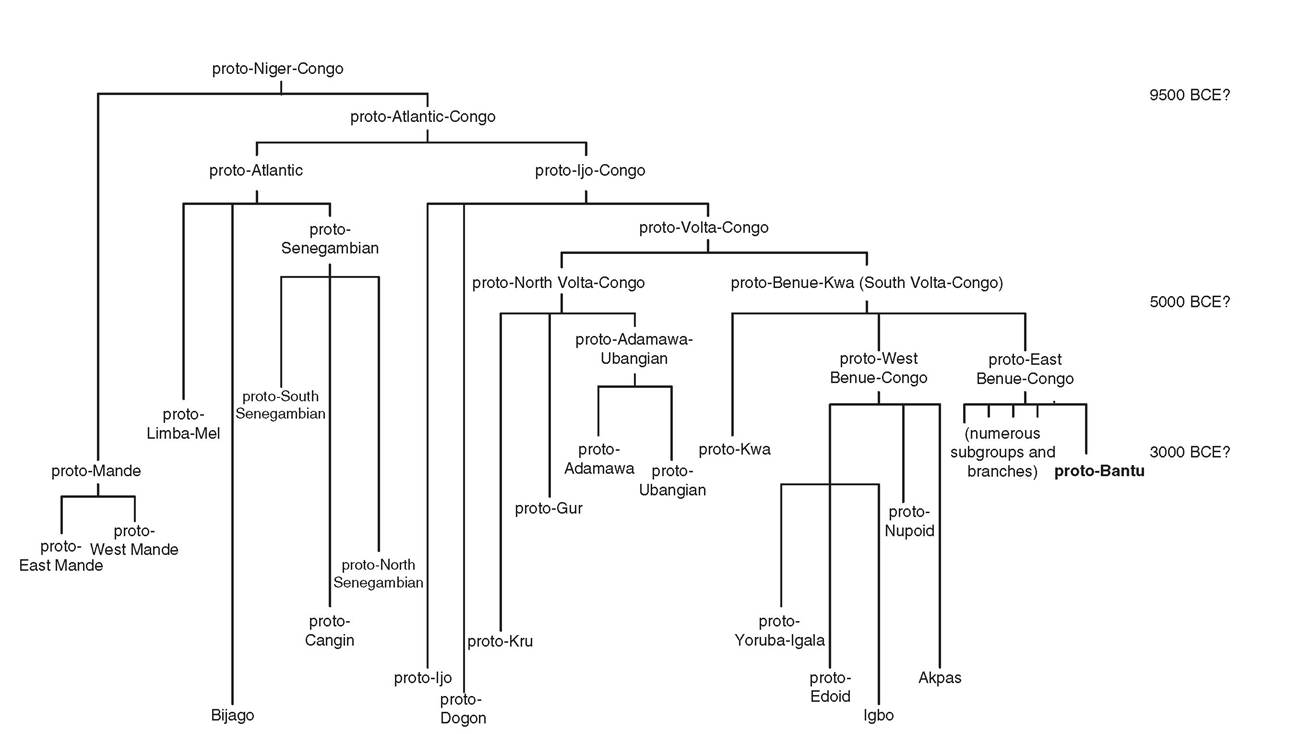
Figure 3.4 The Niger-Congo family tree.
modern-day Mali.[92] Proto-Niger-Congo diverged, as shown in the Niger- Congo family tree (Figure 3.4), into two daughter languages, each of which in turn became the protolanguage of one of the two primary branches of the family. These branches are Mande and Atlantic-Congo. Proto-Atlantic- Congo, the ancestor language of the latter branch, then diverged into two daughter languages, proto-Atlantic and proto-Ijo-Congo, followed not long after by the divergence of proto-Ijo-Congo into three further daughter languages: a language ancestral to the modern-day Dogon cluster of languages; a language ancestral to the Ijo group; and the protolanguage of the far-flung Volta-Congo branch.
The second extended period of Niger-Congo expansion began with a southwards dispersal of languages of one sub-branch of Volta-Congo, the Benue-Kwa, across a swathe of woodland and rainforest extending between what is now southern Cote d'Ivoire on the west and central Cameroon on the east. Linguists estimate that the Benue-Kwa divergence began roughly around the fifth millennium bce,[93]° several millennia later than the initial Niger-Congo dispersal.
The third major era of Niger-Congo expansion began around the third millennium bce. The proto-Bantu society, an offshoot of the East Benue- Congo subgroup of Benue-Kwa (Figure 3.4), diversified between 3000 and 1000 BCE into a large number of daughter societies, as Bantu communities migrated successively deeper into the equatorial rainforests of Central Africa.[94] During the same period, peoples of the Ubangian subgroup of Volta-Congo spread eastwards through the Ubangi river basin of the modern-day Central African Republic, with their farthest expansion reaching the far east of that basin as early as the second millennium bce.[95] A series of subsequent movements of Bantu peoples across East Africa and into south
Central and southern Africa began in the first millennium bce and early first millennium ce. This set of expansions rounded out the spread of Niger- Congo languages across the continent.[96]
Archaeological Correlationsfor early Niger-Congo dispersal
What factors might have set in motion the early Niger-Congo expansions? Current archaeological work in the centre of the West African areas where the Niger-Congo language family most probably originated offers some plausible answers. Excavations at Ounjougou in Dogon country on the Bandiagara escarpment of eastern Mali reveal a major new subsistence strategy and an accompanying major pyrotechnological advance in the tenth millennium bce. In this region, Erik Huysecom and his colleagues have uncovered an economy based on grain collection, with ceramic technology already in place before 9400 bce.[97] The tools of the societies who brought these innovations into being belong to an early facies of a long-lived archaeological tradition, the West African Microlithic, characteristically found across the early Niger-Congo-speaking regions. The investigators conclude that the people of this cultural horizon based their subsistence on such African grains as fonio (Digitaria exilis), which used to grow in extensive and often dense stands in these steppe and dry savanna grassland environments. They propose that the communities of this time and place did not grind their grains into flour, but instead boiled them whole in their pots, and that the invention of ceramic technology was therefore integral to the emergence of this economy.
In keeping with the archaeological expectations, and supporting the conclusion that the makers of these sites were Niger-Congo people, the proto- Niger-Congo (PNC) language did in fact possess a root word **phonde for the grain fonio.[98] Reconstructing the proto-Niger-Congo consonants and vowels is still very much a work in progress; the double asterisk here indicates that pronunciation of the reconstructed root shape is a provisional formulation. Two verbs reconstructed to proto-Niger-Congo indicate an additional possibility: that these early collectors of fonio and other grains may already have been taking measures aimed at enhancing the outcomes of their grain-collecting. One PNC root **khθkh, to judge from its meanings in modern-day languages, denoted the action of clearing away competing plant growth to enhance the growth of favoured food plants.36 A second PNC verb **ba may have referred more generally to digging up the ground rather than specifically to cultivation, although its reflexes in modern-day languages more often than not refer specifically to agricultural digging.37
By the proto-Volta-Congo period (Figure 3.4), the transition to agriculture seems more surely to have been underway. Two new verbs and a noun of specifically agricultural meaning had come into use by that period: a verb **kpa ‘to clear a field'; a verb **gbiε ‘to cultivate'; and a noun **phukho ‘cultivated field'.38 This period, dating to the sixth millennium bce or earlier, is as yet poorly known, still lacking sites with determinative evidence of food production. New archaeological work to test these linguistic predictions against the material record is an urgent matter for future work. The earliest staples would likely have been seed crops, such as the grain fonio.
A new stage in the evolution of West African agricultural practices began by no later than the fifth millennium bce. The archaeological signature of this development is indirect: the adding of ground (and polished) stone axes to the existing West African Microlithic toolkit. This innovation in tool
of this root not included by Blench is Dogon fδ. The alert reader may notice that the English term fonio is itself a borrowing of the Fulani language's reflex of this ancient root word.
36 Reflexes of this root include, among others, Serer (Atlantic branch): khokh ‘to cultivate'; More (Volta-Congo, Gur subgroup): ko ‘to weed, cultivate'; Benue-Kwa: Edo ko ‘to plant'; and proto-Bantu: *kok-ud- ‘to clear away (vegetation)'.
37 Reflexes of this root include, among others, Busa (Mande branch): ba ‘to cultivate'; Ngala (Volta-Congo, Ubangian subgroup): ba ‘to plant seeds'; Day (Volta-Congo, Adamawa subgroup): va- ‘to cultivate'; and Igbo (Benue-Kwa): ba ‘to dig, breakup soil'.
38 Reflexes of**kpa include Buli (Volta-Congo, Gur subgroup): kpa ‘to clear ground for new crops, hoe between growing plants'; Ngbaka and Gbanziri (Volta-Congo, Ubangian subgroup): kpa ‘to weed'; Yoruba (Benue-Kwa): kpakpa ‘cultivated field'. Reflexes of **gbiε include Fon (Benue-Kwa): gbe ‘to weed'; Yoruba (Benue-Kwa): agbε ‘farmer'; and Ngbaka and Gbanziri (Volta-Congo, Ubangian subgroup): gbie ‘cultivated field'. Reflexes of **phukho, all having the meaning ‘cultivated field', include More fuγu, Dagbani pua (Volta-Congo, Gur subgroup); proto-Gbaya *β (Volta-Congo, Ubangian subgroup); and Brong vwo, Twi afuw (Benue-Kwa group); this noun derives from a proto-Volta-Congo verb seen in proto-Bantu: *-puk- ‘to dig up (earth)' and Pambia (Volta-Congo, Ubangian subgroup): fuwu ‘to hoe a field'.
technology initially took hold across the woodland and rainforest zones from Ghana to Cameroon.[99] Linguistic arguments locate the early expansions of the Benue-Kwa branch of the Niger-Congo peoples in just this span of lands, and date them roughly to this broad period,[100] indicating that the early Benue-Kwa were the likely innovators.
The plausible accompanying development in the crops of farming would have been a shift to two new staples, both indigenous to higher rainfall environments: yams and oil palms. Oil palms were valued not just for cooking oil pressed from their nuts, but for palm wine fermented from their sap. The adoption of these crops would have allowed early Benue- Kwa communities to move from the savannas southwards into the woodland and rainforest environments inland from the West African coasts. Yams and oil palms both require direct sunlight, and stone axes would have enabled the clearing of patches of forest for growing those crops.
After 3000 bce, cultures with pottery and stone axes, of the kinds associated with the Benue-Kwa peoples, spread southwards from Cameroon into the equatorial rainforest regions of Africa, in keeping both chronologically and in location with the linguistically inferred early migrations of Bantu-speakers. A considerable number of detailed linguistic and other studies have probed the multiple histories of regional and local population movements that spread Bantu languages across a third of Africa, and raised hypotheses about the archaeological reflections of these movements. The evidence strongly suggests that the initial penetration of Bantu-speakers into the equatorial rainforest zone, between 3000 and 1000 bce, followed river routes.[101] The reconstructed lexicon of proto-Bantu solidly shows that the transition from cultivation to domestication had fully taken place by that period. The protoBantu possessed a variety of words for individual crops - native to West Africa, but not native to the areas into which they were expanding - as well as terms for the domestic goat: to cultivate (*-sad-); cultivated field (*-gunda); two species of yam (*-kua and *-pama); black-eyed peas (*-kondε); the African groundnut (*-jogo); bottle gourds (*-sopa); oil palm (*-bila and *-ba) and palm oil (*-gadi); and goat (*-boli) and he-goat (*-boko).
Only subsequently did Bantu-speaking communities spread more widely into rainforest areas away from the main rivers, with the last major rainforest expansion, of the Mongo, penetrating up several rivers into the heart of the Congo basin between 400 and 1100 C e. Other studies have combined linguistics with the available archaeology, and sometimes with palynology and oral traditions, in constructing regional histories of Bantu expansion beyond the equatorial rainforest, into eastern and southern Africa, in the eras since 42
1000 bce.
Omotic agriculture
One other, apparently separate and independent development of crop cultivation took place in Africa - in the southwestern parts of the Ethiopian highlands, a region of tropical mountain rainforest, broken by deep river valleys - during the period 6000-3000 bce. The historical actors in this case spoke languages of the Omotic branch of the Afroasiatic language phylum. Their early staple crop was the enset plant, possibly supplemented by indigenous Ethiopian yam species. Enset, which is related to and looks very much like a banana plant, is a very different food source, harvested not for its fruit but for its very large edible corm and inner stem. In his recent work on Omotic agricultural history, Shiferaw Assefa reconstructs the histories of the words not just for the enset plant itself, but for useful parts of the plant, for the stages of growth of the plant, and for the processes and tools of cultivation.[102] [103]
The proto-Omotic language possessed at least two terms for parts of the enset plant, including a term that most probably denoted the edible corm and inner stalk, along with terms for two tools used uniquely in the processing of enset. The earliest known word diagnostic of cultivation traces, however, to the second major era in Omotic history, the proto-North Omotic era, probably around the fourth millennium bce. This verb, *tokk-, specifically connoted the planting, as opposed to the sowing, of a crop, exactly the kind of activity that enset cultivation involves. The proto-North Omotic language also had terms for each of the four major growth stages of the enset plant, strong indicators of the high cultural salience of this crop.
Assefa shows that several additional elements began to be blended into the Omotic agricultural system during the same era. Terms for cow and sheep, for milking, and for sorghum each trace back to the proto-North Omotic language. The earliest word for sheep appears to be borrowed from a Nilo- Saharan language spoken in South Sudan not far from the early Omotic lands, and sorghum is likely also to have been an introduction from Nilo-Saharan peoples living immediately west of the southern Ethiopian highlands. Assefa's interpretation is that the early Omotic farmers may particularly have exploited environmental transition zones, cultivating sorghum in fields lower down their mountains, and enset in areas higher up. The regions in which this agriculture arose are almost completely unknown archaeologi- cally as yet, and so Assefa's findings raise a variety of agendas and questions for future archaeological studies.
Cultivation versus domestication
The African linguistic evidence has implications for a current issue in archaeo- botany, and that is the distinction between food production and domestication. By food production is meant the deliberate tending of plants and/or animals. Cultivation of crops and the raising of animals is the first stage of food production. Domestication is a later evolutionary consequence of food production: the processes undertaken in tending food sources themselves affect the evolutionary development of the crops, changing them from their wild into their domestic forms. Plants, for example, best reproduce in nature if their ears or seedpods break easily and scatter the seed. There will always be some plants whose ears or pods do not break as easily as the rest. So, when people harvest plants, they will lose a higher proportion of the more easily scattered seed but retain a greater portion of the less easily scattered seed. Gradually over time, more and more of the seed that people harvest and that they plant back into the ground will be from the seed-retentive plants. In this way human activities over the long run can gradually bring about the genetic evolution of a wild plant into its domesticated form.
But how long does this process take? How long a time can elapse between the point at which people begin to cultivate plants or herd animals and the evolution of the wild forms into archaeologically recognizable domesticated forms? This in-between stage seems frequently to have been a protracted one. Recent studies suggest, for example, that the lag between the first cultivation of grain crops and the full emergence of domesticated forms of those crops may have been as much as 2,000 years, both in the Middle East and in the separate Indian centres of domestication.[104]
In Africa, if one goes by the available archaeology, the lag between the first cultivation of plant foods and the appearance of identifiably domestic forms may have been even more protracted. The great gaps in our archaeological knowledge of Africa are surely part of the explanation for the lack of finds so far of identifiably domesticated plant forms as early as the linguistic evidence indicates. The gaps in the Holocene archaeology of the continent are many and large - for the crucial periods from the tenth to third millennium bce, and in many of the crucial regions, it is more gap than knowledge. Until recently, as well, work specifically directed towards identifying the material markers of early agriculture was rarely a priority. That has now changed. Nevertheless, because of the immensity of the challenge, it may be a long time before the histories proposed from linguistics can be fully tested against the material record (compare Chapter 18).
But even considering this factor, the delay between the first food production and the development of domesticated forms of the cultivated crops may have been especially long in Africa. One long-term consequence of domestication in the Middle East, for instance, was the development of grain crops with non-shattering ears. But the same factor may not have been crucial among the Nilo-Saharan peoples of Africa. A very old method among Nilo-Saharan cultivators was to harvest grain with a tiny curved blade, clasped between the forefinger and thumb, cutting off each individual grain ear directly into a bag held under it. With this technique, even if the ear shattered easily, few of the grains would be lost, and so the harvesting process would not strongly select for non-shattering ears.
Archaeobotanists have noted a second factor that may have slowed the emergence of domesticated forms in Africa. In many of the areas where cultivation first developed in Africa, the wild varieties of African cultivated grains still grow today in unfarmed land near the fields. In this kind of situation, recurrent interbreeding of wild and cultivated varieties of crops may have taken place for many centuries, slowing the development of changes in seed morphology diagnostic of domestication until long after cultivation was already established. This is, of course, a factor that may have operated in other parts of the world as well.
More on the topic Africa:
- Bibliography
- Early polities of the Western Sudan
- Dispersals, evolutionary change, and innovation
- Wiesner-Hanks Merry E., McNeill John, Pomeranz Kenneth. (Eds). The Cambridge World History. Volume 7. Production, Destruction, and Connection, 1750-Present. Part 1: Structures, Spaces, and Boundary Making. Cambridge University Press,2015. — 674 p., 2015
- Wiesner-Hanks Merry E., Bentley Jerry H., Subrahmanyam Sanjay. (Eds). The Cambridge World History. Volume 6. The Construction of a Global World, 1400-1800 ce. Part 2: Patterns of Change. Cambridge University Press,2015. — 510 p., 2015