Atlantic revolutions: a reinterpretation
JAIME E. RODRIGUEZ O.
When considering eighteenth-century political transformations, historians initially identified the American and French upheavals as the democratic revolutions of the Atlantic world.
Subsequently other scholars included the Haitian and the Hispanic transformations as part of this process. Those political revolutions, however, constituted the culmination of a centuries' long process of developing representative government based on the principle of sovereignty of the people. Political revolutions, including an independence movement, had occurred in the sixteenth and seventeenth centuries. Because historians have concentrated on national histories, these early upheavals have not been interpreted as “Atlantic revolutions.”A shared political culture
Western Europe developed a common political culture in the Middle Ages. The works of scholars, who were creating a Western legal and political culture, circulated throughout Europe because they were written in Latin, the language of scholarship. Some of these treatises advanced the theory of a mixed government. Based upon the political cultures of ancient Greece, Rome, late medieval Europe, and the Italian Renaissance city states, mixed government was a regime in which the one, the ruler; the few, the prelates and the nobles; and the many, the people, shared sovereignty. Mixed governments were considered the best and most lasting because they established limitations upon the arbitrary or tyrannical power, of the king, the nobles, and the people.1
Cities rose and commerce expanded in Western Europe during the twelfth to fifteenth centuries. Urban residents, who were neither vassals nor nobles, [464] constituted a new social class. They emerged as significant political actors in twelfth-century Iberia. The cities and towns gained power and influence in Leon-Castilla because their financial and physical resources, particularly their militias, were crucial to the Crown during the reconquista (the reconquest of territory from the Muslims).[465] In 1188, King Alfonso IX convened the Cortes, the first parliament in Europe that included the three estates: the clergy, the nobility, and the towns.
Although the Magna Carta of 1215 is often considered the “foundation of representative government,” the first true English parliament, which included the representatives of cities, met in 1275; and although regions of France created parlements (autonomous courts), the first true French congress, the States-General, met in 1302. Subsequently, other areas of Europe also established representative assemblies. All of those bodies convened randomly when the king required counsel and, especially, when he sought tax increases.[466]Three events in the sixteenth century contributed to a major transformation of the nature of European political thought. A great political revolution, the Rebelion de las Comunidades de Castilla (the Rebellion of the Cities of Castilla), erupted in the Iberian Peninsula during the years 1518 to 1521. The representatives of the cities and towns with self-government, or comuni- dades, of Castilla attempted to assume power and establish a new constitutional order. They formed a Junta General (General Committee) that insisted that the cities represented the patria, that the king was their servant, that they possessed the rights to convene Cortes on a regular basis and to use force, if necessary, to defend their liberties. They maintained that the ruler must recognize the will of the people and obtain the consent of the governed. They demanded not only liberty but also democracy. The movement, which has been called the first modern revolution, was ultimately defeated by the forces of the Crown in the battle of Villalar on April 23,1521.[467]
The Protestant Reformation also contributed to the expansion of the concept of popular sovereignty among political theorists. When Martin Luther advanced the principle of the divine right of princes, in order to reject similar papal claims, the theorists of the School of Salamanca - Diego de Covarrubias, Francisco de Vitoria, Juan de Mariana, Francisco Suarez, and, the most important, Fernando Vazquez de Menchaca - responded to Luther's arguments by asserting the principle of potestas populi (sovereignty of the people).
They “helped to lay the foundations for the so-called ‘social contract' theories of the seventeenth century... ” Moreover, “they advanced a theory of popular sovereignty which, while scholastic in origins and Calvinist in its later development, was in essence independent of either religious creed, and was thus available to be used by both parties.”[468] As Quentin Skinner has shown, the Hispanic Neo-Scholastic theorists provided “a large arsenal of ideological weapons available to be exploited by the revolutionaries” of later periods.[469] Some of the Hispanic theorists' ideas, particularly those of Vazquez de Menchaca, entered English and French political thought through the works of Johannes Althusius and Hugo Grotius.[470]Subsequently, the northern provinces, or states, of the Netherlands relied on these and other political theories to challenge the authority of the king of the Spanish Monarchy, Felipe II. In 1579, they signed the Union of Utrecht, which created the united states that agreed to cooperate with each other in their opposition to higher taxes, the persecution of Protestants, and the elimination of their medieval representative governing structures. Later, in 1581, they issued the Act of Abjuration, their declaration of independence, from Felipe II. Then, in 1588, they established the Dutch Republic. Those insurgents justified their revolt against the king, to whom they owed allegiance, in numerous treatises defending their right to self-determination, religious freedom, and representative government.[471]
During a period of conflict in the seventeenth century, particularly the French Wars of Religion and the English Civil War, political theorists continued to refine concepts about the nature of government and the rights of the people. French and English authors, who believed in the importance of a strong state, reasserted the principle of the divine rights ofkings.
Bishop Jacques Bossuet argued that the Scriptures demonstrated that absolute hereditary monarchies were the ideal forms of government. Jean Bodin translated the Latin concept potestas as sovereignty, a term subsequently widely used. He also emphasized the importance of a strong state at a time when the kingdoms of Spain, France, and England were “composite monarchies,” polities composed of their homelands as well as principalities in Europe and territories in the Americas and in Asia.[472] In his Leviathan, Thomas Hobbes also stressed the importance of a strong unified state. Unlike the French theorists, who maintained that the kings obtained the right to rule from God, he argued that such a government was the result of the evolution of society from its original state of nature. John Locke refined the arguments of the sixteenth-century Hispanic theorists of the rights of the people. He maintained that God had granted rights, such as life, liberty, equality, and property, to the people during their state of nature. They, thereafter, conferred their rights to a government that would protect them and offer them the opportunities to live well. It is important to note that Locke wrote his most significant texts, Two Treatises on Government and the Letter Concerning Toleration while in exile in the Netherlands during the period 1679 to 1681.[473] [474]The English endured four armed conflicts during the seventeenth century. The first three (1642-1646, 1648-1649, and 1649-1651) were known as the English Civil War and consisted of clashes between parliamentarians and supporters of the Crown. The English Parliament composed of the House of Lords and the House of Commons, like its counterparts in Spain and France, met at the monarch's wish, primarily to approve taxes. King Charles I of England believed in the divine rights of kings and governed as a tyrant in the view of many. In addition, he married a French Catholic princess, raising the possibility that an heir to the throne could be Catholic, something that English Protestants opposed.11 Charles I, who rarely convened Parliament, and then mostly to seek taxes for his military ventures in Europe, Scotland, and Ireland, was defeated by pro-Parliament forces; tried; found guilty of tyranny, treason, murder, and being a “public enemy”; and beheaded on January 30, 1649.
His son, Charles II, was recognized as the new king, but when he continued his father's policies, he was soon exiled, thus precipitating the third conflict between supporters of Parliament and the Crown. Thereafter, a body called the Commonwealth of England governed from 1649 to 1653, followed by the Protectorate of Oliver Cromwell, who ruled as a dictator from 1653 to 1659, when the monarchy was restored.[475]The fourth upheaval, called the Glorious Revolution, occurred during the reign of James II (1685-1688), a Catholic whose policies of religious tolerance and close ties with France disturbed many Protestants. Moreover, a believer in the divine right of kings, James II diminished the authority of Parliament. A crisis erupted when the birth of a son, who might become a Catholic, displaced the line of succession of his daughter Mary, a Protestant and the wife of the Dutch Stadtholder, William of Orange. Leading Protestant opponents of King James II invited William of Orange to invade England and ascend to the throne with his wife Mary as joint rulers. William crossed the English Channel in November 1688 with a large army, which together with English Protestant forces, defeated James in the Battle of Reading on December 9. William and Mary were recognized as joint rulers after they agreed to accept a limited bill of rights, which excluded Catholics from the throne. Parliament, essentially the House of Commons, who claimed to represent the sovereignty of the people, insisted on a greater role in government.[476] Great Britain, created by the union of England and Scotland in 1707, established a sort of constitutional monarchy. In that respect, Parliament achieved a portion of the demands that the Revolt of the Cities of Castile had made in 1519 to 1521. Moreover, Parliament expanded its authority over time.
Conflict among the monarchies
During the eighteenth century, the British monarchy waged war against the Spanish and French monarchies for control of the Atlantic world.
The death of the childless Carlos II of Spain triggered the War of the Spanish Succession (1700-1713). The Treaty of Utrecht that ended that conflict reordered the Western European world when it recognized the grandson of Louis XIV of France, Philippe de Bourbon, as King Felipe V of the Spanish Monarchy. Thereafter, formal and informal Bourbon family pacts allied the French and Spanish monarchies against the British. The latter subsequently engaged in war with Spain and France numerous times - from 1718 to 1720, 1727 to 1729, 1739 to 1740, and 1742 to 1748 - to defend its interests in Europe and to force the Spanish monarchy to grant Britain greater commercial privileges.[477]The Seven Years' War (1756-1763) - a world war fought in Europe; America, both north and south; and Asia - was disastrous for the French and Spanish monarchies. The British took Canada and East and West Florida and occupied Havana and Manila. Although the Treaty of Paris of 1763 returned Havana and Manila to Spain and although France ceded Louisiana to Spain as compensation for the loss of the Floridas, the threat to the Spanish monarchy from the British in North America increased. France's withdrawal from the continent in 1763 left Spain and Britain as the principal contenders for control of North America.[478]
The American Revolution
The English had begun to colonize North America a century after the Spanish; by the end of the Seven Years' War, Great Britain had established more than twenty-six colonies stretching from present-day Canada to South America and the Caribbean.[479] The British victory over France and Spain in the Seven Years' War emphasized the Britishness of both sides of the North Atlantic. It also highlighted the Protestant nature of the empire in contrast to the Catholic religion of its enemies. Increased maritime trade and communications integrated those North American societies, which became more alike in cultural practices and political ideology. The thirteen colonies, extending from New Hampshire to Georgia along the seaboard of North America, developed a sense of unity while identifying with the motherland. Those colonies possessed extensive, fertile agricultural lands. They were united not only by easy coastal communications but also by excellent river systems. Because of the greater availability of agricultural land and of efficient low-cost water transportation, most white British Americans acquired property, and many were able to export a variety of agricultural products to Europe and the West Indies. These conditions helped create propertied classes who would later defend their interests from royal reforms. By the end of the eighteenth century, about 5.5 million people, excluding the Indians, lived in the former British North America, the United States. Half a million of these were enslaved blacks, most of them residing in the southern colonies.
British North America, like its Spanish American counterpart, was part of “a consensual empire.” The great difference, however, was that it possessed a substantially larger white settler population. They - not the Indians, the free people of color, or the slaves - are the ones US historians have in mind when they write about the rights and opportunities available in the thirteen colonies. Only if one limits consideration to that important group, and ignores all the others, is it true that the British Americans possessed greater rights and liberties than the other Americans.
The Seven Year's War increased the British monarchy's debt substantially. Moreover, royal troops now were required to protect the colonies and to police the vast territory that France had lost in North America. As a result, the royal government acted to strengthen the colonial administration, which required increasing taxes that were much lower in the colonies than in Britain. Consequently, it introduced a series of acts restricting trade and settlement in the Indian territories and introducing new taxes and regulations, such as the Sugar Act, the Currency Act, and the Quartering Acts. In 1765, Parliament extended the Stamp tax to the colonies, which provoked extensive protests. Although that body repealed it the following year, it nonetheless insisted that it retained the power to enact laws in the colonies “in all cases whatsoever.” Other acts to enforce its authority continued to arouse the ire of the colonials who resorted to violence. In March 1770, frightened British soldiers fired into a violent mob, killing five persons. Subsequently, in December 1773, a group of men dressed as Indians boarded ships in the port of Boston and threw 90,000 pounds of tea into the harbor to demonstrate their rejection of the Tea tax. The government in London retaliated by closing the port and restricting local government.[480]
In an effort to resolve the conflict over the nature of the British monarchy, colonial leaders convened a Continental Congress, consisting of fifty-six delegates from twelve of the thirteen colonies, which met in Philadelphia on September 5,1774. Most representatives were unwilling to sever relations with the British Crown. Therefore, they submitted a petition to the King George III, insisting that their rights and liberties as Englishmen be restored. On April 19, 1775, a British force clashed with the local militia in Concord, Massachusetts. It was the first act in a war of independence. Nevertheless, the second Continental Congress, which met on May 10, 1775, continued to pursue reconciliation. It sent to the king a “Declaration of Rights and Grievances” that requested His Majesty recognize their rights and resolve the conflict that existed. King George III refused to receive the petition and instead declared that rebellion existed in North America and that “traitors” had to be arrested.[481] [482]
Why British Americans objected so strongly to the new measures and why the British government insisted on enforcing its authority remains not fully understood. The British monarchy clearly feared that the colonials would achieve independence if their demands were met. At the same time, the British Americans were convinced that the reforms sought to deprive them of their rights and liberties as Englishmen. Clearly, the revolution resulted from the inability of the disputants to agree upon the nature of the new British monarchy. But in addition, the British, like the Spanish subsequently, proved unwilling to accept a settlement comparable to the later British Commonwealth.
The war for US independence became an international conflict in which France and Spain, eager to avenge their defeat in the Seven Years' War, fought Britain both on land and sea. At the height of the struggle, France fielded a force of more than 10,000 men in North America while Spanish troops harassed the British along its vast border with New Spain and retook the Floridas. The combined French and Spanish navies neutralized the British fleet at sea.19 As a result of foreign involvement, the United States obtained its independence through an international settlement, the Treaty of Paris of 1783.
Many of the founders of the new nation were members of the oligarchy. During the struggle for independence, the British American upper and upper-middle classes shared moderate goals. Although other social groups participated in the conflict, they did not seriously challenge the elites. No social revolution threatened their interests. The US war of independence, with few exceptions, was characterized by traditional military engagements. Local insurgents seeking fundamentally different goals from those of the elite are notable for their absence. No rural insurrection occurred.
Most black slaves did not revolt against their masters. And the Indians did not take the opportunity to recover the lands from which they had been dispossessed. “Despite the Universalistic pronouncements of the Declaration of Independence and the apparent inclusiveness of the phrase ‘We the People' in the Constitution, the American Revolution was a limited revolution that really fully applied, immediately, only to adult white [property-owning] men.”[483]
Although regional tensions existed, and although the first US constitution, the Articles of Confederation, was rapidly discarded in favor of the stronger Constitution of 1787, the British American elite managed to direct the new nation without serious challenges from other social groups. To a great extent, this was the result of post-independence prosperity engendered by twenty-five years of war in Europe. The French Revolution of 1789 and the wars that followed created an insatiable demand for United States' products. Therefore, the tensions that existed in the new nation were eased by the country's general prosperity. The United States emerged as an oligarchic republic that slowly incorporated other groups into full participation.[484]
The independence of the United States, moreover, did not result in the political and economic destruction of the British world. Despite brief and relatively minor conflicts, social, cultural, economic, and diplomatic relations continued between the former metropolis and the former colony. The United States prospered, in part, because Great Britain considered the country an “informal dominion.”[485] Thus, during the first half of the nineteenth century, the new nation benefited from the protection, support, and assistance of Great Britain, the preeminent industrial, commercial, financial, technological, and naval power in the world. The history of the United States would have been considerably different had Spain achieved that preeminence while Britain collapsed. In a world dominated by a country with a different language, religion, and culture, the United States would have been less privileged politically, less able to exploit its rich endowment of easily available resources, and, moreover, would have had to compete with powerful neighbors. That situation, of course, did not occur. Instead, the United States grew territorially through conquest, expanded economically, and maintained a stable political system that became increasingly inclusive.
The French Revolution
The Kingdom of France, which experienced substantial population growth during the eighteenth century, was the most populous state in Europe, increasing from 20 million people in 1700 to 28 million in 1789. It possessed some of the most extensive and fertile agricultural lands in Europe. Although predominantly rural, some regions were industrial and engaged in commerce in the Atlantic world. However, France suffered from uneven development. Northeastern France was a prosperous area with a growing and important textile industry. The south of France, the center, and the west have been described as undeveloped areas with primitive farming and extreme poverty. Agriculture was characterized by large holdings in the hands of a few and small properties in the hands of the many, with vast disparities of wealth between these two groups. Land-tenure arrangements included sharecropping, tenant-farming, and private as well as collective ownership of land. During the second half of the eighteenth century, a growing rural population found it increasingly difficult to support itself and its families through agriculture. Moreover, France suffered from periodic crop failures that resulted in high prices, famine, epidemic disease, and the displacement of peasants. It is interesting to note, in this regard, that great crop failures preceded the French Revolution.[486]
French society consisted of three estates: the clergy, the nobility, and the third estate, which meant primarily the representatives of the cities. That traditional division, however, did not reflect reality in the second half of the eighteenth century. It neither recognized the emergence of the bourgeoisie nor the variety of wealth among peasants. It also failed to account for poor cures and impoverished aristocrats. Economic distinctions between the nobles and the bourgeoisie blurred in France. Both were large landowners and both engaged in business. The richest among them possessed immense fortunes. Because they shared economic interests, serious class conflict did not erupt often between the two groups during the Revolution. Indeed, the wealthy - noble and non-noble - would emerge as the notables who dominated the post-revolutionary period. The clerical hierarchy in France, particularly the episcopate, consisted mainly of nobles, but most priests were relatively poor and from other social groups. Thus, the interests of the clergy varied significantly.
In addition to the bourgeoisie, the cities contained artisans and workers of various sorts who constituted a prosperous urban class. However, late- eighteenth-century France was characterized by a large and growing urban lumpen proletariat who existed at the margins of society. The rural population was similar. Absentee landlords, many of whom resided near the seat of government or in major provincial cities, generally owned great estates. A small, but important, group of middle-sized landowners and wealthy peasants operated as linking agents in the countryside. Tenants and sharecroppers also constituted a middling group of rural society. Finally, the country possessed a large and growing landless, or almost landless, rural proletariat who had become increasingly marginalized.[487]
Although the economy in France, with regional variations, appeared to prosper during the period 1733 to 1770, economic pressures on artisans and workers increased because prices rose faster than wages. After 1770 the French economy contracted. The cost of the Seven Years War and the war for US independence contributed to large-scale financial speculation, which resulted in massive bankruptcies that exacerbated the economic downturn and led to a loss of confidence. In addition, the government's fiscal crisis, particularly the increasing reliance on loans to finance its activities, contributed to the country's economic and political instability. The economy began to recover in the mid 1780s only to fall victim in 1788 to a crop failure. In those circumstances many of the already marginal urban and rural poor faced starvation.
France experienced a constitutional crisis. The conflict centered on the question of governmental accountability, particularly with regard to finances. It focused on the role of the parlements and the obligation of the Crown to French society. The first crisis resulted from noble intransigence. The aristocratic revolt, as it is sometimes called, occurred because the nobility who dominated the parlements would not acquiesce to increased taxes. As a result, the monarchy was forced to convene an Estates General. Once that congress met, however, the traditional nobility proved unequal to the task of leadership and was forced to concede authority to a coalition of the third estate and a significant minority of liberal nobles. In the political struggle that ensued, the third estate, with the support of some clergymen and the liberal nobles, transformed the Estates General into a National Assembly in 1789. Thereafter, the Crown and the intransigent noble majority found themselves reacting to changes initiated by the third-estate-dominated coalition.
The triumph of the third estate led to a political transformation in France. Monarchical rule succumbed to representative government. The Declaration of the Rights of Man and of the Citizen, the Constitution of 1791, and other progressive acts represented the victory of the urban bourgeoisie. Men of property obtained the right to participate in government. But the Revolution heralded a political, not a social, transformation. Neither the peasants nor the workers obtained full redress of their grievances.[488] The revolution of the peasantry is instructive in this regard.
In the spring of 1789, rural people unleashed a series of jacqueries. In some instances, they attacked manor houses, destroyed the records of their traditional obligations, and demonstrated their hostility to the privileged classes, both noble and non-noble, by humiliating and sometimes harming them. In other cases, they prevented the transport of grain from their areas, often taking some for themselves and their families. But the most striking aspect of the rural uprising is the hysteria experienced by rural society. Fear of brigands, of a counter-revolutionary aristocratic plot, and of famine seems to have gripped rural people in what has been called the Great Fear. The peasant revolution in France ultimately achieved only moderate results. The dread, indeed the terror, of a rural revolt convinced urban politicians, both bourgeois and noble, to abolish privilege in the countryside. This was, no doubt, a significant achievement. But it was not a major social revolution, and it was obtained at the cost of relatively little violence. Indeed, the third estate was the chief beneficiary of the peasant revolution. Although threats to the Revolution remained, both the Crown and the aristocracy essentially conceded defeat to the bourgeoisie.
The French Revolution abolished seigniorial institutions and was characterized by mass politics. The radical politics of 1792 to 1794, however, should not be confused with the transformation of social relations. Property generally remained inviolate. Although popular groups broke into the Tuileries on August 10, 1792, demanding “equality” and invoking the “nation,” the Revolution of the people served the interests of the middle class. True, the sans-culottes were ultimately responsible for the execution of King Louis XVI and the destruction of the monarchy. But the leaders who emerged as a result of mass politics, the Jacobins, were bourgeois. While Maximilien Robespierre and the Committee of Public Safety conducted the Terror, they did not overturn the established relations of society. Neither the urban nor the rural poor obtained redress of their grievances. The Constitution of 1793 and mass politics, manipulated by members of the bourgeoisie, ultimately consolidated the political power of the middle class. The defeat and execution of Robespierre only transferred political power from one bourgeois group to another. Subsequently, the Thermidorean regime and the Directory consolidated the political gains of the middle class. Napoleon Bonaparte completed the task of political revolution. Among the achievements of the Revolution was the establishment of a strong centralized state that replaced the relatively weak ancient regime.[489] By the end of the century, revolutionary France had become an imperial nation dominating large parts of the continent. In 1804, Bonaparte became Emperor of the French.
The Haitian Revolution
France lost its thinly populated possessions in North America in 1763. As a result of the Seven Years' War, Britain obtained Canada and Spain acquired Louisiana. The extremely valuable islands in the Caribbean, however, remained French. Initially, during the late seventeenth century, engages - indentured servants - were recruited in France for three-year terms in the West Indies. As the plantation economy expanded, large numbers of African slaves replaced the engages because they were a cheap and reliable labor force. By the end of the eighteenth century, the planters of Saint-Domingue imported 30,000 enslaved Africans a year to meet their labor needs.
The exploited slave majority formed the base of the social pyramid. Above them were a group of free people of color, gens de couleur, composed primarily of racially mixed persons and a few blacks. Some of them formed a wealthy, sophisticated, and cultured elite with ties to France. The Europeans of Saint-Domingue did not constitute a socially homogeneous group. The grands blancs, planters, high officials, and large merchants, constituted the political, social, and economic elite of the island. In contrast, the petits blancs, many of them descendants of the seventeenth-century engages, found themselves in an ambiguous position. They considered themselves racially superior to the gens de coulour elite but lacked their wealth and education.
The social structure of the French colony reflected the composition of an exploitative plantation society. People were divided by race as well as by socio-economic status: the grands blancs held the petits blancs in contempt; the latter feared and despised the free people of color who were often their economic and cultural superiors; and the gens de couleur, while disdainful of the petits blancs, feared and loathed the exploited slaves.
Saint-Domingue, although occupying only the western third of the island of Hispaniola, became, during the second half of the eighteenth century, the most productive colony in the West Indies. During the 1780s and 1790s, Saint-Domingue accounted for about 40 percent of France's foreign trade. Two-fifths of the world's sugar was grown on the coastal plains of this small colony and more than half of the world's coffee was raised in its mountainous interior. Its productivity doomed most of Saint-Domingue's inhabitants to exploitation. Approximately 25,000 whites dominated the social pyramid, almost the same number of free persons of mixed blood constituted an intermediate subordinate group, and, at the bottom, were about 500,000 slaves from Africa or of African descent.[490]
The French Revolution influenced the nature and process of the Haitian Revolution. The violence in Saint-Domingue was initiated by the whites in 1790. As the grands blancs and the petits blancs fought for control of the colony, they armed not only themselves but also their slaves. When the French National Assembly granted political rights to the free gens de coulour, the whites temporarily united to limit political power to their race. Naturally, the free people of color also armed their slaves to defend their interests. After two years of fighting for the liberty and equality of the free people of Haiti - white and non-white - the slaves rebelled to win their own freedom. Although Pierre-Dominique Toussaint Louverture won a temporary victory for the slaves in 1793, which the National Assembly in France appeared to ratify when it abolished slavery, the struggle continued for another decade. The British and the Spanish as well as the French intervened in the conflict, but Toussaint Louverture's forces drove them from the island, controlled internal dissent, and even conquered Spanish Santo Domingo.
When Toussaint Louverture named himself governor-general for life in July 1801, however, he did not declare independence. French attempts to reassert control of Saint-Domingue caused the final rupture. Napoleon Bonaparte, who wished to restore French power in America, seized Louisiana from the Spanish and, in 1802, dispatched a massive French army to restore order in Saint-Domingue. Although Toussaint Louverture was captured and sent to prison in France, where he died, his cause survived. Jean- Jacques Dessalines, his successor, defeated the French and declared Haitian independence on January ι, 1804.[491]
Haiti began its process of independence, like the rest of America, by continuing patterns and processes that had been evolving for years, but it experienced a dramatic social as well as political revolution. At first, Saint- Domingue participated in the transformations of the French Revolution, but the slaves, who were not initially included in those changes, insisted upon freedom and equality. Bloody and destructive wars were necessary to achieve those goals. The Haitians also transformed their agriculture from large-scale plantations to small-scale, self-sufficient agriculture. While they reoriented their production away from exports to internal markets, they nonetheless retained a minor export market sector.[492] However, a revolution of former slaves - people of African ancestry - terrified the white societies of both America and of Europe. When their armies failed to subdue the Haitians, the Europeans and the United States isolated the country. Although some Haitians sought to continue sugar exports, most markets were closed to them. Instead, European nations introduced profitable tropical agriculture to other Caribbean islands. Thus, the citizens of Haiti, an isolated and impoverished land, proved unable to form an economically prosperous and politically stable nation.
The independence of Spanish America
At the end of the eighteenth century, the Spanish monarchy's possessions in America constituted one of the world's most imposing political structures. Its territory, which included most of the Western Hemisphere, stretched along the entire Pacific coast from Cape Horn in the south to Alaska in the north. On the east coast, it shared South America with Brazil and the Guianas, Central America with British Honduras, and North America with the United States and Canada, both of which were limited to strips of land along the Atlantic. In the Caribbean, Spain possessed the principal islands. The Spanish Indies - generally called America in the eighteenth century - also included the Philippines and other islands in the Pacific Ocean.
Originally consisting of two viceroyalties, New Spain and Peru, the Crown further subdivided South America when it established the viceroyalties of New Granada and the Rio de la Plata in 1739 and 1776. But the most enduring territorial units were those areas administered by the audiendas (high courts), often referred to as reinos (kingdoms). With the exception of the audiencias of New Spain, these were the areas that became the new nations of Spanish America. New Spain possessed two audiencias, Mexico and Guadalajara. The other audiencias of Spanish America consisted of Guatemala (Central America), Santa Fe de Bogota (New Granada), Caracas (Venezuela), Quito, Charcas (Alto PeruZBolivia), Lima (Peru), Santiago (Chile), Buenos Aires (Rio de la Plata), and Santo Domingo (Caribbean). Although Cuzco obtained an audiencia in 1787, that high court had not existed long enough when independence was achieved to consolidate the region's separate identity. The area subsequently formed part of the republic of Peru.
In 1800 the Spanish territories in America had a population of approximately 12.6 million people, nearly half of them residing in New Spain. Spanish America was a diverse and complex region. Not only were some kingdoms more populated, developed, and prosperous than other areas, but also within realms, some regions were more advanced than others. Although claiming the vast majority of the continent, Spanish America possessed very limited fertile agricultural land. For example, only about 15 percent of New Spain, present-day Mexico, is arable without irrigation, while the vast fertile Pampas of present-day Argentina - like the Great Plains of North America - were considered in the eighteenth century to be a desert because they could not be cultivated given the technology of the time.
The settled portions of eighteenth-century Spanish America, the region's heartland, were characterized by massive mountain ranges, jagged canyons, great deserts, and extensive rain forests, which posed formidable barriers to communication. Despite Spanish America's extensive shorelines on both sides of the continent, coastal shipping was restricted by the lack of good harbors and by the location of the major population and production centers in the highlands away from the coast. Since very few of the settled areas possessed navigable rivers, the cost and difficulty of land transportation, universally more expensive than water, limited external trade to a few tropical agricultural products and valuable exports, such as silver. Despite the geographical obstacles, the kingdoms of Spanish America engaged in extensive internal trade. During the eighteenth century, the Viceroyalty of New Spain became the most populous, richest, and most developed area in America.
Regional economic variations in Spanish America contributed to social diversity. The core areas included significant urban groups - a diverse elite of government officials, clergy, professionals, merchants, large and middle-sized landowners, miners, and other entrepreneurs - as well as a varied artisanal and working sector. Those regions possessed a complex peasantry, predominantly Indian; it was also composed of mestizos, criollos, blacks, and castas (people of mixed African ancestry), which included small landowners, renters, resident workers, day laborers, and corporate villagers. While “Indians” constituted the majority of the population in core areas, many were not “juridical” Indians, those living in corporate villages subject to tribute. In the urban centers, the population was increasingly defined along class rather than racial lines.
Although generally similar to the core regions, the agricultural-producing areas possessed a simpler social structure, the result of a less complex economy and a smaller population. Dominated by a significant plantation labor force, which included large groups of blacks and castas as well as a smaller contingent of Indians, mestizos, and criollos, the tropical regions contained a comparable but smaller urban component. In many respects, tropical rural society was less differentiated than its counterpart in the core areas. The peripheral, or frontier regions, were characterized by a sharp distinction between settled groups, mostly mestizo, and the generally nomadic “barbarous Indians.” They also contained a much smaller population and less social differentiation than the tropical areas.
Native society, which under the Republic of Indians enjoyed rights to lands, language, culture, laws, and traditions, also possessed its own governments, popularly known as republicas. Located in the settled pre-Hispanic areas, these regional governments consisted of the cabecera, the principal town and seat of administration, and subordinate villages called pueblos sujetos (subject towns). The republicas did not exist in isolation. Even in areas of dense Indian population, those polities coexisted with Spanish cities, mestizo and mulatto towns, and rural estates of various kinds.
The Republic of Spaniards, which expanded over time not only because of population growth but also because of miscegenation and acculturation, possessed countless representative corporate bodies. Ayuntamientos (municipal councils that governed provinces), universities, cathedral chapters, convents, mining and merchant organizations, and numerous craft guilds elected officials who represented their constituents. All these corporate entities, as well as the republicas, enjoyed a large measure of self-government and transmitted their views to the higher authorities such as the audiencias and the viceroys or directly to the Council of the Indies and the King.
After the Seven Years' War, Spain, like Great Britain, had to reorganize its American territories during the last years of the eighteenth century. It established a small standing army and a large force of provincial militias, reorganized administrative boundaries, introduced a new system of administration - the intendancies - restricted the privileges of the clergy, restructured trade, and limited the appointment of Americans to government in their patrias. Although Spanish Americans objected, sometimes violently, to these reforms, they did not imitate their northern brethren by seeking independence. The Spanish monarchy was sufficiently certain of its American subjects' loyalty, that it fought Great Britain during the British American struggle and signed the Treaty of Paris of 1783, which granted independence to the United States.
Spanish Americans opposed those innovations that injured them and managed to modify many to suit their interests. Although the reforms initially harmed some areas and groups, even as they benefited others, the existing political and administrative structures appeared capable of negotiating acceptable accommodations and establishing a new equilibrium. The constitutional crisis in the Spanish Monarchy had not yet reached the breaking point. Events in Europe, however, prevented an orderly readjustment. The French Revolution, which unleashed twenty-five years of war in which Spain became an unwilling participant, further eroded stability. Thus, at the end of the eighteenth century, the Spanish Monarchy faced the greatest crisis of its history.
The collapse of the Spanish monarchy in 1808, as a result of Napoleon Bonaparte's invasion of the Iberian Peninsula and the abdication of its rulers, triggered a series of events that culminated in the establishment of representative government throughout the Spanish world. The first step in that process was the formation of local governing juntas in Spain and America, which invoked the Hispanic legal principle that, in the absence of the king, sovereignty reverted to the people.
Events in Spain profoundly affected the New World. Unwilling to accept French domination, the people of the Peninsula opposed the invader. Although initially divided, the provinces of Spain ultimately joined forces on September 25, 1808, to form a government of national defense, the Junta Suprema Central Gubernativa del Reino (Supreme Central Junta of the Kingdom), to wage a war of liberation. The new Spanish national government, however, could not defeat the French without the aid of its overseas territories. Therefore, the new regime recognized the equality of the American kingdoms and, in 1809, invited them to elect representatives to the Junta Central.
Although restricted to a small elite, the elections enhanced the political role of the municipalities - the ayuntamientos - and were the first of a series of elections that provided Spanish Americans with the opportunity to participate in government at various levels. When the Junta Central convened a national assembly, the Cortes, in 1810, it again invited the American kingdoms to send delegates. The elections to the Cortes extended political participation more broadly than those for the Junta Central, by including Spaniards born in America and Asia and Indians and the sons of Spaniards and Indians.
The deputies of Spain and America who enacted the Political Constitution of the Spanish Monarchy in March 1812 transformed the Hispanic world. The Constitution of Cadiz was not a Spanish document; it was as much an American charter as a Spanish one because the American deputies to the Cortes played a central role in drafting the constitution. The Charter of Cadiz abolished seigniorial institutions, the Inquisition, Indian tribute, forced labor - both in America and in the Peninsula - and asserted the state's control over the Church. It created a unitary state with equal laws for all parts of the Spanish monarchy, substantially restricted the authority of the king, and entrusted the Cortes with decisive power. When it enfranchised all adult men, except those of African ancestry, without requiring either literacy or property qualifications, the Constitution of 1812 surpassed all existing representative governments, including those of Great Britain, the United States, and France, in providing political rights to the vast majority of the male population.
The Political Constitution of the Spanish Monarchy not only expanded the electorate but also dramatically increased the scope of political activity. The new charter established representative government at three levels: the municipality (the constitutional ayuntamiento), the province (the diputacion provincial), and the monarchy (the Cortes). By permitting cities and towns with a thousand or more inhabitants to form ayuntamientos, it transferred political power to the localities as vast numbers of people were incorporated into the political process. Studies of the popular elections in Spanish America demonstrate that although the elite dominated politics, more than two million middle- and lower-class men, including Indians, mestizos, blacks, and colored castes, actively participated in politics.
Despite the unparalleled democratization of the political system, civil war erupted in Spanish America because some groups, who refused to accept the government in Spain, insisted in forming local juntas, whereas others, who recognized the new authorities in the Peninsula, opposed them. Political divisions among the elites combined with regional antipathy and social tensions to exacerbate the conflict in the New World. The struggle in Spanish America waxed and waned during the first constitutional period, 1810 to 1814, and, at times, when the authorities acted with restraint, accommodation seemed possible.
King Fernando VII's return from captivity in France in 1814 provided an opportunity to restore the unity of the Hispanic world. Although he abolished the Constitution, at first, it appeared that he might accept moderate reforms, but ultimately the king opted to rely on force to restore royal order in the New World. Free from constitutional restraints, the royal authorities in the New World crushed most autonomy movements, such as those in New Spain, Venezuela, Nueva Granada, and Chile. Only the isolated Rio de la Plata remained beyond the reach of a weakened Spanish monarchy.
The Crown's repression prompted the minority of Spanish America's politically active population, who favored independence, to act decisively. In South America, self-proclaimed generals gained immense power and prestige as the leaders of the bloody struggles to win independence. Although civilian and clerical institutions - ayuntamientos, courts, parishes, cathedral chapters - continued to function, and although new governments were formed and congresses elected, military power predominated.
It was clear by 1819 that King Fernando VII would have to send more troops if he wished to retain control of America, but raising yet another expeditionary force to reconquer the New World only increased discontent in the Peninsula. The liberals, exploiting the army's disenchantment with the war in America, eventually forced the king in March 1820 to restore the constitution. The return of constitutional order transformed the Hispanic political system for the third time in a decade.[493]
The restoration of constitutional government elicited disparate responses in Spanish America. When the news arrived in May, the people of New Spain and Guatemala (Central America) enthusiastically reestablished the constitutional system. In the months that followed, they conducted elections for countless constitutional ayuntamientos, provincial deputations, and the Cortes.
Political instability in the Peninsula during the previous twelve years, however, had convinced many New Spaniards that it was prudent to seek autonomy within the Spanish Monarchy. The autonomists, the members of the national elite who ultimately gained power after independence, opted for a constitutional monarchy. They pursued two courses of action: autonomy within the Spanish Monarchy or establish an autonomous government at home.
In 1821 New Spain's deputies to the Cortes of Madrid proposed a project for New World autonomy that would create three American kingdoms governed by Spanish princes and allied with the Peninsula. The proposal would form a Spanish commonwealth similar to the later British Commonwealth. Indeed, its proponents argued that they did not wish to follow the example of the United States. Instead, like Canada, they sought to retain ties with the monarchy. The king, however, rejected the proposal that would have granted Spanish Americans the home rule they had been seeking since 1808.
At the same time, New Spain's autonomists convinced the prominent royalist Colonel Agustin de Iturbide to accept their plan for autonomy, which resembled the one presented to the Cortes. Independence was assured in 1821 when Iturbide and his supporters won the backing of the majority of the royal army. Mexico achieved its independence, not because the royal authorities had lost on the battlefield, but because New Spaniards no longer supported the Crown politically. Central America also declared independence and joined the new Mexican Empire. It seceded peacefully in 1823, after the empire was abolished, and formed a separate nation.[494]
The newly independent Mexicans carefully followed the precedents of the Spanish constitutional system. Although they initially established an empire, they replaced it in 1824 with a federal republic, modeling their new constitution on the Hispanic charter because it had been part of their recent political experience. In keeping with Hispanic constitutional practices, they also formed a government with a powerful legislature and a weak executive branch. Federalism in Mexico arose naturally from the earlier political experience; the provincial deputations simply converted themselves into states. Like Mexico, the new Central American republic established a federation based on Hispanic constitutional practices.
In South America, the restoration of the Spanish Constitution provided the advocates of independence with the opportunity to press their campaign to liberate the continent. In contrast with New Spain, the South American insurgents defeated the royal authorities in battle.
Two competing political traditions emerged during the independence period: one, forged during more than a decade of war, emphasized strong executive power, and the other, based on the civilian parliamentary experience, insisted upon the preeminence of the legislature. They epitomized a fundamental conflict about the nature of government. New Spain, which achieved independence through political compromise rather than by force of arms, is representative of the civil tradition. There, the Hispanic constitutional system triumphed and continued to evolve. Despite subsequent coups by military men, civilian politicians dominated Mexican politics.
Unlike Mexico, in Colombia, Peru, and Bolivia, the men of arms dominated the men of law and the Hispanic constitutional experience exerted little influence. The three newly independent South American nations established strong centralist governments with powerful chief executives and weak legislatures. In 1830, Colombia - sometimes called Gran Colombia - splintered into three countries: Venezuela, New Granada, and Ecuador.
The southern cone, which also had won independence by force, did not fall under the control of military men. There, warfare with royalist forces had been limited. Most of the fighting occurred among provinces that struggled for autonomy from their capital cities. Chile eventually established a highly centralized oligarchic republic, whereas, in the Rio de la Plata, the various provinces formed a loose confederation. Despite vast differences in the nature of their regimes, civilians dominated both nations.
The independence of Spanish America did not constitute an anti-colonial movement but formed part of the political revolution within the Hispanic world and the dissolution of the Spanish monarchy. Although a very radical
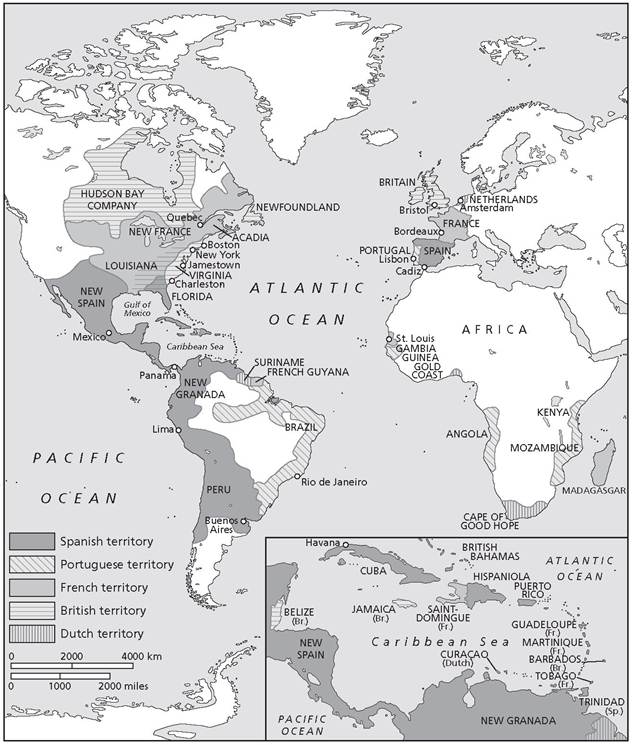
Map n.i Atlantic world, 1826-1830
political revolution occurred, it did not transform the social structure of Spanish America. Members of the complex socio-ethnic groups who existed in the continent based their participation in those processes on political and economic interests rather than on their membership in a particular ethnicity or race. Individuals from all groups participated on all sides of the complex struggle and were willing to modify alliances as circumstances changed. Many Indians, blacks (both enslaved and free), mulatos, mestizos, and creoles sided with the royalists, whereas some of their counterparts supported the varied insurgencies. These shifting coalitions formed to defend particular social, political, and economic interests rather than to advance the interests of these poorly defined heterogeneous socio-economic classes and racial groups.
The emancipation of Spanish America did not merely consist of separation from the mother country, as in the case of the United States; it also destroyed a vast and responsive social, political, and economic system that functioned relatively well, despite its many imperfections. For nearly three hundred years, the worldwide Spanish Monarchy had proven to be flexible and capable of accommodating social tensions and conflicting political and economic interests. After independence, the former Spanish Monarchy's separate parts functioned at a competitive disadvantage. In that regard, nineteenth-century Spain, like the American kingdoms, was just one more newly independent nation groping for a place in an uncertain and difficult world.
By 1826, the overseas possessions of the Spanish Monarchy consisted only of Cuba, Puerto Rico, the Philippines, and a few other Pacific islands. In contrast to the United States, which had obtained its independence in 1783, just in time to benefit from the insatiable demand for its products generated by the twenty-five years of war in Europe that followed the French Revolution of 1789, the Spanish world achieved emancipation after the end of the European conflicts. Not only did the new nations have to rebuild their shattered economies, but also they confronted the world's lack of demand for their products. Instead, Western Europe and the United States flooded Spanish America with their goods. Therefore, the new countries did not enjoy prosperity during their formative years as did the United States; rather, the Spanish American states had to face grave internal and external problems with diminished resources.
Spain's and Spanish America's nineteenth-century experience provides stark proof of the cost of independence. The two regions suffered political chaos, economic decline, economic imperialism, and foreign intervention. Both the Peninsula and the nations of the New World endured civil wars and military pronunciamientos. In their efforts to resolve their political and- economic crises, Spain and Spanish America experimented with monarchism and republicanism, centralism and federalism, and representative government and dictatorship. Unfortunately, no simple solution was found for nations whose economies had been destroyed by war and whose political systems had been shattered by revolution. Consequently, the members of the former Spanish monarchy were forced to accept a secondary role in the new world order. Although military strongmen - not a modern institutional military - frequently came to dominate their countries, they could not eliminate the liberal tradition of constitutional, representative government that had emerged in the Cortes of Cadiz. That tradition, together with the achievement of nationhood, remains the most significant heritage of Spanish American independence.
Further reading
Armitage, David. “The American Revolution in Atlantic perspective,” in Nicholas Canny and Philip Morgan (eds.), The Oxford Handbook of the Atlantic World, 1450-1850. Oxford University Press, 2011, pp. 516-532.
Armitage, David and Sanjay Subrahmanyam, eds. The Age of Revolutions in Global Context. London: Palgrave Macmillan, 2010.
Bosher, John F. The French Revolution. New York: W.W. Norton, 1988.
Chavez, Thomas E. Spain and the Independence of the United States: An Intrinsic Gift. Albuquerque: University of New Mexico Press, 2002.
Chust, Manuel and Juan Marchena, eds. Por lafuerza de las armas: Ejercito e independencias en Iberoamerica. CasteUo de la Plana: Publicaciones de la UniversitatJaume I, CasteUon, 2008.
Dubois, Laurent. Avengers of the New World: The Story of the Haitian Revolution. Cambridge, ma: Harvard University Press, 2004.
Furet, Franςois. Interpreting the French Revolution. Cambridge: Cambridge University Press, 1981.
Geggus, David. “The Haitian Revolution in Atlantic perspective,” in Nicholas Canny and Philip Morgan (eds.), The Oxford Handbook of the Atlantic World, 1450-1850. Oxford University Press, 2011, pp. 533-549.
Greene, Jack P. “The American Revolution,” American Historical Review 105/1 (February 2000), 93-102.
Understanding the American Revolution. Charlottesville: University Press ofVirginia, 1995. Knight, Franklin. “The Haitian Revolution,” American Historical Review 105/1 (February 2000), 103-115.
Maier, Pauline. From Resistance to Revolution: Colonial Radicals and the Development of American Opposition to Britain, 1765-1776. New York: W. W. Norton, 1991.
McPhee, Peter. “The French Revolution, peasants, and capitalism,” American Historical Review 94/5 (December 1989), 1265-1280.
Morgan, Edmund S. Inventing the People: The Rise of Popular Sovereignty in England and America. New York: W.W. Norton & Co., 1988.
Pincus, Steve. 1688: The First Modern Revolution. New Haven: Yale University Press, 2009.
Stein, Stanley J. and Barbara H. Stein. Silver, Trade, and War: Spain and America in the Making of Modern Europe. Baltimore: Johns Hopkins University Press, 2000.
Rodriguez O., Jaime E. The Independence of Spanish America. Cambridge University Press, 1998.
“We are Now the True Spaniards”: Sovereignty, Revolution, Independence, and the Emergence of the Federal Republic of Mexico, 1808-1824. Stanford University Press, 2012.
Rodriguez O., Jaime E. ed., Revolucion, independencia y las nuevas naciones de America. Madrid: Fundacion MAPFRE/Tavera, 2005.