Behavioral Disturbances and Social Disorders
People suffering inanition obviously find it impossible to maintain normal social relations. No matter what their cultural definition, ordinary interactions are also affected by the emotional correlates of starvation and by individual and collective efforts to survive under extreme conditions.
Famine, as a net result, gives rise to a series of social transformations. Seen as variously altered patterns of interaction, these transformations progressively unfold under deteriorating conditions. For this reason, they have been viewed as broadly diagnostic of the prevailing level of want. This view is most certainly justified with respect to two dimensions of interaction, its frequency and the extent to which it involves positive reciprocities. Both of these indicators disclose the characteristic rise and fall of a stress-response curve as famine progresses from threat to full-fledged reality. Figure III.5.1 illustrates this in terms of the relationship between food supply and generosity.Social responses to famine develop through three phases. The first, the alarm phase, marked by general hyperactivity and intensified feelings of attach-
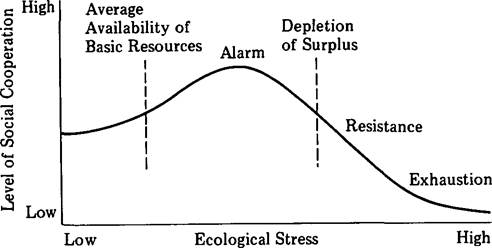
Figure III.5.1. Relation of social cooperation to ecological stress in a social action system. (Adapted from Laughlin and Brady 1978.)
ment, is triggered by the onset of an emergency. This reaction, also reported in the wake of sudden catastrophes such as floods and tornadoes, can create on the community level what has been called a “disaster utopia,” a social environment of extraordinarily intense mutual care and assistance. Thus, the sharing of food and other resources among friends and neighbors actually increases, apparently irrespective of whether there is any prospect of outside assistance.
Although accounts of local-level responses to this earliest phase of famine are relatively few, this phenomenon has been documented in a variety of cultural settings, including diverse urban and rural locations in Africa, western Europe (Ireland and the Netherlands), South Asia (India and Nepal), and Oceania (Yap and Tikopia). Hoarding at this stage does occur, but it appears to be limited to market economies and, more particularly, to those individuals least threatened by starvation.Intensification affects virtually every sphere of life during the alarm stage. Market activity increases and, under certain conditions, may become chaotic. Food prices soar. Population movement increases, as individuals and families seek to relieve their mounting plight. Mystical efforts to find relief intensify; religious congregations swell. Political activity increases. Violence erupts, both spontaneous and concerted, frequently at sites where food and other commodities are in storage or transit.
As starvation begins to exact a physical toll and individuals become weaker and more easily fatigued, famine progresses beyond the stage of alarm and into a protracted phase of resistance. The question of available energy becomes paramount at this point. People turn to unusual sources, including foods known to be edible but normally ignored and species ordinarily regarded as inedible or abhorrent. Items of no nutritional value may be consumed merely to assuage hunger. To conserve supplies, expenditures other than those immediately related to obtaining food are pared to a minimum. The extent of active social relations as indexed by food sharing shrinks considerably as a result.
This “social atomization” is the hallmark of the resistance phase. Essentially, it entails the closure of the household as a food-sharing unit. Generosity disappears; supplies are hidden; food preparation and consumption take place in secret. Visits from relatives and friends arouse suspicion and may be regarded as unfriendly acts.
Lawlessness, including physical aggression, continues to increase, but during the resistance phase of famine there tends to be less concerted and sustained violence, particularly after the average level of weight loss in a community begins to exceed 20 percent. The physical wherewithal for rioting or other active expressions of political unrest becomes practically nil beyond this point. Active expressions of any sort gradually disappear. Ritual observances are put off; religious attendance declines. People congregate only where there is promise of receiving food.
Exhaustion, the final phase of famine, comes with the disintegration of the household, the social bulwark of resistance. Its collapse is foreshadowed as food sharing within the household becomes increasingly discriminatory during the resistance phase. There is a distinct tendency to see the elderly as a drain on provisions. Tolerance toward younger dependents does not erode as quickly, but generally there comes a point when children too receive disproportionately small amounts of food. These types of discrimination - arguably adaptive insofar as they favor principal providers, those on whom eventual recovery will depend - show up in age-specific mortality rates. In the Punjab, for example, where in 1939 famine resulted in an overall increase in mortality of more than 52 percent, the elderly sustained a 288 percent increase in their rate of death and mortality among children under 10 rose by 192 percent. By contrast, among individuals between 10 and 60 years of age, mortality actually declined to a level 14 percent less than the average for the preceding 4 years.
Although exhaustion does not sweep over a famished population all at once, the appearance of neglected, wandering children is a certain sign that pockets of it exist within a region. The same holds for the abandonment and sale of children. Parents may take such drastic steps out of concern for their own survival or out of the hope that being in some other individual’s or agency’s custody will save their offsprings’ lives.
But in either instance, as well as in the case of infanticide or parental suicide, an underlying cause is almost certainly the mental fatigue that comes from hearing ceaseless cries for food that cannot be stilled.The final vestiges of cooperation in the worst famines are found only in the most instrumental relationships. Anyone promising to put a bite of food in one’s mouth is a friend. The fact that people sometimes kill ruthlessly to acquire scraps of food suggests that anyone standing in the way of eating is an enemy. Cannibalism may occur during extreme famine, though its extent is impossible to gauge. Suicide, even in cultures where it is otherwise unheard of, becomes very common.
Exhaustion leaves an indelible mark on survivors. A significant incidence of gross stress reaction (acute situational maladjustment), a disease category that originally comprised the mental depressions of combat personnel whose disturbances could not be described accurately by existing psychiatric labels, has been documented among both European famine victims and Australian aborigines. Gross stress reaction is thought to arise from a severely disturbed interpersonal environment.
Relief-induced agonism is another postfamine syndrome worthy of note. It consists of a varied pattern of aggressive, exigent, and quarrelsome behavior, both verbal and nonverbal. It is seen during the course of relief operations, particularly after the refeeding of victims. Relief-induced agonism appears to be nonspecific in the sense that it is not directed at any particular target. The agonism expresses itself as a general irritability and a remon- strative or combative attitude toward anyone at hand, including relief personnel. What sometimes causes people who were heretofore wasted, inactive, and emotionally apathetic to become suddenly quite animated, clamorous, and contentious upon receiving ample nourishment is not known.