Chapter 1 The Globalized Law of Value
In the introduction to this work, I recalled that my reading of Das Kapital had aroused my enthusiasm yet had given me no greater understanding about the origin of Asian and African ‘underdevelopment’.
And I noted that all my subsequent analytical work—during a half-century—has gone into an effort to fill that lacuna.1In my view, Marx’s opus remained unfinished. I am certainly not alone in recognizing this. Marx himself, in a letter to Lassalle, wrote: ‘‘the whole is divided into six books: (1) Capital, (2) Landed Property, (3) Wage Labor, (4) The State, (5) International Trade, (6) The World Market’’.[1] [2]
As is well known, Marx published only the first volume of Das Kapital in his lifetime. Engels published the (nearly completed) manuscripts of Volumes II and III (parts of which deal with landed property and wage labor) posthumously; and Kautsky later published Marx’s notes for Volume IV, which covers the history of theories of surplus value. The contemplated volumes dealing with the state and the system of globalized capitalism were never written.
I am interpreting the ‘silences’ of that unfinished work, Das Kapital. I am indebted to Michael Lebowitz, author of Following Marx, for this expression.[3] Das Kapital—and here Lebowitz and perhaps several others, like the Englishman E. P. Thompson, share my view—dissects (or ‘deconstructs’) the logic of capital and adduces a critique of political economy (the subtitle of Das Kapital). The term ‘critique’ must be understood not as the substitution of a ‘good’ for a ‘bad’ (or, at best, imperfect) economics but as specifying the status of political economy (in the loftiest sense of the term) as the foundation of bourgeois ideology.
This dissection allows Marx to make visible what is concealed in political economy: value and surplus-value, which show up in political economy only in the forms of price and profit.
This operation is basic. Without it capitalism cannot be grasped in its reality and so would appear as a ‘rational’ system of organizing production.Marx thus envisaged completing this side of the analysis of capital with a book on wage-labor (the third book mentioned in the letter to Lassalle). Here Marx envisaged introducing the new class struggle (that of the wage-earning proletariat against the capitalist bourgeoisie) into the construction not of a ‘‘political economy” but of a ‘‘historical materialism” or ‘‘materialist history” (and I do mean materialist, plainly not ‘‘economic-determinist”). After all, wage labor is not a ‘‘fact of nature,” and human beings try to escape from it whenever possible. As Marx points out in discussing the ‘‘new colonization” (the settler colonization of North America): the ‘natural’ reproduction of the wage-labor force clashes with the handicap formed by its flight and establishment as independent farmers on conquered territory. Emancipation of those who, under capitalism, are wage laborers subordinate to capital (and exploited by it) comes through the abolition of wage labor (communism), not through its ‘‘humane management.” The fragments of an analysis of wage labor published in the volumes of Das Kapital (supplemented with writings by Marx and Engels from newspaper articles and from their correspondence) clearly point to that intention. But they are no more than an indication; this ‘silence’ would thus probably have been corrected in the third book that never appeared.
Pretty much the same can be said about the second book on ‘‘landed property’’. Capitalism was not produced by ‘‘reason’s theoretical invention’’, as the Enlightenment thinkers imagined. Capitalism was built—gradually, then imposed as dominant—through the social struggles of the emerging bourgeoisie against the Old Regime, in concrete historical conditions of time and place, themselves differing from country to country. I have always maintained that the same sort of contradictions were at work elsewhere, from China to the Islamic Middle East.
I refer here to my contribution to discussions on ‘‘global history’’ and ‘globalizations,’ to my book Class and Nation, and to my early criticism of Eurocentrism. But that discussion is only indirectly at issue here. Landed property, as discussed by Marx, is characterized by the transformation of feudal property (with superimposed rights of lords and—serf or free—peasant tenants) into purely capitalist agricultural property. Marx concentrates on that transformation, which he analyzes in some detail in his published writings (Das Kapital and other writings). What Marx inferred from this, in regard to ground rent, is discussed by me in this work and is further developed, even ‘corrected’.But it is only in the Formen (Forms) that Marx takes up the same question for other—‘Asiatic’—societies. This work on pre-capitalist forms of production—one of Marx’s 1857-1858 manuscripts—was only published belatedly (as a complement to the manuscript on principles for a critique of political economy) by Maximilien Rubel.[4] I have rejected those propositions, which indeed Marx neither published nor expanded later. The second book, if it had been written, would perhaps have thrown more light on the subject, but nobody can really know.
Although the fourth book, concerning the state, was also never written, the thought of Marx on this subject can be better understood than on the others. The bourgeois state is a concentrated expression of its economic reality, as Lenin expressed it. By that I mean not that it is solely ‘‘capital’s state” (‘‘in the service of capital”) but that it is also the manager of the ‘whole,’ able if necessary to go against a multiplicity of capitalist interests in dealing with the wage-labor force. Still, it’s likely that if Marx had written that fourth book he would have told us more on the subject, going beyond his concrete analyses of concrete situations—in particular those involving the nineteenth century political history of France from the 1848 revolution to the Commune.
I have put forth several propositions involving a possible theory of the (class) state in societies before capitalism (those which I have termed ‘tributary’), accentuating the reversal of the relationship between politics and economics accompanying the substitution of the bourgeois state for the tributary state.[5]My work mainly has bearing on the fifth and sixth of the books promised in his letter to Lassalle. These two books appear to split a single question into two parts: first in terms of ‘‘international trade’’—the fifth book—and then in terms of the ‘‘world market’’—the sixth book. At first sight, this is a strange way of going about it. Nevertheless, I have followed in Marx’s footsteps on this question. I first (1973) offered a contribution to the discussions about ‘‘unequal exchange’’ in which I specified that this sort of exchange is a relationship between ‘countries’ in which the range of prices for labor-power (real wages) shows a much wider range than that of the productivities of social labor (in the Marxian sense, which is quite different from what bourgeois economists call the ‘‘factor-productivity of labor’’). Unequal exchange (‘‘North-South,’’ to put it simply) makes up only the visible part of the iceberg. The concept of ‘‘imperialist rent,’’ central to the construction of what I call the law of globalized value, implies a deconstruction of everything constituting ‘‘globalized capitalist economics.’’ Marx would perhaps have been led to advance some propositions on this subject if he had written that sixth book on ‘‘the world market.’’ But obviously we will never know.
So then, could the present work be termed the ‘‘sixth book of Capital’’? If by that we were to understand an ‘imaginative' exercise bearing on what Marx might have been able to write on the subject, the answer would be no. I have not undertaken in this work an exegesis of Marx's scattered passages dealing with ‘‘the world market'' (the globalized capitalist system) in order to construct a sixth book as close as possible to what Marx might have written.
I have no idea whether he would have discovered the dynamic of polarization or if, on the contrary, he would have emphasized a homogenizing tendency of the globalization process. I put forward, taking off from my analyses of the development of capitalist globalization, an abstract formalization of the globalized law of value which extends that of the law of value. Thus, in other terms, I am, in writing this sort of ‘‘sixth book” of Capital, deliberately placing myself in the contemporary world, not in that of 1875.It is for the reader to judge whether this Marxist theory of the world capitalist system and of the law of globalized value is road-worthy, correctly extends the works of Marx, and respects their spirit. In any case, I hope that this publication will give rise to a discussion on the matter.
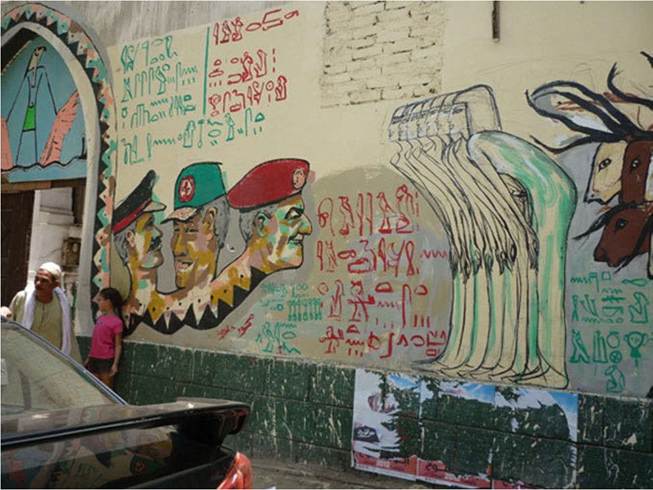
On the walls of Cairo in February 2011: The high command of the army is a snake with many faces. Source Photo from the author's personal photo collection