Clinical Manifestations
For most of the enteric infections, a characteristic clinical illness is not produced by a given etiologic agent. When patients acquire enteric infection, a variety of symptoms other than diarrhea may result, including abdominal cramps and pain, nausea, vomiting, and fecal urgency and incontinence or the urge but inability to defecate.
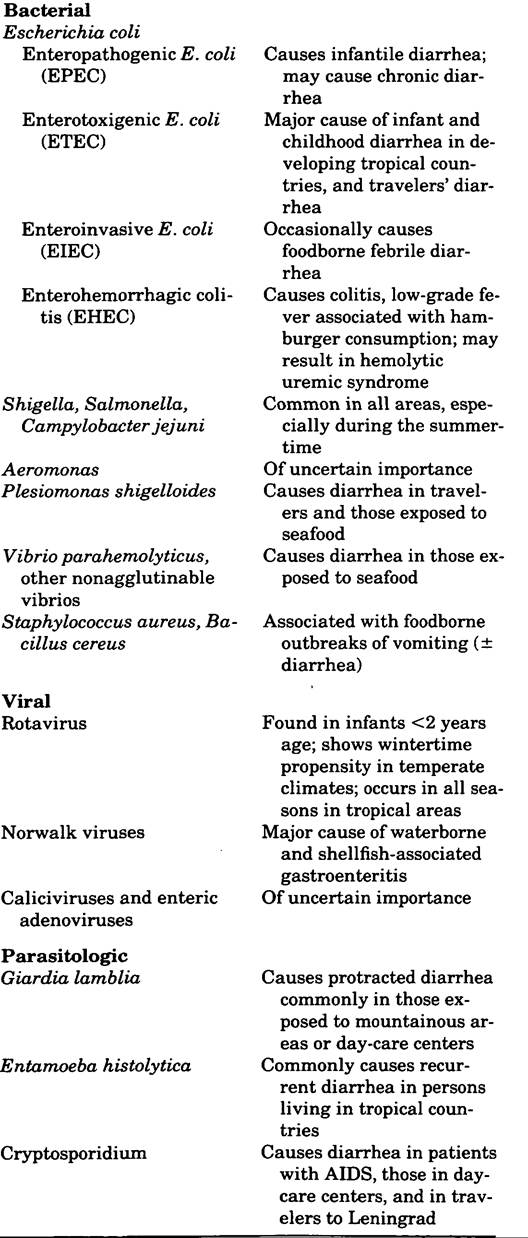
When patients experience fever as a predominant finding, invasive bacterial pathogens should be suspected (,Salmonella, Shigella, and Campylobacter). Vomiting is the primary complaint in viral gastroenteritis (often due to rotavirus in an infant or Norwalk-Iike viruses in older children or adults), staphylococcal food poisoning, or foodborne illness due to Bacillus cereus. When dysentery (the passage of small-volume stools that contain gross blood and mucus) occurs, amebic Shigella or Campylobacter enteritis should be suspected. In salmonellosis, gatroenteritis stools are grossly bloody in just under 10 percent of cases. Other less common causes of dysentery are inflammatory bowel disease, Aeromonas, Vibrio parahemolyticus, Yersinia enterocolitica, Clostridium difficile, and Entamoeba histolytica.Table VIII.35.1. Commonly identified etiologic agents in diarrheal disease
Table VIII.35.2. Etiologic agents of diarrhea, characteristically identified in special settings
Agent Comment
| Setting | Commonly identified agents |
| Day-care centers | Rotavirus, Giardia, Shigella, Cryptosporidium |
| Person traveling | Enterotoxigenic Escherichia coli, |
| from industrial to | Shigella, Salmonella, |
| developing coun- | Campylobacter, Plesiomonas, |
| tries | Giardia |
| Male homosexuals | Herpes simplex, Chlamydia trachomatis, Treponema pallidum, Neisseria gonorrhoeae, Shigella, Salmonella, Campylobacter, Clostridium difficile, Giardia |
| Acquired immune | Cryptosporidium, Isospora belli, |
| deficiency syn- | Herpes simplex, cytomegalovirus, |
| drome | Salmonella, Mycobacterium avium—intracellulare |
More on the topic Clinical Manifestations:
- Clinical Manifestations and Diagnosis
- Clinical Manifestations
- Clinical Manifestations
- Clinical Manifestations and Pathology
- Clinical Manifestations and Diagnosis
- Clinical Manifestations, Diagnosis, Treatment, and Control
- Clinical Manifestations, Diagnosis, Treatment, and Control
- Clinical Manifestations and Diagnosis
- Clinical Manifestations and Pathology
- Clinical Manifestations and Treatment
-
World history -