Department stores and the commodification of culture: artful marketing in a globalizing world
ANTONIA HNNANE
Around the middle of the eighteenth century, a time that in China was marked by a general social conservatism, the scholar-painter Zheng Banqiao (1693-1765) caused a stir in the lower Yangtze city of Yangzhou by attaching a price list for his paintings on the door of his residence.
Zheng, a retired official, belonged to a stratum of Chinese society where painting was a polite activity, not a commercial one. In presenting a social peer with a painted scroll, a scholar should do so as if it were a gift; and if he accepted remuneration for his brushwork, it should be after the fashion that Anthony Trollope prescribed for a physician in English society: “without letting his left hand know what his right hand was doing.” A well-placed client did not wish to know very clearly that the painting of bamboo had just been handed cost two taels of silver.1Except perhaps for the names, this scenario will be familiar to students of art history in the West. The seventeenth-century printmaker Abraham Bosse (1604-1676) captured the juxtaposition of the scholar-painter and the artisan painter in China almost perfectly when he depicted the “vulgar artist” forced by circumstance to work for his living alongside the dignified painter of the French court.[194] [195] Social status was plainly at issue in both cases, but so was the status of art itself. The commercialization of painting was by then already well advanced: in the Dutch Republic, even a shoemaker was likely to have paintings hanging on his walls.[196] That fact hardly softened the jarring effect of conjoining art and commerce.
Underway in both East and West was a process that has become known as the commodification of culture, a term that is used descriptively and often also critically to denote the shift of cultural products from the realms of ritual and relationships to the market place.
Evident in the small-scale commercial practices of artists, shopkeepers and customers active in the markets of early modern towns, this process became a phenomenon of some scale during the nineteenth century.Central to the process were department stores, unknown in the lifetimes of Bosse and Zheng. Like microcosms of the overseas empires that proliferated in this same century, these mega-stores, with their many separate yet linked component sectors, made available to their customers paintings and music along with apparel, furnishings, and the more obvious material requirements of middle-class daily life. In the USA, writes Neil Harris, they “challenged the monopoly of the new museums in the display of art and costly manufactured arts and objects.”[197] As the most obvious site of commodity accumulation in this period, with manifestations in numerous parts of the world, they were characteristic institutions of that in-between century, 1850-1950. They provide a good vantage point from which to view the merging of market and culture. How general was the process? How uniform? How complete?
Department stores
Shops, and particularly department stores, have been much studied by historians in recent years, usually in national contexts and often with a focus on individual stores. Over time, they have provided the foundations for debates in a variety of historical areas, including comparative economics, gender, and architecture. In Paris between the wars, Walter Benjamin spent hundreds of hours taking notes about them. From the boutique came the magasin, he observed, and from the arcade came the department store, where (in the course of the nineteenth century) art and literature “entered the market as commodities.”[198]
As with many other aspects of modern consumer culture, precedents can be found in the early modern era. In the Netherlands, England, and France, retail outlets for handicrafts proliferated in the century leading up to 1750.[199] Thread, cloth, notions, and ready-to-wear items were major items in the burgeoning retail trade, but bookshops also abounded, and so did shops dealing in artworks.
Ann Bermingham captured the temper of that age when she depicted Antoine Watteau as a young man, churning out religious images for merchants from the provinces.[200]From the wealth of studies on consumer society in early modern Europe it would be easy to imagine that the flourishing material and commercial culture that gave rise to the Industrial Revolution was unparalleled in the world, and of course it had its distinctive aspects. But it is worth taking a brief look at the other side of the world, for in East Asia we find counterparts to the shops of Europe in this period. In a rare attempt at a comparative treatment of shops in early modern Europe and China, Robert Batchelor has suggested that Chinese shops were rather temporary structures compared to those emerging in, say, London in the seventeenth century.[201] That comparison probably holds true only for the lower end of Chinese retail. Shops in the prosperous cities of seventeenth to eighteenth-century China were well integrated into the material fabric of the city, probably approximating at least something like shops in Antwerp.[202] In the early 1800s, Henry Ellis was impressed by the shops of Wuhu, in Jiangsu, which he thought “would not disgrace the Strand or Oxford.”[203] [204]
In shopping, as in some other respects, there was a “great divergence” between China and Europe in the nineteenth century. 11 That shop styles were changing rapidly in London and Paris at this time can be deduced from John Thomson’s (1837-1921) description of shops in China around 1870: “A granite base... supports the upright sign-board, which, as with us informer days, is the indispensable characteristic of every shop in China”[205] (emphasis added). In fact, while Thomson was in China, developments in retail back in Europe were taking shopping in new directions that via a circuitous route would soon be evident in China as well.
In the second half of the nineteenth century and the first half of the twentieth, great department stores were built in one major city after another around the world. Macy's in New York, Whiteley's in London and Bon Marche in Paris were among the earliest examples, but these are only the most famous. Between the 1840s, when departmentalized prototypes were developing on both sides of the Atlantic, and the 1880s, when the first department stores began to appear in the British colonies, a large number of these emporia were created. The stages of development through which they typically passed render precise dates of opening difficult to determine, and a clear historical sequence of stores almost impossible to establish.[206]Department stores retain great appeal as icons of consumer culture, especially historically. They stimulated and satisfied the appetites of people in industrial societies - those people, at least, who profited most from the changes being wrought by the Industrial Revolution. Quintessentially bourgeois institutions in the nineteenth century, they expanded to accommodate a post-bourgeois urban mass in the twentieth. In this way they prefigured the premier sites of mass consumption of a later period, the shopping malls, those later “cathedrals of consumption” into which they were either transformed or incorporated.
Their origins lay in dry-goods stores - draperies and haberdasheries - although in the USA the relationship with the warehouse was also close, a fact reflected in architectural features.[207] These origins remained evident in the clothing departments that dominated the fully fledged department stores of later times. In places such as Cairo or Shanghai, the stock of ready-to-wear apparel in a department store was much smaller, but the fabrics department likely to be extensive.[208] In all cases, these stores catered specifically, although not exclusively, for female customers, recognizing women's spending capacity and offering them a relatively sheltered environment for shopping.
Propriety wasimportant to retaining the custom of women from the moneyed classes. For Bon Marche, “virtue was a trademark.”[209]
The term “department store” itself, general in the Anglophone world and evident in phonetic appropriations in some other languages, is of US origin, as were many generic features of these stores internationally. Germany's early department stores, opened around the turn of the century by the Teitz brothers, were created “in conscious imitation of the American model.”[210] So too were the railway depato that sprang up in Japan in the late twenties and thirties.[211] The founders of Almacenes El Siglo (“Century Stores”) in Barcelona were introduced to American retailing methods in Cuba then traveled to New York and Chicago to learn more.1[212] In New Zealand, where British and Australian models were paramount up until World War II, there was a decided shift towards the American model thereafter.[213]
Yet in the early history of department stores, as the New Zealand example suggests, North American models were not always the most obvious. In fact, the term “department store” lacks general applicability for the nineteenth century. It was introduced to Britain only in 1909, when the American Harry Gordon Selfridge, after a quarter of a century's employment with Marshall Field and Co. in Chicago, set up Selfridge's Department Store in London.[214] (Figure 6.1) In Britain a more familiar expression was “universal providers,” a term with religious connotations (“He Who provides all”) that was applied first and most famously to William Whiteley's store in West London, developed from a haberdashery opened by Whiteley in 1863.[215] From London, the term spread through the British world, turning up in Cape Town in application to Mr. J. Oarlick's emporium[216] and in Sydney, where Anthony Hordern's was the self-proclaimed “largest and most popular Universal Providers in the Southern Hemisphere.”[217] In 1885 the Scottish firm Muir and Mirrielees
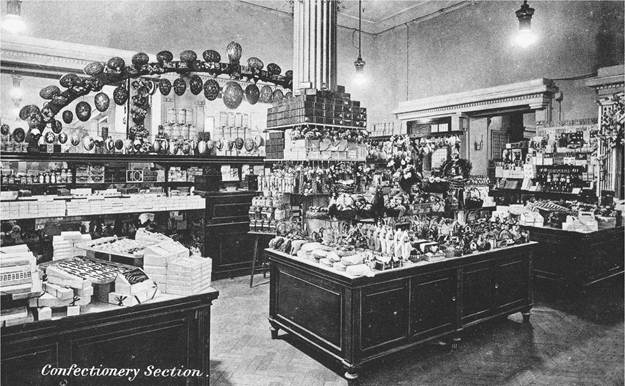
Figure 6.ι Confectionery section in Selfridges department store, early twentieth century
(Private Collection / © Look and Learn / PeterJackson Collection / Bridgeman Images)
opened a “Universal'nyi magazin” in Moscow.[218] Otherwise the term basically followed the routes of the British empire.
From Sydney it traveled to Hong Kong, Canton, and Shanghai, where, beginning in 1901, Chinese Australian entrepreneurs one after the other set up “universal providers” - the famous Sincere, Wing On, Sun Sun, and Dah Sun companies, inspired by Anthony Hordern's.[219] These stores were in British-dominated parts of the empire- turned-republic: the colony of Hong Kong; Shamien in Guangzhou, and the International (non-French, non-Japanese) Settlement in Shanghai.Another great imperial route was carved out by France, using a combination of hard and soft power. In the Middle East, French and British spheres of influence overlapped, so that in Alexandria and Cairo, stores with names such as Davies Bryan and Roberts, Hughes & Co. sat virtually alongside grands magasins such as Cicurel and Orosdi-Back. But French cultural influence was paramount. Not only were many of the local department stores owned by Francophone families; branches of French department Stores - Bon Marche, Printemps, Galeries Lafayettes, Louvre - were also established there.[220] Likewise in Turkey, elite culture was to all intents and purposes French culture, and the grandest of the many Western department stores in Istanbul was the EOB (Etablissements Orosdi-Back).[221] On the other side of the world, in Brazil, French merchants had dominated high-end commerce from the 1820s. Rio fashions followed “the Parisian timetable,” and the burgeoning department stores of the 1870s, bearing names such as Notre Dame de Paris, carried only imports.[222] In Argentina, the British presence was strong enough for Harrod's to establish a branch of its famous store in Buenos Aires in 1910, but Italian and French cultural influence predominated.[223]
Lesser empires, too, can be tracked through international commercial routes in which department stores stand like milestones. In Berlin in 1903, Bruno Antelmann constructed the orientalist-inspired German Colonial House, described by Jeff Bowersox as “a sort of department store for goods from Germany's colonies.”[224] The very first German department store had been built eighteen years earlier, in Vladivostok, one of a chain created by the firm Kunst and Albers, merchants of Hamburg active in the Far East. By 1903, this firm had expanded into China and was busy developing a store in Dalian (Port Arthur), within easy reach by sea of Germany's Chinese colony, Qingdao. Their efforts here were stymied by imperial expansion on the part of the Japanese, who defeated Russia in a short, sharp war in 1905 and began their inexorable move into north China.[225] Where the Japanese army went, department stores followed, springing up across the face of the Japanese empire and becoming established features of life in Korea, Taiwan, and Manchukuo, as also in Japan itself (Figure 6.2). Mitsukoshi, Japan's premier department store, had branches in the colonies.[226]
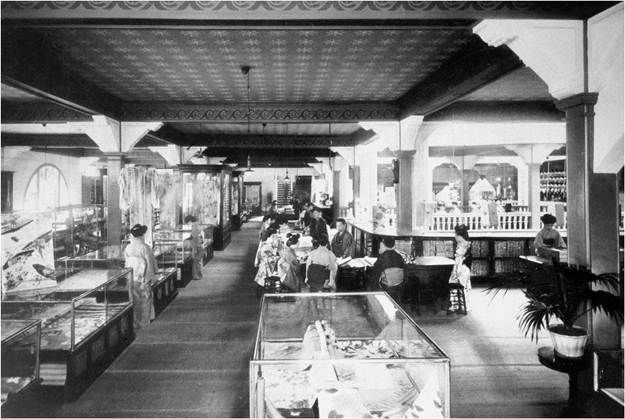
Figure 6.2 Interior of a modern department store in Tokyo, Japan, c.1895-1900 (Private Collection / The Stapleton Collection / Bridgeman Images)
To draw attention to these imperial formations as the context for department stores is not to exclude the USA from the early chapter in the story, because American entrepreneurial might and influence, too, was exercised in a world of empire-building.[227] Nonetheless, it was after the zenith of European maritime empires that the USA came into its own in this domain, emerging as the obvious model of business practice in respect of department stores among other institutions. From this perspective, it seems entirely appropriate that the “universal providers” of the English-speaking world should one by one have ceased to be known as such, becoming instead “department stores” in name as well as in internal organization. Between the wars, the universal embrace of empire was after all gradually relaxing. The empires would break up. In the compartmentalized world of nation-states, the idea of a “department store,” whatever the route by which it attained hegemony, was perhaps more meaningful than “universal providers.”
As products of empire, department stores of the nineteenth and early twentieth centuries positioned themselves, in Nancy Reynolds' words, as “cultural primers for a certain cosmopolitan modernity.”[228] Reynolds was writing of Cairo, but the statement holds true for most places. The department store was a place where the customer met the world. While a store such as Whiteaway Laidlaw was designed to bring British products to the colonies, back in London the Liberty emporium owed its great commercial success to Indian and Chinese arts and crafts.[229] It was desirable that within the confines of a department store, the customer should encounter a world of goods, not merely a selection of local products. In Korea, it was the Japanese store, with its metropolitan sophistication, that was heavily patronized by its colonial subjects, not the provincial Korean stores.[230]
The obverse of empire and cosmopolitanism was colony and nationalism. Overall, little is known about stores in the colonial world, but in India and sub-Saharan Africa they were largely non-indigenous. In Ghana, or the Gold Coast as it was then known, the Kingsway Department Store was set up in 1920 to help Europeans live in the style to which they were accustomed back home.[231] The same was presumably true of S. Jacobs Co. in Nairobi, the largest store in East Africa, established by Sammy and GertieJacobs in 1906.[232] In Kitwe, Northern Rhodesia, Sid Diamond ran “the finest department store in central Africa,” an entity with the prosaic name of Standard Trading.[233] In India, prominent department stores included Whiteaway Laidlaw (which had branches also in East Africa and China), Evans Fraser, and Hall & Anderson.[234] It is possible that such stores were patronized mainly by the colonial elites, but the assumption would need testing case by case. In Shanghai in the 1910s, Whiteaway Laidlaw was regularly advertising in the main Chinese-language daily, Shenbao, from which it can be assumed that it was dependent on Chinese customers for its profit margin. In Accra on the eve of independence, Kingsway's customer base was at least half local.[235]
In the early decades of the twentieth century, the cultural character of commodities traded by stores in the colonial world came under scrutiny and national products campaigns broke out like spot fires. The “Grand Emporium of Swadeshi Goods” in Grey Street, Calcutta, trumpeting its vast range of locally made goods to patriotic customers in 1905 set the tone for probably the most famous of campaigns, a hallmark of the Indian independence movement.[236] The big British department stores all fell prey to campaigns of opposition to foreign-made goods during the Quit India movement, and none survived Indian independence.[237] In Cairo in the 1930s, the French department stores closed down, one after the other, in the face of an energetic national products campaign.[238] In China there were boycotts of foreign goods sporadically from 1905 and with growing intensity in the twenties and thirties, especially in the context of the Japanese advance in the years leading up to the Pacific War.[239] More clearly than the actual inventories of stores, such campaigns expose the meanings invested in material goods within the framework of modern world retail practices.
The commodification of art
National sensitivities concerning the origins of commodities indicate one important sense in which culture became caught up in the process of exchange in department stores. What constituted this “culture”? Pondering the question in the middle of the twentieth century, Raymond Williams concluded that culture was a work in progress that took shape and became a named phenomenon during, and as a reaction to, the Industrial Revolution. He traced it etymologically, from its origins as meaning “tending natural growth” through different stages of development leading up to its application to “the general body of the arts” (a still familiar definition). The end of his journey brought him to broad and encompassing domain: culture as “a whole way of life, material, intellectual, and spiritual.”[240] Had he looked across space as well as through time, he would have observed culture's
Department stores and the commodification of culture dissemination in different linguistic forms (Kultur, cultura, kultur, and so on) across Europe and into Asia. In East Asia, the late nineteenth-century Japanese neologism bunka (culture) made its way into Chinese, Korean, and Vietnamese (wenhua, munhwa, van hoa). These etymological networks were linked to the rise of nationalism and the plethora of nation-state projects in the nineteenth and twentieth centuries, and indeed nationalism affected the idea of culture more closely than Williams allowed.
For critics of the commodification of culture, however, culture meant the creative arts, or “high” culture. It is by no means easy to disentangle literature, painting, and music from a “whole way of life,” especially if these art forms are used to express and defend that way of life. Yet a view of the arts as constituting culture was general in the nineteenth century and through much of the twentieth. The arts had an unrivalled place in the value system of educated elites, for whom they were gradually coming to replace religion as a way of understanding the world. To see them reduced to the status of commodities could be as painful to the beholder as seeing moneychangers in the temple of God.
As the opening paragraphs of this chapter indicate, the process of commodification of the arts has a long history. Theodore Adorno traced the “system of ‘merchandising' culture” to around 1700, in England, and the beginning there “of an approach to literary production that consciously created, conserved and finally controlled a ‘market.'”[241] From this market emerged what he called the culture industry, a blighted thing characterized by repetitiveness, self-sameness, and ubiquity. In this bleak indictment of the culture of his times, Adorno was not alone. Writing on the eve of World War II, Clement Greenberg described mass culture as a sort of virulent disease that was rampaging through the world “wiping out folk culture,” and “defacing native cultures,” to a point where (he prophetically remarked) it was fast becoming “the first universal culture ever beheld.”[242]
Department stores (for Adorno “cemeteries of culture”[243]) became caught up in this process most obviously by including artworks for display and sale alongside household goods. Bon Marche's second floor, with its reading
room and picture gallery, set the tone, providing a space for customers to take respite from the ardors of shopping. The two rooms were eventually merged, writes Michael Miller, to form a salon “conceived in the grand style of a Louvre Museum gallery.”[244] Such an environment was felt to be “improving,” as economist M. N. Sobolev later remarked. Sobolev listed art exhibitions, concerts, and reading rooms as among the benefits middle-class Muscovians could derive from visiting Muir & Mirrielees.[245] InJapan, department stores typically included an art department, used both for the exhibition and for sale of paintings and other national artworks.[246] This was undertaken in fulfillment of what now would be called corporate social responsibility: it was part of a store’s duty to educate the public.[247] A comparable spirit of social responsibility can be detected in the undertakings of American retailers. In Chicago, for example, Marshall Fields sponsored local art through holding a yearly exhibition of Hoosier paintings (paintings made in the nearby state of Indiana), beginning in 1925.[248]
These new spaces for the exhibition and sale of art became available during a general shift in the structure of the art market. In France in the second half of the nineteenth century, the once all-powerful Salon was losing ground to private galleries and dealers; in Germany, art associations proliferated in a move towards professionalization; in China, particularly Shanghai, overt commercialization of painting followed by the first public exhibitions pointed to the same end. In the USA, paintings were being put to auction, creating a new benchmark in the commercialization of fine art.[249] The department stores were entering into a market that might not have been wide open, but was open enough for their purposes.
The agency of department stores in the commodification of the creative arts was to some degree shaped by the same national, and occasionally nationalist, circumstances that gave rise to national products campaigns. Thus the Cairo branch of Bon Marche advertised its local loyalties by exhibiting the pottery made by the female students in a nationalist vocational school.[250] In Sydney, the art departments of Hordern's and Farmers department stores promoted Australian painting in particular, this in an era when recognition of a distinctive local painting tradition was growing.[251] With nationalism intensifying worldwide from the 1890s onward, apart from a brief respite in the 1920s, this evidence of patriotic partisanship in the arts is to be expected.[252] Through the display and sale oflocal art, the department stores achieved commercial exposure for national art products, and simultaneously underscored their own national character.
Although department stores are often compared to museums in scholarly literature, the standing of their art departments is generally not high. Jan Whitaker draws attention to some progressive undertakings in the USA, including Gimbels' travelling exhibition of cubists in 1913 and Hearn's “Art Created by Women” in the 1930s.[253] In Chicago, beginning in 1925, Marshal Field promoted local art through an annual exhibition of Hoosier paintings.[254] But these were unusual undertakings. The art collection of Alexander Turney Stewart, owner of the famous Marble Palace and Great Iron Store in Manhattan, consisted of sentimental middle-brow works with names such as An Eastern Princess, The Little Lamb, and The First Smoke[255] The collection was auctioned after Stewart's death and failed by a considerable margin to realize expectations. The paintings hung in Bon Marche were probably very similar, to judge from a comment by Emile Zola.[256] In Sydney, Charles Lloyd Jones, who had studied painting in London, used his position as heir to David Jones department store to support a journal called Art in Australia. His own tastes in art were conservative, and so was the journal.64
In fact, it was not simply or even primarily by playing the role of art gallery that the department store became engaged with the arts. Rather, bearing out Adorno's insistence on the thorough interpenetration of commerce and the arts in the twentieth century, stores became structurally integrated into the arts world in multiple aspects of their institutional existence, including architecture, window-dressing, personnel (including management), the actual stock in a store, and of course their customers, their critical audience. Taken one by one, these features are not peculiar to the times. Advertising, the display of goods, the social ambitions of merchants expressed through patronage of the arts, grandiose shop-fronts, the wedding of aesthetics and function in everyday objects - these features can all be identified in prosperous urban societies of earlier centuries. Present in regular combination in buildings of scale at numerous sites across the world, however, they present as a specific historical phenomenon produced by economic growth and technological change during the “in-between” century.
Technological advances in the second half of the nineteenth century, especially the harnessing of electricity, underpinned the department store in its material aspects. They also affected art forms. Photography in particular marked a striking expansion of the domain of the conventional, flat, framed image. In a now widely read essay, Walter Benjamin commented on the effects of reproducibility on the “aura” of a work of art, which he saw as a process of decay caused by the desire of the masses to assimilate the work as reproduction, but inevitably leading to a democratization of art ownership.[257] Although this prediction was not quite borne out, technological changes in printing and image making had other effects. Specifically, they served to transform large areas of work and production in industrializing societies. There was resistance to its effects.[258] The same William Morris whose designs and creations were being sold at Marshall Field's denounced the uses to which the “wonderful machines” of the present age had been put, creating a system “that has trampled down Art, and exalted Commerce into a sacred system.”[259] But on Morris's own premises of art “by and for the people,” a meaningful art, others embraced the machine age and worked to reconcile art and industry. The machines and the reaction to them combined to effect the rise and recognition of the decorative arts in precisely the decades in which department stores were emerging as a noted feature of cityscapes. The decorative arts, in which art and function were fused, found in the department store a natural home.
Architectural innovation in the construction and internal organization of stores was among the more obvious ways in which art met function. By and large the architecture of department store buildings was conservative. The multi-story Renaissance-style buildings built to house the department stores in Japan were not untypical of global styles, “monumental expression[s] of commercial prestige” in the word of Henry-Russell Hitchcock.[260] InJapan, and also in China, these examples of European classical architecture were seen as emblematic of civilization and progress. In the West, they were “vaguely historicizing” rather than modern, and imposing without being challenging.[261] They might be compared to the paintings exhibited in the galleries of the various museums, designed to maximize the customer's feelings of comfort. Yet a combination of advances in engineering and design vision did produce some strikingly innovative buildings. Among these were Alexander Turney Stewart's “Great Iron Store,” with its internal iron framework and cast-iron facades, Marshall Field's building of 1907 (a “superb example of the new Chicago School”), and Frantz Jourdain's innovative if controversial design for the Samaritaine department store on the River Seine.[262]
The impact of such buildings on streetscapes and urban development can hardly be overstated. Writing in 1908, Leo Colz remarked on their effect in Berlin, which was to transform the city into “a major metropolis, a world class city.”[263] In New York, Stewart's Great Iron Store, demolished in 1956, occupied an entire block along Broadway between 9th and 10th Streets. Its construction in 1862 spurred the commercial development of the quarter, with other retailers following in Stewart's wake. The largely residential area north of 10th Street was gradually turned over into a retail and entertainment.[264] The same phenomenon was evident elsewhere. In Shanghai, the Sincere and Wing On
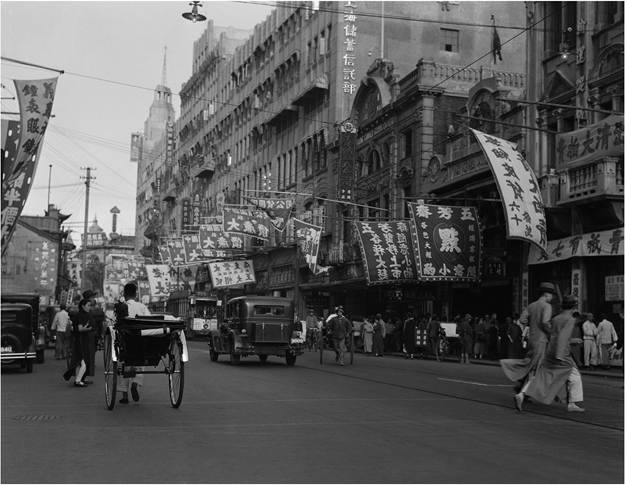
Figure 6.3 Nanjing Road in Shanghai, 1934 (© Bettmann/CORBIS)
buildings were built in 1917 and 1918 amidst a host of inconsiderable small shops and eating places. After this, writes Wellington Chan, “Nanjing Road took off”[265] (Figure 6.3).
A significant site of artistic work in the department store was the display window, which the spread of department stores through cities made a major feature of urban design everywhere. In the 1920s, Ye Qianyu captured its visual impact in a cartoon depicting a scene in Nanjing Road: a modern miss and a migrant worker stand juxtaposed against the brilliantly lit window of Sincere department store, Western mannequin looming behind the plate glass. Ye may not himself have been a window dresser, but he had started his working life in a shop in Nanjing Road in 1921 and within a few years was busy organizing what he claimed was Shanghai's first fashion parade, held in Whiteaway Laidlaw, where he was employed.[266] Destined to become one of most famous graphic designers and cartoonists in China, he was not untypical of twentieth-century artists internationally in respect of his close association with the retail sector. James Narramore identifies a long list of notable arts figures in the USA who had at some time dressed a shop window: Vincent Minnelli, Man Ray, Salvador Dali, and Andy Warhol among others.[267] In Japan, Yu Ryutanji must have been drawing on a similar occupational history when he made an artist turned window dresser the protagonist in his prizewinning novel, A Vagabond Era.[268]
The art of window dressing is often described as originating in North America in the late nineteenth century, and specifically with L. Frank Baum's spectacular efforts in Chicago in the 1890s.[269] The fact that an American visitor to Europe could be struck by the wonderful window displays before this date points to a distinction between the artful display and the merely sumptuous one.[270] In great European cities such as London, Paris, and Brussels the use of plate glass windows for seductive displays of goods was already well known in the eighteenth century, and increasingly obvious in the nineteenth. Attention to display even in the absence of plate glass must have been more widespread again. Melchior Yvan was struck by display of goods by Chinese retailers in the early nineteenth century. “In no country, not even Paris,” he wrote, “have people ever invented such ingenious means of puffing goods by exhibiting them, and of speaking to the eyes.”[271] [272] L. Frank Baum served notice, then, of the arrival of a phenomenon not utterly novel in its material components but rather one that was historically distinctive in its assemblage. Stewart Culver describes the window display in Baum's hands as “a distinctly new medium of artistic expression, one characterized by a unique tension between commercial and aesthetic interests” and one capable, moreover, of transforming pedestrians on the city streets into “an audience of absorbed
.. »80
spectators.
Baum’s influence in Chicago in the 1890s has been described as a factor in the disintegration of the distinction between art and commerce.[273] That distinction did indeed seem to be dissolving through the early decades of the twentieth century. In Wilhelmine Berlin, department store display windows became the site of struggles between commerce and religion, between art as individual expression and art for society, between Romanticism and modern style.[274] In Amsterdam, Joseph de Leeuw made the Metz and Co. store central to the establishment of an industrial arts (“Art Deco”) aesthetic in the Netherlands through the employment of artists and designers for the production of store wares and household goods.[275] Personnel in this store were key contributors to de Stijl (Style), the arts journal that constituted the Netherlands’ most influential contribution to Modernism.[276] In Paris, Art Deco was spectacularly displayed in a great exhibition in 1925, when leading department stores competed with architectural firms for the public’s attention in an international show meant to show consumption in a contemporary context.[277]5 In New York in 1928, Macy’s followed suit with an international exhibition of modern furnishings. Significantly, Robert W. De Forest, President of the Metropolitan Museum of Art in New York, was invited to write the foreword to the exhibition.[278]
Macy’s exhibition was among the more obvious signs of how the globalization of art deco and modernist aesthetics was effected in the 1920s. The visual effects internationally were not overwhelming but nearly everywhere apparent. A certain “look” was evident in print media, furniture designs, fashion, and fine arts in urban societies worldwide. In Japan in the 1920s, followers of Muroyama Takahashi’s Mavo movement, strongly influenced by the Bauhaus School, engaged intensively in commercial art, working in advertising, department stores, and the popular press and striving to overcome the distance between art and everyday life.[279] Likewise in Brazil, art deco and Bauhaus influence was everywhere evident in the industrial fine arts.[280] With Paris and Berlin magnets for aspiring artists and writers from around the world, and London and New York exerting their own forms of cultural hegemony, it should be no surprise to find these commonalities in place.
The flows were by no means one-directional. The Netherlands Pavilion at the Paris Exhibition in 1925 showed the influence of an Indonesian (Dutch East Indies) aesthetic.[281] At the same exhibition, locally manufactured batik, again inspired by Indonesian arts, was on show in no fewer that twelve different pavilions.[282] French department stores were around this time selling turbans and Turkish-inspired harem pants that were worn by fashionable Chinese women on their world travels.[283] “Art deco,” as Rosie Thomas writes, “was coming to connote modernity around the world. ”[284] The part played by department stores in communicating this aesthetic was considerable: in their showrooms and behind the counters of stores everywhere were industrial products that combined function, line, and surface in a distinctive style that everyone came to recognize as belonging to that time.
Critiques and conclusions
The role of department stores in the world of the arts was not constant across time and space, but nearly everywhere they had the capacity of “speaking to the eyes.” Looking at Accra with the eyes of a future President, Kwame Nkrumah sensed this: he wanted a department store in the main street of capital that would speak “modernity.”[285] The leadership of the newly established People's Republic of China felt the same.[286] That these revolutionary leaders with their critical attitudes towards capitalism and imperialism should deem a department store necessary to the contemporary, international look of the capital was powerful testimony to its paradigmatic status in modern retail.
In the course of the second half of the twentieth century, however, the department store suffered a diminution in status. In the world's advanced economies, suburban sprawl sent the major retailers in pursuit of populations located far from city centers. New stores built to serve these populations were effectively lost to sight within vast shopping malls. Display windows, if evident at all, lost their discrete character and ceased to be artful. Art departments gradually disappeared from stores, and department stores from towns. The palatial buildings were sub-divided for lease to multiple tenants, or else demolished. This was not the fate of every one, of course, but it signified a major shift in the visibility and social roles of department stores. The prominent place they had occupied in the domain of the arts in the opening decades of the twentieth century was theirs no longer.
At the same time the art market was being reconfigured in ways that diversified and transformed the process of commodification with far-reaching effects. In 1981, when canvas painting was introduced to the Aboriginal community Balgo Hills, Western Australia, it was as an activity with religious meaning in a church community context. The initiative coincided with the emergence of a viable market for Aboriginal artworks at home and abroad. When the Warlayirti Art Centre was established in 1987, it was nicely positioned to reap the benefits of the international exposure of Aboriginal art at the Asia Society exhibition “Dreaming,” held in New York in 1988 (Figure 6.4).[287] The creation of the World Wide Web subsequently allowed it to emerge as a tourist site with multiple connections to the outside world. Its website advertises a wide range of products for sale, ranging from paintings to objets d'art and souvenirs. The mail plane comes only once a week, but the Internet links the community to the world, and provides the means for money earned in postindustrial economies to be exchanged for works done by hand that are substantially about the relationship of the painters to the land.
Is this a relationship to which everyone has finally become accustomed? One of the earliest art journals to emerge in China after the Mao era was called Art Market. It was established by a group of art critics who wanted to put painting in China on an economic footing. Chinese art was “heading
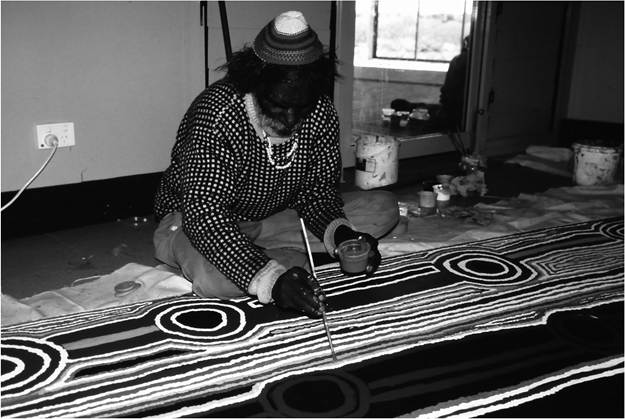
Figure 6.4 Balgo Community desert artist, the late Tjumpo Tjapanangka, working on a dot painting at the Warlayirti Culture Centre in the north-west desert region of Western Australia south of Halls Creek
(Werner Forman Archive / Bridgeman Images)
full-force toward the market,” wrote painter Lu Peng in its pages. He defined “heading towards the market” very simply: “art ought to be produced for the purpose of sale.”[288] This was a radical break indeed from the ideals of a revolutionary art for “the workers and peasants, soldiers, and petty urban bourgeoisie,” enunciated by Mao in 1942,[289] and suggests a commonsensical approach to material life that Max Weber would have recognized. But it was not long before creating for the market revealed some problems. For Wang Nangming, Chinese artists abroad, “seeking to carve out a niche in order to survive within the order of the dominant culture,” had been reduced to creating art projects that “are at best only on par with mass recreational activities in China's tourist industry... ”[290]
Here is a critique of the commodification of culture that would have been familiar to the ears of department store owners a century earlier, and even perhaps to Zheng Banqiao in an earlier time again. In these pages I have focused on a period of history during which the position of the fine and decorative arts in the market was profoundly affected by department stores, but it is mainly as an institutional history that the period can be said to be discrete. It is possible that a historian of the emotions, investigating attitudes to the relationship between art and commerce, would find continuities over a much longer period.
Further reading
Adamson, Walter. Embattled Avant-Gardes: Modernism’s Resistance to Commodity Culture in Europe. Berkeley, ca: University of California Press, 2007.
Benjamin, Walter. The Arcades Project. Cambridge, ma: Harvard University Press, 1999.
“The work of art in the age of its technological reproducibility,” in Walter Benjamin, The Work of Art in The Age of Its Technological Reproducibility, and Other Writings on the Media, EdmundJephcott, trans. Cambridge, ma: Belknap Press, 2008, pp. 19-55.
Bermingham, Ann and John Brewer, eds. The Consumption of Culture, 1600-1800: Image, Object, Text. London: Routledge, 1997.
Benson, John and Laura Ugolini, eds. A Nation of Shopkeepers: Five Centuries of British Retailing. London: I.B. Tauris, 2003.
Brewer, John and Frank Trentmann, eds. Consuming Cultures, Global Perspectives, Historical Trajectories. London: Berg, 2006.
Chaudhuri, Arun. Indian Advertising, 1780-1950 A.D. New Delhi: Tata McGraw Hill Publishing Company, 2007.
Choi, Sang Chul, John Dawson, Roy Larke, and Masao Mukoyama, eds. The Internationalisation of Retailingin Asia, London: Routledge Curzon, 2003.
Cochran, Sherman, ed. Inventing Nanjing Road: Commercial Culture in Shanghai, 1900-1945. Ithaca: East Asia Program, Cornell University, 1999.
Culver, Stewart. “What manikins want: The Wonderful Wizard of Oz and the art of decorating dry goods,” Representations 21 (Winter 1988), 97-116.
Deeg, Lothar. Kunst and Albers Vladivostok: The History of a German Trading Company in the Russian Far East, 1864-1924, Sarah Bohnet trans. Berlin: epubli, 2013.
Domosh, Mona. American Commodities in an Age of Empire. New York: Taylor and Francis, 2006.
Finnane, Antonia. Changing Clothes in China: Fashion, History, Nation. New York: Columbia University Press, 2008.
Gerth, Karl. China Made: Consumer Culture and the Creation of the Nation. Cambridge, ma: Harvard University Asia Centre, 2003.
Goodman, Dougles J. and Mirelle Cohen. Consumer Culture: A Reference Handbook. Santa Barbara: ABC-CLIO, 2004.
Harris, Neil. Cultural Excursions: Marketing Appetites and Cultural Tastes in Modern America. Chicago: The University of Chicago Press, 1990.
Hilton, Marjorie L. Selling to the Masses: Retailing in Russia, 1880 - 1930. University of Pittsburgh Press, 2012.
Kogod, Lauren. “The display window as educator: the German Werkbund and cultural economy,” in Peggy Deamer (ed.), Architecture and Capitalism, 1845 to the Present. New York: Routledge, 2013, pp. 50-70
Kose, Yavuz. “Vertical bazaars of modernity: western department stores and their staff in Istanbul (1889-1921),” in Touraj Atabaki and Gavin Brockett (eds.), Ottoman and Republican Turkish Labour History. International Review of Social History, Vol. 17, Supplement. Cambridge University Press, 2009, pp. 91-114.
Lancaster, William. The Department Store: A Social History. Leicester University Press, 1995.
Longstreth, Richard. The American Store Transformed, 1920-1960. New Haven: Yale University Press, 2010.
Mathur, Saloni. India by Design: Colonial India and Cultural Display. Berkeley, ca: University of California Press, 2007.
MacPherson, Kerrie L., ed. Asian Department Stores. Honolulu: University of Hawaii Press, 1998.
Miller, Michael B. The Bon Marche: Bourgeois Culture and the Department Store, 1869-1920. Princeton University Press, 1981.
Murillo, Bianca. “‘The modern shopping experience': Kingsway department stores and consumer politics in Ghana,” Africa 82/3 (August 2012), 368-392.
Rappaport, Erika. Shopping for Pleasure: Women in the Making of London's West End. Princeton University Press, 2001.
Whitaker, Jan. Service and Style: How the American Department Store Fashioned the Middle Class. New York: St. Martin's Press, 2006.
The World of Department Stores. New York: Vendome Press, 2011.
Woodhead, Linda Shopping, Seduction, and Mr Selfridge. London: Profile Books, 2007.
More on the topic Department stores and the commodification of culture: artful marketing in a globalizing world:
- Contents
- Wiesner-Hanks Merry E., McNeill John, Pomeranz Kenneth. (Eds). The Cambridge World History. Volume 7. Production, Destruction, and Connection, 1750-Present. Part 2: Shared Transformations? Cambridge University Press,2015. — 569 p., 2015