38 Dracunculiasis
This disease is a pathological condition resulting from infection with the parasite Dracunculus medi- nensis. In most instances, the adult worms, which are about 1 meter long, are quite evident as they emerge slowly through the skin of their victims.
Distribution and Incidence
In the 1980s and 1990s, Dracunculiasis is found mainly in India, in Pakistan, and in a band of 19 African countries between the Sahara Desert and the equator, from Senegal in the west to Ethiopia in the east (see Map VIII.38.1). Formerly this disease was much more widespread in the Middle East and Africa, and it occurred for some years in the Americas after it was introduced there by infected Africans during the slave trade.
In general, the incidence of dracunculiasis is significantly higher in endemic rural Africa communities than in endemic Asian villages. In West Africa especially, for example, rates of infection in affected areas often reach 20 to 40 percent, and sometimes exceed 50 percent, whereas in Asia, the rates usually are below 20 percent. In rural areas, the disease occurs sporadically, with adjacent villages sometimes differing greatly in the percentage of those infected. Susan Watts (1987), a medical geographer, has estimated that the number of persons at risk of this infection in Africa is about 120 million, with
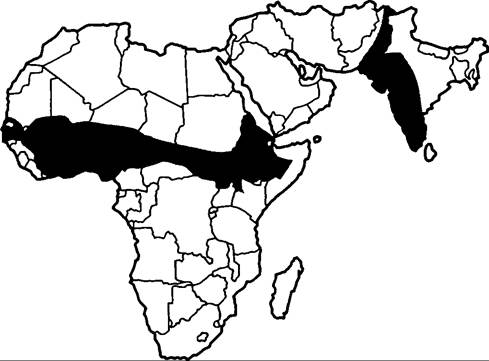
Map VΠI.38.1. Areas in which dracunculiasis is reported or probably exists.
another 20 million at risk in India and Pakistan, based on the assumption that everyone is at risk who is living in a rural district where a minimum of one case of dracunculiasis has occurred.
The number of persons affected annually by this infection is not known. Although diseases are often underreported in the countries affected, the reporting of dracunculiasis is especially poor because the infection generally is found only in impoverished rural communities where medical facilities are rare, and where many victims cannot walk and have little incentive to seek treatment because there is no drug that can cure the infection.
The best estimate is that probably between 5 and 15 million persons contract dracunculiasis each year.Epidemiology and Etiology
Dracunculiasis is a seasonal infection, usually occurring at the precise time of year when rural villagers must plant or harvest their crops. People are infected when they drink water containing a tiny crustacean of the genus Cyclops, called a copepod, which harbors the infective larvae of the parasite. About a year later, the adult worms emerge through the skin to discharge larvae into freshwater, to be ingested by an appropriate copepod, thus continuing the cycle. In drier ecological areas, such as the Sahelian zone in Africa, the infection appears during the brief rainy season (summer), when surface water is available. In areas that receive more rainfall, such as the coastal regions along the Bight of Benin, the infection appears, and is transmitted, during the dry season (winter), when stagnant surface water sources are scarcest and most polluted.
The most commonly affected age groups are generally persons 15 to 45 years of age - that is, working adults. Younger children are affected, but not infants under 1 year, and generally not many children under 5 years. Often farmers are particularly liable to infection, apparently because they drink large volumes of contaminated water while laboring on their farms. School children also suffer high rates of infection in some areas. Male or female victims may predominate in any given area, depending on their relative exposures.
There is no drug suitable for effective mass treatment of dracunculiasis, and from time immemorial, the disease has been treated by slowly winding the emerging worm around a stick. The disease can, however, be prevented by teaching villagers to boil their drinking water or filter it through a cloth, by treating contaminated sources of water with a chemical (temephos), or by providing protected sources of drinking water, such as tube wells or draw wells (rather than ponds or open “step wells”).
Clinical Manifestations and Pathology
Usually the first clinical sign of infection is a blister, which the adult worm produces, accompanied by severe burning of the skin, at the site where the worm is about to start emerging. This begins about 1 year after the contaminated water has been drunk. The blister ruptures when the affected part of the body is immersed in water, leaving a small ulcer, at the center of which is the worm. Most worms emerge on the foot, ankle, or lower leg, but they can emerge through the skin on any part of the body. Sometimes the worm first appears as a curvy line beneath the skin, or at the center of a painful abscess or nodule.
Worms that do not emerge from the body die and are then absorbed, or calcify, in which case they appear as characteristic curled lines on X-ray. The worms may invade a major joint, the brain or spinal cord, or other vital area, producing more serious manifestations, although this is rare. Much more common are secondary infections of the local wound that give rise to abscesses, local arthritis, and sometimes tetanus. In most patients, only one worm emerges at a time, though as many as two dozen or more may present themselves simultaneously in one person.
Affected persons may be crippled for several weeks or even months, by the pain associated with the worm’s slow emergence and secondary infections. Because the infection appears at such a critical time of year for food production and cripples large numbers of persons simultaneously, it has an enormous economic impact. Moreover, people who are infected develop no immunity, so they may be and often are infected year after year.
History and Geography
This is a very old infection, which many believe to have been the “fiery serpent” said by Moses to have attacked the Israelites when they were on the shores of the Red Sea. At least one calcified Dracunculus worm has been discovered in the mummy of a 13- year-old Egyptian girl who died around 1000 B.C., and a treatment for this condition may be described in the Ebers Papyrus.
Some Greek and Roman writers described the infection, and it was Galen who named it “dracontia- sis.” The ancient medical practice of treating infections by winding the worm slowly around a stick is thought by some historians to have been the origin of the Staff of Aesculapius. Several medieval Arabian physicians described dracunculiasis. Of these, Avicenna gave the first detailed clinical description of what he called “medina sickness,” because the infection was then so common in Medina. Shortly before, Rhazes showed that the swelling caused by the infection was due to a parasite.
Sixteenth-century European travelers mentioned having encountered cases of the disease in Persia and the Congo. It is said to have been called “Guinea worm” for the first time by another European who saw persons suffering from the infection on the Guinea Coast (West Africa) early in the seventeenth century. The disease is also mentioned in the traditional legend by which the Dahomeyans explained the founding of their ancestral cult. Although G. H. Velschius described the parasite clearly in his monograph, published in 1674, it was left for Linnaeus (Carl von Linne) to give the worm its modern scientific name of Dracunculus medinensis in 1758.
British army medical officers reported seeing cases of dracunculiasis among British military personnel serving in India in the nineteenth century, and a large punitive English expedition sent to invade Ethiopia in 1868 also suffered greatly from the same disease. The role of the copepod intermediate host in the life cycle of the parasite was discovered only in the 1870s, by a Russian, Aleksei Fedchenko.
The geographic extent of dracunculiasis shrank considerably during the first half of the twentieth century, largely, it appears, because of gradually improving standards of living, and especially standards that have produced better water supplies. The disease was eliminated from the southern area of the Soviet Union in the 1930s by means of a deliberate campaign, and from Iran in the 1970s.
With the advent of the United Nations-sponsored International Drinking Water Supply and Sanitation Decade in the 1980s, India and several other endemic countries began national campaigns to eradicate dracunculiasis. In 1986, the World Health Assembly adopted a resolution calling for the elimination of this disease country by country. It appears likely that this ancient disease will not plague humankind much longer.Donald R. Hopkins
Bibliography
Foster, William C. 1965. A history of parasitology. London. Hopkins, Donald R. 1983. Dracunculiasis: An eradicable scourge. Epidemiologic Reviews 5: 208-19.
1987. Dracunculiasis eradication: A mid-decade status report. American Journal of Tropical Medicine and Hygiene 37: 115-18.
Muller, Ralph. 1971. Dracunculus and dracunculiasis. Advances in Parasitology 9: 73-151.
Watts, Susan J. 1987. Dracunculiasis in Africa: Its geographical extent, incidence, and at risk population. American Journal of Tropical Medicine and Hygiene 33:121-7.
World Health Organization. 1989. Dracunculiasis: Global surveillance suπunary - 1988. Weekly Epidemiological Record 64: 297-300.