Early herding and farming in southern Africa
The transition to food production in southern Africa commenced around 2,300 to 1,800 years ago. As in other parts of the continent, the transition was likely triggered in part by the southward movement of groups of farmers (generally considered to have entered the region from two directions, the northwest and the northeast, and to have been speakers of early Eastern Bantu languages) and herders (thought by some to have been speakers of a proto- Khoekhoe language, who entered the region from the Lake Nyasa-Malawi/ Lake Tanganyika corridor).
However, it is also clear that LSA huntergatherers in the region were regularly exploiting wild grasses and other plants for food and so may well have been predisposed to the adoption of cereal agriculture without much incentive for changing other cultural practices.The first herders kept mostly sheep with some cattle in certain localities, and in a few instances also goats. Evidence for the presence of domestic livestock has been recovered from a number of sites across southern Africa dated to around the bce/ce transition, and in a few localities somewhat
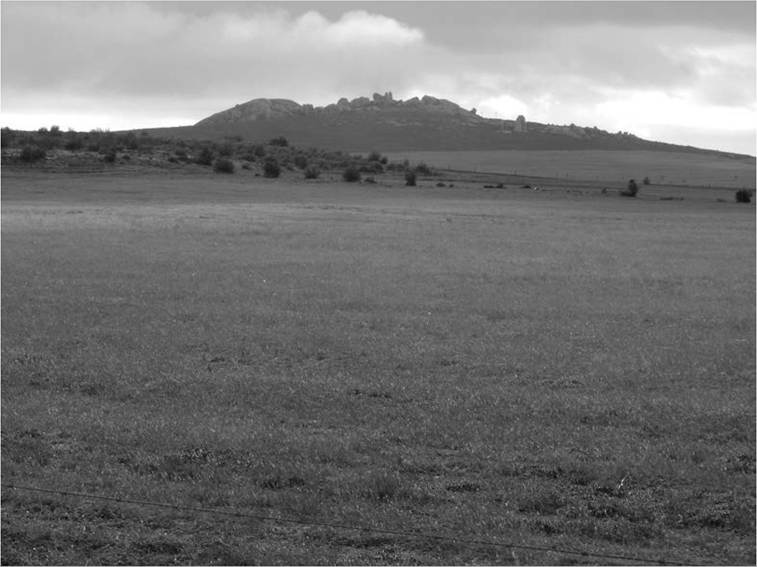
Figure 18.9 View across early herder settlement areas, Kasteelberg Hill, South Africa.
earlier. The earliest known examples come from the recently investigated Holocene levels at Leopard Cave, in the Erongo mountains, central west Namibia, where caprine remains associated with a large, mixed terrestrial wild fauna have been directly dated to c. 300-40 bce.[1080] Other sites yielding the remains of domestic sheep include Bambata Cave, southwestern Zimbabwe; Toteng, northern Botswana, c. 50 bce; and several in South Africa, including Spoegrivier, c. 100 bce, and Blombos Cave, c. 40 ce.[1081] Other Namibian sites yielding caprine remains that are likely to be of an early date include Geduld, Mirabib, and Orunwanje 95/1, although none of these remains have been directly dated.
Among the South African sites, several localities on Kasteelberg Hill (Figure 18.9), roughly 140 km north of Cape Town, and the site of Jakkalsberg close to the mouth of the Orange/Gariep River, have yielded large assemblages of domestic stock, in both cases associated with thin-walled ceramics and dated to around the mid first millennium ce.[1082] In contrast, at many of the other sites wild terrestrial species, and in the case of coastal sites shellfish and seals, dominate the faunal assemblages. In the light of such trends, along with other ambiguities in the available data, there has been considerable debate over whether all of the sites with evidence for the presence of domestic livestock were indeed inhabited by herders, with some arguing that certain sites were more likely occupied by forager populations who had obtained livestock by some means. Sadr, in particular, has questioned the universal attribution of various material culture signatures (such as thin-walled ceramics, fine-line rock-paintings of sheep, the comparatively large variants of ostrich eggshell beads, and even aspects of the stone toolkits) to ‘pastoralist' proto- Khoekhoe.[1083] He has also argued that the generally low percentages of livestock remains relative to wild taxa on these sites more likely suggests a subsistence strategy involving a mix of goat herding and regular hunting and gathering.In contrast to the early herding populations, the early farming communities (EFC) of southern Africa were typically restricted to the moister eastern and southeastern parts of the region, where rainfall is restricted to the austral summer months. Within this large area, certain ecological zones were unsuited to farming, often because of low rainfall but also because of other factors, including topography, soil characteristics, vegetation cover, and wildlife density. Most of these areas were already inhabited by autochthonous LSA hunter-gatherers, and in many cases these groups continued to exploit the natural resources of these locales and co-existed alongside farming communities.
As has been illustrated by archaeological research in areas such as the Thukela basin in KwaZulu-Natal, the nature of these relationships was quite variable across both space and time, ranging from symbiosis and clientship to serfdom, marginalization, and even outright hostility.[1084]EFC sites are typically signalled in the archaeological record by the first appearance of pottery, at least on the eastern side of the region, and evidence for the use of iron (and in some cases also copper). As in East Africa, because of this close association with the introduction of iron-smelting technology, this phase is often referred to as the Early Iron Age, or EIA, commencing in this region around 200 ce and lasting to the ninth or tenth century ce. Ceramic typologies in association with radiocarbon dates for the first occurrence have been used to reconstruct the southward spread of EFCs. EFC ceramics are all attributed to the Chifumbaze Complex, comprising two major traditions: the Urewe tradition, originating in East Africa, and the Kalundu tradition, which possibly originated in Angola. Urewe tradition ceramics are further divided into two branches (Kwale and Nkope), with Kwale occurring along the Indian Ocean seaboard and its hinterland between southern Kenya and Durban (South Africa), whereas Nkope ceramics are found on EFC sites in central and western Tanzania, Malawi, Zambia, Zimbabwe, and northern South Africa. The earliest manifestations of these traditions in the region date to between c. 350 bce and 300 ce, and include the sites of Situmpa (Zambia, Nkopebranch, c. 290 bce to70 ce), Benefica (Angola, Kalundutradition, c. 250 ce), and Matola (Mozambique, Kwale branch, c. 350 bce to 255 ce).
Key early sites include Happy Rest (fourth to seventh centuries ce) and Klein Africa in South Africa (fifth to sixth centuries C e), and evidence from both points to subsistence economies based on stock-keeping and the cultivation of sorghum, millet, and pulses.
At Happy Rest, ovicaprines outnumber cattle and, to judge from the slaughter patterns, were normally raised to near adulthood. Hunting was also important at many EFC sites, including many in the area of the Kruger National Park. Overall, the faunal assemblages from a great many of the earliest farming sites in the region (among them Nkope Hill, Malawi, c. 530 Ce, and Kalundu, Zambia, c. 540 ce), as well as from some second or third phase EFC sites, such as Kadzi (Zimbabwe, c. 770 C e) in the middle Zambezi valley, are dominated by wild species. Where domesticated species are present, ovicaprines tend to be significantly more common than cattle - a situation which does not change until late in the first millennium c e, and then only at some sites.[1085]On the eastern side of the region, ‘Matola/Silver Leaves' ware (c. 350 bce to 430 ce) represents the earliest archaeological expression of these pioneer farmers in coastal Mozambique, southeastern Zimbabwe, Swaziland, and a westward-trending extension across Limpopo province (South Africa) as far as southeastern Botswana. These groups expanded southwards along what is now coastal KwaZulu-Natal, preferentially settling areas that today receive more than 800 mm of rain a year and/or are close to iron ore sources. Most were mixed agropastoralists, although there is local and regional variation. In coastal Mozambique and KwaZulu-Natal, shellfish were an important element in local diets, as were various gathered wild seeds, fruit, and nuts. Whereas cattle and small stock are represented in faunal assemblages, so too are wild fauna, as at Chibuene (c. 600-900 ce, southern
Mozambique).[1086] Local pollen signatures there also point to some small-scale clearance or vegetation in the general area,[1087] which may have been used for cultivation or grazing, but overall the scale of agriculture at and around the site seems to have been limited during this initial pioneering phase. On Mzonjani sites further south there seems to have been a much greater reliance on ovicaprines, along with the cultivation of African cereals, including sorghum and millet, pulses, and cucurbits.[1088] In areas away from the coast, including the Limpopo valley and Northern Transvaal (Gauteng), there is similar evidence for mixed herding and cultivation of cereals, from sites such as Silver Leaves (c. 420-545 ce) and Broederstroom (c. 550-700 ce). There are also several material indicators on many EFC sites that further point to the importance of crop cultivation, most obviously the upper and lower grinding stones found on most sites and sometimes in considerable quantities, and frequent remains of grain bins (e.g. Mabveni, south-central Zimbabwe) and storage pits (e.g. Broederstroom, South Africa).