Epidemiology (and Phylogenetic Considerations)
Table VIIL 11.1 lists the 16 members of the Arenaviridae, their known vertebrate hosts’ geographic distribution, date of first finding, and au- thor(s) and dates of first description.
Four of these are important agents in human disease: LCM, Junin, Machupo, and Lassa. In addition, 10 other members of the group are apparently nonpathogenic (for human beings). Epidemiological information about these is scanty, although several — particularly Tacaribe and Pichinde — have been studied intensively in the laboratory.Table VIILll.1. History and natural occurrence Ofarenaviruses
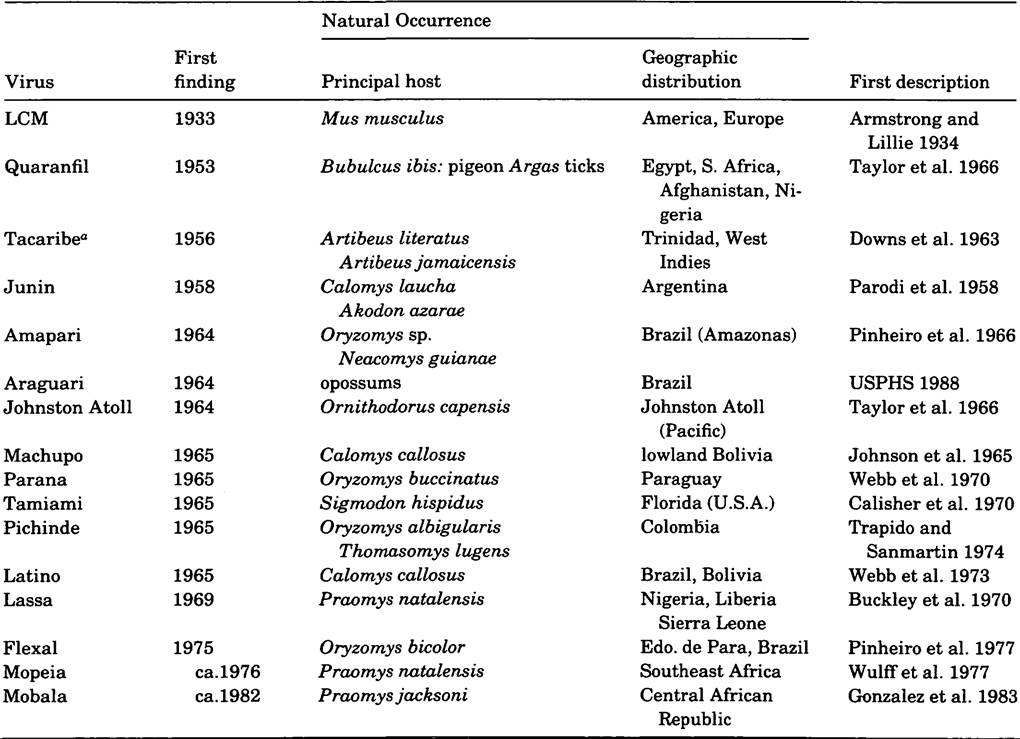
Note: Three of these viruses are already named in the International Catalogue of Arboviruses (1975 and 1988 update): Araguari1 Quaranfil, and Johnston Atoll are considered possible Arenaviridae1 the latter two on basis of electron microscopic studies (Zeller, personal communication, 1989). None of these three viruses has rodent hosts.
αThe isolation of Tacaribe from mosquitoes is considered doubtful, and due to a possible laboratory numbering error (Downs et al. 1963).
In regard to the Tacaribe group viruses, beginning with LCM, and continuing with other members of the group, a rodent association is usually found. Exceptions are Tacaribe, a virus isolated several times from bats in Trinidad in 1957 (and never reisolated there or elsewhere), and the two recently associated agents, Quaranfil and Johnston Atoll, found in birds and tick ectoparasites of birds (learned from personal communication with wife of H. Zeller in 1989).
A fascinating feature is the geographic-ecological-natural host range of the Arenaviridae. Each rodent species involved with an individual virus has its ecologically determined range, and thus delimits the territory of distribution of the virus.
As can be seen in Table VIII. 11.1, the exception to the limitedhost-range rule is the house mouse, M. musculus. The genus Mus is an Asiatic and European genus. Mus musculus is well adapted to the human environment and now has worldwide distribution but is found particularly in the temperate regions of America, Europe, and Asia. It moves where humans move, and communication by sea has opened the world to it, although in the tropics it has remained more restricted to coastal or riverine settlements.Praomys natalensis, the multimammate mouse, is also very common; commensal with humans, it is widely distributed in Africa, and is associated with Lassa virus and Mopeia virus. Praomys jacksoni, another member of the genus, which holds 14 species, is associated with Mobala virus in the Central African Republic. The literature is confusing because Praomys is often referred to as Mastomys. Currently, however, Mastomys, Myomys, and Myomys- cus are all considered to be synonymous with Praomys (Honacki, Kinman, and Koeppl 1982). Praomys is placed in the rodent family Muridae.
The New World rodents associated with arenaviruses are all placed in the family Cricetidae, with several genera involved. It is likely that there have been many opportunities for virus dispersal as well as adaptation of viruses to new rodent hosts, when one considers (1) the number of viruses, such as LCM, Lassa, Junin, Machupo, and others; (2) the diversity of rodents; and (3) the rise (and later enormous development) of intracontinental and intercontinental traffic; and (4) the recently recognized pair of viruses Quaranfil and Johnston Atoll (provisionally placed in the Arenaviridae on the basis of electron microscopic studies), which are associated with birds that disperse widely. Thus it seems evident that the whole world is at risk for species radiation of Arenaviridae.