Etiology
There are two forms of human sleeping sickness in Africa. An acute form caused by Trypanosoma brucei rhodesiense with a short incubation period of 5 to 7 days occurs in eastern and southern Africa.
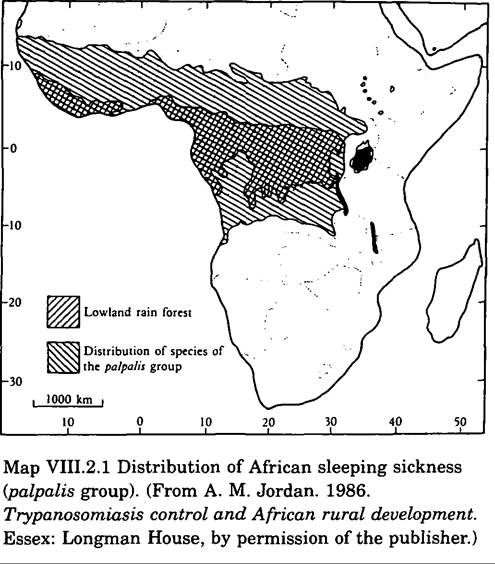
The chronic form, Trypanosoma brucei gambiense, of western and central Africa can take from several weeks to months or even years to manifest itself. Both diseases are transmitted by tsetse flies. There are many species of Glossina, but only six act as vectors for the human disease. Thepalpalis group, or riverine tsetse, is responsible for the transmission of T. b. gambiense disease. Riverine tsetse include Glossina palpalis (see Figure VΠI.2.1), Glossina fuscipes, and Glossina tachinoides; these inhabit the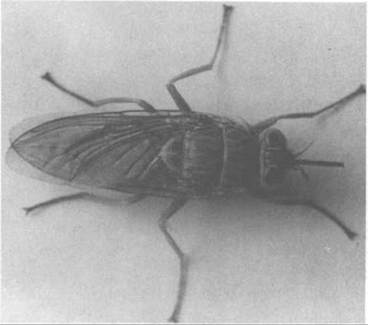
Figure VΠI.2.1. Glossina palpalis.
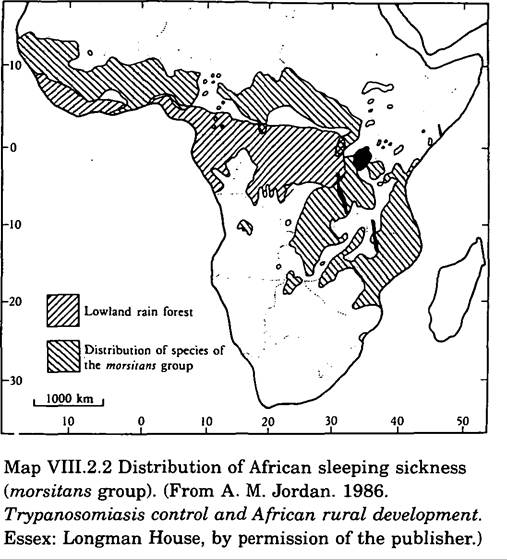
two large blocks of lowland rain forest in western and central Africa as well as the fringing gallery forests along waterways, which extend into neighboring savanna regions. The morsitans group, or savanna tsetse, is the vector for T. b. rhodesiense, the cause of the rhodesiense form of sleeping sickness; it includes Glossina morsitans (see Figure VIII.2.2), Glossina pallidipes, and Glossina Swynnertoni, which live in the savanna woodlands of eastern and southern Africa (see Maps VIII.2.1 and VIII.2.2). Although tsetse flies are not easily infected with trypanosomes, once infected they remain vectors of the disease for life.
After being bitten by an infected fly, most victims experience local inflammation, or the trypanosomal chancre; and parasites migrate from this site to multiply in blood, lymph, tissue fluids, and eventually the cerebrospinal fluid. The blood trypanosome count oscillates cyclically, with each successive wave, or parasitemia, manifesting different surface antigens. In this manner, trypanosomes evade antibodies raised by the host to their previous surface coats. (This antigenic variability has helped to make
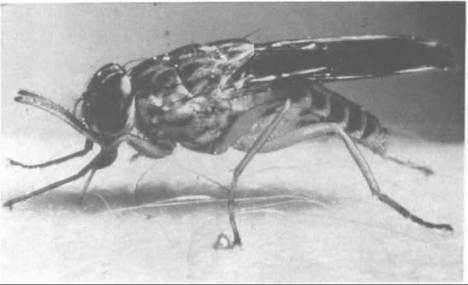
Figure VIII.2.2. Glossina morsitans.
the trypanosome one of the most researched pathogenic parasites and a particular favorite with molecular biologists today [Warren, personal communication].) Eventually, all organs are invaded, with central nervous system involvement ultimately leading to death.