Etiology
Arboviruses, numbering at latest count 512 separate and identifiable agents, are placed in 11 families, with a few as yet unclassified agents. Table VIII. 10.1 presents a listing of family and subfamily groupings, limited to those viruses of major importance in human and veterinary diseases.
It is evident from the table that there is no simple delimiting definition of an arbovirus on a taxonomic basis, or even on a biochemical basis. There are 511 RNA viruses, and then there is African swine fever virus (ASF), a DNA virus. ASF belongs to the Iridoviridae and is the only Iridovirus (so far as is yet known) with an arthropod vector and a vertebrate host. There are numerous Iridoviridae, incidentally, with arthropod vectors and plant or arthropod hosts.
Viruses must qualify in several important points in order to be considered as arboviruses. The life cycle of an arbovirus involves an arthropod (usually insect, tick, or mite) that is capable of becoming infected itself when it imbibes the virus from an infected host. The arthropods serve as vectors of the virus, from an infected vertebrate host to an uninfected one. The virus must multiply in the arthropod, a process requiring several days, and reach a concentration suffi-
Table VIILlO.1. 512 recognized arboviruses listed by family and subcategories, with totals
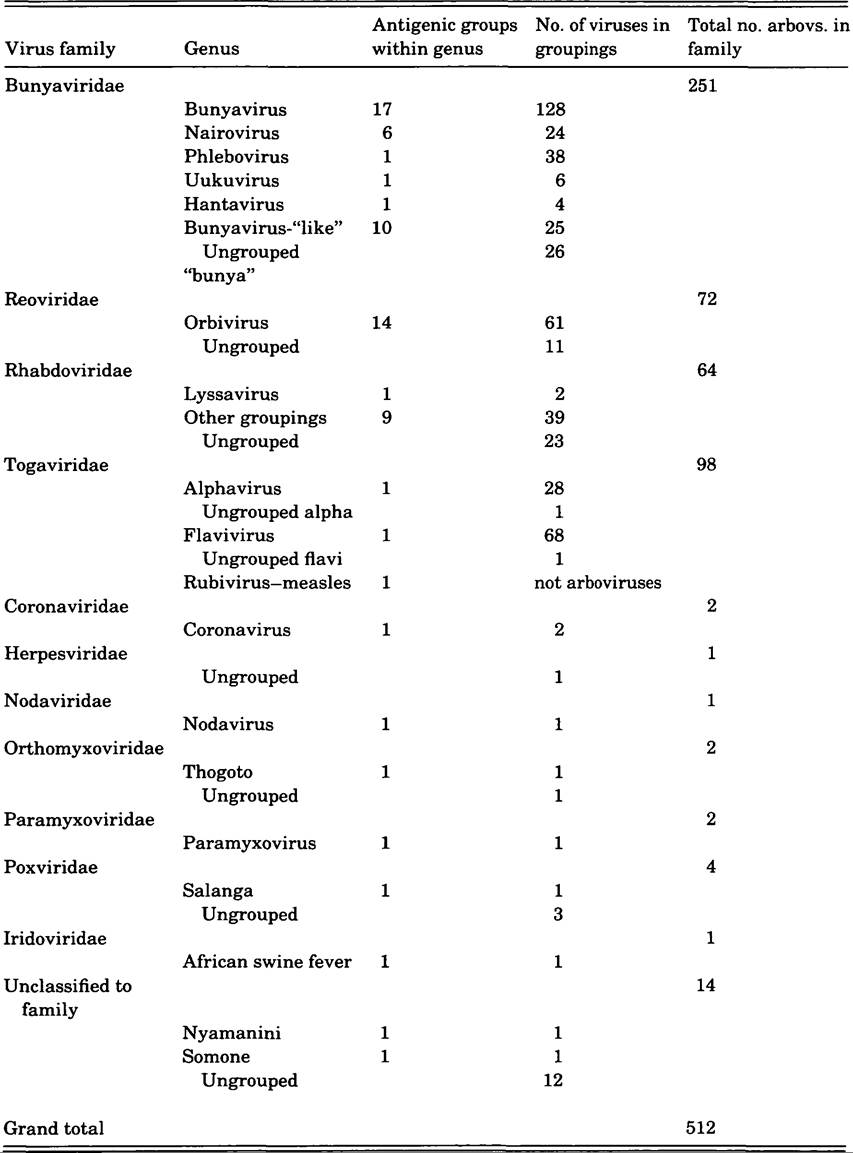
Source: Modified from U.S.P.H.S. Centers for Disease Control, Center for Infectious Diseases (1988)
cient to be passed, in a later feeding, to the host, and to induce an infection in that host. The host, in turn, must have a viremic phase in order to pass the virus back to a biting or sucking arthropod.
This rigid definition gives rise to confusion (e.g., recent misconceptions about putative arthropod vectors of measles, hepatitis B virus, and human immunodeficiency (HΓV) virus), but the definitions are uncompromising. The confusion is compounded when it is realized that although an arthropod, with mouth parts freshly contaminated by feeding on an infected host, may possibly transmit virus mechanically, a defined vector must be capable of multiplying the virus internally over a period of several days and of transmitting it by then biting a susceptible host in later feedings.
This is referred to as the biological transmission cycle. Mechanical transmission must be quite unusual and with respect to arboviruses has never been observed in nature, but has been achieved in the laboratory under controlled conditions. In the case of HIV (not an arbovirus), mechanical transmission by needle is thought to be a dominant mode of transmission in the subset of drug users in some societies. The malaria parasite similarly can be transmitted by infected needle.Again, from the point of view of the virus, it must be capable of multiplying in one or more vertebrate hosts, usually over a period of several days, reaching a level in the bloodstream adequate to infect a foraging vector.
The above considerations define (1) the interval between the arthropod ingestion of infected blood and the ability to transmit virus biologically, again by biting, to a susceptible host (the extrinsic incubation period), and (2) the period, in the host, before the viremia level rises to a height necessary to infect the biting arthropod (the intrinsic incubation period). The minimum interval between infection in one vertebrate host and acquisition of infection by the next vertebrate host is the sum of the extrinsic and intrinsic incubation periods. It is frequently about a week or more, and the maximum interval from one infection to the next may be weeks or months.