Foreword
This anthology follows the selection of texts published under the title Samir Amin, Pioneer of the Rise of the South. The texts chosen focus on a central concept which can be concisely formulated as Theory is History, meaning that the theory of capitalism can only be formulated on the basis of an analysis of its history.
In contrast, bourgeois thinking replaces the analysis of historical capitalism with an abstract theory without any links to reality. ‘Economics’, which is the theory of an imaginary system, then becomes an apologia which reminds us of the medieval debates about how many angels can dance on the head of a pin, and whose sole function is to give legitimacy to the behaviour of the owners of capital.My views are those of an independent Marxist in that they do not necessarily, and definitely not unconditionally, belong to any school of thought of historical Marxism as formulated by parties that claim to be inspired by Marx. Nevertheless, I do not belong either to the purely academic sphere chosen by others, who I consequently believe to be Marxologists rather than Marxists. I am a militant who intends to contribute to ‘changing the world’. This is why, when I defend my opinion, I do so without any criticism of those who also intend to act from a socialist perspective by joining a party.
Does the reading of historical capitalism I propose add anything to Marx’s teachings? I believe so (but the reader must decide), since I pay specific attention to the globalization of the law of value in this interpretation. This is why I have decided to begin this anthology with the theoretical and political conclusions that I drew from formulating the globalized law of value. The chapters following illustrate my thesis (Theory is History) by focusing on the links between capital and ownership (Chap. 2), between modernity and religious interpretation (Chap. 3), and on questions of the global expansion of capitalism (Chaps. 4-6), and on the particular ways it has unfolded in certain countries, in this case Russia and China (Chaps. 7 and 8).
This anthology supplements my previous work, centred on the Rise of the South—my reading of capitalism having been one of the unfolding of its imperialist nature.
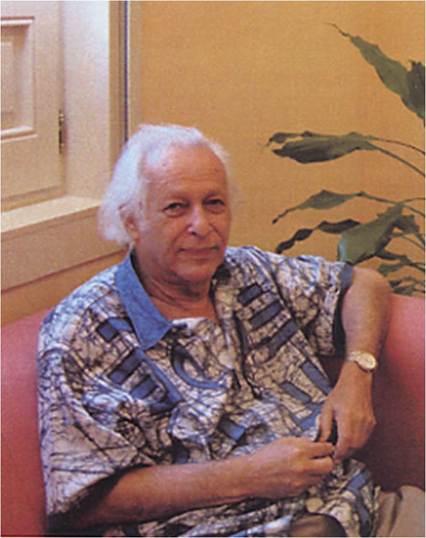
Photograph of Samir Amin. Source Photo from the author’s personal photo collection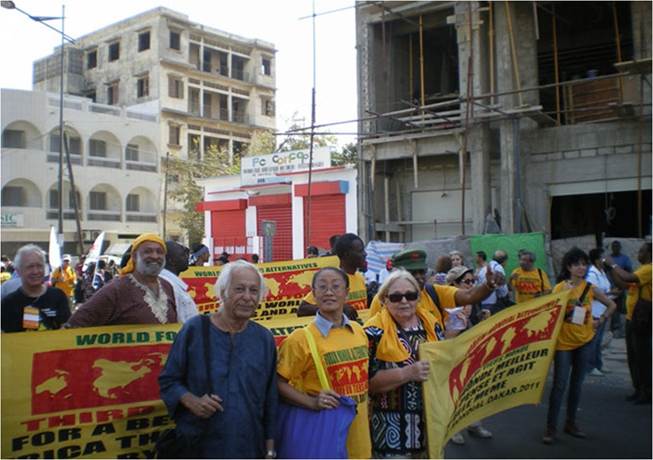
Photograph of Samir Amin in Dakar, World Social Forum, February 2011. Source Photo from the author’s personal photo collection
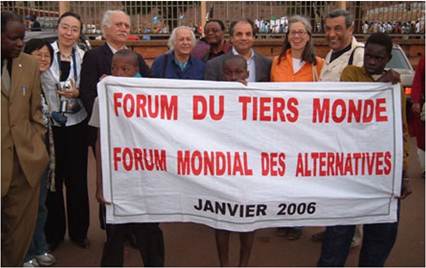
Photograph of Samir Amin in Bamako, World Social Forum, 2006. Source Photo from the author’s personal photo collection