Oracle-Bone and Bronze Inscriptions
The oldest form of Chinese writing is that found on the scapulae and tortoise-shells used for divination in the Shang Kingdom (fifteenth to eleventh centuries B.C.). From this was derived the scripts found on bronze vessels recovered from tombs of the Chou
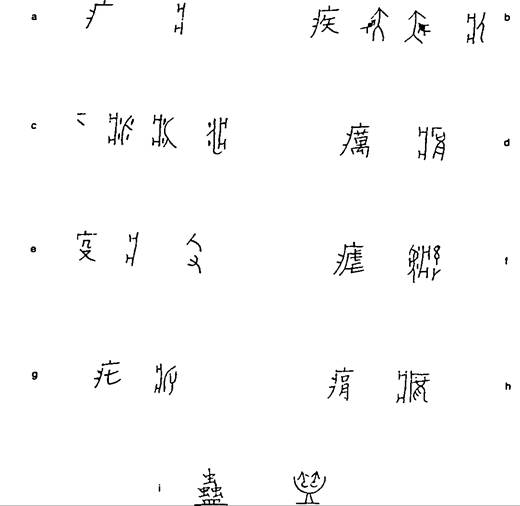
Figure VI.
1.1. Oracle-bone and bronze terms specifying disease entities: (a) ni — sickness (radical); a bed. (b) chi — epidemic disease; a man with arrows of disease attacking him, or lying on a bed. (c) chieh - “itching scabies-like epidemic”; a man with spots of rash lying on a bed. (d) H1 — epidemic fever; man, bed, and scorpion, (e) i — epidemic fever; bed, and hand holding stick; the patient belabored by the disease, (f) nio - fever (later more specifically malarial); man, bed, and spots, with other pictographic components of unknown significance, (g) pi - thin scabs or lesions on the head; bed, and unknown pictographic components, (h) yuan — arthritic pains; bed, and other pictographic components of unclear significance. (i) ku — poison or disease; insects or worms within a vessel. (From Yii 1953.)period (first eight centuries of the first millennium B.C.). Chinese writing was stylized into approximately its modern form after the first unification of the empire under the Chhin dynasty in the third century B.C.
The radical ni, under which the great majority of diseases were later classified, is revealed by the oracle bones to have been the pictogram of a bed (Figure VI.l.la). Of the 20 or more medical terms that are found on bronze inscriptions, some four of these are clearly recognizable already on the oracle bones. For example, chi, which subsequently invariably meant “epidemic disease in general,” shows a man alone or lying on a bed with the arrow of the disease shooting into him (Figure VI.l.lb).
The word chieh, in great use afterward to designate an “itching scabieslike epidemic” (i.e., infectious fever preceded by rash), shows again a man lying on a bed, but the spots are actually indicated (Figure VI.l.lc). Li1 also means an epidemic fever, and in this case the oracle-bone form seems to show a scorpion (for that is the meaning of the phonetic in this case) occupying the bed alone, with little remaining of the patient; or, perhaps the maggotlike object is the patient, and the scorpion is represented by the little numeral “1” (Figure VLl.Id). Another term for epidemic disease, i, combines the disease radical with a phonetic that is a pictogram of a hand holding a stick (Figure VI.l.le). This, however, has been found only on bronzes. The last of these oracle-bone terms is the word nio, which combines the disease radical with pictograms for tiger and hand; the drawing in Figure VI.l.lf is complex, and the significance of it is not clear. In later ages, this word came to be confined to fevers of malarial type, but in ancient times it was used to indicate all kinds of fevers.Among the bronze forms we find the word pi (Figure VI.l.lg), which means “thin scabs” or “lesions on the head,” suggesting eczema and lichen or alopecia or psoriasis, for which there were other words used later on. On the bronze we also find yuan (Figure VI.l.lh), which signified arthritic pains in the joints.
The medical content of the oracle bones is, of course, far from exhausted by mere consideration of the few technical terms that had been developed at that early time. Many inscriptions show that illnesses were defined without relying on technical terms. From these we know that there were diseases of the special sense-organs such as eyes and ears; dental problems; speech defects; abdominal diseases; dysuria; diseases of the extremities, including beriberilike syndromes; and pregnancy abnormalities and diseases of women and children. We also know of epidemic diseases coming at a particular time of year and causing death. All these they mention without recourse to a technical phraseology. There is one other oracle-bone term of great interest, however, and that is the poison or disease ku (Figure VI.l.li): This pictogram indicates insects or worms within a vessel. Although we know that in later ages ku did indicate particular poisons prepared artificially by humans, there is also reason to think that it referred to a particular disease. This has been identified by Fan Hsing-chun and others as schistosomiasis, partly because the term ku occurs so often in combination with the term chang {kul chang, ku2 chang) and hence indicates without any doubt edematous conditions of various kinds - in particular, ascites. And the Nei Ching describes similar syndromes; certainly in schistosomiasis the liver and spleen become enlarged, and ascites occurs when the disease is chronic.