Out of Africa ι
The timing of this process is defined by the earliest unambiguous record of hominins outside Africa. At present, this comes from the site of Dmanisi, Georgia, where a remarkable set of deposits 1.77-1.85 million years old were found under a medieval castle during restoration work.
Excavations of only a small part of these deposits has so far produced four complete skulls of a very early form of Homo erectus, two mandibles, numerous post-cranial bones, hundreds of very simple stone tools, and a large number of animal remains.[527] Recently, the earliest stone tools from Dmanisi have been dated to 1.85 million years ago.[528] These hominins were small, with small brains less than half the modern size, and highly sexually dimorphic, with males considerably heavier than females. This may have implications on their social organisation: some researchers argue that a high degree of sexual dimorphism (as in gorillas, for example) implies a harem-type of social grouping, with a few males dominating several females. Although it is not yet clear whether the Dmanisi hominins hunted or scavenged, their stone tools would have been adequate for defleshing animals and smashing their limb-bones to extract marrow. A handful of sites across Eurasia mark the earliest recorded appearance of our genus outside Africa (see Map 17. 1). InJava, the earliest finds of Homo erectus at Sangiran date from slightly before c. 1.5 million years ago; in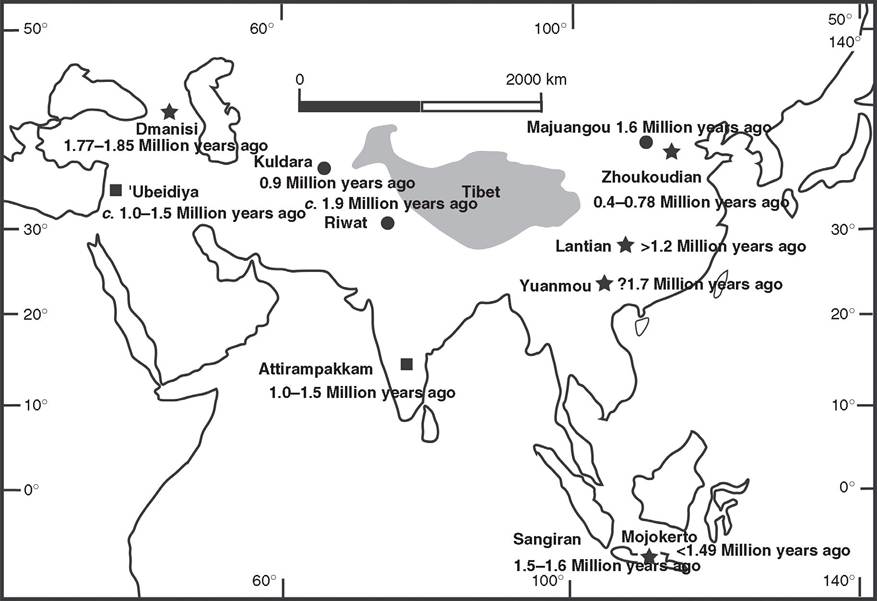
Map 17.1 Primary evidence for early Homo erectus in Asia. Stars denote sites with skeletal evidence of Homo erectus; circles denote sites with the earliest stone tool assemblages from different parts of Asia; and squares denote the earliest evidence for Acheulean assemblages.
At present, there is little definite evidence of a hominin presence outside Africa before 1.85 million years ago, but the size of Asia and small number of observations should make us wary about excluding the possibility of an earlier presence. By 1 million years ago, hominins had colonised much of Asia as far as 40° N.
north China, the earliest artefacts from the Nihewan Basin currently date to c. 1.66 million and 1.6-1.7 million years ago, and the Homo erectus cranium from Lantian in Central China has recently been dated to 1.63 million years ago.[529] A mandible c. 1.3 million years old from Atapuerca in northern Spain and a tooth from Barranco Leon, Orce Basin, Spain that may be 1.4 million years old are currently the oldest evidence for our genus in Europe, and show that hominins were now distributed across the entire Eurasian landmass south of 40° N.[530]
Three comments are worth making about the current evidence for our ancestors' first appearance outside Africa. First, the evidence is so slight that a chance discovery could easily transform our opinions of when they first left Africa: Dmanisi, for example, was a wholly unexpected discovery. Secondly, the dating of these very ancient sites is critically important, but not always as robust as one would like. Although dating techniques have improved hugely in recent years, dates (like share prices) can fall as well as rise, and some important finds have turned out to be much younger than first thought. Thirdly, we are almost certainly not dealing with a single dispersal event; instead, it is much more probable that the colonisation of Eurasia spanned scores of millennia and thousands of generations. With the very limited evidence at our disposal, we see only the cumulative end-result of what was likely a long, complex process, with many false starts and set-backs. Although the overall trend was from west to east, back-movements may have occurred at times, and perhaps (as has been suggested for the type of hominins evidenced at Dmanisi) even re-entered Africa.[531] What is likely is that sites even older than Dmanisi will eventually be found in Eurasia. One credible scenario is that our ancestors were able to expand their range and disperse into Asia shortly after they had mastered the repetitive and regular flaking of stone to produce sharp edges for cutting and scraping c. 2.6 million years ago. Because this innovation enabled hominins to deflesh carcasses rapidly, it must have conferred them with a considerable advantage over their competitors by allowing them to delay consumption until after they had procured their food.11