Political Orientation
Samir Amin sees himself as a ‘political animal’ who cannot separate his intellectual path, his thinking, from his political struggles and decisions. Very early during his adolescence he had defined three positions which are inseparable in his opinion and which served as the foundation for his entire intellectual and political approach.
His first standpoint was to reject the social injustice that he saw all around him in Egyptian society. He witnessed the striking contrast between the misery of the working classes and the arrogance, opulence and waste that characterized the lifestyle of the upper classes. This rejection was the starting point of his social revolt.Secondly, the context of the Second World War played a very important role in the genesis of his ideas. He had adopted firm positions against fascism and Nazism. He had rejected the idea held by some Egyptians who considered that “the enemy of their enemy was their friend” and consequently thought that the enemy of Great Britain was their friend. Very early on, his resolute stance against Nazism and fascism fuelled his sympathy for the Soviet Union, which had a decisive role in the fall of Hitler and of the Nazi regime.
The upheaval against British domination in Egypt and in other countries of the region was the third decisive factor in the definition of his thinking.
His positions always remained the same, however, and they were reinforced during his studies in Paris, immediately after the war. He had indeed actively participated in the anti-colonialist movements of the time. This led him to join the French Communist Party (PCF) and he became a fervent supporter.
His ideas and political position were also strongly influenced by the 1955 Asian-African Bandoeng Conference and the nationalization of the Suez Canal by President Gamal Nasser in 1956. In fact, this nationalization encouraged him to postpone the defence of his PhD thesis, which was ready in June 1956, so that he could take part in the political unrest. In 1957 he finally defended his thesis and immediately afterwards left for Egypt, where he immersed himself in the very tense political climate linked to the nationalization of the Canal, the 1956 war, the establishment of the Non-Aligned Movement, and so on.
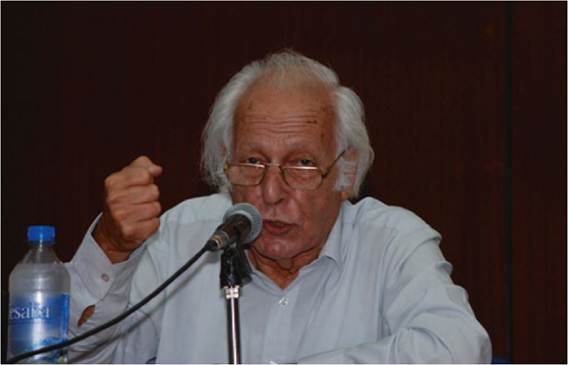
Samir Amin. Photograph from the personal photo collection of the author
1.3