Popular history of technology
While historians and philosophers were debating these issues, popular culture was also attracted by new technologies. In the mid-nineteenth century, along with the first stirrings of interest in the history of technology among the literate elite, a phenomenon appeared that was to have a far greater impact upon the general population: national exhibitions of industrial and crafts products, beginning with the French Industrial Exposition of 1844.
This exhibition was overshadowed by the Great Exhibition of the Works of Industry of All Nations that opened in London in 1851, popularly known as the “Crystal Palace Exhibition” because it was housed in a gigantic greenhouse (see Figure 7.1). In it were displayed, as the title indicates, industrial products and machinery (fields in which Great Britain enjoyed a substantial lead over all other nations), but also agricultural and crafts products from around the world. The Crystal Palace Exhibition was the model for many subsequent expositions and world's fairs, such as those in Paris in 1889 and 1900, Chicago in 1893, and New York in 1939-40, the most recent being the one in Shanghai in 2010.World's fairs and other technological exhibitions privileged the most recent innovations rather than historical ones. But another phenomenon closely related to temporary exhibitions was the museums of science and technology that appeared two centuries ago and which have proliferated since. The Conservatoire National des Arts et Metiers had several rooms where the public could view machinery, the origin of the Musee National des
(History of all the Inventions and Discoveries in the Trades, Arts, and Sciences from Earliest Times to Our Day) (Stuttgart: Hoffman'sche Verlags-Buchhandlung, 1837).
2 Karl Marx, The Poverty of Philosophy (Chicago: Charles H. Kerr, 1920), p. 119.
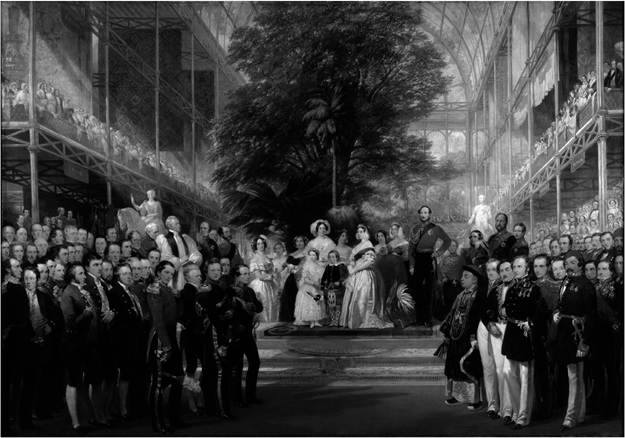
Figure 7.1 “The Opening of the Great Exhibition by Queen Victoria on ι May 1851” by Henry Courtney Selous, 1851-2 (oil on canvas) (reproduced by kind permission of the Trustees of the Victoria & Albert Museum).
Arts et Metiers. Since then it has been quite overshadowed by the Cite des Sciences et de l'Industrie at La Villette, founded in 1986 on the northeastern edge of Paris, the largest science museum in Europe. Among its rivals we might cite the Science Museum in London, the Museum of Science and Industry in Chicago, the Science Museum in Boston, the Deutsches Museum in Munich, and the Smithsonian Institution's Museum of American History in Washington, D.C., a repository of historic American artifacts. Though several of these institutions call themselves “science” museums, the scientific phenomena and artifacts they feature are almost all from the applied sciences and are commercial products that the public can easily relate to.
In addition to museums of technology in general, there are numerous museums devoted to particular technologies. Railway museums have sprouted up wherever there are old locomotives and rolling stock to be preserved. Of the several hundred such museums in the world, the United States has fifty-two, Germany thirty-four, and Great Britain twenty-six. Many of these are in private or municipal hands and feature not only static exhibitions but also working trains pulled by steam locomotives, to the delight of rail-buffs and children alike. In the same vein (without the live performance, however) are the museums of airplanes and rockets, the most elaborate of which is the Smithsonian Institution's Museum of Air and Space. Almost all nations that have produced aircraft or space-related artifacts have created museums to display their achievements. Likewise, there are museums of automobiles, ships and boats, clocks and watches, computers, and other artifacts.
Nor must we forget “villages” with old buildings (much cleaned up and prettified, of course) in which re-enactors demonstrate how old-time artisans spun yarn, forged horseshoes, built boats, and the like; Sturbridge Village in Massachusetts and Colonial Williamsburg in Virginia are but two examples of this phenomenon. Evidently, the more technology advances into the postindustrial information age, the more popular are places where tourists can relive an idealized past and parents can show their children what life was like in the “good old days.”
Popular interest in matters technological was also evidenced by the appearance of magazines aimed at the general public. In the United States, Scientific American was among the earliest, starting in 1845; despite its name, it always featured as many articles on inventions and devices, such as railroads, steam engines, and electric lights, as on scientific matters. It was followed by Popular Science Monthly in 1872 and Popular Mechanics in 1902, and similar magazines in other countries.