Prewar scholarship
It is in the presence of nationalism and the belief in progress - the two elephants in the room - that historians have been seeking to understand the evolution of technology and its role in society in an unbiased and scholarly manner.
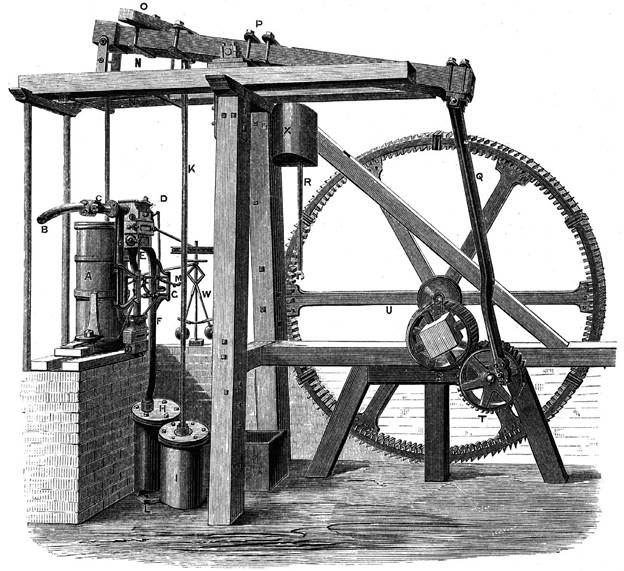
Figure 7.3 James Watt's (1736-1819) prototype steam engine ‘Old Bess' c. 1778 (World History Archive/Alamy).
Historians of science had established a beachhead in academia before there was a scholarly society in the history of technology. This was the achievement of George Sarton, a Belgian chemist and mathematician who emigrated to the United States and began writing a universal history of science, including medieval Islamic science, the first three volumes of which were published before his death in 1956. In 1912 he founded the journal Isis; in 1924 he helped found the History of Science Society; and in 1936 he founded the journal Osiris: all of them devoted to the history of science. Sarton's journals and the History of Science Society were only peripherally interested in technology, however.
Also interested in the history of technology, albeit in a secondary way, was the Frenchjournal Annales d’Histoire Economique et Sociale, founded by Marc Bloch and Lucien Febvre in 1929. While concentrating on economic and social questions, the editors were keenly interested in the material aspect of life, especially rural life and agriculture.
The history of technology lagged behind social and economic history and the history of science. The first scholarly societies and journals devoted to the history of technology were the creation of engineers with an interest in the history of their fields or historians with an engineering background. Such was the Newcomen Society for the Study of the History of Engineering and Technology, founded in 1920 and based at the Science Museum of London.
It was named after Thomas Newcomen, inventor of the first working steam engine. Itsjournal, Transactions, concentrates on the history of engineering in Britain, Europe, and North America. Starting in 1923, it had an American affiliate, the Newcomen Society of the United States, which was directed by business leaders and concentrated on the history of American businesses; more political than scholarly, it ceased its activities in 2007.There was also considerable scholarly interest in the subject in Germany, which saw the publication of scholarly books by Ludwig Darmstaedter, Edmund O. von Lippman, and Georg Neudeck, along with one in Belgium by Arthur Vierendeel.[231] Like von Poppe's work of 1837 mentioned earlier, these works were encyclopedic and heavily internalist, that is to say they privileged inventors of important and successful inventions (the “great men” of history), and largely ignored the social and economic environments in which they arose. Germany also had two scholarly journals, ArchivJur die Geschichte der Naturwissenschaften und der Technik, published in Leipzig from 1909 on and mainly devoted to the sciences, and Beitrage zur Geschichte der Technik und Industrie: Jahrbuch des Vereins deutscher Ingenieure, published in Berlin from 1909 on and renamed Technik- geschichte in 1933, with a heavy emphasis on industrial engineering.
Two exceptions to this general trend and the only prewar works on the history of technology that have withstood the test of time appeared in the United States. Though Abbott Payson Usher's History of Mechanical Inventions was, as the title indicates, largely internalist and devoted to the history of important machines, the first four chapters introduced a general theory that placed innovations in their social and cultural context.[232] Even more significant and still influential almost a century later is Lewis Mumford's Technics and Civilization, published in 1934.[233] Mumford was one of the leading American intellectuals of the mid-twentieth century, a noted social critic of modernity and American civilization.
Technics and Civilization is basically a work of philosophy that situated technology in the broader context of “technics,” a term Mumford uses to describe not only technological devices and processes, but also the culture in which they are embedded. His overview of technological history is very broad and sweeping, dividing the history of the world since 1000 ce into three phases: the Eotechnic from 1000 to 1800 in which the clock was the most important innovation because it divided time into small parts, laying the basis for the dominance of capitalist enterprises; the Paleotechnic from 1800 to 1900, the age of industry, huge cities, and dehumanizing labor; and the Neotechnic, after 1900, an age in which electricity, information devices, and communication networks promised to liberate humanity from the dangers of Paleotechnic industrialization, but also spawned mass automobility and advertising. Mumford therefore presents a powerful antidote to the mechanistic and internalist position that dominated the field before the Second World War.