Sport since 1750
SUSAN BROWNELL
A history of world sport since 1750 is a history of the peaceful connection of the world's peoples. Why and how amicable sports competitions flourished during the century of history's most brutal wars is the central riddle of sport's place in the history of the modern world.
The institutional backbone of today's international sport system consists of a structure of voluntary associations segmented into local, national, and international levels, with the International Olympic Committee (IOC) at its pinnacle. This system took shape in only two decades, between the founding of the IOC in 1894 and the start of World War I. The new sport organizations were part of a much larger phenomenon: in the second half of the nineteenth century, voluntary associations moved like wildfire around the planet, jumping from continent to continent within only a few years even when travel could take weeks or even months. They facilitated the new kinds of social networks that rapidly traversed the globe along with Western capitalism, colonialism, and Christian missionizing. Observers of the times were aware of the new phenomenon - nineteenth-century Greeks labeled it syllogomania (“association mania”).The world history of sport
Previously, world histories of sport typically focused on the discrete segments of the global system - particular sportspersons, sports, Olympic Games, nations, and world regions - rather than on the ties that knitted the segments together.1 The groundwork for the present chapter began to be laid in the [406] 1980s by social histories that viewed sports in the context of bourgeois sociability, urbanization, and citizenship.[407] A second development was recognition of the central role of international organizations in the “making of the contemporary world.”[408] What still remains is for local athletic clubs and international organizations to be fully explored as a single isomorphic form of sociability - after all, international organizations share the same internal structure as local clubs, the difference being the scope of the territory over which they claim jurisdiction.
Both manifest a modern mode of sociability that still today is largely - but not exclusively - dominated by white, middleclass men, and by Western culture.From classicism to athleticism
The process of linking thousands of local games and contests into a global system started in Western Europe at the end of the eighteenth century. As modern transportation and communications linked people across long distances, they did so on the foundation of a sense of “imagined community” that already existed among educated men who had never met face-to-face, but who had received a classical education and believed themselves to share membership in “Western civilization.” The classics also provided a reservoir of ideas upon which educated men drew for their design of novel social forms in an era when the old society was collapsing. The parallel between warring ancient Greek city-states and warring modern nation-states was not lost on these men; they knew that in antiquity athletic games had been important forums for inter-state diplomacy, and they sought to replicate this function in their times.
The first book on the history of the ancient Olympic Games was published in the Netherlands in 1732. A call to revive the Olympics appeared in 1790 in France, where the foundational thinkers of the French Revolution had linked sports with notions of ancient Greek democracy. By the mid nineteenth century, the transformation of the class structure under the growth of capitalism and imperialism had provoked calls across Europe for reform of the traditional classical education, including a greater emphasis on the physical health of students. Physical education emerged as a professional field in the 1880s, and its practitioners used classicism to legitimize their craft, claiming that mens sana in corpore sano (a sound mind in a sound body) was an ancient Greek ideal (albeit expressed in a Latin phrase). Pierre de Coubertin was a French aristocrat and an educational reformer. He convened the first International Olympic Committee in 1894, and many of the members whom he invited to join were educationalists and classically educated intellectuals.
German universities were the world centers for classical studies, and with their scholarship on the Olympic Games they created a new image of an ancient Greek lifestyle that exalted sports for male, amateur athletes. This erroneous, romantic construction then became the model for Germans as the “New Greeks,” the heirs of Aryan civilization. It was not until the mid 1980s that scholars would seriously attack the popular wisdom by documenting that ancient Greek athletes were professionals, and contests for women in honor of Hera were also held regularly at the ancient Olympic complex.[409]
Around the world, physical education was included in the curricula of the schools and universities established by colonial administrators, Christian missionaries, and governments emulating the Western model of national education. Youngpeople who had learned sports in schools went out into the world and formed sports clubs, so that the global educational network became the foundation upon which the international sport system was built. School sports were never integrated into a global structure; rather, they serve as the training ground and the feeder system for the global sport system, which is functionally independent from them.
Greece turned the Western fascination with ancient Greece to its advantage as it sought to claim membership in the West and expunge the remnants of the Ottoman occupation. The inaugural 1896 Olympic Games, as well as the 1906 Intercalary Olympic Games (planned for each Olympiad, but held only once due to Greece's subsequent instability) were both held in Athens. Unlike the 1900, 1904, and 1908 Olympic Games, they were stand-alone events not attached to the premier mass spectacle of the time - world's fairs. The Greek Olympic Games attracted substantial government and private support - particularly from diasporic Greeks, whose donations totaled one-sixth of the total revenues - because of their importance to modern Greek national identity, an importance that they retained when, in 2004, the Olympics “went home” to Athens (as one official slogan put it).
Neoclassicism was integral to the nationalism that was to dominate in Western Europe until World War II. It reached the height of its extravagance in the 1936 “Hitler” Olympics in Berlin, as documented in Leni Riefenstahl's classic documentary, Olympia.
German gymnastics vs. British sports
In the last half of the nineteenth century, two sporting traditions radiated out from two centers in Germany and Britain. The German model, the Turner (gymnastics) movement, included gymnastics, dancing, and calisthenics, and favored mass festivals of solidarity over individual competitions. Swedish gymnastics and the Czech Sokol movement were related systems. Additionally, figure skating, equestrian dressage, and fencing were popular in Europe. The hallmark sports of the British model were horseracing, boxing, cricket, soccer, and rugby. Basketball, baseball, volleyball, and American football were American inventions based on the British model. Both models included track and field. Both linked masculinity with Christianity and service to nation and empire - an ideology labeled “Muscular Christianity” by British writers in the 1850s. In both Britain and Europe, the inclusion of sport in the education of adult males made sport into a “male preserve” that reinforced gender differences among the middle and upper classes.[410]
German gymnastics were preferred in military schools worldwide, modeled after the admired Prussian military. British sports were preferred in schools modeled after the British “public” schools (Harrow, Eton, Rugby, etc.) that prepared young men for capitalism and colonial service. Soccer was the British sport that spread most widely throughout the European continent because it traced the path of capital as it was carried by men from wealthy families who had attended schools in England or Switzerland. Cosmopolitan private schools and polytechnics in Switzerland were the launching point on the continent because British sports - soccer in particular - helped to attract the sons of the British capitalists who dominated the international economy.
The Anglophilia that accompanied British sport provoked nationalistic antiBritish responses throughout Europe, particularly Germany. By contrast, state schools in Europe were associated with nationalist movements and emphasized gymnastics.From ritual to record
Association mania and modern sport were both linked with the bourgeois “record-breaking mania” (as Communist Soviet critics were later to call it; Chinese Communists called it “medals-and-trophyism”). The original 1888 version of the Oxford English Dictionary could not find a usage of the word “sport” in its current sense prior to 1863.[411] The modern concept of sport appeared at the same time as the concept of the sport record. One of the earliest usages of the word “record” as a best-ever, measured performance occurred in an 1868 training manual for track and field.[412]
Allen Guttmann proposed that the simultaneous emergence of modern sports and industrial capitalism manifested the development of an empirical, experimental, mathematical worldview that underlay both. He maintained that a key feature distinguishing modern from pre-modern sports was a process of secularization and bureaucratization in which measured achievements replaced religious beliefs.[413] The “from ritual to record” theory has inspired heated debate, and both sides still have their adherents. Research has revealed sports record-keeping in other cultures and epochs, leading some scholars to argue that the sports record is not distinctly modern.[414] Nevertheless, even if an obsession with record-keeping and quantification per se is not modern, what is decidedly modern is a bureaucratic system in which associations keep records classified into local, national, and world levels.
Sport records resulted from the modern capacity to imagine a runner in North America and one in England as members of a single sporting community, even if they never actually met in face-to-face competition.
Records set by athletes excluded from the community were disregarded, such as the American pole-climbing records set by the natives in the 1904 Anthropology Days at the St. Louis World's Fair (personally observed by James Sullivan, the editor of Spalding's Almanac, which published American records); or the women's high jump world record of 1.77 m set by Zhang Fengrong in 1957, when China was not a member of the International Amateur Athletic Federation (IAAF) due to its exclusion from world organizations after the communist revolution.The growth of associational life
Before 1800, horse racing, golf, cricket, boxing, rowing, and fencing became the first sports in which written rules were codified, clubs established, and regulated competitions held. In England boxing was codified in 1743, cricket in 1744. Between 1800 and 1840, shooting and yachting were codified and regulated. Between 1840 and 1880, baseball, soccer, rugby, swimming, track and field, skiing, cycling, canoeing, football, tennis, badminton, and field hockey were codified and regulated. By 1900, twenty-two of the approximately thirty sports that have been or will be summer Olympic sports were systematized.[415]
Early modern sport had been organized by courts, municipal governments, academies, and universities. Now, volunteer associations popped up everywhere. At first they were local, single-sport clubs. In England, the Jockey Club was formed in 1752, the Marylebone Cricket Club in 1787. In Germany, the Hamburg Turner Society was formed in 1816.
The social life of sport clubs was similar across space and time. A description of two sport clubs in Athens at the turn of the last century would still characterize countless sports clubs today. Selective recruitment of club members ensured that they came from similar backgrounds. Leading citizens of the community served as the governing board. A high level of discipline was enforced through sanctions and expulsion. Members met to play or watch sports, accompanied by dances, dinners, or other social activities in which women played a greater role than they did in the sports. The biggest event of the year was often not a competition, but a social dance. The mix of cooperation and rivalry with other clubs motivated the hosting of national games, through which clubs gained prestige.11
For-profit clubs in revenue-generating sports might look different on the outside, but the internal leadership structure was similar. The soccer club West Ham United, renowned for the loyalty of its East London followers, was started when Arnold F. Hills, president of the Thames Ironworks, sought to dissipate worker discontent. In 1900 it was registered as a company. Among the original shareholders, Hill was the only “gentleman,” but within two years, only 41 of the 211 shareholders were laborers. Succeeding generations of two prominent local families have served on the board from its inception to the present.[416] [417]
As the “imperial sport,” cricket clubs in the British colonies provided the ritualized social meetings where British imperial ideology was reinforced and the social ties that knit together the empire were negotiated. Membership in cricket clubs was limited to the British and to local elites who had been properly inculcated in British ideals; people of color were largely excluded until the 1930s due to the concern with maintaining proper social distance. In sub-Saharan Africa, the formation of sports clubs by and for the locals was particularly strongly suppressed. The Football Association of Kenya, founded in 1922, may have been the first association for black players in Africa. Sport clubs for Africans finally began appearing in the 1920s and 1930s.[418]
The colonizer's romantic ideal of civilizing the colonized through sport was underpinned by a darker reality. Contests between people of color and white Europeans or North Americans were seen as demonstrations of racial and civilizational superiority, and sports clubs were powerful symbols of colonial subordination. In 1896, a team of Tokyo schoolboys resoundingly defeated the Yokohama Athletic Club, a team of foreigners that had disdained to compete with Japanese five years earlier. The defeat of the imperialists at their own game sent baseball on its way to becoming Japan's national sport.
After the Anglo-Egyptian War in 1882, the Gezira Sporting Club was founded in Cairo at the request of the British Army of Occupation that had been sent to quell the uprising against the ruling pasha of Egypt and Sudan. Its members were mostly British (but sometimes French or German) aristocrats, army officers, and high government officials; only one out of every fifty members was Egyptian, and almost all of them were pashas or beys. The only female members were governesses, commoner nurses, and teachers - the last two admitted in order to supply female companionship to junior military officers. During the July revolution of 1952 against the British occupation, the government took control of the club and replaced its leadership with Egyptians. After the Suez crisis of 1956 the old elite was replaced with the new, but this was new wine in an old bottle: it has been the most prominent sporting club in the Middle East from its inception to the present.[419]
Association mania moved from the local to the national level in the mid nineteenth century. In the USA, the National Association of Base Ball Players was formed in 1859. The German Turner Society was founded in 1860. England's Football Association was founded in 1863, the Rugby Football Union in 1871.
National associations for single sports were followed by associations for multiple sports. The British National Olympian Association was founded in 1865 to promote “Olympian” contests throughout Britain; the British Olympic Association (est. 1905) was a continuation of it. The American Amateur Athletic Union (AAU) was founded in 1888, the French Union des Societes Franfaises de Sports Athletiques (USFSA) in 1890.
The IOC was one of the several hundred international organizations founded between 1860 and 1910.[420] It was one of the earliest international sport organizations, and perhaps the first to claim jurisdiction over multiple sports. Internationalism was not simply a cumulative total of nationalisms, but rather the two developed simultaneously: often the formation of an international organization stimulated the formation of lower-level organizations by people wishing to be represented in it. The first three Olympic Games faced the daunting challenge of identifying a person and address to which an invitation could be sent; national Olympic Committees were formed in response, and the Athens 1906 Intercalary Games were the first at which national team members were selected by the national Olympic Committees, and clubs and individuals could not submit entries. A second challenge was establishing common rules of play; international sport federations were formed in response. By 1914, fourteen of them had been established and they organized increasing numbers of world championships.
The growth of mass culture along with global capitalism
The legacy of this historical process is that many, if not most, of the associations that administer profitable sporting empires are actually incorporated as non-profit organizations, including the International Olympic Committee; international sport federations such as FIFA; and the associations that oversee US professional sport, such as the NFL, NHL, NBA, and so on (Major League Baseball gave up its tax-exempt status in 2007). Sport grew as one component in the mass culture that emerged in the mid-nineteenth century along with the concentration of populations in cities. These organizations invented the mechanisms that made mass spectatorship possible, such as advertising, crowd control, close collaboration with the mass media, corporate sponsorship, and a reconfigured relationship between elite club owners and the commoner fans whose loyalty they needed.
Corporate sponsorship was an inherent part of modern sport from the beginning; sponsorships of cricket matches have been identified as early as the 1860s. Baseball was perhaps the first commercialized team sport: the National Association of Base Ball Players, established in 1859, was one of the world's earliest national sport associations; it was replaced by the National League in 1876, the world's oldest extant professional sports league. In that same year, the world's first major sporting goods company was formed, Spalding Athletic Goods, and it prospered together with the sport of baseball. In its advertisements, Spalding thoroughly utilized the first American Olympics in St. Louis in 1904 to promote its products. Coubertin complained about the deviation of “utilitarian America” from his neoclassical ideals, and did not attend the games. In 1899, Coca Cola developed the first bottled drinks in order to sell their product at baseball games. In 1928 it shipped crates of bottles to the Antwerp Olympic Games and became the first Olympic corporate sponsor; it has remained an Olympic sponsor ever since. While the influx of corporate capital fit rather comfortably into the owner-player hierarchy of professional sports, it exacerbated class conflict in sports organized by voluntary associations. Sport clubs with corporate sponsors could afford to pay athletes to train, which broke down the barriers to participation for proletarians lacking the leisure time and financial wherewithal. As the twentieth century proceeded, the “amateur ideal” was invoked in increasingly rigid ways against the incursion of workingclass athletes into bourgeois sports, and the IOC became its most prominent defender.
Soccer has been contested in every Olympic Games except 1896 and 1932, and the Olympics served as the soccer world championship for more than two decades. However, its mass spectator appeal inevitably led to commercialization. By the 1920s, soccer had become the most popular spectator sport in the Olympics, and professional leagues were becoming more numerous. The IOC threatened to exclude soccer from the Olympics for violating the ban on professionals. FIFA's response was to organize the first soccer world championships in Uruguay in 1930 and open it to professionals; Uruguay was selected because it had won the title in the two most recent Olympics. The commercialization of soccer and the huge global audience ultimately made FIFA the only sport organization with enough wealth and power to rival the IOC.
The leadership of the IOC continued to perceive professionalism as the major threat to the Olympic system up until the Cold War, when the threat of national boycotts came to overshadow it. Until the 1980s the “amateur ideal” prohibited athletes in the Olympic sport system from receiving compensation, under penalty of expulsion.
The growth of radio and television dramatically increased the flow of money from corporations into sport. Ford Motor Company paid $100,000 for the radio broadcast rights of the 1935 Baseball World Series. The Rome i960 Olympic Games were the first Olympics broadcast to televisions in multiple countries, and the first satellite broadcast took place during the Tokyo 1964 Olympics.
Despite the high levels of commercialization of many sports inside individual countries, the global sports system was surprisingly impervious to market forces until the end of the Cold War. The primary function of the Olympic Games was as a vehicle in international relations, and the hosting of games was spearheaded by national governments for political, not economic, purposes. As the global economy evolved, Olympic sport became a valuable commercial property, but the legal framework that enabled the IOC to claim ownership of it did not exist until the Nairobi Treaty on the Protection of the Olympic Symbol was adopted in 1981 under the auspices of the World Intellectual Property Organization. National trademark law in Switzerland - as was common worldwide - limited registration of trademarks to commercial companies until it was amended in 1993, enabling the IOC (headquartered in Lausanne) to register the Olympic rings and the word “Olympic” as trademarks. In 1988 the IOC finally opened up the Olympics to professional athletes. It also created a global corporate sponsorship program and asserted control over the revenues from television broadcasting rights. It used these revenues, which have increased continuously ever since, to bind the components of the Olympic system more tightly to it by distributing them to the national Olympic committees, international sport federations, and Olympic organizing committees, as well as to individual athletes in developing countries. In the 1990s, the amalgam of corporate sponsorship, mass media coverage, and sports events - which had been perfected in the USA - permeated sport at the global level, and in the first decade of the new millennium began to seep down into greater numbers of national sport systems.
In all of this, sport reflected the changing nature of global capitalism.
Why some sports globalized, and others did not
A comparison of the two sports with the widest worldwide participation - soccer and track and field - with three major sports that did not globalize - cricket, baseball, and Turner gymnastics - provides insight into why some sports attained global reach while others did not.
Cricket
Because of its importance to British power, the administration of the rules and behavior codes of cricket was tightly controlled from London, first by the Marylebone Cricket Club and then by the Imperial Cricket Conference (est. 1909). The first Commonwealth Games in 1930 presented an image of the unity of the British Empire just as it was starting to disintegrate. Allowing the colonial subjects onto the same playing fields counteracted the increasing “glocalization” of cricket that had been occurring since the 1920s as the locals altered the sport in conformity with their own cultures; the amalgamation of cricket and traditional dances and feasts in the Trobriand Islands is the best- known example.[421] It was not until the dissolution of the empire was well under way in 1965 that the Imperial Cricket Conference admitted members outside of the Commonwealth and replaced “Imperial” with “International” in its name. To this day, the popularity of cricket is limited to the former members of the British Empire.
Baseball
While baseball had spread throughout the American sphere of influence starting in the 1860s (Cuba, the Caribbean, Central America, Japan, and Korea), the center of power never wavered from the USA, and Major League Baseball succeeded in subordinating leagues in other countries in an unequal system that expropriated talented athletes for US teams. MLB resisted the creation of a genuine world championship, and when the first World Baseball Classic was finally held in 2006, it was overseen not by an international organization as was typical of other sports, but by MLB, which kept a large share of the proceeds. Baseball was contested in the Olympic Games in 1912, 1936, and from 1992 to 2008, but it was removed starting in 2012.[422] [423]
Soccer
The British establishment attempted to maintain control over soccer just as the American establishment did with baseball. While control over the organization of the sport escaped Britain's grasp, it maintained control over rulemaking. The International Football Association Board (IFAB) was formed in 1886 to standardize rules of play and coordinate relations between the national football associations in England, Scotland, Ireland, and Wales. The Federation Internationale de Football (FIFA) was founded in 1904 as a continental initiative, and the (British) Football Association was not a founding member. It joined FIFA shortly thereafter, but the relationship was unstable, and after World War I Britain withdrew from international competition and from FIFA. It did not become a full participant in FIFA until 1946. However, the FIFA statutes recognized the IFAB as the sport's rule-making body; FIFA did not gain representation on IFAB until 1913 and gained equal representation only in 1928.
At first, soccer clubs in Europe had a smaller membership than Turner gymnastics clubs, but Turner clubs were characterized by xenophobia and nationalism. Almost every Turner club had a nationality clause, but soccer clubs rarely discriminated on the basis of citizenship. This made soccer the sport of choice of the transnational elite, while gymnastics only went where Germans did.18 Still, Germans and German diasporas constituted a huge participation base worldwide, augmented by the Turner influence in the worker's sport movement. Ultimately, the Turner movement went into decline for two reasons. One was that the downplaying of competition meant that Turner activities had less popular appeal than competition-oriented
British sports. The second was Germany's defeat in two world wars. The conflict between German gymnastics and British sport worldwide was not finally resolved in favor of the latter until Germany's defeat in World War II.
Tight control exercised by an organization based in a single powerful nation limited the spread of cricket and baseball to the British and American spheres of influence. The defeat of Germany in two wars and its political isolation led to demise of Turner gymnastics as a sport, although Turner clubs are still the backbone of the German sport system. The emergence of several centers of control in soccer - Britain, the Continent, and Latin America - was a major factor in its global spread. Popular interest in soccer before 1930 was also facilitated by its inclusion in the Olympic Games, while cricket has never been contested in the Olympics, and baseball was contested only twice before 1992.
Track and field
By contrast with soccer, the world's other global sport - track and field - was always heavily dependent on the Olympic Games. The IAAF was only formed in 1912 after providing assurances to the IOC that it would not organize its own world championships - and it did not, until 1983. As an individual sport with many events that only require rudimentary equipment, athletics did not require the high level of organization that soccer did. The sport was not openly professionalized until the Olympic Games were opened to professionals, and the Olympics remain the only track and field championship that attracts a global audience. Being so closely intertwined with the Olympic Games may have facilitated its early globalization, but hindered its later ability to compete in the increasingly commercialized sports world.
Marginalized groups and the replication of sport associations
Because elite European men utilized sport associations to strengthen their networks and reinforce their social privileges, marginalized groups saw the necessity of doing the same. The result was that (with the exception of worker sport), marginalized groups never mounted serious challenges to the system itself, but merely replicated it. When their numbers and strength reached the stage that they were a threat to the core system, their organizations were neutralized by being incorporated into it.
Jewish sports
The wave of anti-Semitism that began in the late 1880s resulted in the exclusion ofJews from most sport and country clubs in Europe and America by the turn of the century. Jews responded by excelling in sports when they were allowed to, and establishing parallel institutions when they were not. Excluded from the German Turner Society, Jews formed the Jewish Turner Society. Excluded from the YMCA, they formed the Young Men's Hebrew Association, which became the Jewish Community Center movement in America. Being stateless, they were not represented inside the IOC and FIFA, and so proposed to host a “Jewish Olympic Games” in Palestine. This plan was finally realized after the creation of the first Jewish state: the first Maccabiah Games were held in Tel Aviv in 1932 and, except for a break during World War II, they have been held ever since.
As a diaspora, Jewish people needed a means of sociability in their host countries just as much as the Protestant industrialists did. The “most prolific” soccer club founder in Europe was Walter Bensemann, the son of a Jewish medical doctor. Educated at a Swiss private school, he founded Club Karlsruhe at the age of sixteen, followed by other clubs in German towns before moving to Britain in 1901; after the war he founded the weekly soccer magazine Kicker.'9
By adding to the proliferation of sporting institutions, Jews played an integral role in building up the global sport system. As they were integrated into the middle classes, their prominence in sports waned.
Women’s sports
The German Turner movement might have been more closed to foreigners and Jews, but it was more open to women than British sports were. Turner clubs for girls and women were established as early as the 1840s. In the USA and Great Britain, faced with exclusion by men's sports clubs, women who had learned sports in schools began forming their own clubs in the 1870s. The traditionally elite sports of archery, croquet, golf, and tennis were more open to women than other sports: the first national championship in tennis for women was played on the courts of Wimbledon in 1884; and in Scotland, the Ladies Golf Union was established in 1893.
Coubertin was opposed to the participation of women in the Olympic Games, but against his will the second games included women's golf and tennis, the third included archery, and the fourth included tennis, archery, and figure skating. The growing women's sports movement led to the
19 Pierre Lafranchini and Matthew Taylor, Moving the Ball: The Migration of Professional Footballers (Oxford and New York: Berg, 2001), p. 29. organization of the first “Women's Olympics” in Monaco in 1921 and 1923. Alice Milliat founded the Federation Sportive Feminine Internationale (FSFI) in 1921 and organized the International Women's Games in Paris in 1922. She began lobbying the IOC to include women's track and field events on the Olympic program, but neither the IOC nor the IAAF was receptive until she organized a second successful Women's Olympics in Paris in 1926. Then the IAAF requested her to delete Olympiques from the name of her events in return for membership in the IAAF and the inclusion of five track and field events on the 1928 Olympic program. When, at those games, several women displayed fatigue at the end of the 800 meters, the IOC decided to eliminate track from the program, but it was forced to reconsider. The IOC and IAAF demonstrated little interest in expanding women's track and field. The 800 meters would not be reinstated until 1960, and it would remain the longest event for women until the 1500 m was added in 1972; the marathon held at the Los Angeles 1984 Olympics was a quantum leap forward.
The IOC presided over a steady increase in the proportion of female Olympians over the years. Women constituted 42 percent of the athletes taking part in the London 2012 Olympics. However, the percentage of women in sport leadership positions did not increase accordingly. The first woman was not admitted as an IOC member until 1981, and three decades later there were only 19 women among the 115 IOC members, no female department head on the IOC headquarters staff, and few or no female officers in numerous national and international sport organizations. Participating in sports does not imply the same degree of power as does organizing them, and the dearth of women in leadership positions demonstrates that the essentially male, middle- and upper-class character of the global sport network has changed little in more than one hundred years.
Worker sports
Since the German Turner Society excluded workers, the Worker's Turner Federation of Germany was founded in 1893. It became the center of the worldwide worker sports movement. By 1928 there were two million members of various worker sport organizations in Germany, and in most Western countries, including Eastern Europe, the total membership ranged from tens of thousands to several hundreds of thousands.[424]
The Olympic amateur rule effectively excluded workers from sport if they did not have the financial resources to support training. Four “Workers' Olympics” took place between 1921 and 1937. The second and third were organized by the Socialist Workers' Sports International, which claimed two million members at the time of the third Workers' Olympics in 1931. At the final installment, it negotiated a truce with its rival, the communist Red Sports International, and the two organized an event in opposition to the Berlin 1936 Olympics. In contrast to the campaigns by Jews and women, the worker sports movement sought to develop an alternative model not characterized by the bourgeois “record-breaking mania.” Athletes did not represent nations, and the games symbolized the unity of workers of the world by being open to all regardless of sex, race, or performance level. They included poetry, song, political lectures, artistic displays, and pageantry. After World War II the worker sports movement began to shift toward competitive team sports in response to their greater popular appeal. This ended the rivalry with the Olympic system, but many worker sport organizations still exist.
The socialist sport model
Inside the Soviet Union, a grand experiment after the 1917 Revolution attempted to create an alternative model to the bourgeois sport system. To block the resurgence of “bourgeois” sport associations, in 1923 the USSR's Supreme Council of Physical Culture became the world's first permanent government body in charge of sport. Sport clubs housed within branches of the military, security forces, and trade unions became the pillars of the Soviet sport system. This model was adopted by other socialist countries after the war; in the East German and Chinese systems sports were directly under the control of units of the government, rather than indirectly through trade unions.
Expressing their opposition to colonialist uses of sport, the Soviet Union and China convened large-scale games for ethnic minorities intended to showcase their inclusive policies, beginning with the Central Asian Olympics in Tashkent in 1920. Soon after the Communist Party came to power in 1949, China held its first National Minority Games in 1953, and since 1982 they have been held every four years. These games allowed ethnic groups to showcase their traditional sports, rather than forcing them to engage in the sports of the dominant culture.
The Soviet Union emerged from World War II with newfound confidence, and almost immediately began to rejoin international sport organizations.
The first Soviet Union participation in the Olympics was in Helsinki in 1952. Hoping to strengthen the socialist presence in Olympic Games, the USSR persuaded China to attend. Chinese foreign policy did not allow participation in any event or organization that recognized the “Republic of China,” the name of the defeated regime that had fled to Taiwan and still claimed to be the legitimate government of mainland China. Taiwan withdrew from the Helsinki games, but afterwards the IOC refused to expel Taiwan, so Helsinki was China's last Olympic participation for twenty-eight years.
Sports outside the West
East Asia is the only world region outside the West and its former colonies to have hosted Olympic Games. Tokyo 1964 was the first summer Olympics in East Asia; Seoul 1988 was the second, and Beijing 2008 was the third (Figure 10.ι). In addition, Japan hosted two Winter Games, and Korea will host its first Winter Games in 2018. Japan and Korea jointly hosted the 2002 FIFA World Cup. In 1968, Mexico became the first developing country to host an Olympic Games. In 2014, Brazil hosted the FIFA World Cup, and in
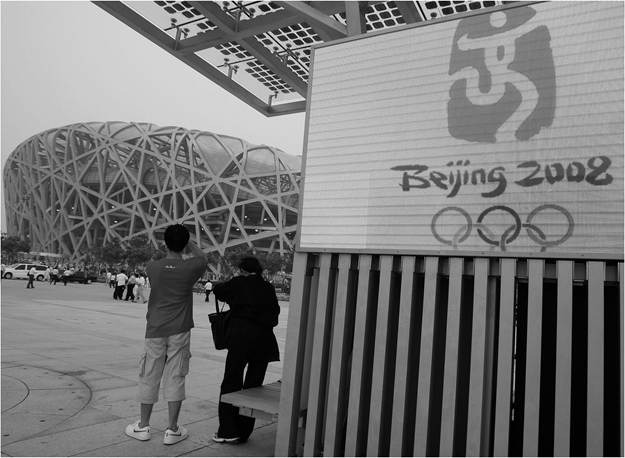
Figure 10.1 Man takes a picture of the Beijing National Stadium shortly before the official
opening of the 2008 Summer Olympic Games (© ITAR-TASS Photo Agency / Alamy)
2016 it will become the first South American nation to host the Olympic Games. The African continent hosted its first FIFA World Cup in South Africa in 2010, and has never hosted an Olympics.
East Asia
Because the institutional basis for sports in East Asia was strongly shaped by the YMCA and the USA, the early emphasis was on Olympic sports and baseball, rather than on soccer or cricket. The Far Eastern Games, launched by the YMCA from the Philippines in 1913, were the world's first regional games. Ten installments were held in Japan, China, and the Philippines up until 1934, when Japan's occupation of northeast China ended cooperation. The strong YMCA presence explains the early incorporation of East Asia into the Olympic system. The YMCA organizer Elwood Brown envisioned that regional games would be a feeder system for the Olympic Games, a concept that secured the IOC's support. This idea galvanized the patriotism of East Asians who wanted to see their countries take their place among the strong nations of the world, symbolized by hosting Olympics and winning medals.
Kano Jigoro became the IOC member in Japan in 1909, making him the first Asian and first non-European member. Kano was the creator of the sport of judo, which in 1964 became the first sport based outside the West to enter the Olympic Games (taekwondo was the second and last). Kano apparently anticipated that a sport perceived as too non-Western would not be accepted in the West, because when speaking about judo before international audiences he was careful to use scientific language and avoid Confucian philosophy or religion, which he used when speaking in Japanese.[425] This had been forgotten by the time that China began promoting its martial arts form, wushu, with the expectation of seeing it included on the program for the Beijing 2008 Olympics. When the IOC failed to vote it onto the program, it initiated a debate inside China about whether the West was capable of accepting Chinese culture. A century after Kano became the first non-Western IOC member, the presence of “Eastern culture” in the Olympic system was still a problem.
Latin America
Based on the success of the Far Eastern Games, the IOC entered into a partnership with Elwood Brown to organize regional games in Latin America. By this time football and cricket had become well-established due to the intense British commercial and naval presence since the beginning of the nineteenth century. The Fluminense Football Club had been founded in 1902 by a Brazilian of British descent, and its members were European-educated. It supported the YMCA in organizing the first Latin American Games in 1922, attended by Argentina, Brazil, Chile, Paraguay, and Uruguay. A Central American and Caribbean Games (Mexico, Cuba, and Guatemala) followed in 1926. The Pan-American Games - which include both North and South America - were established in 1951 during the postwar wave of revitalization. In the same year, the first Asian Games revived the Far Eastern Games in a new and more inclusive incarnation.
Africa
The first IOC member in Africa was actually Greek. Angelo Bolonaki, or Bolonachi (as he was known in the IOC), a member of the large Greek community in Alexandria, was the IOC member in Egypt from 1910 to 1932, when his membership was switched to Greece and he continued to serve until 1963. His fifty-three years in the IOC were the longest term of any IOC member, but his background evokes troubled national histories, with the result that he has been largely forgotten by Olympic historians. Following the success of the Latin American Games, Coubertin and Bolonaki initiated a discussion with French and Italian officials about an African Games. The first installment was planned for Algiers in 1925, but under French pressure they were not held. The date was pushed back and the site changed to Bolonaki's own Alexandria, but a few weeks before the starting date, the British blocked the plans and persuaded the French to support them. Coubertin argued that victories of the “people in bondage” over the “dominant race” would not lead to rebellion, but British, French, and Italian colonial administrators were not
1 22
convinced.
The debate about boxing in Salisbury, Southern Rhodesia (Zimbabwe after independence in 1980) in the late 1930s illustrates the apprehensive British attitude. Boxing had become popular around 1915 without any European encouragement, stimulated by the prestige of the British-trained police who practiced it. In the local version, bouts were short, few blows were exchanged, no one was ever knocked out, no points were awarded, there
22 Dikaia Chatziefstathiou, “The diffusion of Olympic sport through regional games: a comparison of pre and post Second War contexts,” Final Research Report, Postgraduate Grant Programme, IOC Olympic Studies Centre, Lausanne, 2008, pp. 36-41 (http://doc.rero.ch/record/12567). was no decisive result, and the boxers performed strutting dance moves when an opponent took a rest. Europeans who observed the matches were mystified. Boxing clubs were organized along tribal lines and matches often provoked inter-tribal fights between the crowds of up to two thousand spectators. After considerable debate, the authorities finally decided to regulate and control boxing so as to prevent it from serving as a vehicle for selfdetermined “urban tribalism.”[426]
Only South Africa and Egypt competed regularly in Olympic Games until after World War II. Other outstanding African athletes represented the metropole. European IOC members observing the nationalism incited by the Far Eastern Games feared that the “spreading of the doctrine of International Sport” in Africa would be ill-advised.[427] Despite their concerns, East Asia was allowed to have its sporting nationalism, while Africa was not. Although Coubertin did hold colonialist and racist views, he seemed to believe that incorporation into the Olympic system had greater potential to ensure peace than did the colonial project founded on the hierarchical notion of white men civilizing the natives through sport:
A structure comprising independent, interrelated segments is gradually replacing the tutorship system from which Europe has benefitted for so long. Europe itself has hastened this demise through its tactlessness in using the system.[428]
The tide of history increasingly turned toward the global segmentary system that he had engineered.
Decolonization
From the 1950s to the end of the 1970s, forty-eight new National Olympic committees were recognized in Asia and Africa (almost 25 percent of the total in 2013), initiating a shift of power in the world of sport. When Indonesia hosted the 1962 Asian Games, President Sukarno was angered by the IOC's withdrawal of its approval over Taiwan's exclusion from the games, and its threat to ban any Asian Games competitors from the 1964 Olympics. He organized the Games of the New Emerging Forces (GANEFO) in the following year. The First GANEFO in Djakarta attracted 3,000 athletes from as many as 51 nations, including the Soviet Union, China, recently independent colonies, and even some individual athletes from Europe. Much of the funding came from China, which at that time was outside the Olympic system. The IOC regarded it as a serious threat because it was a rival Asian initiative on the eve of the Tokyo Olympics, which were to mark the Olympic Movement's expansion into Asia. A coup d'etat in Indonesia and the Cultural Revolution in China put an end to subsequent GANEFO.
In 1978 China led a second attempt to break the West's “death grip” over sport - the establishment of the Intergovernmental Committee for Physical Education and Sport under UNESCO. By this time it had become clear to IOC President Killanin that the IOC should not continue to exclude one quarter of the world's population. He pushed through China's readmittance into the IOC in 1979 under the “Olympic formula,” which prohibits the use of the name, flag, and anthem of the Republic of China, and allows Taiwan to compete under the name “Chinese Taipei.”
African nations finally began to find their voice in world sport when they unified against the apartheid system in South Africa, which was excluded from the Olympic Games and FIFA from the 1960s to the early 1990s. Twenty-five African nations boycotted the 1976 Olympics in protest over New Zealand's sporting contacts with South Africa. The anti-apartheid movement is generally considered one of the few - if not the only - successful examples of mobilizing the international sport system to help bring about major political reform. This lends a special pathos to the formation of a soccer league by anti-apartheid prisoners in Robben's Island prison, who used it to create a semblance of normal life.[429]
The global sport system: the first 150 years
Most of the sports with international scope today had already been codified in rules by 1900, and by 1914 they had been incorporated into a system of national and international governing bodies that has hardly changed in the century since then. The only periods when the momentum of the global sport system ground to a halt were during World Wars I and II. However, both wars were preceded by periods of accelerated growth due to the escalating national rivalries, and were followed by sports events marking the victories - the 1919 Inter-Allied Games in Paris (an Olympic-style competition between the troops, organized by Elwood Brown) and the 1948 Olympic Games in London. It is often argued that the 1936 “Hitler” Games added momentum to Germany's aggression against its neighbors, but four decades later West Germany chose the hosting of a second Olympics to demonstrate its peaceful reintegration into the world community. The supremacy of the system was sealed when the People's Republic of China was readmitted to the IOC in 1979. No longer on the outside of the global sport system, China became one of its most committed members. The Beijing 2008 Olympic Games were the first truly “universal” games, with 204 teams participating, which covered every territory on the planet that could conceivably mount a team (excepting Brunei).
The nodes of the sport system multiplied and flourished even where racism, sexism, class conflict, anti-Semitism, colonialism, xenophobic nationalism, two world wars, and the Cold War worked to tear the system apart. Indeed, in important ways the sport system fed on these divisive forces, and proliferated precisely because of them. The principle of complementary opposition meant that when one group organized a sporting club, a rival group felt compelled to similarly organize in order to avoid being socially out-maneuvered. This systemic logic caused sport associations to replicate around the globe wherever local people possessed freedom of assembly, and nationalities possessed self-determination.
The modern era would not exist in its current form without sports.
Further reading
Arbena, Joseph L. Sport and Society in Latin America: Diffusion, Dependency, and the Rise of Mass Culture. Westport, cτ: Greenwood Press, 1988.
Baker, WilliamJ. and James A. Mangan, eds. Sport in Africa: Essays in Social History. New York: Holmes and Meier, 1987.
Bale, John and Mike Cronin. Sport and Postcolonialism. Oxford: Berg, 2003.
Bottenburg, Maartenvan. Global Games. Urbana: University of Illinois Press, 2001.
Brownell, Susan. Beijing's Games: What the Olympics Mean to China. Lanham, md: Rowman and Littlefield, 2008.
ed. The 1904 Anthropology Days: Sport, Race, and American Imperialism. Omaha: University of Nebraska Press, 2008.
Edelman, Robert. Serious Fun: A History of Spectator Sports in the USSR. Oxford University Press, 1993.
Gems, Gerald R. The Athletic Crusade: Sport and American Cultural Imperialism. Lincoln: University of Nebraska Press, 2006.
Georgiadis, Konstantinos. Olympic Revival: The Revival of the Olympic Games in Modern Times. Athens: Ekdotike Athenon, 2003.
Giulianotti, Richard and Roland Robertson, eds. Globalization and Sport. Malden, ma: Blackwell, 2007.
Guttmann, Allen. Games and Empires: Modern Sports and Cultural Imperialism. New York: Columbia University Press, 1994.
Sports: The First Five Millennia. Amherst: University of Massachusetts Press, 2004.
Holt, Richard. Sport and Society in Modern France. London: Palgrave, 1981.
Sport and the British: A Modern History. Oxford University Press, 1989.
Journal of Global History, special issue on Sport, Transnationalism and Global History, 8/2 (July 2013).
Kelly, John D. The American Game: Capitalism, Decolonization, World Domination, and Baseball. Chicago: Prickly Paradigm, 2006.
Kelly, William W. and Susan Brownell, eds. The Olympics in East Asia: The Crucible of Localism, Nationalism, Regionalism, and Globalism. New Haven, cτ: Yale Council on East Asian Studies Monograph Series, 2011.
Keys, Barbara. Globalizing Sport: National Rivalry and International Community in the 1930s. Cambridge, ma: Harvard University Press, 2006.
Klein, Alan M. Baseball on the Border: A Tale of Two Laredos. Princeton University Press, 1997.
Korr, Charles and Marvin Close. More than Just a Game: Soccer vs. Apartheid: The Most Important Soccer Story ever Told. New York: St. Martin's Press, 2010.
Kruger, Arnd and W. J. Murray. The Nazi Olympics: Sport, Politics, and Appeasement in the 1930s. Champaign, ιι: University of Illinois, 2003.
Kruger, Arnd and James Riordan, eds. The Story of Worker Sport. Champaign, ιι: Human Kinetics, 1996.
Lanfranchi, Pierre and Matthew Taylor. Moving with the Ball: The Migration of Professional Footballers. Oxford and New York: Berg, 2001.
MacAloon, John, ed. Muscular Christianity in Colonial and Post-Colonial Worlds. London: Routledge, 2007.
Maguire, John. Global Sport: Identities, Societies, Civilizations. Cambridge: Polity, 1999.
Power and Global Sport: Zones of Prestige, Emulation and Resistance. Abingdon: Routledge, 2005.
Mandell, Richard D. Sport: A Cultural History. New York: Columbia University Press, 1984.
Mangan, J.A. The Games Ethic and Imperialism. New York: Viking, 1985.
Morris, Andrew D. Marrow of the Nation: A History of Sport and Physical Culture in Republican China. Berkeley, ca: University of California Press, 2004.
Niehaus, Andreas D., ed. Olympic Japan: Ideals and Realities of (Inter)Nationalism. Wurzburg: Ergon, 2007.
Ok, Gwang. The Transformation of Modern Korean Sport: Imperialism, Nationalism, Globalization. Seoul: Hollym, 2007.
Pope, S.W. and John Nauright. Routledge Companion to Sports History. New York: Routledge, 2009.
Riordan, James. Sport, Politics and Communism. Manchester University Press, 1991.
Roche, Maurice. Mega-Events and Modernity: Olympics and Expos in the Growth of Global Culture. London: Routledge, 2000.
Sugden, John and Alan Tomlinson. FIFA and the Contestfor World Football: Who Rules the Peoples' Game? London: Polity, 1998.
Wagg, Stephen and David L. Andrews, eds. East Plays West: Sport and the Cold War. New York: Routledge, 2007.
Xu, Guoqi. Olympic Dreams: China and Sports, 1895-2008. Cambridge, ma: Harvard University Press, 2008.
Young, David C. The Modern Olympics: A Struggle for Revival. Baltimore: Johns Hopkins University Press, 1996.