The arrival: 75,000-50,000 years ago
Australasia was colonized by groups of Homo sapiens whose ancestors had migrated out of Africa many millennia earlier. The pathways taken by migrating human groups throughout this journey, and the motives driving successive generations to expand over such immense space, have been difficult to establish, but questions about the dispersal process are clarified by the Australian evidence.
At the time of colonization cooler global temperatures resulted in substantial quantities of water being locked in glaciers in the Northern Hemisphere and the consequent lower sea levels exposed now submerged land, linking mainland Australia with the large islands of Tasmania to the south and New Guinea to the north. This palaeo-continent is called Sahul, and it was always separated from the palaeo-landmass of peninsula southeast Asia, called Sunda, by a series of deep water passages. The rate of migration across these barriers, and the social and economic systems that facilitated the spread of people from Africa, have been much debated.PETER HISCOCK
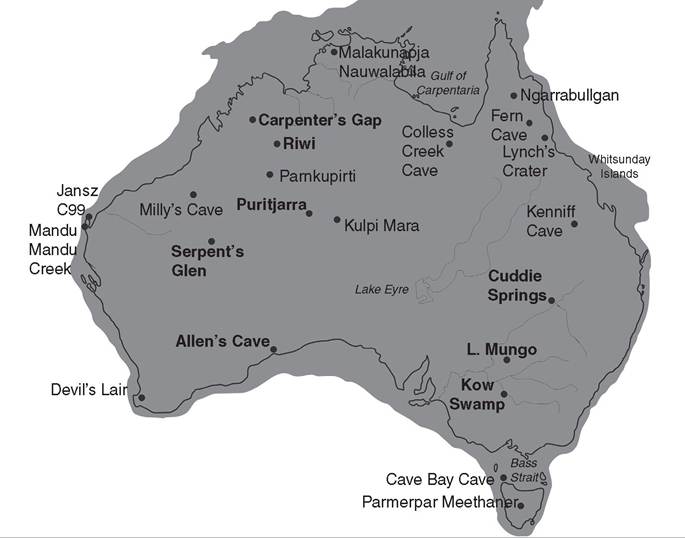
Map 18.1 Pleistocene continent of Australia.
Much of the archaeological evidence for the entrance of people into the Australasian region has reflected chronological models developed from genetic analyses. Two models of the migration to Australia have been grounded in genetic patterns: one proposing a ‘late dispersal' while the second suggests a relatively ‘early dispersal'. Until recently the late dispersal proposition was dominant, positing that humans had exited Africa little more than 60,000-65,000 years ago, based on the estimated time from the common ancestor of the MtDNA haplogroups L3 (found in Africa) and the descendant M/N groups (found outside Africa). Archaeologists and geneticists alike have used this age estimate to constrain the departure of modern humans, and consequently many interpretations have been built on this relatively late date for the initiation of the global dispersion of humans from Africa.[559]
That ‘late dispersal' model had several implications for reconstructions of the passage of Homo sapiens to Australia.
For example, it obliged its proponents to hypothesize that groups of Homo sapiens had moved out of Africa on multiple occasions between 120,000 and 70,000 years ago.2 Since skeletons of modern humans were present in the Middle East substantially before 90,000 years bp a much later genetic estimate for the movement out of Africa of groups whose descendants are represented in living non-African populations required that archaeologists view those skeletons as a false start: a small excursion beyond Africa of humans who then became extinct or retreated back into Africa.Most importantly, a late dispersion chronology required that human populations had spread from Africa to Australia in a remarkably short amount of time. A rapid migration has commonly been explained by positing three characteristics of the geographic expansion. First, it has been common to think of populations moving from Africa to Sahul in a direct fashion, along the Southern Arc of Dispersal: the southern coast of south Asia and southeast Asia and straight into northwestern portions of Sahul. Second, archaeologists have argued that populations expanding on that arc had economies that were narrowly focused on marine resources and that this facilitated rapid move- ments.3 For instance O'Connell and Allen hypothesized that migrating groups focused on resources such as molluscs that were readily depleted but supported large population sizes, thereby committing people to continue their migration in search of unexploited food supplies.4 Such a process might have driven fast colonization of coastlines all the way to Sahul. Third, O'Connell and Allen reject dates for many Australian and New Guinean sites that are claimed to be older than 45,000 years and advocate a relatively late colonization, thereby providing slightly more time for the dispersal process.5 Together these propositions provide a coherent hypothesis
Luisa Pereira, ‘The expansion of mtDNA haplogroup L3 within and out of Africa', Molecular Biology and Evolution 29 (2011), 915-27.
2 Rainer Grhn, C. Stringer, F. McDermott, R. Nathan, N. Porat, S. Robertson, L. Taylor, G. Mortimer, Stephen Eggins and M. Mcculloch, ‘U-series and ESR analyses of bones and teeth relating to the human burials from Skhul', Journal of Human Evolution 49 (2005), 316-34; and Jeffrey I. Rose, Vitaly I. Usik, Anthony E. Marks, Yamandu H. Hilbert, Christopher S. Galletti, et al., ‘The Nubian Complex of Dhofar, Oman: An African Middle Stone Age industry in Southern Arabia', PLoS ONE 6 (2011).
3 Mellars, ‘Going east'.
4 James F. O'Connell and Jim Allen, ‘The Restaurant at the End of the Universe: Modelling the colonization of Sahul', Australian Archaeology 74 (2012), 5-17.
5 James F. O'Connell and Jim Allen, ‘Dating the colonization of Sahul (Pleistocene Australia - New Guinea): A review of recent research', Journal of Archaeological Science 31 (2004), 835-53.
depicting the timing and mechanism of a rapid dispersal from Africa to Australia, a movement propelled and given direction by the structure of coastal geography and early foraging focus on specific marine foods. However, mounting archaeological and genetic evidence indicates the human passage to Australasia was slower and far more complex than is allowed in such rapid dispersal models.
The plausibility of the emerging alternative, an ‘early dispersal' model, has been increased by the demonstration that the human mutation rates had been significantly overstated and that consequently the antiquity of the movement of Homo sapiens out of Africa has been significantly under-estimated.[560] Calculating time using twenty-five years as the typical generational span, the revised mutation rate indicates that the separation of Africans and non-Africans, and by implication the geographical separation created by migration from Africa, began about 120,000 years ago. This far earlier estimate means that early sapiens skeletons outside Africa are most likely not anomalous and mark the passage of dispersing humans rather than failed excursions.
Genetic evidence also indicates that the people who colonized Australia, the ancestors of Australian Aboriginal people, were part of an early dispersal of Homo sapiens across south and eastern Asia.[561]Ancestral Australasian populations split from ancestral Eurasian populations, probably more than 75,000 years ago, as a result of both adaptations/ drift and through hybridization with archaic hominids that had left Africa previously.[562] In modern Australian Aboriginal people there are a substantial number of genes from Denisovan hominids, a sister group of hominids who were distantly related to Neandertals and evolved from a common ancestor (perhaps Homo heidelbergensis) who had left Africa more than 500,000-600,000 years ago. These genes reveal inter-breeding between dispersing humans and Denisovans. While the Denisovans are known only from northeast-central Asia, Stewart and Stringer hypothesize a southwards depression of their range during the colder periods, which brought them in contact with colonizing Homo sapiens populations.[563] Nevertheless there is no reason to think the Denisovan distribution extended across Asia, and so there is every
Colonization and occupation of Australasia likelihood that dispersing humans whose descendants reached Australasia: (1) spread far from the southern coastline of Asia and therefore were not dependent on only marine foods, and (2) moved slowly and indirectly towards Australia, expanding across territories already occupied by culturebearing hominids. Furthermore, since those genes are absent from modern East Asian populations it seems that after the original expansions of hybridized human population into southeast Asia and Sahul, and subsequent to the extinction of Denisovans, later waves of Homo sapiens moved into the Asia region. And because the same lineages are found in ancient and modern DNA within Australia we know that no population replacement occurred there (see below).
Hence the genetic evidence indicates that colonization of Australia was carried out by some of the initial populations dispersing eastwards across the Old World.Archaeological evidence dates the arrival of humans in Australia at between 50,000 and 60,000 years ago, an antiquity that is readily accounted for through an ‘early dispersal' model in which ancestral groups left Africa more than forty millennia earlier. The appearance of humans in the landscape of northern Australia is documented in the rock shelters of western Arnhem Land. At the Malakunanja II shelter the lowest artefacts were in sands estimated, by luminescence analysis of associated sand grains, to be 50,000 and 60,000 years old. At Nauwalabila, the lowest artefacts were estimated to be between 53,500 and 67,000 years old.[564] [565] Critiques of these associations, and suggestions that all of the lowest artefacts have moved down vertically through the deposit, overlook stratigraphic evidence in Malakunanja II for a small pit dug more than 40,000 years ago, and this cannot have been vertically displaced.11 Humans were occupying these sites more than 45,000-50,000 years ago, and this represents a minimum date for the occupation of Sahul.[566] Sites with a similar antiquity are found around Sahul, confirming the widespread presence of people across the continent at or not long after 50,000 years ago and suggesting that the movement of people into different niches was rapid. For instance, in central Australia open sites such as Parnkupirti and cave sites such as Puritjarra were occupied in excess of 40,000-45,000 years ago; in the southwest the Devil's Lair cave
was occupied about 46,000-47,000 years ago, and in southeastern Australia debris from human occupation was present at Lake Mungo at least 45,000-50,000 years ago.[567] It may have taken some time for population levels to grow to a point where material indicators of human activity became sufficiently common that they can still be found by archaeologists today, and hence humans may have been present in landscapes for a prolonged period before they become archaeologically visible at about 50,000 years ago. However, archaeologists currently have no reliable indications of an earlier human presence and it is the sites dating from the period 45,000-55,000 years ago that appear to record the expansion of people across the continent.