The background to the introduction of irrigated rice cultivation
There is no doubt that the introduction of irrigated rice cultivation was an epoch-making transition in the Japanese archipelago. It eventually provided a stable food supply and agricultural surplus, resulting in the distribution, accumulation, and concentration of wealth.
This process was very important for the subsequent development of society and economy in Japan. The reasons for the introduction of rice farming were not as simple as agriculture being superior to what went before, which is how it is perceived by some, who regard rice farming as being a better way of life than hunting and gathering.It is well known that during the Jomon period complex hunting-gathering societies developed supported by sophisticated techniques, including storage and the removal of bitter tannins from nuts. I consider that the technologies of Jomon culture facilitated the introduction of rice cultivation, along with its complex irrigation facilities, because there was no demerit to the pre-existing ways of life, and because rice farming could be accommodated within the
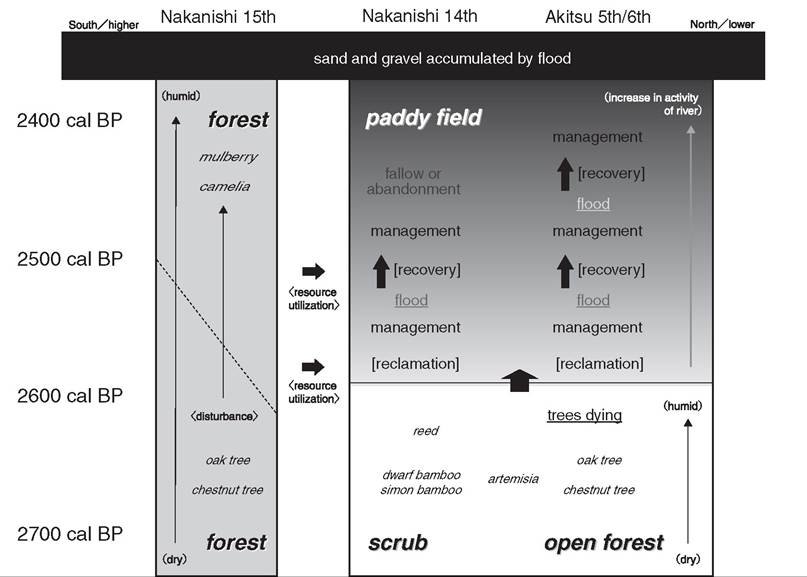
Figure 15.8 Transformation of the wild landscape to paddy field at Nakanishi-Akitsu.
range of existing social activities. In this regard, it is especially important to note that rice cultivation did not infringe on the various existing means of subsistence, and it neither replaced nor was it superior to these. No evidence has yet been discovered for any clash between the old and new economic activities.
The development of large rice paddies at Nakanishi-Akitsu at the start of the early Yayoi period does indeed seem to have been relatively sudden, but they were constructed using part of the landscape that was hardly used at the end of the final Jomon, as demonstrated by the absence of traces of Jomon activities from the palaeosol which become the basis for the creation of the paddy field.
As mentioned above, it is likely that the area used was rather dry, dominated by grasses, becoming wet when the groundwater level was high. Therefore, the productivity of Jomon gatherers was low in this area and it was not much used, so that it was not problematic to transform it for these new economic activities.However, the reclamation of land for large paddy fields and the building of irrigation facilities, along with the ongoing management of cultivated, land including the removal of undergrowth and weeding, represent an investment of labour not directly connected to the harvest. There must have been reasons why this was put into practice. Two reasons can be considered.
1. The continuity of cultivated land. The control and cultivation of useful plants were practised by interfering with the natural vegetation in the final Jomon period. An example is the development of a stand of chestnut trees at Kannonji-Honma during the middle final Jomon period.[838] Such chestnut stands were utilized not only for gathering nuts, but also for procuring timber. The continuous utilization of land led to the depletion of resources, so that it was usually necessary to leave the exhausted land until it recovered and to seek out new land to secure sufficient resources. In the case of rice paddies, however, it was possible to continuously make use of the same land. Even if the soil was exhausted after the harvest, through leaving sections of the paddy complex fallow it was possible to continue growing rice.[839] Namely, it was no longer necessary to wait for the natural recovery of the land. In this way rice cultivation and the cyclical use of land made the food supply more stable and predictable.
2. Storing capability and reproducibility of harvests. The idea of storing food developed during the Jomon period, as can be seen in the large numbers of storage pits for nuts, particularly in low wet areas. Similar nut storage pits existed in the Yayoi period, but the most common form of storage was for harvested rice brought into the village.
The difference between the methods is in the form of storage, and the more important point is that storing nuts was just for consumption, while storing rice was for both consumption and seeds for sowing in the next year.This reproducibility of harvest was very attractive. Jomon society longed for rebirth and held many kinds of ritual, including those involving dogu ceramic figures, examples of which were excavated at Kashiwara and Tamade. The main target of rebirth was of course human beings, but since many animalshaped clay figurines were made, and are often found in conjunction with
The Nara basin paddies, Japan accumulations of burnt animal bones and other remains, the natural resources which supported the society were also the focus of ideas of rebirth. The cyclical reproduction of natural resources could maintain and reproduce society, and human beings greatly influenced the cycle. Therefore, rice grains became symbolic of rebirth, and the storage of seed rice meant the control of rebirth by humans.
A number of impressions of seed rice on pottery dating from the late final Jomon period are known from sites in the Kinki area. While these impressions demonstrate the existence of rice, they do not prove that agriculture was yet being practised.
Twenty impressions of rice grains were found on a deep ceramic bowl of the tottaimon 2a phase from the Saragi site near Tamade.[840] Such a quantity of impressions indicates that this was more than an accident or that these were just miscellaneous grains. At present, there is no evidence of irrigated rice cultivation to the east of the Setouchi region (the area facing the Seto Inland Sea) during the later final Jomon period, but it is possible that seed rice itself was introduced to the Nara basin as the symbol of reproducible grains. It is proposed here that irrigated rice cultivation was introduced to these new areas from existing rice-producing areas, soon after the introduction of the grains themselves.
This chapter has tried to explain the processes of the introduction of irrigated rice cultivation at the transition from the Jomon period to the Yayoi, based on the detailed recent excavations in Nara prefecture. I have tried to present a model for the major changes that constituted the ‘origins of agriculture' in the Nara basin. The investigation of the sites described here is still in progress and my hypotheses will no doubt have to be re-examined in the light of future research results.