The emergence of early modern human cultures, 70,000-48,000 BCE
We should not expect that advantage immediately accrued to our first fully modern ancestors with full syntactic language. Stanley Ambrose and Karl Lorenz have suggested computer similes for the cultural effects of the acquisition of the capacity for fully modern language.
The mutations that enabled this capacity produced the necessary hard drive. But to use a hard drive one needs software. Our common human ancestors, now fully modern in their linguistic potential, still had to accumulate the body of knowledge and skills - the software - through long experience and experimentation, that would allow them to take advantage of their new capacities for communication, cooperation, planning, and reasoning.[433] We can expect, as a result, that the full suite of Later Stone Age technology and cultural behaviors came together only gradually over an extended period. That expectation is borne out in the archaeology.Africa, our common homeland, was still entirely occupied by archaic humans with Middle Stone Age technology down to as late as 70,000 bce (Map 14. 1). Most of these industries had existed already for thousands of years, changing little in their techniques and tools over long spans of time. One complex, the Nubian, had outliers extending out of Africa and into the Arabian peninsula.[434] The archaic humans who moved into the Levant just before 100,000 years ago would originally have been associated with that industry. West of the Nile the North African Mousterian was in retreat in the face of the spread across the Sahara and North Africa of a newer Middle Stone Age tradition, Aterian, which some scholars derive from the Nubian complex. To the south all across the Congo Basin and in adjoining eastern areas of West Africa, the Lupemban complex was, and for many thousands of years had been, the prevailing Middle Stone Age tradition.
Other Middle Stone Age traditions thrived farther west in West Africa. The Stillbay industry represents the Middle Stone Age of that period widely in southern Africa, while other Middle Stone Age industries predominated in eastern Africa and the Horn of Africa.But after 70,000 bce that picture slowly transformed, as our fully human ancestors brought into being the cultures of the Later Stone Age.
Eastern and southern Africa, 70,000-48,000 bce
The evidence of human genetics places the emergence of the fully modern human ancestors of all of us today in the eastern side of Africa. Three deep sets of human genetic lineages exist. One can be found in people who belong to populations living in several areas from central East Africa to South Africa;
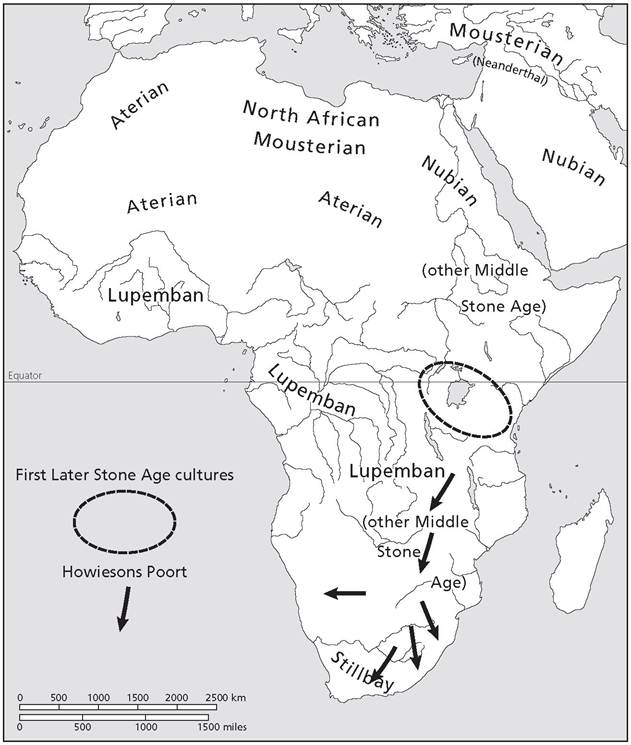
Map 14.i The earliest Later Stone Age: the cultural world of the common ancestors of all modern humans, c. 68,000-61,000 bce.
and a second, in the Batwa peoples - often called “Pygmies” (an inappropriate term that should have stayed in Greek mythology, and not been applied to real people) - who today reside in a scatter of communities all across Central Africa, from the western edge of East Africa as far west as southern Cameroon. The third set of deep lineages is typical of all the remainder of humankind.[435] The one world region in which all three deep lines of human descent anciently conjoined and overlapped was East Africa.
The findings of archaeology are consistent with placing the origin areas of our common fully human ancestors broadly in East Africa. These findings also confirm the expectation that fully modern behavior and technology would emerge not abruptly, but gradually or episodically over an extended span.
The period of this transition lies beyond the effective reach of radiocarbon dating. Methods suited to the time depth involved, such as thermoluminescence dating of sediments and electron spin resonance dating of teeth, have been applied in relatively few sites in East Africa so far.
As a result, at several important sites the proposed dates of the early Later Stone Age rest on estimates of how long it would have taken to accumulate the Later Stone Age deposits that lie below the layers for which there are radiocarbon dates. Dates reached in this latter manner, although they do not command the same level of credence, fall closely in line, however, with the more reliable chronometric dates. Much further work on dating the East Africa finds is needed, but the evidence we do have is consistent in placing the transition to the Later Stone in the period between 68,000 and 48,000 BCE.The earliest combinations of tools typical of the Later Stone Age cultural package gained prominence in the archaeological record first in East Africa and secondarily in several parts of southern Africa (see Map 14. 1). A very early such item, appearing in sites in the Western Rift valley region along the western side of East Africa, was ground bone points. According to the most recent series of thermoluminescence determinations at the relevant sites, the dates for these finds cluster between 68,000 and 58,000 bce.[436] A second feature of the Later Stone Age, the systematic and deliberate fashioning of quite small blades and small backed flakes and blades, may have originated in nearby areas of East Africa. The earliest occurrences yet known may be from the Mumba industry of northern Tanzania, estimated to date as early as 63,000 bce.[437]
Farther south in southern Africa, blades and flake tools, alike in size and technique to those of the Mumba industry, along with bone tools (see Map 14.1),[438] make up what is called the Howiesons Poort culture. Dating to the period 63,000-58,000 bce,[439] Howiesons Poort layers appear in sites in Kwazulu-Natal, the Free State, the two Cape provinces, Lesotho, Namibia, and Zimbabwe.[440] What is remarkable about the chronology of this incipient Later Stone Age industry is that, everywhere, it appears juxtaposed between strata with Middle Stone Age technology.
The findings have several historical implications. For one thing, the close resemblances of the Howiesons Poort with the Mumba toolkit - and the sharp distinctions between it and the Middle Stone Age industries that preceded and followed it in southern Africa - favor the conclusion that the makers of Howiesons Poort arrived as an intrusive population from East Africa. The South African archaeologist Hilary Deacon proposed that this tradition displays fully modern human behavior because it contains several characteristic features of the Later Stone Age, including the spatial organization of living sites around hearths and the exchange of formal blade-based backed tools made from stone imported sometimes from more than ιoo kilometers away.[441] But other archaeologists, among them Richard Klein and Stanley Ambrose, point out that the patterns of food resource exploitation at Howiesons Poort sites indicate that its makers were not yet as effective in their hunting and gathering as Later Stone Age peoples had become by 48,000 bce.[442]
The capacities of the Howiesons Poort people for exploiting their environment, in any case, do not seem to have given them a significant advantage over toolmakers with Middle Stone Age technologies, because Middle Stone Age industries in southern Africa re-expanded and, by around 58,000 bce, had replaced Howiesons Poort everywhere. That Howiesons Poort disappeared coincident with a shift to warmer conditions globally, at the beginning of Marine Isotope Stage 4, implicates climate change as a possible contributing factor. If so, this would be still another indicator that the Howiesons Poort people did not yet possess the full adaptive capacities in place by 48,000 bce among our fully human ancestors.
In several parts of East Africa, however, sites dating as early as 60,000 bce had begun to take on more and more of the characteristics of full Later Stone Age technology. In the Lemuta industry of northern Tanzania - dated to 60,000-57,000 bce by electron spin resonance dating of associated teeth[443] - backed blades and geometric microliths typical of the mature Later Stone Age had become plentiful.
At the Ntuka River site in southwestern Kenya, indirectly estimated to date possibly earlier than 58,000 bce, narrow-backed microliths, blades, and small obsidian points are characteristic finds.[444] Farther north, in Ethiopia, the latest securely dated Middle Stone Age deposits belong to the period of 77,000-61,000 years ago,[445] so the emergence of fully Later Stone Age industries in the Horn of Africa may also have begun there not much later than 60,000 bce. But that possibility remains to be adequately documented in the archaeology.A final clinching advantage of the early fully modern humans came from their possession of a complex projectile technology, with either bows and arrows or spear-throwers and darts or with both, and thus the ability to disable or kill game at a distance. The earliest fully modern humans who moved from Africa into western Eurasia around 48,000 bce, as John J. Shea and Matthew L. Sisk have shown, already possessed one version of this kind of technology, the spear-thrower, unknown previously outside the continent.33 Earlier hominins may have had simple projectile weapons, that is to say, spears, but not bows and arrows or spear-throwers and darts.
Just how early Later Stone Age people in Africa began regularly to depend on this kind of weaponry is a historical issue very much in need of study. Some of the tool shapes employed by this technology go back earlier in Africa,34 but the proliferation in early Later Stone Age sites of the kinds of smaller points essential for efficient weapons of this type indicates that the Later Stone Age was the period in which this technology became fully established. Archaeologists have proposed that the bow and arrow may have been present in the Howiesons Poort culture before 60,000 bce.35 But if so, the lack in those sites of the remains of animals of the kinds that would have been hunted with complex-projectile weaponry would seem to imply that the Howiesons Poort people had not yet mastered the full potential of this technology.
By 48,000 bce, however, complex-projectile technology seems well established in the cultural repertoire of fully modern humans.The universality of the bow and arrow in Africa in later ages, and the lack everywhere in the African continent of spear-throwers and darts, suggests
Review 2 (1984), 37-71, and David Pleurdieu, “Le Middle Stone Age de la Grotte de Porc-Epic,” L'Anthropologie 107 (2003), 15-48.
33 JohnJ. Shea and Matthew L. Sisk, “Complex projective technology and Homo sapiens dispersal from Africa to Western Eurasia,” Paleoanthropology (2010), 100-22.
34 JohnJ. Shea and Matthew L. Sisk, “The African origin of complex projectile technology: An analysis using tip cross-sectional area and perimeter,” International Journal of Evolutionary Biology (2011), Article ID 968012, www.hindawi.com/journals/ijeb/2011/ 968012/
35 Lucinda Blackwell et al., “Middle Stone Age bone tools,” and Marlize Lombard and Laurel Phillipson, “Evidence of bow and stone-tipped arrow use 64,000 years ago in KwaZulu-Natal, South Africa,” Antiquity 84 (2010), 635-48.
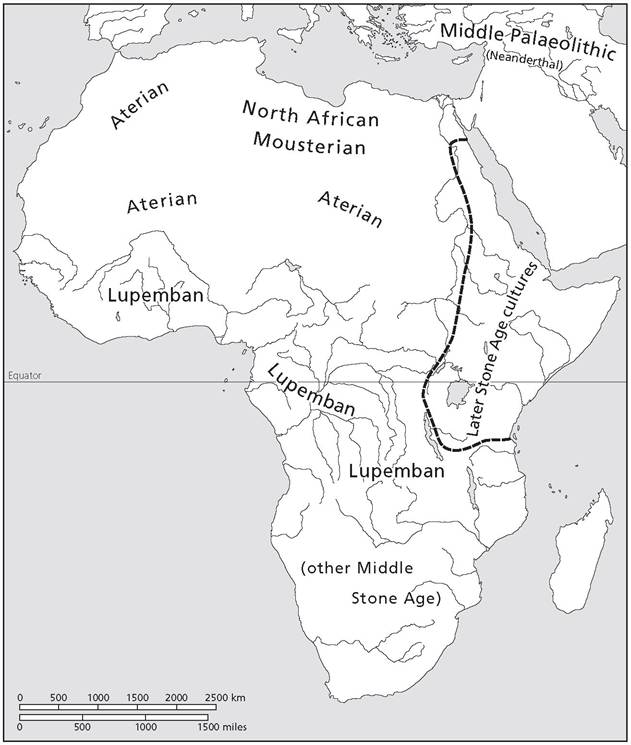
Map 14.2 At the threshold of human dispersal out of Africa: our common human ancestors of the Later Stone Age, c. 50,000-48,000 bce.
that the bow and arrow was the original complex-projectile weapon of the early Later Stone Age, when all of our ancestors still lived in Africa. The spear-thrower and dart appear to have been an alternative invention brought into use by those modern human populations who moved out of northeastern Africa by 48,000 bce, into western Eurasia and also eastward along the Indian Ocean coasts to island South Asia and Sahul (Map 14.2).
Social relations among early fully modern humans
Perhaps even more important to the success of our early fully modern ancestors than their growing technical competence were the cultural and cooperative behaviors and institutions that they brought into being because of their command of the tools of syntactic language. They lived in larger local groups than all previous hominins, including their archaic human contemporaries in Africa, and they cooperated and exchanged goods with other communities over longer distances than ever before.
The development of systematic kinship reckoning was probably a crucial component in such relations. Locally, formal kin relations served to define people's positions and responsibilities in their community and to establish norms of behavior toward each other. Intermarriage between communities drew people into networks of formal affinal relationship; and people could also apply the metaphors of kinship to individuals in other communities and, in that way, cement peaceful relations among their communities and facilitate the exchange of valued goods.
There are a variety of indications that the earliest kin terminologies may have resembled a type that anthropologists have called “Iroquois.”[446] In such a system one's parallel cousin - the child of one's father's brother or one's mother's sister - is called by the same term as a brother or sister. A separate cousin term applies to cross cousins - the children of one's father's sister or mother's brother.
Unilineal kin institutions, such as lineages and clans, did not yet exist in the emerging fully modern human societies of 70,000-48,000 bce. Recent studies from several scholarly disciplines give us reason to believe that the core social unit in the gathering and hunting band of that time may have been a kin group of a different sort - a coalition of close female relatives, consisting of sisters and female parallel cousins, their daughters, and their daughters' children. These female kin groups would have been matrilocal; the local foraging band would have coalesced around them. The anthropologists Kristen Hawkes, James O'Connell, and Nicholas BlurtonJones observed just such female coalitions in operation in the Hadza gathering and hunting society of Tanzania in the 1980s and 1990s.[447] The historian Christine Saidi has shown that a similar institution, going back historically at least 1,500 and perhaps 3,000 years, existed among the early agricultural peoples of Central Africa.[448]
Coalitions of close female kin would have enhanced human survival in several basic ways. Older women helped with the gathering of food for younger women burdened with children not as yet weaned, and they also helped by taking care of weaned children. Cooperative multi-generation female kin groupings thus freed up time for women to go about the tasks of providing the majority of the food that sustained life in the band, while supporting the reproductive success of the group as a whole and enhancing the survival chances of their children. Among the Hadza, men gained access to marriage and reproduction with the women of these coalitions, and to the women's regular and ongoing subsistence productivity, through being able to provide - although in much more variable and intermittent fashion - meat from the hunt. Meat provides additional nutrients enhancing the health and survival of children, and thus good hunters would have been acceptable mates to the female kin group, which oversaw these matters. In the matrilineal farming societies of the past 2,000-3,000 years in southern Central Africa, studied by Christine Saidi, a man had similarly to prove his worthiness for marriage by undertaking a long stint of working for his future mother-in-law and her close female kin.
Religious belief and observance in the early Later Stone Age
What can we say about the inner life of the formative period in Africa of the Later Stone Age/Upper Palaeolithic cultural world of our earliest fully modern ancestors? How did the peoples of the period around 48,000 bce understand their place in the universe?
A wide array of comparative ethnographic evidence, in conjunction with the evidence of rock art from around the world, strongly suggests that the original religion of fully modern humans was shamanism. In this belief system existence is bimodal: it has two spheres - the concrete world of everyday experience and a parallel realm of Spirit. The surface of the earth forms the interface between the two realms. The shaman was the religious and medical practitioner, female or male, who tapped into the world of Spirit for the benefit (or sometimes the ill) of human beings. Shamans, as we discover from the operations of this religious system in more recent eras here and there around the world, were people able to put themselves into a state of trance. The trance experience, it was believed, transported them to the Spirit realm, allowing them to engage with Spirit power and bring it back into the everyday world in which their society lived.[449]
Rock art in southern Africa, dating to before 29,000 bce at Apollo Cave in southern Namibia, as well as the European cave art of similar age, seem to have had the trance experiences of shamans as their principal subject.[450] In this art we discover fuller and more complex presentations of the images that inhabited the shamans' minds when they were in a state of trance. The specific spirit figures, animals, and other images of this art differed in different parts of the world because humans everywhere have been historical beings: over time they have developed different myths and associated images to convey their experience of the two realms.
But the shamanistic traditions also abounded in old shared structural features and specific imageries. For example, the rock surfaces on which early humans painted held special numinous significance as a boundary between the concrete world of everyday life and the realm of Spirit. In different parts of the world, we find cases where the painters depict an animal as emerging from or entering a crack in the rock, in other words, as a spirit animal passing from the one world into the other. More than just inherited human mental tendencies are involved here. Widely shared motifs, such as animals exiting or entering the rock surface, surely draw also on a more ancient heritage of ideas and imagery going back to our common ancestors in Africa.
The use of sheltered rock surfaces as canvasses of shamanist art all across the world, from farthest southern Africa to the most distant reaches of the Americas, suggests that this practice probably goes back, too, to the early Later Stone Age, before our common ancestors began to spread out of our home continent. Because in Africa and most of the world the artists painted in rock shelters or on open rock faces, works older than 10,000 years have probably nearly all been obliterated over time by wind and water. The cave art of the Upper Palaeolithic in Europe survived because the artists painted on rock surfaces deep under the earth. At Apollo Cave in Namibia, the painted surfaces were preserved by burial under other deposits.