The long Age of Divergence
As the number of modern humans slowly increased, differences developed among populations both within Africa and then among those who spread out of Africa to the distant corners of the planet.
Some changes were biological, but over time cultural differences became far more profound. The long millennia during which biological and cultural diversification were dominant can be called the Age of Divergence.In part, divergence was nature's way for species to adapt to new circumstances and for new species to evolve. Modern humans (Homo sapiens sapiens) evolved from earlier primates and hominids through such an evolutionary process. The physical differences that continued to evolve among modern humans are both obvious and subtle. Thus, visible differences in hair and skin pigmentation are obvious, while the existence of multiple blood types and two types of human earwax is largely of interest to specialists. During the past quarter century, tremendous advances in genetics have revolutionized our understanding of human variation and simultaneously undermined unscientific prejudices. The mapping of the human genome, for example, has brought to light evidence that supports a coherent narrative of early human dispersal across the planet. DNA evidence confirms archaeological evidence that modern humans evolved in tropical Africa about 200,000 years ago, and from about 70,000 years ago began moving into the other continents. Distinguishable genetic lineages transmitted through females, known as mitochondrial DNA haplogroups, show that the earliest migrations were across southern Asia and into Australia, followed by later movements into the colder regions of Europe and northern Asia, from where people moved on into the Americas (see Map 5.1).[143] Along the way, each branch of humanity's family tree developed distinctive traits.
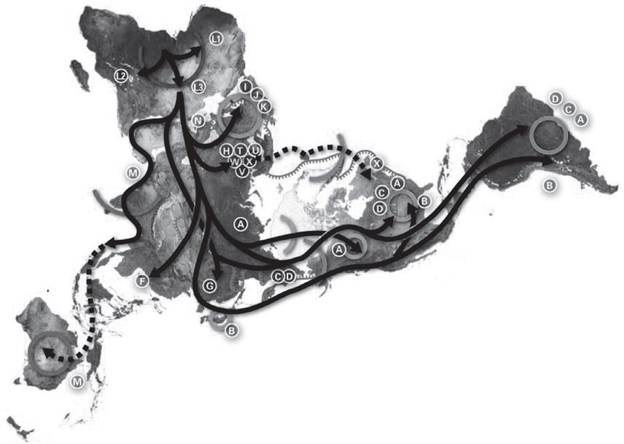
African: L, L1, L2, L3
Near Eastern: J, N
Southern European: J, K
General European: H, V
Northern European: T, U, X
Asian: A, B, C, D, E, F, G (M is composed of C, D, E, and G)
Native American: A, B, C, D, and sometimes X
Map 5.i DNA evidence of global human migration since about 170,000 years ago. The map traces human dispersal out of Africa of mitochondrial DNA haplogroups (populations genetically related through the female line) and the subsequent development of new mtDNA haplogroups. The capital letters on the map locate common groups. Source: Wikipedia Commons, licensed under the Creative Commons Attribution-Share Alike 3.0 Unported license.
Genetic variations had a number of causes. Since Darwin, the importance of natural selection in shaping evolution has been widely recognized. Even before humans moved out of Africa, other major differences had developed, such as the small body size among Pygmies that enhanced their movement through tropical rainforests. As the human species colonized the full range of the planet's climate zones and geographical regions, one obvious example of natural selection was the variation in skin color. Human populations that had gained pigmentation to reduce the harmful effects of the tropical sun lost pigmentation to enhance the beneficial effects of sunlight in more northern climes. Other variations in the human genome resulted from genetic drift, that is, random alterations in genes that occur naturally. Some isolated populations also changed as a result of assortative mating, that is, mating within a local gene pool, which had the effect of reducing the population's genetic variety and increasing the distance between them and other groups. In the early process of expansion out of Africa there is also evidence of interbreeding with other varieties of humanity, such as Neanderthals in the Mediterranean region and similar populations in Melanesia.
Two other circumstances affected human biological diversity. The first is that humans in Africa had long millennia to develop significant genetic variations. Second, DNA evidence suggests that the number of individuals who left Africa about 70,000 years ago was very small and thus represented a tiny part of the genetic diversity within the mother continent. All of the populations of Eurasia, Australasia, and the Americas developed from this restricted gene pool. For these reasons, genetic variation outside of Africa is actually less than within Africa. Overall, the biological diversity among humans is of modest proportions.
Unlike other species, modern humans have an enormous capacity for cultural change, which has been a far more important force for differentiation than biological change. Cultural changes came slowly during most of human existence, but they were inexorable because human communities were small and had limited contacts with others. Cultural differences would have occurred in a variety of contexts, including technologies, beliefs, food preferences, and forms of adornment. Because direct evidence for many forms of cultural variation is quite uneven (or absent) in early times, language multiplication is a useful surrogate for discussing the broader cultural changes that were taking place.
Although direct records of spoken languages date only from the invention of writing, linguistics can provide striking indications of ancestral speech and of how, over time, a single language could fragment into dozens, even hundreds, of mutually unintelligible languages. By 1000 ce some 10,000 to 18,000 languages were in use, and great numbers of older languages had passed out of existence. Today humans are more than one hundred times as numerous as a millennium ago, yet we speak far fewer languages. Why did so few people once have so many languages and why has the number of living languages declined?
Distinct languages evolved among populations that experienced prolonged isolation from each other, a circumstance that was common when human numbers were few.
Such isolation could occur even on a single island, as was the case on New Guinea, whose highlands became home to the greatest concentration of distinct languages in the world. The island's population of less than a million in 1500 developed 500 languages divided among 33 language families. Evidently people who settled in the island's deep inland valleys had so little contact with those in the neighboring valleys that each community developed a distinctive language and other cultural traits.Other populations became even more isolated by vast expanses of ocean, as was the case of island communities in the Pacific. Similarly, isolated communities in the larger continents of Australia and the Americas developed great linguistic diversity as they dispersed over vast territories with abundant wild game. At the time outsiders opened sustained contacts with Australia in the late eighteenth century, the aboriginal inhabitants numbered about a quarter of a million and were divided into between 360 and 750 distinct social groups, each speaking a distinct language. The size of the populations of the Americas at the time of sustained outside contacts began in 1492 was much larger, though estimates vary widely. Based on evidence recorded much later, the number of languages spoken in the Americas 2,000 years ago is conservatively estimated at about 500. Estimates of the number of indigenous languages still spoken in the Americas range from around 150 into the thousands.[144]
New Guinea, Australia, and the Americas are extreme examples of places where the average language before the end of isolation had only a few hundred or a few thousand speakers, but analogous linguistic situations existed in much of the rest of the world for most of history. Communities that survived through hunting and gathering had to be small and spread very thinly on the ground. Pastoralists also needed vast grazing lands to survive. In 10,000 bce there were perhaps 4 million people in the world and some 7,000 spoken languages.
In striking contrast to more recent times, none of the languages had more than a few thousand speakers, and the average was fewer than 600 per language.[145]It appears that new languages may have emerged at an even faster rate after the development of agriculture, since farmers were tied to smaller terrains than pastoralists and hunter-gatherers. One example of language fragmentation during early agriculture is the development of the Bantu language family in the vast southern cone of Africa. Over the course of the past 2,500-3,000 years a single ancestral language (“proto-Bantu”) branched into approximately 250 separate languages. The growth of the family was associated with the spread of people possessing agriculture and other technological advantages that enabled their numbers to multiply much more rapidly than those of the hunter-gather populations they displaced or absorbed. Even though some historians cite the spread of the Bantu-speaking peoples as a unifying trend, the actual outcome was the creation of hundreds of distinct languages and ethnicities. Bantu expansion was not a “migration” (as it has often been called) or even several “migrations,” but appears to have been a very slow, gradual drift of populations across an extensive area. As food-rich agricultural communities increased in numbers, some among the younger generation had to move out to new farm and pasture lands beyond the periphery of the ancestral community. Over dozens of generations, such short movements eventually frayed or broke the ties to ancestral communities and led to the formation of new identities, languages, and cultural complexes (see Map 5.2).
Archaeologist Colin Renfrew has used the model of Bantu expansion to interpret the expansion of the older and larger Indo-European language family. Renfrew starts with the hypothesis that, like the spread of Bantuspeaking peoples, the giant Indo-European family was not the product of a migration or an invasion but resulted from a long, slow drift of people outward from an agriculture center.
He also believes that the fruits of their agricultural labors enabled these populations to multiply faster than the pastoralists or hunter-gatherers they were displacing or absorbing. The farmers' superior numbers also led to the dominance of their languages. Even though linguistic evidence did not then support the proposition, he posited an origin of the process in central Turkey because it was an area of early agricultural innovation. New linguistic evidence has recently been marshaled in support of this thesis. Not all specialists agree that Turkey was the starting point nor that agriculture (along with nomadic pastoralism in the steppes) was the mechanism for Indo-European language spread over Europe, the Middle East, Central Asia, and South Asia. Nevertheless, a peaceful outward movement of a growing population could account for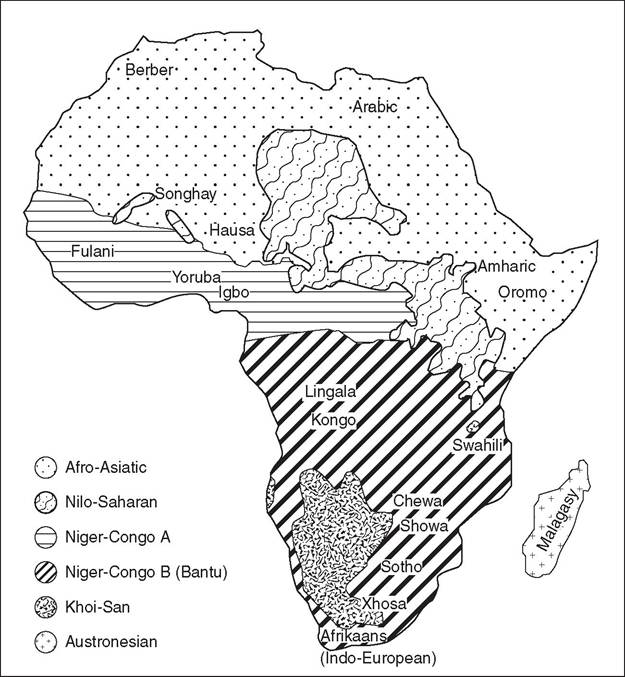
Map 5.2 African language map, showing Bantu language area (Niger-Congo B).
Source: Wikipedia Commons, licensed under the Creative Commons Attribution-Share Alike 3.0 Unported license; created by Mark Dingemanse.
the process that over six millennia led to the formation of nine IndoEuropean sub-families consisting of some 450 languages.[146]
The formation of thousands of distinct languages and the other cultural differences bundled with them was a formidable achievement. So was the spread of humans across the planet, mastering of new environments, domesticating plants and animals, and developing new technologies. But over millennia the process of cultural differentiation also created formidable barriers to understanding and laid the basis for animosities and conflicts that are still being played out.
Despite their differences, communities also shared many cultural features, such as the much-studied Indo-European religious traditions. Many commonalities seem to have arisen from ideas and aims that were widely shared. For example, formal burials with grave goods were widespread from early times, implying belief in an afterlife. In addition, aesthetic expression was a common human impulse. An entrenched belief that artistic expression could not have existed among “cavemen” had made the dating of the cave paintings at Altamira and Lascaux to between 15,000 to 20,000 years ago highly controversial. Newer evidence of finely made, decorated stone tools from Blombos Cave in South Africa show that such sensibilities existed fifty millennia earlier. Despite the lack of physical evidence, other arts, including dance, music, and rituals, also must have had a similarly long history.
Although present-day scholars can assign languages into families and detect broad cultural commonalities (such as, African art or “primitive” art), such connections would not have been meaningful enough to support ties among those who lived at those times. Similarly, while world historians might categorize technologies such as agriculture and iron smelting as commonalities for large numbers of humans in the last few millennia, it is unlikely that the diverse populations using such technologies would have perceived them as significant enough to overcome entrenched cultural differences. Indeed, it now seems that such technologies, once thought to have had a single origin, were in fact the product of separate inventions in different places. The evidence for agriculture is the most compelling, with separate inventions occurring not just in the Middle East and the Americas, but also in East Asia and at least three separate places in sub-Saharan Africa.[147] Even the borrowing of technologies and ideas by different groups did not form meaningful ties. Those who borrowed food plants, for example, might prepare them for consumption in their own distinctive ways. There is no evidence of people bonding on the basis of eating the same grain, root, or fruit. Differences, not commonalities, were (and are) the basis of cherished identities.