The state of the classroom
In our cursory survey of historians' treatment of knowledge and belief, we have seen a quite consistent Euro-centrism, but a great diversity in what that means, in what its consequences are.
The Wider World mostly reinforces the secularization thesis, begs questions of the Scientific Revolution, and delights in the level playing field of the Axial Age. In every case that involves a “Europe”, Euro-centrism plays important roles. How does the state of this historiography translate into our classrooms? To get a manageable panorama of the field, I did two small experiments, neither reliable by Euro-scientific standards nor multicultural by ethno-scientific standards. Both, I hope, help us see the underlying structural patterns in how historians approach belief and knowledge.For the first experiment, I surfed through dozens of websites of the University of Cambridge with a net trawling for names of the key producers of knowledge. Because Cambridge does not aggregate course descriptions in the style of the North American academic catalogue, and because not all webpages are open to external eyes, I ended up working through a diversity of tripos descriptions, lecture titles, undergraduate prospectuses, and staff research interests. Ignoring textbook authors, my trawl caught the names of people whose selves or thoughts or schools had been deemed worthy of study. Putting aside the Faculty of Divinity, to which we turn below, I looked at all the faculties and departments of the university, although only about half gave up these sorts of names. Much depends on the vicissitudes of webpage design, or indeed on the more explicit interest a sociologist professes in Weber than a scientist in Newton, but I believe the resulting lists are telling, and give us a sense of the Cambridge pantheon of knowledge makers.
Putting a dot on each knowledge maker's birthplace gives us a visual representation of the geography of knowledge at Cambridge (see Map 6.1).
The vast majority are Europeans, with Plato, Kant, and Wittgenstein in the first row, as most frequently appearing. There is a small contingent of Americans, such as Nozick and Rawls, Quine, the trumpeter Miles Davis, and T. S. Eliot - who would become legally British and intellectually very British. The entire rest of the planet, the entire non-Western world, is represented by four dots: Italo Calvino in Cuba, Marguerite Duras in French Indochina, Jacques Derrida in French Algeria, and J. G. Ballard, by virtue of his birth in the Shanghai International Settlement. Calvino returned to Europe as a baby, and the other three as teenagers. A full eighty-eight members of this group of ninety-seven men and four women were born within 1,000 miles of Konstanz, Germany, which indeed might serve us as a kind of absolute “West Pole”, around which our intellectual world revolves. These results - the peoples with knowledge and those without - visually echo the century-old map distinguishing between the colourful places of the “people with history” and the inky blackness of the land of the people merely with tradition (see Figure 6.4).Names from the Faculty of Divinity's website were treated separately, in part because of our sense of difference between religious belief and scientific knowledge, and in part because they ran opposite to the grain of the overall pattern. Here, if we deny Jesus and Augustine honorary status as Europeans, we are left with only three Europeans' names: Maimonides (1137/8-1204) and Ibn Juzay (1321-57), both of Andalusia, and the Sicilian Thomas Aquinas (1225-74) - one Jew, one Muslim, and one Christian. The list is dominated by nonEuropean Muslims and Jews, and bucks the overall trend yet again by being populated mostly by medievals. Here religion saves the non-European intellectual world from complete obscurity. Because of the relative decline in theology's prestige as it has been crowded out in modern times by new secular fields of study,[221] these names make only a small broadening in the overall pattern.
155
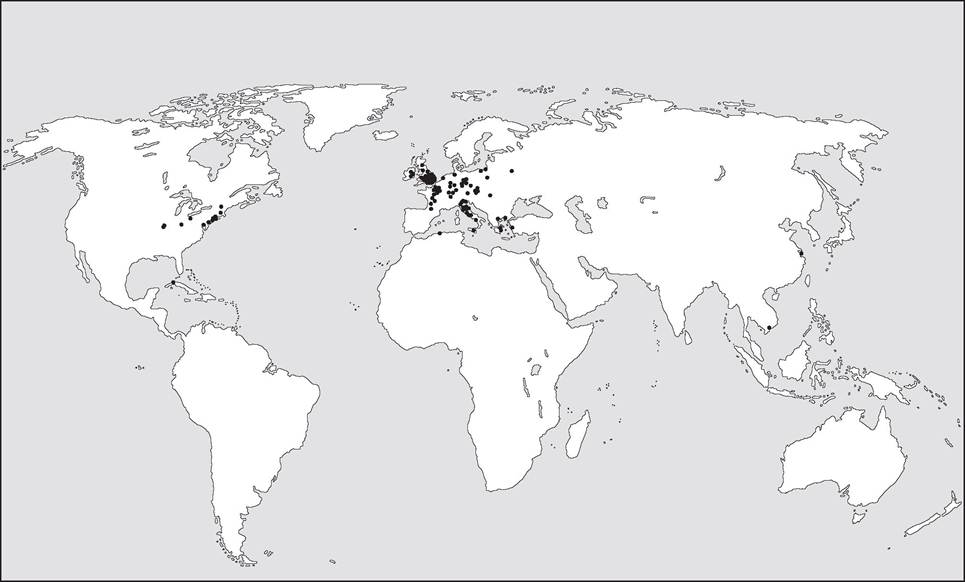
Map 6.1 “Knowledge makers” in courses taught at the University of Cambridge.
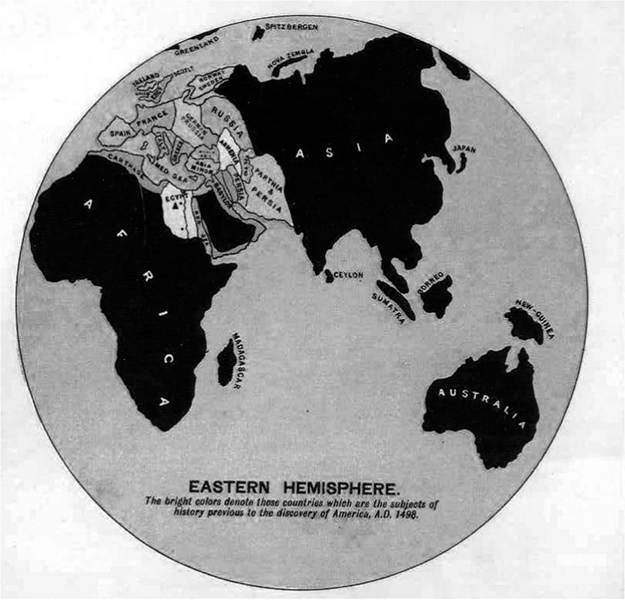
Figure 6.4 1890 map of areas with history and those without (from Synchronological Chart ofUniversal History, Edward Hull, 1890).
My point is not to pick on Cambridge University, and indeed deeper digging reveals a layer of more recent and more global reading lists. This experiment suggests its excellence is as a regional university, and that it might avoid the dangers of parochialism by reaching out to the Wider World, or at least by being cognizant of the narrow geographical basis of the knowledge it teaches. The situation is not better elsewhere. The best universities in non-Western countries have a similar curriculum, slightly supplemented by regional knowledge; an African university looks to the West and Africa, while an Asian university looks to the West and Asia, or its part of Asia. There is no knowledge of universal authorship. In our universities, knowledge was created by Europeans.
Our second experiment shifts its focus from space to time. Here I have chosen three popular and reliable world history textbooks (Bentley and Ziegler's Traditions and Encounters, Fernandez-Armesto's The World: A Global History, and the Princeton historians' Worlds Together Worlds Apart), worked through their over 1,500 subsections and 3,000 pages, and noted when knowledge or belief shows up in the narrative. Of course, both appear well integrated throughout these texts, so to bring some precision to an impossible task, I counted subsections in which most paragraphs were mostly about science or about religion. I found some 200 such subsections, and classified these into Western versus Wider World, and religion versus science. The division was crude and bloody. Science became defined as the sort of thing that would be found in a history of science book. Religion became everything else, including “bad science”, fields that might have been science except for our disbelief in them today, such as divination. Religion also included religious beliefs no one holds anymore; those classified as science held up better over time.
The shape of this story appears in (Figure 6.5). Religion dominates, with a great peak during an extended, and slightly delayed, Axial Age before beginning a long decline that gains speed in the wake of the Scientific Revolution.
Less dramatic in its movements, science has a lower baseline it rises from twice, once to partake modestly in the Axial Age, and then for the Scientific Revolution (a peak no greater than that for the Axial Age) - after which it dips and begins a slower rise. Only for the twentieth century do our textbooks pay more attention to science than to religion.When we look at the geography of this data, we get a sense of how the West-versus-Wider-World question resolves itself in our textbooks. Figure 6.6 plots, for each era but the first, the percentage of discussion that focuses on the West, for both science and for religion. (I offer no data for the earliest period, as what little coherence the Western/Wider World division has in later centuries completely disappears here.) For every era, the science line is higher than the religion line; that is, discussions of science are more focused on the West than are discussions of religion. For the most part, science stays above the 50-per-cent boundary, and religion below it; that is, discussions of science are almost always more Western while discussions of religion are almost always more Wider World. Religion trespasses only once, is only once more Western than Eastern, from 1400 to 1600, during the Christian reformations. These are also the early years of the Scientific Revolution, and so even here science moves ever further West as if to accommodate religion's brief intrusion into Europe. Science trespasses twice, is only twice more Eastern than Western: the first millennium bce, when so
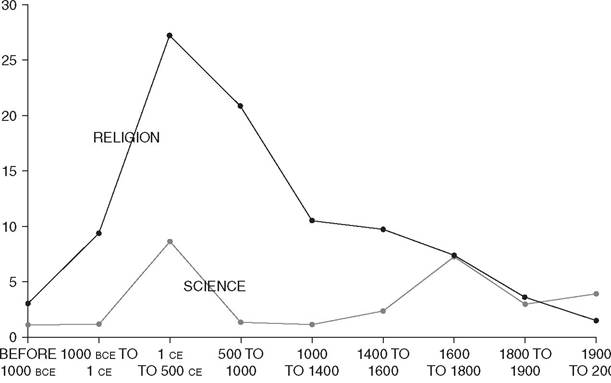
Figure 6.5 Percentage of world history textbook content about science or religion, by era.
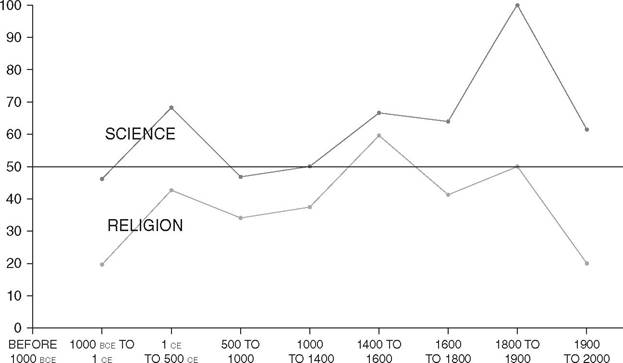
Figure 6.6 Percentage of world history textbook content centred on “the West” for science and religion.
little science is discussed that even brief consideration of the Maya calendar drags it outside of the West, and the five centuries from 500 to 1000 ce, the so-called European “dark ages”.
Comparing both charts (Figures 6.5 and 6.6) indicates that when science is most important, it is also most Western.For most of human history, neither science nor religion was a distinctive category, so this search is historically anachronistic, but historiographically revealing. Because the number of atheists - despite their greater propensity than, say, Australian aboriginals to advertise their views on the sides of buses - has been so small, we might think the amount of religion in the world has essentially been constant. If the coverage in textbooks is not constant, we then have here an opportunity to understand how belief and knowledge fit into our artifices of world history periodization. This reflects not only the historiography as a whole (reflecting the current “further readings” bibliographies), but also the story we tell our university students, the story that those students - including most future world historians - are told in their formative years.