When V. Gordon Childe1 coined the term ‘Neolithic Revolution', he may have had no idea how enduring it would be.
This transition from hunting and gathering economies to those based on agriculture was one of the most significant and transformational events in human history, affecting virtually every sphere of human society since its inception through to the present day.
Perhaps because of this, the Neolithic defies easy definition. Certainly it was an economic transformation that involved the domestication of wild food resources and the establishment of permanent communities. It is not that simple, however, since there were at least semi-sedentary settlements in the Near East and other regions prior to domestication. Conversely, domesticated plants initially occur in some places, such as parts of the American Southwest, without the development of villages.[384] [385] Thus, a flexible range of behaviour is embedded in the concept of ‘Neolithic'. Ultimately, the most significant impacts of the Neolithic dictated a change in how humans interacted with each other and the environment. Thus, the Neolithic was an economic transformation, but not so much of what was domesticated, but rather of how people used and viewed food. This required technological and social innovations, all of which comprise the ‘Neolithic package'.The oldest documented Neolithic cultures occur in the ‘Fertile Crescent' of Southwest Asia, more commonly known as the ‘Near East' (Map 8.1).[386] While future research may ultimately yield an even older Neolithic, it has been best and
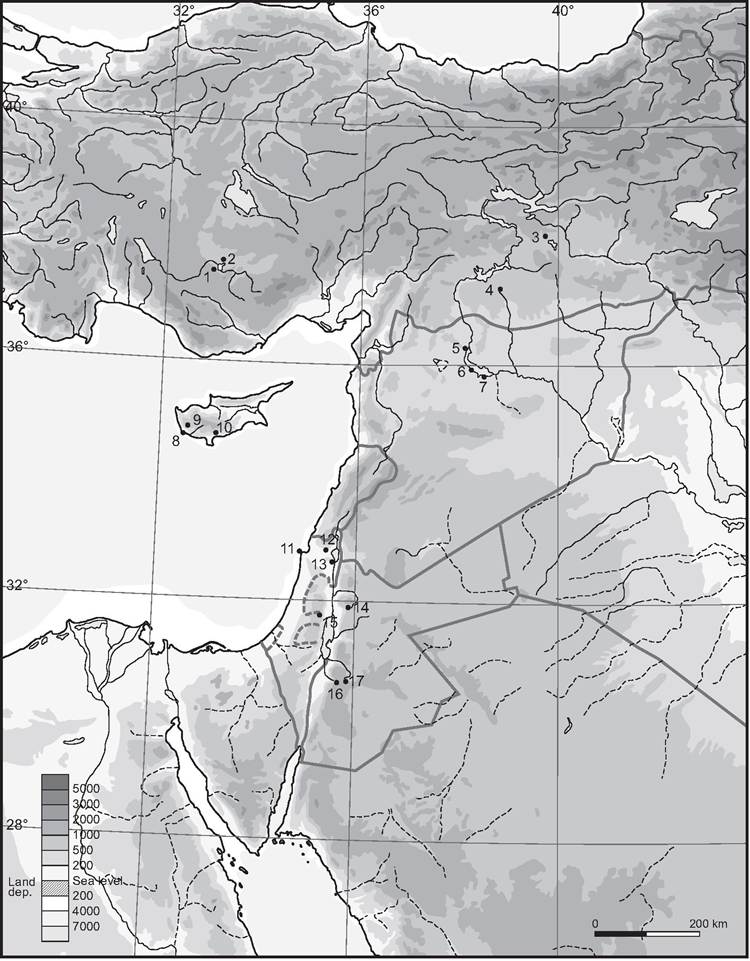
Map 8.i Near East showing principal archaeological sites mentioned in Chapter 8: 1. Suberde; 2. Catal; 3. Cayonu; 4. Godeckli; 5. Jerf el Ahmar; 6. Mureybat; 7. Abu Huyera; 8. Mylouthkia; 9. Ais Yiorkis; 10. Shillourokambos; 11. Atlit Yam; 12. Kfar Hahoresh;
i3.
Shar HaGolan; i4. Ain Ghazal; i5. Jericho; i6. Wadi Feinan; i7. Ghwair I.most thoroughly studied in this region. One reason for this is that much of Western culture derives from the Near East, so much of the early development of European and American archaeology focused on this area. My usage of ‘Near East' in this chapter is a broad one, and includes the intensively studied Levantine region, as well as Mesopotamia and Anatolia, or modern Iran, Iraq, and Turkey.
I use the term ‘Neolithic' as follows. It is defined by both a timeframe and similarities in material culture. The definition, however, becomes a bit fuzzier after chronology and material culture. For example, my conception of ‘Neolithic' can include people who largely remained hunters and gatherers economically, but adopted Neolithic material culture and interacted with villagers. This is reflected, for example, in arid parts of the southern Levant, where some Neolithic peoples were mobile hunter and gatherers, at least part of the year.[387] While these ‘marginal' Neolithic people were present, however, the bulk of Neolithic populations lived in permanent villages and subsisted largely on humanly manipulated resources.
In this chapter, I provide an overview of the Near Eastern Neolithic in the context of several co-related themes: environment and climate, Near Eastspecific theories on the Neolithic, the economic nature of the Neolithic, issues of sedentism and the nature of the first villages, trends in material culture, newly developed social orders, regional cores and the expansion of the Neolithic, consequences of Neolithic lifestyles, and contemporary and future research trends. Before addressing these themes, however, a few words are necessary on terminology and chronology.