1956
CAROLE HNK
It is impossible to reduce, or at least to hold a distant country against the wishes and efforts of its inhabitants.
Edward Gibbon, The Decline and Fall of the Roman Empire, Vol.
4.Herein lies the tragedy of the age... that men know so little of men.
W. E. B. Du Bois, The Souls of Black Folk
One date or year can never encompass the complex political, social, economic, cultural, and intellectual transformations that comprise human history or the even more intricate developments in medicine, science, technology, climate, and the environment. Nonetheless, certain dates resonate in human consciousness, signifying important moments of political disjuncture that affected large numbers of people and afterwards served as markers of their legacy. In the Cold War era 1956 was such a year, and it indeed had a global impact.[552]
Two striking events are associated with 1956: the Soviet repression of the Hungarian Revolution and the abortive Anglo-French-Israeli campaign in Suez. These nearly simultaneous episodes are also linked to other momentous developments: The upheaval in European communism was accompanied by the onset of the Sino-Soviet split and the transformation of global Marxist movements. The Suez crisis not only drew the US and the Soviet Union more deeply into the Middle East but also underlined the oil factor in international affairs and the growing nuclear danger. And the Franco- British withdrawal from Egypt accelerated the decolonization of Africa and Asia but also the decision by six West European governments to create a Common Market.
Hungary
Within six months of Joseph Stalin's death in March 1953 the Communist Party of the Soviet Union had a new leader, Nikita Khrushchev. After gaining control over the party machinery and vanquishing his political rivals, Khrushchev set a new course for the USSR in order to reduce its political, financial, and military burdens.
In 1955, in spectacular displays of conciliation, he made an expiatory pilgrimage to Belgrade and reestablished relations with Yugoslavia whose leader, Josip Broz Tito, Stalin had failed to topple in 1948. That year Khrushchev also took three substantial diplomatic steps, agreeing to the withdrawal of Allied forces from Austria in return for that country's permanent neutrality, the return of Soviet captured bases to China and Finland, and the establishment of diplomatic relations with the Federal Republic of Germany, including the repatriation of the remaining 10,000 German prisoners of war still held in the Soviet Union. At the Geneva Big- Four conference, ten years after the last Allied summit in 1945, Khrushchev uttered the words “peaceful coexistence.”[553]More surprises awaited in 1956. Shortly after midnight on February 25 Khrushchev shook the communist faithful with his four-hour-long “Secret Speech” to the 20th Party Congress of the Soviet Union, the first such gathering since Stalin's death. In grim detail he denounced the dictator's crimes: the self glorification and the cult of the individual that violated Leninist principles of collective leadership; the terror tactics toward his enemies; the ruinous errors during the Great Patriotic War; the hideous postwar purges; and Stalin's “suspicion and haughtiness [toward] whole parties and nations.” Circulated almost immediately, the revelations by one of Stalin's former intimates suddenly stirred hopes for greater freedom in Eastern Europe.[554]
The Soviet empire in Eastern Europe had been a prime cause of Cold War friction. During the early years the West had contested the denial of freedom to people beyond the USSR's borders, first through diplomatic means and undercover agents, then with a barrage of propaganda through Voice of America, Radio Free Europe, and the BBC.[555] But by 1953 US leaders
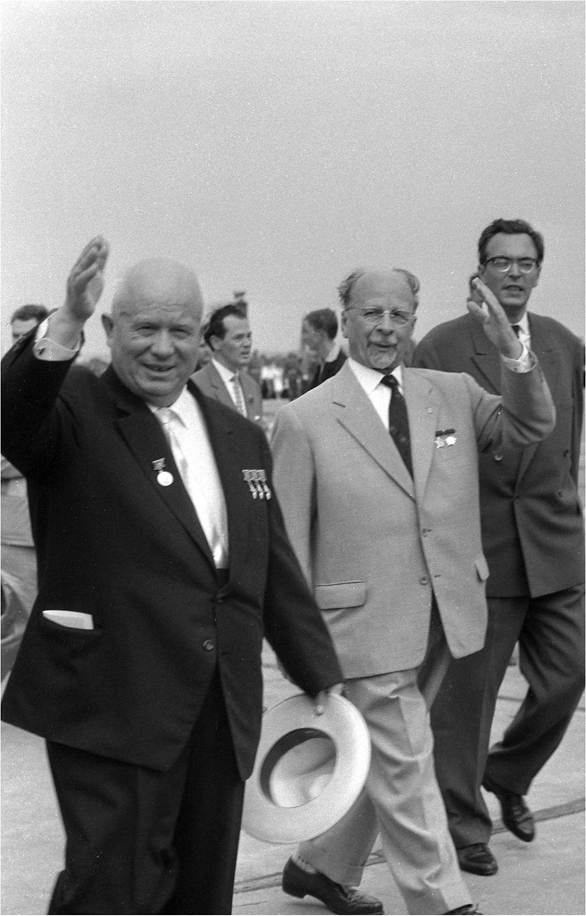
Figure 15.1 Arrival of Nikita Sergeyevich Khrushchev, Soviet politician and General Secretary of the Central Commitee of the Communist Party of the Soviet Union, at Schonefeld Airport on a visit to the German Democratic Republic in 1963 (© Interfoto / Alamy)
recognized that Moscow's possession of nuclear weapons made any change in the European status quo unlikely.
The Kremlin was the overwhelming master of Eastern Europe, with troops on the ground in Poland, Hungary, East Germany, and Romania and thousands of military and political “advisors” stationed throughout the region. Through the Cominform (The Communist Information Bureau, founded in 1947) Moscow managed the affairs of foreign fraternal parties, and through Comecon (The Council for Mutual Economic Assistance, founded in 1949) it coordinated the economies of Eastern Europe with the Soviet Union's. The 1955 Warsaw Pact (the Treaty of Friendship Cooperation, and Mutual Assistance, the Kremlin's response to West German rearmament) established tight control over its seven small dependents from the Baltic to the Black and Adriatic seas.[556]
Khrushchev's secret speech in February 1956, accompanied by a relaxation of party supervision over East European artists and intellectuals, the dissolution of the Cominform in April, and Tito's invitation to Moscow in June, hinted at an overall loosening of the Kremlin's control over its satellites. However, the Soviet leader had no intention of encouraging independent initiatives. Despite his reference in February 1956 to “many different paths to socialism,” Khrushchev lectured his Yugoslav guest on the priority of Leninist principles and brandished Soviet economic power in an attempt to win Belgrade back to a “unified communist camp.”[557]
The first demonstration of Khrushchev's methods occurred in Poland. In response to the massive anti-Soviet demonstrations in Poland between June and October and the return of Wladislaw Gomulka (whom Stalin had earlier deposed) Khrushchev initially decided on a Soviet military strike. However, he backtracked in return for Gomulka's assurances that the existing communist power structure in Warsaw would remain intact and that Poland would remain a loyal member of the Soviet bloc.[558]
The Hungarian revolution of 1956 posed an existential problem for Khrushchev by challenging the principles of Stalin and Lenin.
By mid October Hungary's massive anti-Soviet demonstrations led by workers, students, soldiers, and writers had led to the disintegration of communist control. The newly appointed Prime Minister Imre Nagy, a moderate party man who lacked Gomulka’s political agility, was swept along by the revolutionaries. At first, Khrushchev was inclined to withhold the use of force until Nagy suddenly announced a multiparty system and Hungary’s withdrawal from the Warsaw Pact.[559]The danger to Moscow was clear. A liberated Hungary, ruled by noncommunists and with an independent army, threatened to create a physical wedge in the Soviet Union’s East European empire, the “first domino” that could encourage imitators and even menace the homeland.[560] It would also provide the “imperialists” with a valuable propaganda victory, especially at the very moment when the Israelis, British, and French were threatening Khrushchev’s client Egypt. Indeed, the Anglo-French bombardment of Egyptian air bases on October 31 provided valuable cover for Khrushchev’s fateful decision.[561] [562]
There were also strong political and personal reasons why the wavering General Secretary opted for a military intervention: Facing Khrushchev was a Politburo, KGB, and military leadership that would undoubtedly hold him responsible for the loss of Hungary because of his de-Stalinization campaign and his vacillation during the crisis.11 Moreover, the former party chief in the Ukraine had scarcely shrunk from using force in the past. Thus, with the support of the Kremlin’s hard-line majority and the assent of Mao, Tito, and even Gomulka (all recognizing the peril to communism’s as well as their own future) Khrushchev decided on the night of October 31 to intervene militarily, reestablish reliable communist rule, and maintain Soviet troops in Hungary.[563]
It was a pyrrhic victory. By crushing the Hungarian revolt, the Soviet Union preserved Stalin’s conquests in Eastern Europe for more than three decades, but the price was substantial.
The casualties were high: some 640 Soviet soldiers were killed and 1,251 wounded. On the Hungarian side 2,000 died, tens of thousands were wounded, some 35,000 were arrested, 22,000 incarcerated, and 200 executed (among them Imre Nagy in 1958), and over 200,000 people (2 percent of Hungary's population of 10 million) fled the country.13 Not only was Khrushchev's stature greatly diminished at home and abroad; but he also forced his country to assume the economic and political burdens of pacifying millions of resentful Hungarian and other East European subjects through continued military occupation and the institution of “goulash communism” - a less austere, more consumer-oriented economic regime - while the USSR was embarking after 1956 on a costly nuclear and global competition with the West. In the meantime the emerging “thaw generation” in the Soviet Union - imprinted with Khrushchev's denunciation of Stalin and his “spasmodic reformism,” leading to better food, housing, wages, and social services - would now express rising expectations and a diminution of their parents' Socialist fervor.148
9
10
11
12
The Western public reacted strongly to the news from Hungary. Eleven years after the end of World War II the images of Soviet tanks crushing a popular uprising in one of Europe's ancient cities received wide coverage in the press. (To be sure, the prevailing Cold War mindset prevented most Western observers from drawing comparisons between Soviet control over Eastern Europe and Western imperialism in North Africa, the Middle East, Asia, and Africa and the US sphere of influence in Latin America.) In Western Europe, where intellectuals decried the straitjacket of the Cold War, the nuclear threat, and the growing Americanization of their economies and culture, Khrushchev's revelations about the show trials and the gulags followed by Soviet repression in Hungary served as a reminder that the world behind the Iron Curtain was far more dismal.
In a taunt to disillusioned radicals, the French political philosopher Raymond Aron declared in October 1956 that the Soviet Union was merely a “long-term despotism” that was doomed to fail.15The bloodbath in Hungary ostensibly delivered a propaganda victory to the United States, which promptly admitted some 35,000 Hungarian refugees. Yet Washington, which for several years had officially preached “rollback” in
Eastern Europe and whose paid radio broadcasters in Central Europe had until the last moment imprudently encouraged the revolutionaries' belief that outside support was imminent, had also suffered a political and moral defeat.16
Dwight Eisenhower, the architect of D-Day in 1944, preferred peace in Europe over confrontation. In the final days of his second presidential campaign and in the midst of the agonizing Suez imbroglio involving two of his closest allies, the president made it clear that America was unwilling to risk a nuclear war over Hungary. Indeed, prior to the Soviet invasion Washington had sent reassuring signals to Moscow and declined to raise a ruckus in the UN. After the revolt was crushed and his reelection sealed, Eisenhower combined expressions of sympathy for the Hungarians' plight with an open acceptance of a divided and stable continent, thus dispelling the myth of liberation and moving toward detente in Europe.17
One major Cold War problem - the question of a divided Germany - remained outside the headlines in 1956. One year earlier, Khrushchev had faced the disagreeable faits accomplis of the Federal Republic's entry into NATO and its imminent rearmament. Cornered at the Geneva summit meeting, Soviet negotiators had rejected a US proposal for all-German national elections and NATO membership, even accompanied by security guarantees and a demilitarized zone. Confronted with the ruin of Stalin's hopes for a neutral, demilitarized Germany similar to Austria, Khrushchev at the end of 1955 made a fateful decision: impulsively, he committed the Soviet Union to preserving the independence and survival of East Germany (which Stalin had considered merely a Cold War bargaining card), thereby saddling Moscow for more than three decades with the burden of propping up a weak and unpopular but an also economically valuable regime. Moreover, the Berlin problem - the status of the divided former Reich capital lying one hundred ten miles inside the GDR - would strain East-West relations for another fifteen years.18
Nonetheless, after 1956, the Cold War in Europe did moderate in at least one regard. The ideological confrontation became less aggressive. The doctrine of peaceful coexistence, repeated by Khrushchev at the 20th Party Congress in February 1956, facilitated cultural exchanges between East and West.19 Westerners gradually discovered the films, literature, music, art, and scholarship from behind the Iron Curtain, while Soviet and East European citizens, increasingly exposed to Western visitors and ideas, continued to hope for a less repressive, more humane socialism.20
Outside Europe Khrushchev's tumultuous 1956 had a profound effect on Sino-Soviet relations. The Chinese leader, Mao Zedong, who had chafed under Stalin's “Janus-faced” policies during the Korean War and what he considered the Soviets' ungenerous economic and military assistance afterwards, had determined to strike a more independent course. Thus, China in 1954 concluded a pact with neutral India based on “The Five Principles of Coexistence” among nations with different social systems (Pancha Shila),21 and one year later secured an important invitation to the Bandung Conference, where foreign minister Zhou Enlai began wooing the nonaligned states.22
Sino-Soviet relations had undergone a brief rapprochement in 1954, marked by their cooperation during the July Geneva Conference on Indochina, and followed a month later by Khrushchev's visit to Beijing to celebrate the PRC's fifth anniversary bringing generous economic and political concessions. But they cooled one year later. Mao, fearful of Soviet competition in the nonaligned world, was also deeply suspicious of Khrushchev's foreign policy, fearing concessions to the West at China's expense in the name of peaceful coexistence. And Khrushchev, like Stalin, had little sympathy for Mao's obsession with “liberating” Taiwan at the risk of antagonizing Washington.23 The leaders of the world's two communist giants were also mismatched partners. Mao in 1954 had deemed his Soviet guest boorish and unintelligent, and Khrushchev, baffled by Mao's ideological rigidity and his “oriental” court, returned to Moscow convinced that a conflict with China was “inevitable.”24
19 Yale Richmond, Cultural Exchange and the Cold War: Raising the Iron Curtain (University Park: Pennsylvania State University Press, 2003).
20 Zubok, Failed Empire, pp. 167-73; James H. Satterwhite, Varieties of Marxist Humanism: Philosophical Revision in Postwar Eastern Europe (University of Pittsburgh Press, 1992).
21 Mutual respect for territorial sovereignty, mutual non aggression, mutual nonintervention in internal affairs, equality and mutual benefit and peaceful coexistence.
22 Lorenz M. Luthi, The Sino-Soviet Split: Cold War in the Communist World (Princeton University Press, 2008), pp. 36-40.
23 Odd Arne Westad,“The Sino-Soviet Alliance and the United States,” in Odd Arne Westad (ed.), Brothers in Arms: The Rise and Fall of the Sino-Soviet Alliance, 19451963 (Stanford University Press, 1998), pp. 170-171.
24 William Taubman, Khrushchev: The Man and His Era (New York and London: Norton, 2003), p. 337. The CIA had made the same prediction a year earlier: Phillip Bridgham, Arthur Cohen, Leonard Jaffe, “Mao's road and Sino-Soviet Relations: a view from Washington, 1953,” China Quarterly 52 (Oct. 1972), 670-698.
After February 25, 1956, the Chinese leadership carefully scrutinized Khrushchev's Secret Speech, which was surprising only in its depth and detail. As a theorist Mao was appalled by Khrushchev's tampering with the essential tenets of Marxism. Even more disturbing was his attack on Stalin's personality cult and his record of economic and military blunders. As a former target of Stalin's arrogance, Mao readily acknowledged the boss [vozhd]'s “big mistakes”; but he also insisted on the dictator's “meritorious achievements” and the risk of demolishing him “at one blow.” Mao could well construe Khrushchev's denunciation of Stalin as handing a weapon to his Chinese Communist Party rivals who were insisting on reviving Lenin's principle of collective leadership.[564]
The uprisings in Poland and Hungary, testing Khrushchev's vow to end Stalin's domination of fraternal governments, drew Beijing into European affairs. In the case of Poland, Mao firmly opposed a Soviet invasion, although there is no hard evidence that Khrushchev's last-minute reversal was influenced by China's stance.[565] Hungary was another matter. Mao, far less informed of the situation on the ground in Budapest, apparently wavered before agreeing to the intervention. Although China's role in Soviet decisionmaking cannot be determined with certainty, Mao's participation underlined his influence in the communist camp.[566]
The events in Eastern Europe confirmed the Chinese leader's growing disdain for Khrushchev - for his bungled de-Stalinization campaign that had confused communists in Eastern Europe and for his erroneous assessments of events in Poland and Hungary that had intensified both crises. Although still too weak to challenge Moscow's leadership of the communist world or openly criticize its detente efforts toward the West, the Beijing government had nonetheless by the end of 1956 embarked on a road to distance itself ideologically and politically from the Soviet Union. This decision was underlined a year later when Mao abruptly cancelled the program to liberalize China's political climate under the slogan “Let one hundred flowers bloom and a hundred schools of thought contend.”[567]
The year 1956 was also a tumultuous one for the world's Marxist faithful. To be sure, Khrushchev's catalogue of Stalin's crimes did not diminish the loyalty of communist parties in Japan and Mexico, but it split parties in Latin America. The eighty-eight-year-old African American political philosopher W. E. B. Du Bois remained an admirer of Stalin for having established “the world's first socialist state,” for breaking “the power of the kulaks,” and for “conquer[ing] Hitler.” Although regretting the excesses of Stalin's last years (“He was not the first tyrant in the world and will not be the last”), Du Bois in July 1956 pronounced Khrushchev's criticisms “irresponsible and muddled,” the Soviet state “great and progressing,” and the upheaval in Poland due to “the old landlord and military clan bribed by the United States.”[568]
Closer to home, however, European communists faced the massive negative reaction to Stalin's crimes and to the bloodbath in Hungary. The Comintern veteran Palmiro Togliatti, himself a victim of Stalin's Cold War political maneuvers and also the leader of Italy's second largest party, now coined the term “polycentrism” to characterize his virtual independence from the Kremlin, thus facilitating his party's electoral success two years later.[569] On the other hand French Communist leader Maurice Thorez, who had been closely tied to Stalin, denigrated Khrushchev's campaign but also stayed loyal to Moscow, causing a major split in the party precisely as it faced another major crisis over its stance vis-a-vis France's colonial war in Algeria.[570]
Khrushchev's call for coexistence sent shock waves everywhere, restraining communist militants in Asia, Africa, and Latin America and quenching their efforts at sabotage, subversion, and armed action. Khrushchev's endorsement of a hybrid form of “non-capitalist” development in countries such as Indonesia, India, Burma, Iran, and Egypt dispirited their struggling communist movements; his call for an alignment with bourgeois-nationalist forces in the anti-imperialist struggle eroded the independence of African communists; and the looming Sino-Soviet split forced the North Korean and North Vietnamese communists into a delicate balancing act between Moscow and Beijing.[571]
Communist movements survived the shocks of 1956 in places unanticipated by either Khrushchev or Mao, some aligning themselves with nationalist movements (Iraq) and others with rural workers (Brazil).[572] A key country was South Africa, where in 1955 the communist party had fully endorsed the Freedom Charter calling for equal rights for all races under a welfare state democracy. Nelson Mandela who, on December 5, 1956, along with one hundred fifty African National Congress leaders was arrested on charges of high treason based on allegations of a “communist conspiracy,” was no leftwing radical. Yet he upheld Marxism's “sociological constructions,” valued its “conceptual vocabulary,” and appreciated the South African communists' collaboration in working to create a democratic non-racial South Africa.[573]
Another unforeseen development in Cold War history occurred in America's backyard, where two years earlier Washington had toppled a left-wing government in Guatemala and restored that country as a compliant neighbor. On December 2, 1956, eighty-two revolutionaries, including Fidel Castro and Che Guevara, landed on Las Coloradas Beach in Cuba and launched a military revolt against a corrupt and unpopular, US-supported dictator. Aligning themselves with students and the disgruntled middle class, tapping local nationalism and anti-imperialism, and proceeding to destabilize the Batista regime with a string of battlefield victories, Castro's July 26 Movement triumphed three years later without local or foreign communist support. Only after Washington rebuffed Castro's overtures and Khrushchev applied his Third-World ambitions to the Western Hemisphere did Cuba become a full, if also a costly and difficult Soviet satellite.[574]
The Suez crisis
In 1956, only four years after toppling the corrupt and ineffective King Farouk, Egypt’s second president and virtual dictator, the thirty-six-year-old Colonel Gamal Abdel Nasser, had become a major figure in international affairs. A veteran of the disastrous 1948-49 Arab-Israeli War and the Rhodes armistice negotiations, Nasser once in power had displayed a political ruthlessness and diplomatic acumen that impressed his countrymen and foreigners alike. At home, backed by the army and bureaucracy, this charismatic leader with a gift for stirring crowds had crushed the communist and Muslim oppositions, created a new constitution for Egypt, and launched programs to expand Egypt’s economic and military power. Abroad Nasser had won a string of triumphs, obtaining Britain’s agreement to withdraw its 80,000 troops from the Suez Canal Zone in two years’ time, playing a starring role at the Bandung conference, and defying the West with a spectacular arms deal with communist Czechoslovakia in 1955 and the establishment of diplomatic relations with the People’s Republic of China in 1956.[575]
By 1956 Nasser’s pan-Arab program to unite the Middle East against Western domination had raised alarm in several capitals. In neighboring Israel, Nasser’s imminent acquisition of a major cache of sophisticated weapons from the Eastern bloc - coupled with its increased skirmishes over the past year with Egyptian and Palestinian troops and the rising anti-Israel propaganda from Cairo radio - caused the Ben Gurion government to contemplate a pre-emptive strike. Israel found a kindred spirit in France where the Guy Mollet government was obsessed with Nasser’s support of the Algerian Revolution and intent on toppling the Egyptian leader. On June 26, 1956, representatives of the two countries signed a secret agreement in which France pledged to supply Israel with a significant number of planes and tanks and Israel to assist France in its struggle against Egypt and the Algerian rebels.[576]
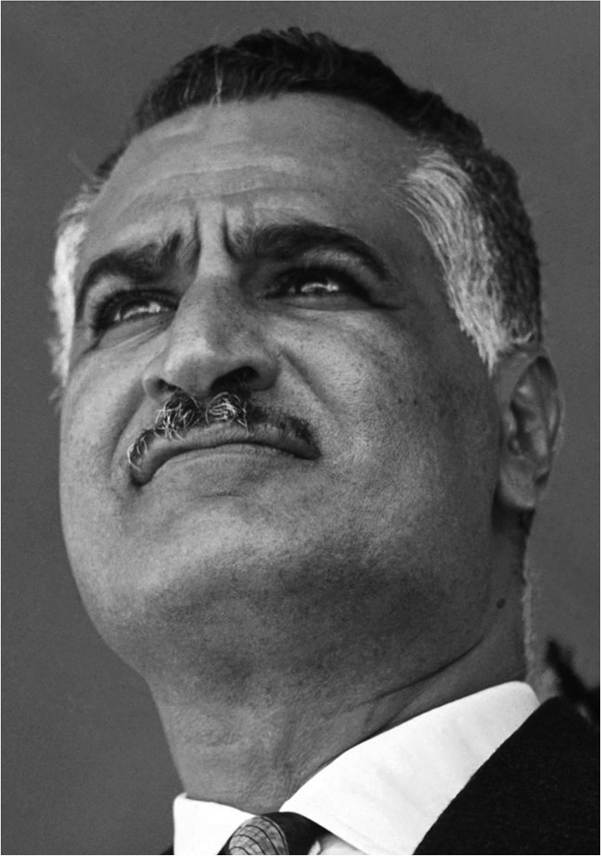
Figure 15.2 Portrait of Gamal Abdel Nasser Hussein, President of Egypt (© World History Archive / Alamy)
British Prime Minister Anthony Eden was no less hostile toward Nasser. Eden, a decorated World War I veteran, staunch anti-appeaser in the 1930s, and newly appointed successor to Winston Churchill, viewed Nasser not only as an uncouth troublemaker who threatened Britain's leading position in Iraq and Jordan but also as an “Arab Mussolini” intent on using Soviet aid to dominate the Middle East and to threaten Western Europe's oil supplies - placing his “thumb on our windpipe.”[577]
The USA and the Soviet Union were ineluctably drawn in. One year earlier, the United States, hoping to gain influence in the largest Arab state, had agreed to a $54 million dollar loan to support the building of the Aswan Dam, a major element of Nasser's campaign to raise Egypt's standard of living. This generous political gesture immediately raised objections in the US Congress and protests from Nasser's Arab rivals.
By the spring of 1956 Eisenhower had grown wary of the Egyptian leader's military dependence on the Soviet bloc, his anti-Western statements, and his hostility toward Israel. Khrushchev on the other hand - despite his nod to non-capitalist development - was absorbed in the tumult in Eastern Europe and skeptical of the dam project and therefore declined Nasser's request to enter a bidding contest with Washington.[578] Suddenly on July 19, an exasperated and suspicious Eisenhower withdrew the US loan and Eden readily vacated Britain's $ 14 million dollar offer as well. One week later a shocked and humiliated Nasser announced the nationalization of the Suez Canal to pay for his massive electrification and land reclamation project, stirring his compatriots, arousing the Arab world, and triggering a prolonged international crisis.[579]
The seizure of the canal, which had opened in 1869 and was administered under a ninety-nine-year lease by the Franco-British dominated Suez Canal Company, had been a longstanding goal of Nasser's.[580] In a stroke, the removal of this last vestige of Western domination placed Nasser in commanding position over the lifeline of Britain's Commonwealth and Empire as well as one of two principal routes of Middle Eastern oil deliveries to the West. With the closure of the Strait of Tiran, he had also gained a chokehold on Israel's maritime ties with eastern Africa and Asia.
The superpowers'[581] responses were a study in contrast. Khrushchev, caught off balance by Nasser's move, neither spread a Soviet diplomatic mantle over Egypt nor offered additional arms, expecting the United States to rein in its allies. Thus during the next three months Eisenhower took the lead, striving to prevent an attack on Egypt which, he was convinced, would destabilize the Middle East and encourage further Soviet moves into the region.[582]
Pitted against the US president were his two agitated NATO partners: France, smarting over the loss of Indochina and the Algerian uprising and with a popular opinion solidly behind punishing Nasser; and Britain, with a divided cabinet and parliament and strong Commonwealth opposition to the use of force but led by an ailing and impulsive prime minister determined to assert his nation's power and protect its oil supply. Under US pressure, France and Britain submitted to two mediating conferences in London in August and September, and in October they made a lame effort to involve the United Nations in establishing international control over the canal. During this three-month period of suspense - while Eisenhower was increasingly absorbed in the November 6 presidential election and Khrushchev in the mounting threats to Soviet control of Eastern Europe - Nasser's enemies had gained time to mobilize.[583]
Israel played a crucial role. For the hawks, Chief of StaffMoshe Dayan and Deputy Director of the Ministry of Defense Shimon Peres, the Suez Canal crisis had created an opportunity to settle scores with Nasser. Prime Minister Ben Gurion, who at first had hesitated out of fear of US or Soviet intervention, was brought over by Israel's acquisition of a long-sought Western ally and the hope of regaining navigation through the Strait of Tiran. In the summer of 1956 France delivered sixty Mystere jets to Israel and on September i, Paris proposed a joint action against Egypt. In early October Eden signed on to Mollet's audacious scheme for an Israeli invasion of Egypt as a cover for an Anglo-French seizure of the canal and the toppling of Nasser, and a secret pact was concluded at Sevres on October 24, 1956.[584]
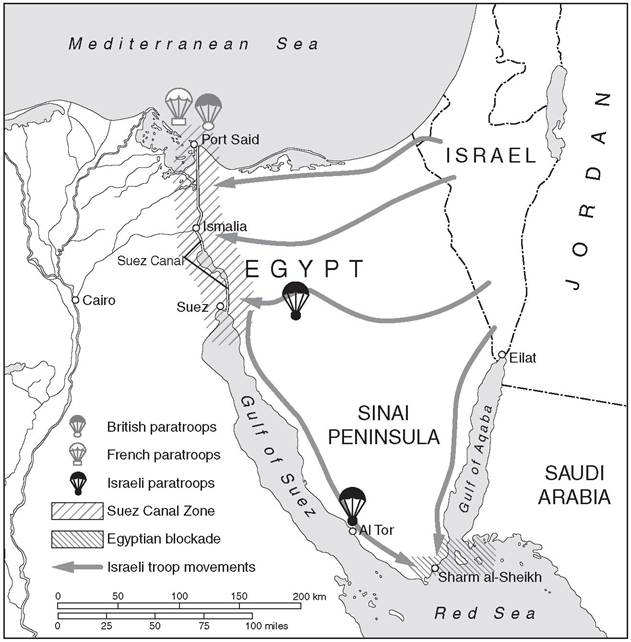
Map 15.i Suez Crisis, 1956
“Operation Musketeer” began smoothly according to the prearranged tripartite plan: On October 29 Israeli paratroops landed in the central Sinai and quickly reached the Suez Canal. One day later Britain and France issued a 12-hour ultimatum demanding that both sides withdraw from the Canal Zone; and when Nasser refused, on October 31 they bombarded Egyptian airfields. After a five-day delay, British and French troops began ground operations on November 5 with the goal of occupying Port Said, Ismaila, and Suez.46 In the
Studies 20/4 (Dec. 1997), 1-17. Avi Shlaim, “The Protocol of Sevres, 1956: anatomy of a war plot,” International Affairs 73/3 (July 1997), 509-530.
46 Ben Gurion, deeply distrustful of Eden and fearing Arab retaliatory air raids, had urged his partners to reduce the delay between the Israeli attack and their intervention and fumed at the delay in Allied bombings and military action. Keith Kyle, Suez (London and New York: I.B. Tauris, 2011), pp. 314, 317, 319-321, 370, 382. meantime Nasser had responded on November ι by blocking the canal with blown-up craft and equipment. During that explosive week a wave of outrage swept the world, almost obliterating the dire news from Hungary.[585]
It was now up to the superpowers. Khrushchev was again taken unaware, having been lulled through October by Nasser’s overconfidence, faulty Soviet intelligence, and his own misjudgment of Eden’s resolve. Once hostilities began, Khrushchev, absorbed by Hungary, ignored Nasser’s pleas for military or diplomatic support, leaving the way open for US management of the crisis.[586]
Eisenhower, far better informed, was furious over his NATO allies’ actions, fearing an opening to Soviet subversion in the Middle East. Although he had acquiesced in the Soviets’ use of force in Hungary, he was determined to halt the aggression against Egypt and to do so before Moscow raised its voice. The scene now shifted to the United Nations. After an Anglo- French veto blocked action by the Security Council, the USA called for an emergency session of the General Assembly which, on November 1, voted 64-5 in favor of an immediate ceasefire.[587] [588] In an extraordinary Cold War moment, Soviet and American aims had become identical.
Both superpowers overplayed their hands. With the Hungarian uprising almost crushed, Khrushchev on November 5 suddenly sprang into action, proposing a joint US-Soviet military force to impose a ceasefire and issuing warnings to Eden, Mollet, and Ben Gurion that the Soviet Union was prepared to use its nuclear weapons to “crush the aggression and to restore peace in the Middle East.” However, Moscow’s threats, meant to impress the Arabs and the neutrals, were too little and too late to prevent the humiliating rout of Egypt’s forces. Khrushchev’s unprecedented proposal of a joint occupation force - bypassing the UN - was snubbed by Eisenhower; and his nuclear bluff compelled the three combatants to bow to Washington’s wishes.59
Eisenhower was outwardly triumphant. On November 6 he easily won a second term, and that day the three belligerents accepted a ceasefire. The United States then took the lead in transporting a UN Emergency Force to Egypt and pressuring the three invaders to withdraw their armies. The last Anglo-French armies were gone by December 22 and the Israeli forces on March 22, 1957.[589] But Washington’s victory was also questionable. Not only had the USA failed to prevent bloodshed over Suez but it had also aligned itself with Egypt and the Soviet Union against its closest allies. Eisenhower's hardnosed pressure on Britain's money and oil supply had humiliated Eden and led to his replacement in January 1957 by the more pliable Harold Macmillan. However, Anglo-American relations suffered a severe shock over the president's high-handed treatment, forcing Washington to alleviate tensions with Britain and reassure other NATO members of US protection and goodwill.[590]
France was even more disaffected, furious over Eden's yielding to Washington's threats and aggrieved by Eisenhower's nonchalance over Khrushchev's saber-rattling. Musketeer's author Guy Mollet also fell from power in May 1957; and the Suez fiasco undoubtedly prepared the way for the reemergence one year later of Charles de Gaulle, a leader imbued with a profound distrust of the Anglo-Saxons and determined to ensure France's national security outside a US-dominated NATO and to build its own nuclear force.[591]
Israel, which in 1956 had taken the battle over the control of Palestine onto its neighbor's territory and demonstrated its military prowess, emerged stronger from the Suez crisis. It now had a French ally willing to supply arms and even nuclear material; and with strong French support it had secured an international guarantee of naval passage through the Strait of Tiran as well as a UN force to protect it against guerrilla raids from Egypt:.[592]
Yet these gains had to be balanced against other outcomes. Given Nasser's record, Egypt's future compliance with the settlement was questionable. Moreover, the exiled Palestinian leadership in Gaza, which had observed Egypt's rout first hand, had become more determined than ever to pursue their goal of national liberation.[593] And, finally, Israel's relations with Washington had soured; following four grueling months of negotiations, Israel had been forced to relinquish the prizes of its stunning victory, Gaza
and the Sinai, and to recognize its minor role in Eisenhower's political calculations.[594] As events in 1967 would demonstrate, Israel was determined to avoid this fate in the future.
Eisenhower's actions in 1956 accelerated the spread of the Cold War into the Middle East. Despite Moscow's exclusion from the Suez settlement, the Soviet threat continued to haunt Washington.[595] Indeed, Khrushchev raised these fears by trumpeting the effectiveness of his nuclear threat and exaggerating his support of Nasser against Western imperialism. OnJanuary 31,1957, he announced a multimillion arms deal with Cairo.[596]
Having dislodged Britain and France from the region, Eisenhower responded in January 1957 by introducing a new policy to “make [the US] presence more strongly felt in the Middle East.” Echoing Truman's commitment to Greece and Turkey ten years earlier, the Eisenhower Doctrine pledged US military and financial aid to Arab countries threatened by the “spread of communism.” Before a skeptical Congress, Eisenhower stressed the need to fill the vacuum left by the imperialists' departure from a major center of the world's oil supply. With this initiative Eisenhower continued the expansion of presidential power and also downgraded the importance of the United Nations in US policy. Implicitly, too, his administration had shifted its Middle East policy focus, abandoning its efforts to solve the seemingly intractable Arab-Israeli problem in favor of improving US relations with the oil-rich Arab countries.[597]
The local responses to the Eisenhower doctrine were predictably swift and largely negative. Israel bristled over its exclusion from the US guarantee, Syria suggested that Washington stay out of the region's problems, and Nasser dismissed it as a new version of Western penetration. Only Iraq, the sole Arab member of the increasingly hollow Baghdad pact, hailed the president's announcement; but three years later, after a military coup had toppled the pro-Western monarchy, Iraq too joined the anti-imperialist
60
camp.
Neither superpower would gain full control over the Middle East. Washington, obsessed with blocking Moscow's threat to NATO's weak southern flank, overestimated the Arabs' fear of communism and underestimated their nationalism, their regional rivalries, and their hatred of colonialism and of Israel. Moscow, fixated on securing a foothold in a strategically important region of the nonaligned world, overestimated its resources and its influence over the Arabs and underestimated the US resolve to replace Great Britain. The Suez crisis had demonstrated the readiness of Middle Eastern actors to use the superpowers but also the latter's insufficient knowledge and understanding of the region's populations and politics.[598] [599]
The impact of Suez
Oil as a factor in international affairs
Nasser's nationalization of the Suez Canal in July 1956 raised the nightmare of a rupture in the West's oil supply. Through this waterway traveled almost 20 percent of the world's oil production from the Middle East to a Western Europe that was consuming increasing quantities of petroleum.[600]
The invasion of Egypt produced the predictable crisis. Not only was the canal abruptly closed for shipping but a day later Syria broke off diplomatic relations with Britain and France whereupon the pipeline carrying oil from Iraq to the Mediterranean was disabled when three Syrian pumping stations were blown up by the Syrians. On November 6 Saudi Arabia also broke off diplomatic relations with the aggressors and banned tankers from carrying its oil to Britain or France. Everything now depended on the United States, still a major oil producer and exporter as well as home to five of the seven multinational oil companies. An incensed Eisenhower added to the pressure on Britain and France, refusing to relieve the mounting oil shortages (and currency drain) until their armies withdrew.[601]
Although the Western world's first oil scare in 1956 presaged the future crises in 1967,1973, and 1979, it had little impact at the time. Once Britain and France had caved in, the United States helped ease the delivery problem from its own sources and from Latin America. Moreover, an unusually warm winter in Europe in 1956-57 softened the impact of reduced supplies. Higher prices reduced consumption, and the major oil companies worked cooperatively to end the crisis. By March 1957, the canal had been cleared, the pipelines repaired, and rationing ended in Western Europe. Subsequently worldwide oil production increased dramatically, and prices returned to their low, pre-crisis levels. Although Anglo-American oil cooperation had resumed, US companies were in the process of eroding British sway in much of the Middle East and North Africa.[602]
Nonetheless the specter of future oil shortages that could threaten the West's security, disrupt its economies, and bring hardship to its populations had now presented itself in 1956.[603] Moreover, although recognizing the necessity of closer collaboration among governments and the oil industry, the West made no serious preparations for future crises.
The nuclear danger
Khrushchev's nuclear threats in November 1956 against Britain, France, and Israel were the first ever issued by a Soviet leader. They occurred at a moment when both superpowers were expanding their arsenals, delivery systems, and placement of their nuclear weaponry.
Khrushchev's bluff was also the threat of an underdog. The United States still held a clear superiority in strategic weapons, its nuclear bombs and long- range bombers outnumbering the USSR by a ratio of approximately 11:1.[604] Moreover, the United States had encircled the Soviet Union with a chain of bases housing its Strategic Air Command bombers that included 1,000 B 47s, 150 B52s, and 250 B36s and were complemented by a worldwide fleet of US aircraft carriers capable of launching long-range bombers from practically everywhere. Thus in 1956 the Soviet Union was vulnerable to a massive US first strike or a retaliatory attack, while the US was still sheltered by numbers, distance, and a superior detection system.[605]
Khrushchev was determined to overcome the Soviets' inferiority. Alongside his calls for peaceful coexistence came not only a buildup in Soviet bombs and bombers but also the rapid development of intercontinental ballistic missiles. With the appearance of Sputnik in 1957, thrust into space by advanced long-range Soviet rocketry, the US mainland suddenly became vulnerable to attack, and America's civil defense programs were rapidly expanded.[606]
Europe stood precariously between the two superpowers; and here the Soviet Union held the decisive edge. Khrushchev's threats in November 1956 and Eisenhower's bland response had exposed the vulnerability of Western Europe. Despite the latter's growing economic strength and the turmoil in the Soviet bloc, the Warsaw Pact's ground forces - which outnumbered NATO's by a ratio of some 6:1 - could not be stopped before they reached the Rhine, even with the use of tactical nuclear weapons. Moreover, few West European leaders believed that the USA would expose itself to retaliation by launching a nuclear strike against Moscow.[607]
The crises of 1956 affected the strategic and political debate over nuclear arms. As the superpowers raced to expand their nuclear delivery systems and plant nuclear weapons throughout Europe, a backlash also developed against atomic warfare that gave rise to citizens' antinuclear movements throughout the world.[608]
By 1957 both sides had acquired enough weapons to destroy the other.[609] That year the Anglo-Australian Neville Shute's novel On the Beach captured world attention with its gripping portrayal of the aftermath of a nuclear apocalypse.
Decolonization, the Third World, and the Cold War
The Anglo-French debacle in Suez hastened the worldwide process of decolonization. Indeed, the British Commonwealth, a nine-member global body[610] that had been created to bolster British power by turning former colonies into strategic allies, almost collapsed during the crisis. Not only did Eden fail to convene the nine or take their leaders into his confidence, but the group itself was deeply divided. Pakistan, Australia, and New Zealand endorsed British toughness; India opposed the use of force; and Canada played the role of conciliator.[611]
Moreover, there were already cracks in European imperialism. Following World War II the French and British had withdrawn from Syria, Lebanon, Palestine, Iraq, and Jordan. In Asia, the Philippines had gained independence from the United States and India from Britain. After a bloody conflict, the Dutch left Indonesia in 1949 and the French were forced out of Vietnam in 1954. Prior to Suez, the French had granted independence to Morocco and Tunisia, and Britain had left Sudan and was preparing to grant independence to Ghana in 1957.[612]
The striking exceptions were Algeria and Kenya, two strategically important possessions and with a substantial number of European inhabitants. France was determined to crush the revolt in Algeria, which began in 1954 and two years later had spread to the entire country, including its urban areas. The Algerian struggle for independence had also gained international attention, brought before the United Nations by the Soviet bloc and Third World governments and threatening a rift in the NATO alliance. In Kenya Britain was confronted with a four-year-old uprising that it suspected had communist backing; and in 1956 it unleashed an all-out military effort to suppress the guerrilla movement. However, both countries' military campaigns, which were costly and politically divisive, ended with pullouts, the French from Algeria in 1962 and the British from Kenya in 1963.[613]
Another complex colonial site was Indochina, where France had been soundly defeated in the battle of Dien Bien Phu and was preparing to withdraw. At the Geneva Conference on Indochina in 1954 Laos and Cambodia became independent.[614] But Vietnam - with Sino-Soviet acquiescence and contrary to the wishes of the nationalist leader Ho Chi Minh - was temporarily partitioned into the (communist) Democratic Republic of Vietnam in the north and a non-communist government in the south. National elections were to be held in July 1956 with the aim of unifying the country.
The elections were never held. On the eve of the Suez crisis South Vietnam's president Ngo Dinh Diem, with his US backer's compliance, refused to participate and proceeded to consolidate his regime. Three years later, when an insurgency erupted in the south (supported by North Vietnam) the Eisenhower administration sent weapons and advisors to prevent the communist domination of all of Vietnam, which ostensibly threatened the rest of Southeast Asia, thus beginning direct US involvement in the region.[615]
In the meantime, much of the Third World was attempting to escape the Cold War.[616] [617] At the 1955 Bandung Conference the delegates had not only endorsed the goal of ending colonialism but also of resisting both US and Soviet domination. Their host, Indonesian president Sukarno, had greeted the representatives of twenty-nine states from Africa and Asia (comprising fifty-six percent of the world's population) with the announcement: “we are united by a common detestation of colonialism, in whatever forms it ∙,∙,79
appears.
The Bandung principles appeared to triumph in 1956. Nasser's selfproclaimed victory - three years after an Anglo-American sponsored coup had toppled Mohammad Mossadegh, who had nationalized Iran's oil industry - was heralded as an achievement of anticolonialism and nonalignment. The Egyptian leader had not only seized the foreign-owned Suez Canal and survived the armies of three invaders, but - ignoring the crucial role of the superpowers - continued to declare his political independence.[618] The United Nations, with its growing number of African and Asian members in the General Assembly and its activist Secretary-General Dag Hammarskjold, was also given a temporary boost in its prestige.[619] And Western European public opinion now shifted dramatically against the use of military action to hold on to empire.[620]
Nonetheless the Suez crisis presaged the future character of global decolonization: the long and costly US-Soviet competition to fill the vacuum left by the departing European powers, with each side drawn in by ideological, strategic, and economic interests. The most difficult arena would be in Africa where, by the end of i960, twenty-five new states had joined the United Nations (representing one-quarter of its membership). The USA, although largely unprepared for the collapse of European power on that continent, was determined to shape the course of decolonization in the world's mineral-rich and strategic regions. Similarly, the Soviet Union had to scramble to win friendly governments in a largely unfamiliar terrain.[621]
The consequences in former colonial regions were devastating. After i956 the struggle for racial equality, economic justice, cultural liberation, and selfdetermination were often subordinated to US or Soviet dictates. Moreover the hopes for non-alignment in the Cold War became a major casualty of the post-Suez environment. In 1957 the Tunisian leader Habib Bourguiba dourly pronounced neutralism a “precarious” stance.[622]
Building Europe
Among the most anxious witnesses to the Suez crisis was West German chancellor Konrad Adenauer. The Federal Republic, NATO's newest member, had declared its neutrality in the war against Egypt; but it had been jarred by the Soviets' brutal repression in Hungary and by Moscow's threats to London and Paris as well as by America's cavalier treatment of its principal European allies. Seizing the moment of his arrival in Paris on November 6, just as the Suez ceasefire was announced, Adenauer was determined to “build Europe.”[623]
The project of European unity had a long history, and it had gained force after World War II with the Marshall Plan and the European Coal and Steel Community as well as the abortive European Defense Community. But for more than a year the Benelux project of a “common market” - involving both economic and nuclear cooperation - had languished because of Franco- German hesitations, France over the future role of its empire and Germany caught in an internal debate over chaining itself institutionally and politically to its economically weaker neighbors.[624]
The Suez crisis was clearly the spur that brought Bonn and Paris together in 1956 in an historic gesture of real and symbolic reconciliation. Adenauer argued that Western Europe, wedged uncomfortably between the two nuclear superpowers, needed to form a counterweight to the Soviet threat and American unilateralism. Mollet, also a convinced European, readily agreed to Adenauer's suggestion of avenging the humiliation of Suez. The Treaty of Rome of March 25, 1957, which brought the European Economic Community to life, grew out of a Franco-German bargain, with substantial concessions to France's overseas territories and a major financial commitment by Bonn; but it was also a clear indication of West Germany's increased role in European affairs.[625]
Suez also cast a shadow over Britain's future role in Western Europe. Eden's successor, Harold Macmillan, was happy to shed London's ties with Paris, seek a closer relationship with Washington, and repair Britain's frayed bonds with the Commonwealth. Already a nuclear power, Britain had no need to share secrets and techniques with the continent. Moreover, it still sent 74 percent of its exports outside Europe, primarily to the Commonwealth, thus diminishing the attraction of submitting to the tariff and political and atomic controls of continental bureaucrats.[626]
With Britain outside, the EEC developed, and with Eisenhower's unwavering support. In 1959 the British created a short-lived rival, the European Free Trade Area. Subsequently, it made two abortive efforts to join the Six. For the next sixteen years Britain's isolation from Western Europe - years of unprecedented EEC prosperity - left the Franco-German duopoly in charge, much to the frustration of the smaller powers which had hoped for more robust supranational institutions.[627]
Conclusions
By the end of 1956 the Cold War had engulfed almost the entire world, pitting the United States and the Soviet Union in a long-term rivalry that outsiders found difficult to escape. But that year there were three books by Nobel-prize authors expressing a more intimate human perspective from the communist, Western, and Third World: Boris Pasternak's Dr. Zhivago, which depicted an idealistic physician-poet crushed by the Bolshevik Revolution (and brought severe reprisals to its author from Khrushchev), Albert Camus' The Fall describing an individual's search for moral responsibility within the political and material forces that dominated Western society, and Naguib Mahfouz's Palace Walk, recounting the erosion of an Egyptian patriarch's stature as his traditional society crumbled under foreign and domestic pressures.
The global Cold War continued for another thirty-three years. The superpowers accelerated their arms race, competed for the allegiance of peoples and governments throughout the world, and engaged in costly proxy wars. But the year 1956 had also set a pattern for the future. The Soviet Union - with Western acquiescence - was able to impose its will on its satellites but unable to prevail over China. The United States replaced Britain and France in the Middle East and thwarted Soviet claims to parity but failed to control the region. The Third World fought for independence and to resist superpower domination. And Western Europe laid the basis for economic if not political unity.
The superpowers tried to reap propaganda rewards from the other's actions in 1956. The United States long trumpeted the repression of Hungary as revealing the true nature of the Soviet regime, and the USSR castigated the Eisenhower doctrine as an expression of US imperialism. Yet despite their rhetoric both sides had exhibited remarkable caution throughout the trials of 1956. Their leaders were prudent men who had experienced two world wars, and their fear of a nuclear catastrophe far outweighed their political adventurism.
In the aftermath of 1956 there was thus little alteration in the US-Soviet relations. Europe remained divided by the Iron Curtain and would remain so for more than three decades, and NATO, although weakened in 1956, survived the shocks of Hungary and Suez and continues to this day. But two transformative events did occur that year: the beginning of the Sino- Soviet rivalry that would change the Cold War, and the emergence of the Middle East - a major source of the world's oil and the center of its transportation and communication networks - as a perilous arena of global politics where the local players would (and still) continue to fiercely resist outside domination.
Further reading
Bracco, Helene. Pour avoir dit non: actes de refus dans la guerre d’Algerie, 1954-1962. Paris: Paris-Mediterranee, 2003.
Fink, Carole, Frank Hadler, and Tomasz Schramm, eds. 1956: European and Global Perspectives. Leipziger Universitatsverlag, 2006.
Furedi, Frank. The Mau Mau War in Perspective. London: James Currey, 1989.
Fursenko, Aleksandr and Timothy Naftali. Khrushchev’s Cold War. New York and London: W.W. Norton, 2006.
Garrett, Stephen A. From Potsdam to Poland: American Policy toward Eastern Europe. New York: Praeger, 1986.
Gati, Charles. Failed Illusions: Moscow, Washington, Budapest, and the 1956 Hungarian Revolt. Washington, do: Woodrow Wilson Press/Stanford University Press, 2006.
Giauque, Jeffrey. Grand Designs and Visions of Unity: The Atlantic Powers and the Reorganization of Western Europe, 1955-1963. Chapel HiIl and London: University of North Carolina Press, 2002.
Golan, Galia. Soviet Policies in the Middle East. Cambridge University Press, 1990. Granville, Johanna. In the Line of Fire: The Soviet Crackdown on Hungary, 1956-1958.
Pittsburgh: The Carl Beck Papers in Russian & East European Studies, Vol. 1307,1998.
The First Domino - International Decisionmaking during the Hungarian Crisis of 1956. College Station, τx: Texas A & M University Press, 2004.
Gyorkei, Jeno and Miklos Horvath, eds. 1956: Soviet Military Intervention in Hungary. Budapest: Central European University Press, 1999.
Hahn, Peter. Caughtin the Middle East: U.S. Policy Toward the Arab-Israeli Conflict, 1945-1961. Chapel Hill: University of North Carolina Press, 2004.
Heinemann, Winfried and Norbert Wiggershaus, eds. Das Internationale Krisenjahr 1956. Munich: Oldenbourg, 1999.
Horne, Alistair. A Savage War of Peace: Algeria, 1954-1962. New York: Penguin, 1989.
Jian, Chen. Mao’s China and the Cold War. Chapel Hill: University of North Carolina Press, 2001.
Kingseed, Cole C. Eisenhower and the Suez Crisis of 1956. Baton Rouge and London: LSU Press, 1995.
Kunz, Diane B. The Economic Diplomacy of the Suez Crisis. Chapel Hill: University of North Carolina Press, 1991.
Kyle, Keith. Suez. London and New York: I.B. Tauris, 2011.
Litvan, Gyorgy et al., eds. The Hungarian Revolution of 1956: Reform, Revolt and Repression 1953-1956. New York: Longmans, 1996.
Louis, William Roger and Roger Owen, eds. Suez: The Crisis and its Consequences. Oxford: Clarendon Press, 1991.
Machcewicz, Pawel. Rebellious Satellite: Poland, 1956. Trans. Maya Latynski. Washington, do: Woodrow Wilson Press/Stanford University Press, 2009.
Morris, Benny. Israel's Border Wars, 1949-1956. Oxford: Clarendon Press, 1993.
Pineau, Christian. 1956/Suez. Paris: Lafont, 1976.
Satterwhite, James H. Varieties of Marxist Humanism: Philosophical Revision in Postwar Eastern Europe. University of Pittsburgh Press, 1992.
Sayigh, Yazid. Armed Struggle and the Search for a State: The Palestinian National Movement, 1949-1993. Oxford: Clarendon Press, 1997.
Tal, David, ed. The 1956 War: Collusion and Rivalry in the Middle East. London and Portland: Frank Cass, 2001.
Taubman, William. Khrushchev: The Man and His Era. New York and London: Norton, 2003.
Wetting, Gerhard. Bereitschaft zu Einheit in Freiheit? Die sowjetische Deutschland-Politik 1945-1955. Munich: Olzog, 1999.
Wittner, Lawrence. Resisting the Bomb: A History of the World Nuclear Disarmament Movement. Stanford University Press, 1997.
Yaqub, Salim. Containing Arab Nationalism: The Eisenhower Doctrine and the Middle East. Chapel Hill: University of North Carolina Press, 2004.
Zubok, V. M. A Failed Empire: The Soviet Union in the Cold Warfrom Stalin to Gorbachev. Chapel Hill: University of North Carolina Press, 2007.