1989 as a year of great significance
NICOLE REBEC AND JEFFREY WASSERSTROM
The fall of communism was as decisive a turning point in modern history as the French or Russian revolutions. In 1989 the Soviet empire in Eastern Europe collapsed; the division of Europe symbolized by the Berlin Wall crumbled...
and more pluralistic, sometimes democratic, states emerged where one-party dictatorships had dominated... hopes were raised, momentarily as it turned out, for a “new world order” without debilitating ideological conflicts.Ronald Suny, “Empire falls: the Revolutions of 1989,” The Nation, November 16, 2009
Twenty years ago... a software consultant... at the European Organization for Nuclear Research (better known as CERN) hatched a plan for an open computer network to keep track of research at [a laboratory]... modestly titled “Information Management: A Proposal” [it] would become the blueprint for the World Wide Web.
“Remembering the day the World Wide Web was born, ” Scientific American, March 12, 2009
Unsurprisingly, the twentieth anniversary of 1989 has added to an already groaning shelf of books on the year... [There are new] retrospective journalistic chronicles... spirited essays... and original scholarly work... Most add something to our knowledge... [And yet] I come away dreaming of another book: the global, synthetic history of 1989 that remains to be written.
Timothy Garton Ash, “1989!” New York Review of Books, Nov. 5, 1989
Before 1989 had even come to a close, it was clear that it would go down in history as a special kind of year, one of significance not just for a country or two, but for the world. Thanks in part to the powerful images that flashed across front pages and television screens, from that of a lone man standing up to tanks in Beijing in June to those of crowds cheering and lending their hands to the dismantling of the Berlin Wall in November, it seemed destined to be the sort of year whose tenth and twentieth anniversaries would be marked.
And this is just what happened in 1999 and again in 2009, the year when the works containing all of our opening quotations and many others reflecting on 1989 were written. Both of those anniversaries that have passed inspired backward looking books, special issues of journals, documentaries, and media commentaries in print and also, thanks in part to what was done at CERN in 1989 itself, in online venues.1 It seemed by the time that 1989 ended that it might even join the very select ranks of years whose centennials and even bicentennials are commemorated.If it does get commemorated in 2089 and 2189, it will not be the first year that ends with the digits 8 and 9 and is associated with revolution that gets such attention, as that distinction is already claimed by 1789. In 1889, to mark the passage of one hundred years since the French Revolution, a great World's Fair was held in Paris, at which many countries displayed their products and for which Eiffel built his famous tower.[628] [629] In the year that interests us here, that same city hosted a lavish bicentennial parade, which again marked a national anniversary in a decidedly international way. Leaders from around the world came to France; marchers from many lands paraded. One notable thing that reinforced the idea that 1989 might join 1789 as a special sort of revolutionary year was the inclusion in that Paris march of a group of Chinese activists-in-exile who had come to France to seek refuge after the June 4th Massacre, which had put an end to the protest struggle that had brought massive crowds to Beijing's Tiananmen Square and seemed for a time to have the potential to push the Chinese Communist Party to make major political reforms.[630]
It is still much too early to tell if 1989 will actually inspire important centennial let alone bicentennial rituals, but a quarter-of-a-century on, we can say that there has been no abatement of the strong initial sense that 1989 was an unusually important year.
Many other late-twentieth-century years have had their champions ready to assert that they should be considered special and momentous. This is true of 1956, the subject of a chapter in this volume. It is true as well of 1968: a year that, like 1989, saw far-flung protests, including some that challenged Communist Party rule.As if those two clear rivals were not enough, as we began preparing to write this chapter in mid 2013, we became aware of two far less obvious rivals for the distinction “biggest year in world history since 1945,” to borrow a phrase that Timothy Garton Ash has employed to refer to 1989.4 First, we came across an old newspaper article, published a full twelve months before the Berlin Wall fell, which argued that an epochal shift had just taken place. No less an eminence than former Carter White House National Security Advisor Zbigniew Brzezinski suggested that 1988 would “turn out to be as upsetting of the old order of things as was the year 1848.” Why? Because it had witnessed a shift from a postwar era dominated by rivalry between the USA and the Soviet Union and start of a “post-postwar” period of new tensions and relationships.5 In an article introducing and assessing Brzezinski's argument, the Christian Science Monitor highlighted several factors, from the rising economic clout of Japan to a China that “had become a factor in everyone's calculations,” that had shifted the status quo. It was also no longer possible to take “for granted” in 1988, the article said, foreshadowing events of 1989, “that Moscow would enforce the Brezhnev doctrine (once socialist, always socialist) against any satellite which tried to break away.”6
horrific bloody crackdown are merely propaganda without a factual basis. An early and still important discussion of the latter fact and why it matters, which also stresses that workers and members of many social groups, as opposed to mainly or exclusively students, were killed by troops is Robin Munro, “Who died in Beijing, and why,” The Nation, June ii, 1990, 811-822.
4 Timothy Garton Ash, “1989 changed the world. But where now for Europe?” Published in the Guardian, November 4, 2009.
5 This was not a completely unprecedented claim in terms of an end to a world oriented around a single Moscow-Washington divide. In the 1970s, spurred by the end of Bretton Woods, the spread of atomic weaponry to more countries, and China's increased independence from the Soviet Union, some people had begun to talk of a move beyond the bipolar structures of the Cold War having taken place.
6 Joseph C. Harsch, “Welcome to the ‘post-post-war' era: US-Soviet rivalry no longer dominates, as other states increase roles,” Christian Science Monitor, October 21,1988: www. csmonitor.com/1988/1021/opat2i.html/(page)/2 (last accessed July 10, 2013).
While still digesting that counter-intuitive assertion of 1988’s importance, we learned of a major just-published book that makes a comparable year- that-changed-it-all claim for 1979. Written by Christian Caryl, this revisionist text asserts that the “21st century” began a full decade before the momentous upheavals associated with Beijing's Tiananmen Square, Prague's Charles Square, the first electoral victory of Poland's Solidarity Movement, and the dismantling of the wall separating East and West Berlin. It was in 1979, Caryl notes, that a series of seemingly unrelated events occurred - from Deng Xiaoping's inaugurating reforms in China to Margaret Thatcher's election in the United Kingdom, and from the Pope's trip back to his native Poland, which helped lay the groundwork for Solidarity's eventual rise, to Iran's Islamic Revolution - that between them signaled a resurgence of free market economic strategies and the political power of religious ideas. The world, he says, would never be the same, and it seems clear that his call in raising up the importance of 1979 is in part to question the notion that the events of one decade later were as pivotal as some have imagined, particularly in the sense of curtailing socialist experiments.[631]
None of our reading has undermined our sense that 1989 can be seen as, in many ways, the most important single year of the past half-century if one is to choose, but we have realized it is a good deal more complicated now than it was a quarter century ago to pinpoint how exactly its significance should be described and assessed.
Should it be seen as having marked the end of the Cold War era or, rather, as the year when the epoch of the World Wide Web began? Was 1989 the year when the “End of History” arrived? Was its defining image China's Tank Man or a shot of sledgehammers knocking down the Wall? Was its key figure Gorbachev (who got TIME's “person of the year” nod for 1989), the Dalai Lama (who won the Nobel Peace Prize, in part as a stand-in for the youthful protesters who challenged the Chinese authorities from April to June, but gained fame too late to be nominated), or Vaclav Havel (whose journey from dissident playwright to president of a the Czech Republic is tightly associated with the Velvet Revolution of that year)? Was it a year that should be remembered only for victories achieved by crowds, in Prague and East Berlin, or also for massacres, not only in China but also in Romania?To get at these kinds of issues, and bring in less well remembered features of 1989 - which was also the year when crowds gathered in Iran to mourn Ayatollah Khomeini and some wondered if the Iranian system he did so much to create would endure, when Nelson Mandela was released from prison, and when the Exxon Valdez sank - we find it useful to consider three quite different, though sometimes overlapping ways in which any year can stand out from those near to it in the annals of history. Some do so because they can be seen as establishing a definitive break between eras; some do so because of their association with a particular type of event, such as a variety of social movement; still others do so because they were simply unusually action-packed, times when more than the ordinary number of perhaps largely unrelated dramatic things transpired. In the pages that follow, we will use the terms “hinge year," “movement year,” and “eventful year” for heuristic purposes to differentiate between these three types of ways that a period of twelve months can stand out.
We will also suggest that in some cases, despite speaking of special “years,” we may really be talking about periods quite a bit longer or quite a bit shorter than 365 days.
We will thus ask which sort of special year 1989 was, and whether in categorizing it as such, we are perhaps thinking of a “long” or “short” year in the way that historians sometimes speak of a “long” eighteenth century (starting before 1700 and ending after 1800) and a “short” twentieth century (that began in the 1910s and ended with the Soviet Union's implosion). We will also consider, in the end, whether it should be seen, perhaps, as fitting into more than one category. Some years, after all, may be best thought of as hybrids, partly “hinge years” and partly “movement years” or “eventful years,” or having aspects of all three sorts of years.What exactly, then, is a “hinge year”? Our use of the term is inspired by an Economist review of Caryl's book on 1979, which refers to the “professional fondness” historians have for identifying “years that act as hinges of history rather than numbers in a sequence.” Clear examples from the relatively distant past that came to the mind of the reviewer included, not surprisingly, 1789, as well as, a bit less obviously (except to those closely attuned to European or religious history), “1517 (when Martin Luther nailed his 95 theses on the door).” These are not just famous years, the reviewer noted, but ones whose pivotal acts “resound down the ages,” dividing chronology into before and after, years when we can say that “one era ended and another was born.”[632] We would add that “hinge years” are often relatively easy to characterize with reference to a single act, a single date, even a single emblematic image. If 2001 deserves to be seen as a “hinge year,” it is because of September 11, a single date that divides the time before the so-called “War on Terror” and the time when that undertaking was continually discussed in the English language mass media and used as a pretext for military actions across the globe. A shot of the Twin Towers collapsing works well to conjure up this hinge year's meaning in a single image.
We will devote an entire section below to exploring 1989's claim to membership in this club. For now, we will just offer one quote, from a famous essay written midway through the year itself, that speaks of it dividing time into a clear before and after. By Francis Fukayama and appearing in The National Interest's Summer 1989 issue, the essay suggests to readers that the year in progress might be one that witnessed “not just the end of the Cold War, or the passing of a particular period of postwar history, but the end of history as such: that is, the end point of mankind's ideological evolution and the universalization of Western liberal democracy as the final form of human government.” The essay was titled “The End of History?”[633]
Let's turn now to “movement years" - twelve-month periods that stand out because of not a single event or date but certain sorts of action and two or more related but distinctive struggles for change. Classic examples here would be 1848 and 1968, thanks to the importance of European revolutions associated with democratic causes in the first case and more globally distributed youth revolts in the second.[634] Similarly, 2011 could claim that status, due to the “Arab Spring” or “Jasmine” risings taking place in a year that also saw significant, if not system-changing, “Occupy Wall Street” demonstrations in the United States and anti-austerity demonstrations in Europe.11
Conceptualized in this way, 2011 can be seen, like 1848, as a year when a revolutionary tide moved through a specific region. If US and European events are brought in, though, it could qualify for a “movement year” status closer to that of more globally distributed bursts of unrest. In this sense, 1968 rather than 1848 might be the closer referent for this latest “Year of the Protester” (a term Time magazine employed in its annual “person of the year” decision, which especially of late has sometimes been awarded to objects, groups, and so on rather than the traditional individual).[635] [636]
What exactly is the basis for thinking of 1989 as an important earlier “Year of the Protester”? If it qualified it did so due to struggles that were more geographically disparate than those of 1848 and yet more similar, at least in choice of target, than those of 1968. If 1989 was a “movement year,” it was one characterized by upheavals in Communist Party-run states. This is what Ban Ki-Moon, the United Nations Secretary General, had in mind when making a comment about 2011 quoted in a UN report issued that spring: “The world is facing an important shift in global history, which is ‘no less transformative' than the ‘epochal' year of 1989, when numerous governments fell.”[637]
What then of the third way that a year can stand out - as a time when a surprisingly large number of important though perhaps unrelated things took place in different parts of the world? The year 1956 might be seen as such an “eventful year,” as arguably the most important developments it witnessed, the Suez Crisis and the Hungarian Uprising, were only loosely linked to one another. The eventfulness of 1989 is suggested by a 20 years on TIME magazine piece, “Shifting on its pivot,” written by the magazine's then- editor Michael Elliott. It carried the following subheading: “From the Berlin Wall to the Web, from Tiananmen Square to a moment in South Africa, from an oil spill to a banned book - how a year of both hope and despair transformed our planet forever.” And it began with Elliott reminding readers of just how “spoiled for choice” news editors were on a singularly eventful weekend that came midway through that eventful year. In early June, they had to decide whether to lead their global coverage with reflections on Solidarity's electoral victory in Poland, the violent crackdown on protesters in Beijing, or the death of the emblematic figure of Iran's Revolution.[638]
Having laid the groundwork, let us dive in more deeply to considering each kind of special year 1989 may be said to have been, focusing especially on the “hinge year” and “movement year” categories, which seem the most compelling. In closing, we will suggest that the most useful way to approach 1989 in world-historical terms is not to choose definitively between viewing it as a Hinge Year, a Movement Year, or an Eventful Year, but rather to keep in mind the way that it was all of those things.
The hinge year
If 1989 divides the world into a time before and a time after, then it does so because it saw the end of Communist Party rule in Eastern and Central Europe. Thinking about 1989 in these terms is easily the tidiest way of approaching it. There is both an unusually close symmetry here between key developments and the passing of a period of exactly twelve months. Yes, the Soviet Union's implosion in 1991 means that one can make a case for a “Long 1989” here that took two more years to conclude, and, yes, it is possible to see the roots of the unraveling of Eastern and Central European communism going back to the early 1980s, with the initial rise of Solidarity. Still, as we will show below, events of January and December 1989 stand out as good starting and ending points for this story. There is also a sense in which this vision of 1989 picks up right where a preceding clearly dramatic year, 1968, left off - and carries forward to success some of the events that ended in tragedy then.
The easiest way to tell the tale of 1989 as a sequel to 1968 that played out over twelve months is to zero in on Prague. Some of the most gripping images of 1968 - including a famous-for-a-time but largely forgotten by 1989 shot of an unarmed man confronting a tank, which eerily presages the more enduringly famous Beijing Tank Man image to come - were photographs of protests in that city, which were eventually suppressed by Soviet forces. The events of Prague Spring, as the 1968 protests were called, were on the minds of many Czech activists early in 1989. Some of the first important European protests of 1989, in fact, were framed as twenty-years on commemorations of the death of a Prague Spring activist, Jan Palach, who had committed suicide by self-immolation in January of 1969. Palach had performed this sacrificial act to express his frustration and anger at the 1968 struggle's failure, but by December of 1989, participants in events marking the 20th anniversary of his death were in a celebratory rather than depressed state. For while the first month of 1989 found Prague protesters invoking memories of death and failure, the last month of the year found them gathering to hail the installment of a new post-Communist government at the end of their country's Velvet Revolution.
It was not only in Prague nor only at the start and the end of the year that we see evidence to support the idea of 1989 as a crucial hinge year. Across the Soviet bloc, long-time dissidents and newly politicized youth, began to take dramatic actions and confer with and borrow tactics and slogans from one another. Some key players, such as Adam Michnik, the Polish journalist, and Miklos Haraszti, the Hungarian critic of censorship, were veterans of 1968, had been influenced by one another's writings, and had moved over the preceding decades, spent partly in prison, from thinking in terms of reforming to dismantling the status quo. They were joined by actors with very different backgrounds and motivations, including some galvanized as much by the thought of restoring control of a particular country to the people within it and freeing it from outside Soviet control as pursuing human rights, and some youth who were inspired in part simply by a desire to be part of global youth culture.
Coalitions spanning generations and linking people of varied ideological stances took shape during the opening months of the year. Sometimes, these built on old ties to traditional entities like the Catholic Church. Sometimes on linkages established through explicitly dissident networks. And sometimes they evolved out of networks created in the preceding years via new sorts of civil society organizations, such as an environmental group formed to protect the Danube River that brought together like-minded people in different nations through which that waterway flowed.[639]
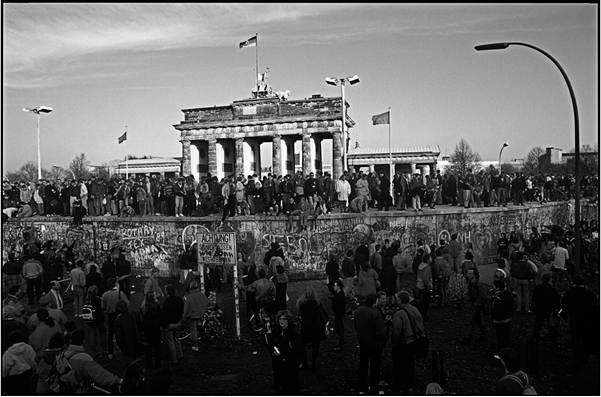
Figure 16.1 Berliners from East and West celebrating the opening of the border at the Berlin Wall, Brandenburg Gate, Berlin, 9th November 1989 / © H.P. Stiebing / Bridgeman Images
Crucial developments occurred in each month of the year in an array of Soviet bloc countries. Here are some highlights that take us through the year, with a stop in nearly every month: on February 6, in Warsaw, round table discussions began that reached a conclusion on April 4 with the legalizing of Solidarity; while those discussions were underway in Poland, massive protests on March 15 in Hungary persuaded the government in that country to begin their own round table talks with non-communist organizations; on May 2, in a precursor to the dismantling of the Berlin Wall, the Hungarian government began to take down a 150-mile barrier separating Hungary from Austria; on June 4, as noted above, Solidarity won Polish elections; on July 6, Gorbachev gave a speech signaling his unwillingness to use force against protesters in countries within the Soviet orbit; on August 24 Poland's first postwar noncommunist Premier took office; in September a wave of protests in East German cities began; in October, there were massive protests in East German cities; then, in November, which is often seen as standing out as the great hinge month of this hinge year, the Berlin Wall came down.[640]
As important as November events were, if there was a hinge moment within this hinge year, it may have come earlier than that, in the second week of October, when hardliners lost out to more conciliatory factions within the East German leadership, in part because Gorbachev had signaled that Moscow would not reprise the role in helping crack down on protests it had played in 1968. On October 9, the New York Times reported as follows:
Protesters clashed with the police and security forces today in cities throughout East Germany as the Communist Government's efforts to celebrate its 40th anniversary ignited rallies and demonstrations... Spurred on in part by the presence of the Soviet President, Mikhail S. Gorbachev, who came for the celebrations, protesters took to the streets late Saturday and again today, often mingling their calls for greater freedom with chants of ‘‘Gorby! Gorby!''... In East Berlin, Dresden, Leipzig and elsewhere, the police beat back defiant protesters, swinging riot sticks and menacing them with water 17
cannon.
The very next day, though, the same newspaper reported that
Tens of thousands of East Germans marched peacefully through Leipzig this evening in the largest of a wave of demonstrations for change that has swept East Germany in recent days... [and] in contrast to a weekend of violence and arrests, no clashes were reported, although the police presence in Leipzig and East Berlin was strong... [There was] a new willingness by the local authorities to consider the demands of the protesters.[641] [642] [643]
The following summary on George Mason's “Making the history of 1989” website sums up the shift well here:
Some party leaders were calling for a ‘Chinese Solution' to stop the growing demonstrations, a reference to the Chinese government's use of military force against pro-democracy demonstrators... local authorities prepared for mass arrests and even the use of deadly force - 3,000 riot police, 500 additional militia members, and 3,000 regular army soldiers were issued live ammunition and placed on alert at the outskirts of town. Faced with strong international pressure for moderation, the German authorities instead allowed the demonstration to proceed without incident. The crowds marching through Leipzig chanted “Wir sind das Volk” or “We are the people”...19
By October 18, the hardliner Eric Honecker, whom Gorbachev had warned needed to adjust to the times, was out of power, replaced by the more reform-minded Egon Krenz.[644]
The movement year
The best way to begin thinking of 1989 as a movement year rather than a hinge one is to consider a dog that did not bark in the night - the Chinese Communist Party, though challenged by massive protests that brought roughly a million people to the streets of Beijing and tens or hundreds of thousands to central squares in various other cities, did not fall. It did not experience the same fate as its counterparts in Central and Eastern Europe, many of which were forced to negotiate with competing organizations in late 1988 or early 1989 and in most cases to cede power completely by the end of the latter year. Nor did it go into the spiral that year that the Soviet Union did, soon losing control of territories once under its influence. Had Beijing seen a change of government in 1989 - or even 1991 - the hinge year vision would have been complete, or at least nearly so, as there might still have been Cuba, Vietnam, and North Korea left as Communist states. And it did seem, for a time, as enormous and colorful gatherings at Tiananmen Square, the most spiritually charged political locale in the PRC, captivated the attention of audiences around the country and around the world, that the Chinese Communist Party would have to tilt in a political reformist direction, if not share power. Yet, in the end, hard-liners within the government prevailed and the most enduring Chinese image from 1989 became not the victory of protesters but a lone man standing before a line of tanks on June 5, the day after the June 4th Massacre in central Beijing, an event that saw hundreds of workers, passersby, and other urbanites as well as students slain on the streets of the capital.
In the immediate wake of the June 4th Massacre, and especially after the Berlin Wall fell a few months later, the fact that the Chinese Communist Party was still in power seemed to many an anomaly. Surely, some argued, this organization would soon follow suit and become part of what one leading political scientist would term “The Leninist Extinction,” a phrase that took on particular force when the Soviet Union imploded in 1991.[645] Many observers took for granted that the struggles in China belonged to the same genre as those in Central and Eastern Europe, that Beijing leaders faced the same sort of threat to their legitimacy that those in cities such as Warsaw and Budapest had, and that they had merely gotten a temporary reprieve when state violence cleared the crowds from the streets. Encouraging this sense of parallels was that, during 1989, references to events in the Soviet Union and Eastern and Central Europe showed up in Chinese protests (e.g., a Beijing protest banner lamented that heaven had “given Russia a Gorbachev,” but had only given China “a Deng Xiaoping”), and that well after the fact leaders in Beijing were speaking of the need to keep their country free of the “Polish disease” (a term for organizations such as Solidarity). As already noted, developments in the PRC were seen as relevant by actors in settings such as East Berlin, where some leaders used the term “Chinese solution” to refer to the possibility of using repressive tactics like those deployed in Beijing, while some demonstrators claimed to take courage from the example of the brave Chinese man who stood up to a line of tanks.[646] Further reinforcing this sense of connectedness were reports of how intensely Beijing's leaders were monitoring events in settings such as Romania and also the Soviet Union, in order to try to ensure that what had already happened in the former country and seemed on the verge of happening in the latter, did not occur in China.[647]
Over time, however, this view of China's 1989 as directly parallel to the Eastern and Central European one has become less and less tenable. Twenty- five years on, the differences between the Chinese and Central and Eastern European protests of that year loom as large to us as their similarities. There are even some ways - including the extent to which some Chinese then placed their hopes for change in a revitalized as opposed to overturned Communist Party - in which Beijing's 1989 had more in common at times with Prague's 1968 than its Velvet Revolution.[648] Recognizing these differences, while diminishing somewhat the hold of a “hinge year” view of 1989, is not a problem for a “movement year” interpretation of it. For, after all, in the case of other “movement years,” it is taken for granted that protests in different parts of the world may be both interconnected in some ways and quite dissimilar in others.
The story of China's 1989 as being of a piece with that of Eastern and Central Europe is well known, so we will focus here on offering a brief account of Chinese events that highlights contrasts. In contrast to Czech protesters who first took to the streets in 1989 to commemorate the death of a man who had selfimmolated himself to express despair at Communist Party rule, Chinese youth first rallied in 1989 to express sorrow at the recent death of Hu Yaobang, who had been demoted from a high position in the official structure to a low one because of his gentle handling of student demonstrations two years earlier. Hu had come to represent hopes for the reform of the Communist Party, and throughout the Chinese struggle, many saw their goal, as was not true in most Central and Eastern European settings, as that of getting the Party and the revolution back on track, not completely jettisoning current arrangements. Though some called for systemic change, much of the focus in early wall posters and banners was on the damage to the country being done by corruption and nepotism.
A key contrast between the Chinese protests and those in other Communist Party-run countries in 1989 has to do with patriotism. Love of country was crucial in China as it was in nearly all other settings, as shown, for example, by the popularity of the anthem “Children of the Dragon” by Hou Dejian, a song infused with national pride that was part of an eclectic movement soundtrack that also included “The Internationale,” the Chinese national anthem, rock songs, such as Cui Jian's “Nothing to My Name,” and a reworked version of “Frere Jacques” (that included criticism of Deng Xiaoping).[649] Patriotism manifested itself quite differently in Eastern and Central Europe, where the Communist Party was seen as having been imposed on the populace from outside, as opposed to China, where this was not the case. In places other than China, the tension between rulers and ruled often expressed itself in contestation over which symbols from the past should be valued, whereas Chinese protesters often framed their struggle as questioning the government's claim to represent national symbols both sides celebrated.26
This side of China's 1989 became clearest on May 4th, the anniversary of a great 1919 patriotic upsurge, which is hallowed by the Chinese Communist Party as a struggle, led by students who were joined on the streets by workers and members of other classes, that helped pave the way for the Party's eventual rise to power. The anniversary of that movement, in which many future leaders of the Communist Party took part and in which the main themes included anger at imperialism, disgust with authoritarian rule at home, and a desire to see China become a strong, modern, and open state, is often celebrated with great fanfare, especially when, as in 1989, a round number commemorative year is involved. On the 1989 anniversary, there was not just one commemoration but two battling ones in central Beijing, with officials presenting themselves, per usual, as leading the Party that had realized the dreams of May 4th activists, while student leaders insisted in a separate and larger event that in fighting for change, it was they who deserved to be seen as carrying forward the May 4th spirit. One of the most stirring manifestoes of China's 1989 was the “New May Fourth Movement” one issued on that day.
The eventful year
As attractive as it is to see 1989 as a hinge year or as a movement year, there is also a fair case to be made for viewing it simply as a year that had more than its share of disparate major events. Looked at this way, we are encouraged to frame its importance not solely in terms of a single anti-Communist storyline, or even in terms of a pair of different sorts of struggles against
winning Long Bow film “The Gate of Heavenly Peace” and the materials gathered at the associated website, www.tsquare.tv (last accessed July ιι, 2013).
26 It is also worth noting, regarding patriotism, that the three other main countries in which Communist Party governments have stayed in power - Cuba, Vietnam, and North Korea - are also ones in which this organization has historic links to struggles against imperialism and foreign bullying. authoritarian rule, with the Chinese one standing apart from the others, but rather as a time of separate and not necessarily connected or connectable developments. The “end” of communism and varied challenges to different sorts of Communist rule approaches, though valuable, simply fail to account for some important events that, in retrospect especially, stand out as having made 1989 extraordinary. Pushing this idea even further, the case could be made that the sheer variety of major events that year challenge the depiction of 1989 through the lens of any coherent narrative. Here, to begin this section on eventfulness, is an example of two 1989 occurrences that can be interpreted as related, though not via a through line associated with the Cold War or with movements, or completely unrelated depending on how one approaches them.
The first event we have in mind involves the tanker the Exxon Valdez. It left a literal mark on the Prince William Sound and a symbolic mark on the ecological conscience of Earth's inhabitants in March of 1989 after running aground and spilling approximately 10 million gallons of crude oil on the pristine coastline of Alaska. A report produced by the National Response Team in May of 1989 noted that “The lack of necessary preparedness for oil spills in Prince William Sound and the inadequate response actions that resulted mandate improvements in the way the nation plans for and reacts to oil spills of national significance.”[650] The Exxon Valdez incident was not the first ecological disaster to make headlines, but it did so in an unusually dramatic way, and it remained for more than two decades the biggest oil spill in U.S. history, leaving an indelible mark on America's memory. The second event took place two months prior to the Exxon Valdez incident, on January 2, 1989: Time Magazine paid homage to the “Planet of the Year: endangered Earth.” This was the second time - the first had come when it chose the computer in 1982 - when Time broke with its “Man of the Year” tradition to make a choice that was not an individual, a pair of individuals, or a group of people. Addressing human-driven ecological catastrophes like global warming, overpopulation, and looming threats to biodiversity, one article asked in its title, “What on EARTH are we doing?”[651]
The fact of Time’s 1989 selection of a “Planet of the Year” and the Exxon Valdez oil spill two months later evinces the complexity of how we think about a given year. Time's plea for people to take a more critical look at the twentieth-century environmental impact of human civilization was published just weeks before an ecological disaster that came to symbolize the consequences of modern living. Stories about the initial devastation (and later issues of accountability and remediation) made headlines around the world; the 1989 Exxon Valdez spill was a major event that mattered - not because it could be worked into some sort of overarching narrative about political change but simply because it happened.29
The year 1989 could, in this sense, be a seen as a year not of coherent moves in one direction but disparate colliding impulses. It saw the Dalai Lama win the Nobel Peace Prize after Tibet had been rocked by protests the previous March, yet also was the year Khomeini not only died mid-year but months before that issued his infamous fatwa against Salman Rushdie. It was a year envisioned by some as ushering in a new era of global cooperation and peaceful cohabitation, yet many random acts of violence made headlines in that year, as in one preceding and following it. One of the most important, though hardly a singular event, was the “Stockton Massacre,” a school shooting of a sort we have grown more used to since then, which resulted in the death of five children in a “random spray of gunfire,” a tragic event that contributed to US President George H. W. Bush’s March 1989 executive order banning the importation of semiautomatic assault weapons.30
Yet another key development in 1989 was the dramatic loosening if not yet complete undoing of Apartheid’s grip on South Africa.31 The year marked the beginning of the end of official, decades-old segregation policies in the country. And though Nelson Mandela would not gain his freedom until the following year and would not come to power until 1994, 1989 saw him move toward a position of centrality, as major international publications,
1989 see: www.time.com/time/covers/o,16641,19890102,00.html (last accessed July 17, 2013).
29 Ironically, while the Exxon Valdez had more truly global implications than most other 1989 events, commemoration of its anniversaries have largely focused on its local dimensions; see, for example, “10th anniversary of the ‘Exxon Valdez’ oil spill,” Capital Words website http://capitolwords.org/date/1999/03/24/S3159-4_10th-anni versary-of-the-exxon-valdez-oil-spill/ (last accessed July 16, 2013).
30 Dan Morain and Stephen Braun, “The Stockton school yard massacre somber students and teachers wrestle with the horror.” Published in The Los Angeles Times, January 19, 1989. http://articles.latimes.com/1989-01-19/news/mn-1498_1_school-custodians (last accessed May 16, 2013).
31 For an introduction to major issues and debates on Apartheid in South Africa, see Nigel Worden, The Making of Modern South Africa: Conquest, Apartheid, Democracy (Malden, ma: Blackwell Publishing, 2011). such as the New York Times in one of its editorials, began to present him “as a legitimate leader with whom South Africans must reckon.”[652]
The 1989 also saw a series of disparate political convulsions in another part of the Global South: Latin America. In Central America, under the name “Operation Just Cause,” the United States invaded Panama, overthrowing General Manuel Antonio Noriega. In Nicaragua, a decade of Cold War infighting between American-backed “Contra” rebels and the Soviet- supported Sandinista government came to an end. That same year, Paraguay's Alfredo Stroessner was overthrown along with his fellow, more well-known dictator in Chile: General Augosto Pinochet. While free elections were held in Chile for the first time in nearly two decades, Brazil was holding its third free election since the end of military dictatorship. With the fall of Stroessner, Pinochet, and Noriega, 1989, for all intents and purposes, marked a watershed moment in the dissolution of Latin America's lengthy history of dictatorship.[653]
Despite major political transformations in Latin America, fear of brewing economic crises in the region dominated policy discussions: “the debt crisis gripping Latin America could lead to a political crisis and a return to authoritarian rule on the continent.”[654] In 1989, economist John Williamson coined the term “Washington Consensus” to encompass requirements that highly indebted developing countries had to meet in order to continue receiving financing from global financial institutions like the International Monetary Fund (IMF) and the World Bank (WB).[655] While the Washington Consensus compelled developing countries to engage in neoliberal economic restructuring, the directives, which were blamed for intensifying economic inequality, led to outbreaks of popular discontent throughout the region - in 1989 as well as the years shortly before and after.[656] For instance, Venezuela, once heralded as a poster-child of liberal democracy in Latin America during the 1980s, was the site of popular revolt against President elect Carlon Andres Perez Rodriguez in 1989 in response to neoliberal reforms and government imposed austerity programs under his direction. In one of “Latin America's most stable democracies” in February of 1989, waves of violent protests and riots gripped the capital city of Caracas, resulting in “an estimated 300 people dead, 2,000 injured and another 2,000 in jail.”[657]
While in many parts of the world people actively ushered in a new era of democratic and neoliberal economic reform measures, massive pushbacks against similar measures in countries like Venezuela complicate one of the more dominant memories of 1989 as a year of successful, nonviolent people power. And if events around the globe favor the story of 1989 as a hinge year or a movement year with narratively and thematically neat parameters, transformative events like those recounted above ask us to consider in what ways 1989 was a significant year simply because it was so filled with consequential events.
It is, of course, impossible to list every occurrence of 1989 - let alone to adequately gauge the different registers of importance on, say, a global versus a national scale. The sheer variety of events in 1989 makes the year unusually kaleidoscopic and hard to evaluate substantively. As the final year of a decade increasingly dominated by satellite television and global broadcasting, audiences around the world were unarguably privy to unparalleled coverage of major events in 1989. Perhaps 1989 continues to reverberate in memory simply because of the confluence of advancements in media during a year of major happenings without recent precedent. The proliferation of technologies to project events and news to people around the world in 1989 lends the year much significance in its own right; the level of unprecedented massive visibility served as both a medium for and a sign of an increasingly interconnected world accounts, at least in part, to the designation of 1989 as a year of events, however disparate or only tangentially connected they may be. If 1989 was a long and busy year, perhaps it is because we watched so much of it unfold live in our living rooms.
Thinking through 1989
In the end, it may be best to refuse to choose one of the three approaches to 1989 outlined above and treat it as a hybrid year. There were too many distinct yet iconic events to be squeezed into a single grand narrative, but this does not mean there were no recurring themes. Two that seem particularly salient to us are mobilization and spectatorship. From changes in Poland and Prague to shifts in South Africa and Venezuela, 1989 saw an uptick in popular political engagement through the mobilization of masses. These far-flung crowd-driven movements were shaped by geographical specificity - unfolding in different ways, responding to different social crises/concerns, demanding different outcomes, and achieving different levels of success. Sometimes, they even pushed in different directions: popular protest in Eastern Europe pushing through reforms toward market economics, while in many Latin American countries popular protest railed against neoliberal reforms that, on the surface, promised democracy, freedom, and rising standards of living. Still, when taken together, they suggest 1989 saw an overall uptick in popular resistance, much of which gained strength from playing out on screens around the world that made it easy for protesters in one place to know what their counterparts far away were doing in real time, something that has been important again in more recent years of the protester such as 2011, albeit with the Webjoining satellite television broadcasts in this dissemination of images process.
Images of 1968’s crowd actions saturated the media in a way that felt novel at the time, giving rise to phrases such as “The Revolution will be Televised” and “The Whole World is Watching,” but this was taken to a new level in 1989, thanks to the rising importance of satellite television. It was not just that on a single day, June 4, Solidarity won a major election in Poland and troops massacred civilians in Beijing, but that images of these events so closely associated with crowd actions could circle the globe simultaneously, and within days compete for the attention of viewers with shots of the masses that turned out to mourn Khomeini, who had died on that most eventful day of an eventful year. One could argue that the image of the lone man staring down tanks in Beijing attained iconicity in memories of 1989 as an invocation of solitary protest made more powerful when juxtaposed to the ubiquitous television coverage of massive demonstrations of vocal discontent. And this is one way that the Exxon Valdez, which did not involve crowds, fits in, as while not the first ecological disaster to cause great damage and inspire deep concern, it was one of the first (though not the first) to get the kind of intense widespread attention that the new media technologies and new media landscape could provide - even if that one in turn did not have the intensity of the Internet-driven ones of the current moment.
Coming to terms with 1989 is more difficult than with many other big years of the past, due to its proximity to today's world, the degree to which the processes set in motion by it continue to play out. As such, there is an ongoing tension between events of immediately agreed upon import like the fall of the Berlin Wall and the early development of the Internet which, only in retrospect, become understood as critical historical turning points. Discussions of 1989's significance occurred simultaneously with the year's unfolding; more than a quarter century later the conversation continues. However one chooses to remember 1989, be it as a hinge year of before and after, a year of sequential markers fitting a mass movement narrative, or a year laying claim to a slew of major events, 1989 was a year that transformed our world, via struggles whose importance was clear at the time and phenomena from the dawn of digital media to increased awareness of climate change and other threats to the survival of our species and our planet whose significance would loom much larger by the time its tenth, twentieth, and twenty-fifth anniversaries were marked.
Further reading
Ash, Timothy Garton. "1989!” New York Review of Books, November 5, 2009.
Axworthy, Michael. Revolutionary Iran: A History of the Islamic Republic. Oxford University Press, 2013.
Barme, Geremie and LindaJaivin, eds. New Ghosts, Old Dreams: Chinese Rebel Voices. New York: Crown, 1992.
Calhoun, Craig. Neither Gods Nor Emperors: Students and the Struggle for Democracy in China Berkeley, ca: University of California Press, 1997.
Caryl, Christian. Strange Rebels: 1979 and the Birth of the 21st Century. NewYork: BasicBooks, 2013. Chirot, Daniel, ed. The Crisis of Communism and the Decline of the Left: The Revolutions of 1989.
Seattle: University of Washington Press, 1991.
Day, Angela. Red Light to Starboard: Recalling the Exxon Valdez Oil Disaster. Pullman, wa: Washington State University Press, 2014.
Elliot, Michael, ed. TIME 1989: The Year that Defines Today's World. NewYork: Time Books, 2009.
Gwertzman, Bernard and Michael T. Kaufman, eds. The Collapse of Communism. New York: Times Books, 1990.
Han, Minzhu, ed. Cries for Democracy. Princeton University Press, 1990.
Hinton, Carma and Richard Gordon, directors. The Gate of Heavenly Peace (film). Long Bow Group, 1995.
Kenney, Padraic. A Carnival of Revolution: Central Europe 1989. Princeton University Press, 2003.
Lim, Louisa. The People's Republic of Amnesia: Tiananmen Revisited. Oxford University Press, 2014.
Michnik, Adam. Letters From Freedom: Post-Cold War Realities and Perspectives. Berkeley, ca: University of California Press, 1998.
Perry, ElizabethJ. and Jeffrey N. Wasserstrom, eds. Popular Protest and Poltiical Culture in Modern China. 2nd edn. Boulder, co: Westview Press, 1994.
Picou, J. Steven, Duane A. Gill, and Maurie J. Cohen, eds. The Exxon Valdez Oil Spill: Readings on a Modern Social Problem. Dubuque, ia: Kendall Hunt Publishing Co., 2008.
Rushdie, Salman. Joseph Anton: A Novel. New York: Random House, 2012.
Smith, Peter H. Democracy in Latin America: Political Change in Comparative Perspective. Oxford University Press, 2011.
Suny, Ronald. The Soviet Experiment: Russia, The U.S.S.R. and the Successor States. 2nd edn. Oxford University Press, 2010.
Tismaneanu, Vladimir and Sorin Antohi, eds. Between Past and Future: The Revolutions of 1989 and Their Aftermath. Budapest: Central European University, 2000.
Worden, Nigel. The Making of Modern South Africa: Conquest, Apartheid, Democracy. Malden, ma: Blackwell Publishing, 2011.
Wiener, Jon. How We Forgot the Cold War. Berkeley, ca: University of California Press, 2013.