Aceramic early villages in South Asia
There are outstanding questions about the processes that led to the establishment of the first sedentary villages like Mehrgarh. The rise and dispersal of farming practices in South Asia likely must have seen the displacement of preexisting mobile hunter-gatherer populations, the conversion of these populations to an agricultural lifestyle, and/or their co-existence with settled populations.
Life at Mehrgarh period i
The earliest occupation at Mehrgarh was exposed in area mr 3 and comprises 7 m of stratified deposits made up of the remains of nine separate building phases.[577] These levels are ostensibly aceramic, though they contain fired ceramic figurines and remains of asphalt-covered baskets. The earliest period i levels are characterized by a barley-dominated agricultural economy, with the evidence for cereal exploitation primarily coming from grain impressions and charred remains preserved in mud bricks. Naked six-row barley (Hordeum vulgare) makes up more than 90 per cent of the seeds and impressions identified, while domestic hulled six-row and wild and domestic hulled two-row barley were also present, and very low proportions of domestic emmer, domestic einkorn, and a free threshing wheat were attested.[578] The faunal assemblage for period i is dominated by wild species, including gazelle, goats, sheep, deer, buffalo, and cattle, though significant numbers of goat kids in burials and the remains of relatively small subadult or adult animals in trash deposits indicate that behaviourally domesticated goats were exploited from the earliest levels.[579] The earliest inhabitants of the site thus appear to have engaged in hunting in combination with the cultivation of domesticated crops and keeping of domesticated animals. Mehrgarh period i appears to have been at least partly contemporaneous with the earliest aceramic levels at the site of Kili Gul Muhammad, which is situated in the Quetta valley, at the other end of the Bolan Pass.[580]
The earliest structures at Mehrgarh are predominantly made of mud or mud brick, and comprise small cell-like rooms that have hearths and occupation deposits containing stone and bone tools.[581] J.-F.
Jarrige et al. have long noted that there are clear similarities in craft products, architecture, and agricultural practices between Mehrgarh and the earliest Neolithic sites in the central and northern Zagros in Iran, which until recently were the closest aceramic sites known to the west (see below). Jarrige et al. have, however, also argued that diffusion from west to east is unlikely, and favour parallel developments achieved by populations that had indirect contact through groups living in the intervening regions.[582]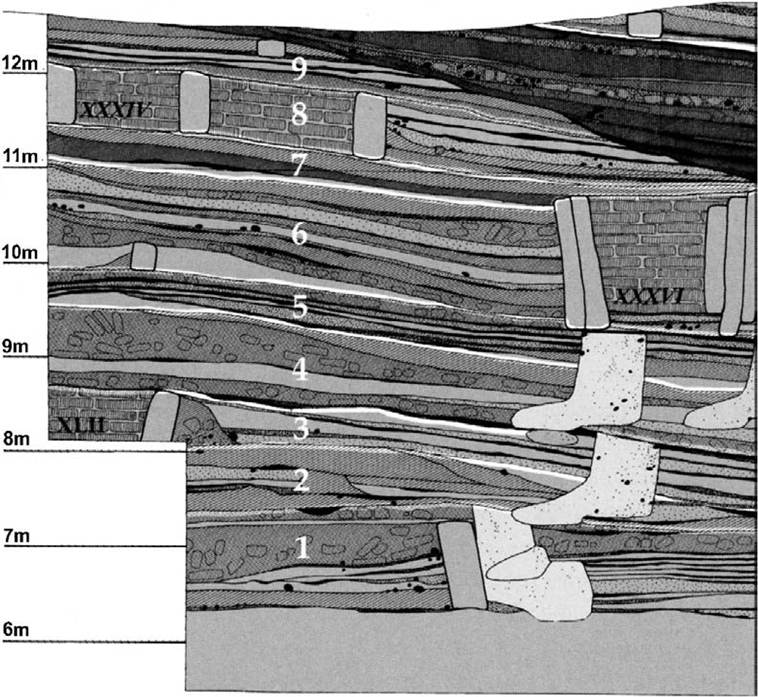
Figure 11.3 Reproduction of the section along the river adjacent to mr 3 South, showing alternating levels of occupation and grave pits.
Relative and absolute dating of the Kili Gul Muhammad phase
The protracted sequence of occupation attested in the period i deposits at mr 3 has been used to suggest that the earliest occupation at the site might have begun c. 7000 bce, or even earlier in the eighth millennium.11 A critical piece of evidence used to support a more extended chronology for the sequence of aceramic levels at mr 3 is the depth of the stratigraphy in this part of the site (Figure 11.3). The period i occupation at Mehrgarh was, however, not continuous in any one area of mr 3 and new structures appear to have then been erected adjacent to older ones. Abandoned structures were filled with [583] rubbish while they were collapsing, and graves containing single or multiple inhumations of adult and subadult individuals were excavated into the accumulating debris.[584] These burials often contained young goats and/or a range of artefacts, some of which were manufactured from raw material not available locally, such as marine shell, lapis lazuli, and turquoise (Figure 11.4).[585] It is notable that the grave pits do not cut through mudbrick walls, suggesting that the decaying walls were still visible when the graves were being dug.
When the newly built structures were subsequently abandoned, the earlier decaying walls were levelled and new structures were erected in the original area. Jarrige et al. have drawn on modern ethnographic observations on the longevity of unbaked mud-brick structures to suggest that each of these occupation phases is likely to have been thirty to forty years in duration.[586] Although a range of variation is to be expected, this estimate is likely to be broadly accurate when taking an average of the duration of multiple phases. The eighteen phases of period i occupation might thus reasonably be expected to span between 540 and 720 years.Although an early date is claimed for Mehrgarh period ι, it is not supported by an unambiguous sequence of absolute dates. In fact, the range of extant radiocarbon dates from period i is problematic and cannot be used to outline a clear absolute chronology, so relative indicators are typically used instead. There were very few charred seeds preserved in period i deposits, and the preservation of charcoal in the earliest levels is poor, and both of these factors may have contributed to the inconsistent radiocarbon determinations for this period.[587] There have been several modifications to the phasing of the period i deposits, and they were initially divided into ia aceramic and ib ceramic levels,[588] and it is not yet clear how this revision affects the available absolute dating evidence.
J.-F. Jarrige's estimate of thirty to forty years for the life of a mud-brick building suggests that the eighteen structural phases of Mehrgarh period i may have spanned up to c. 720 years, assuming continuous occupation throughout the period. Given that period iia is dated by secure radiocarbon dates spanning c. 5470-4700 bce (see below), then it is possible that the aceramic occupation at Mehrgarh began in the very late seventh millennium
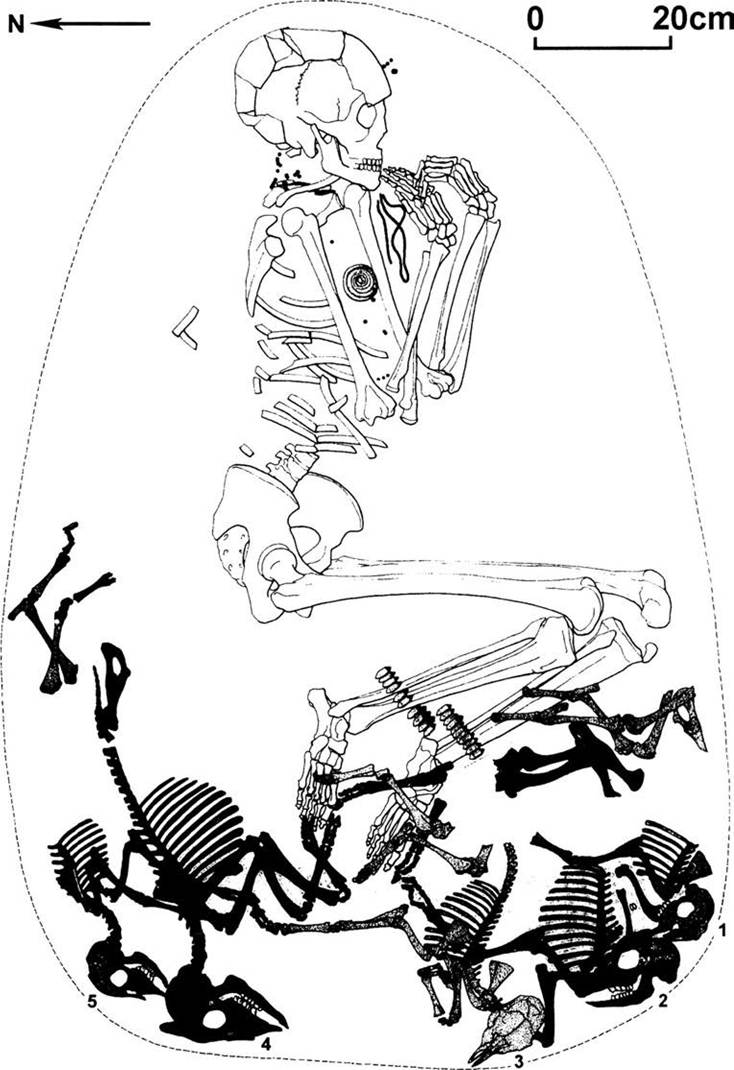
Figure 11.4 Plan of Burial 287, Mehrgarh period I.
bce, though this assumes that the end of period i and the beginning of period IIA are coeval. However, based on the stratigraphy exposed in the Bolan River profile, it has been suggested that there may have been a substantial gap between the period i and period iia occupation layers,[589] so it is likely that the date for the establishment of Mehrgarh period I will only be determined accurately through a future radiocarbon dating programme.
Domestication: local, imported, or both?
The cereals present in Mehrgarh period i (naked six-row barley, domestic hulled six-row barley, wild and domestic hulled two-row barley, domestic emmer, domestic einkorn, and a free threshing wheat) represent several of the founder crops of Southwest Asian agriculture, though notably none of the pulse domesticates have been attested. Zohary and Hopf have shown that the Fertile Crescent is the centre of the distribution of wild barley, but report what have been interpreted as ‘weedy forms' in Afghanistan and the areas of Baluchistan that are close to Mehrgarh.1[590] While this distribution makes it possible that barley might have been domesticated locally, Meadow has noted that the truly wild forms found in Mehrgarh period i deposits could be field weeds, and pointed out that wild barley is not identified in any postperiod i deposits there or elsewhere in South Asia.1[591]
Genetic evidence indicates that barley landraces in Greater Asia fall into two genetically distinct clusters, one with an origin in the Levant and the other somewhere to the east of the Fertile Crescent, possibly in the Zagros foothills or even further east.[592] This eastern genetic group appears to have contributed the most to the genetic diversity of barley in regions stretching from Central Asia to the Far East, suggesting that all of the samples that have been analysed from these areas share a similar genetic identity.
The two domestication clusters were not entirely independent, however, and Jones et al. have shown that this eastern group made a genetic contribution to the flowering-time adaptation of the cultivated barley types found in Europe.[593] The presence of early village sites in the western Zagros, such as Jarmo and Ali Kosh, has led to the suggestion that this region might be the source of this eastern genetic group of barley, but Morrell and Clegg have noted that as Mehrgarh also lies at the easternmost range of wild barley, a local domestication there is possible.[594] While not necessarily disagreeing with this proposal, Salamini et al. and Saisho and Purugganan have hypothesized that the eastern variant of barley is partly due to the genetic influence of strands in the Himalayas.[595] This evidence is far from conclusive when it comes to the situation in South Asia, largely because these analytical projects have used very few accessions from areas to the east of the Fertile Crescent, and no samples taken from the critical zones of modern Afghanistan and Pakistan, so the role of Mehrgarh in the domestication of barley remains unclear.In contrast to barley, Mehrgarh is located well outside the distribution of the wild progenitors of both domesticated einkorn and emmer wheat, which are limited to the Near Eastern arc or the Fertile Crescent.[596] Given that wild varieties of these grasses do not occur further east than the central-western Zagros, it is likely that domesticated varieties of both crops were introduced to the rest of the Iranian plateau and the regions beyond to the north and southeast. It can only be presumed that the domesticated strands found in period i deposits at Mehrgarh were imported into Baluchistan at some point, either by incoming populations bringing seeds with them, or local populations obtaining seeds from afar through exchange.[597]
As with barley, there have been recent attempts to characterize the ancient genetics of wheat, although much of this research has focused on Europe.
Analysis of diploid goat grass (Aegilops tauschii) and hexaploid wheat (Triticum aestivum) suggests that hexaploid wheat is likely to have originated in southeast Turkey or northern Syria, in the heartland of the Fertile Crescent,[598] which supports the suggestion that domesticated wheat was introduced to Mehrgarh. Nevertheless, as with barley, a clearer impression benefiting from genetic analysis of wheat will require the analysis of more samples from the subcontinent.Given the likelihood that the various species of wheat seen in Mehrgarh period i were introduced into Baluchistan, there is certainly a possibility that domesticated barley was introduced as well. However, the apparent absence of pulses in the earliest levels at Mehrgarh might indicate that the entire range of Southwest Asian founder crops did not arrive in South Asia at the same time, and in fact, it is still not precisely clear when pulses did arrive.[599] The pattern of crop adoption at Mehrgarh has implications for our understanding of how the Southwest Asian founder crops moved around. These crops in Southwest Asia have often been described as a ‘package', but the evidence from Mehrgarh suggests that they did not necessarily spread as such to other regions. The earliest domestic cereals being used at Mehrgarh may thus represent the first of several sets of crops introduced from Southwest Asia and elsewhere.
As noted above, the faunal assemblage for Mehrgarh period i is dominated by wild species, though behaviourally domesticated goats were likely present from the earliest levels. Detailed genetic research on the spread of domesticated animals has primarily focused on the diffusion of domesticated species out of the Fertile Crescent westwards into Europe. In contrast, the dynamics that were in operation to the east of the central-western Zagros are poorly understood. Analysis of mitochondrial DNA from modern domestic goats and bezoar (the wild ancestor) collected from across the entire distribution range of the bezoar, including numerous samples from Pakistan, has shown there is no haplotype in the modern population that could have been domesticated in the east of the Iranian plateau or regions further east.[600] Of the two centres of domestication identified, the one stretching across the central Iranian plateau to the southern Zagros contributed relatively little to modern mtDNA, while the other stretches from the central to the northern Zagros and into eastern Anatolia, and is the zone that appears to be the centre of origin for all modern domestic goats. Naderi et al. state unequivocally that goats were not domesticated in the area of the Indus valley, and that their results suggest that the early Neolithic goats found in the subcontinent most likely came to the region from over 1,000 km to the west.[601] These results have dramatic ramifications for claims that Mehrgarh was an independent centre of goat domestication, and it will be important to analyse ancient samples from the site, as it is possible, though perhaps unlikely, that the modern populations sampled by Naderi et al. may in the intervening millennia have completely replaced an ancient population domesticated in South Asia.
Sheep and cattle increasingly came to dominate the faunal assemblage over the course of period i at Mehrgarh, and the animals decreased in size, which is a common marker used to identify domestication.[602] Genetic studies carried out in the 1980s suggest, however, that all modern domestic sheep appear to have come from a single Southwest Asian ancestor (Ovis orientalis), and this is supported by more recent genetic research using mtDNA and chromosomal analysis.[603] These findings preclude an independent South Asian domestication of sheep, unless more recently imported breeds completely replaced a population domesticated in the eastern regions. Given the apparent definitiveness of the genetic evidence, it may be most parsimonious to accept that the domesticated sheep exploited by the Mehrgarh i population were introduced into the subcontinent.
The evidence for cattle, in particular Bos indicus, is quite different. MtDNA analysis has shown that there is a marked genetic distinction between humpless (taurine) and humped (zebu) cattle (zebu-specific alleles), which, taken in conjunction with the zooarchaeological analysis of the bones from Mehrgarh, indicates that the zebu was domesticated from wild stock locally in South Asia, or possibly eastern Iran.[604] MtDNA research focusing only on South and East Asian zebu has suggested that the most likely centre of domestication was the Indus valley, c. 6000 bce,[605] and the faunal remains from Mehrgarh may attest to this process occurring there.
Taken as a whole, the bioarchaeological evidence thus suggests that the earliest inhabitants of Mehrgarh engaged in hunting and gathering in combination with the cultivation of domesticated crops and the exploitation of some domesticated animals. Although there is some zooarchaeological and genetic evidence for domestication taking place locally (e.g. zebu), it now appears that the majority of the constituents of the agropastoral economy exploited at Mehrgarh in period i were imported domesticates (wheat, goats, sheep, and possibly barley). This reconstruction implies that there were long-range interactions between the inhabitants of the relatively small number of known aceramic settlements spread through the borderlands of South Asia and across the Iranian plateau. Nevertheless, the variation between the domestic plant and animal species used at Mehrgarh period i and those seen at aceramic sites further to the west suggests that there may not have been a simple process of transferring a complete or packaged subsistence economy from one region to another; rather, it was both complex and nuanced.
Long-range links and dispersals in the aceramic Neolithic
Until recently, the closest known aceramic Neolithic sites to Mehrgarh lay over 1,500 km to the west in the central Zagros (Ganj Dareh, Tepe Abdul Hossein, Jarmo, and Tepe Guran), and in lowland Susiana (Ali Kosh, Chogha Bonut, and Chogha Mish). New aceramic sites have, however, now been found in southwest and southeast Iran (Tappeh Rahmatabad, Tell-e Atashi), which have added significantly to our understanding of the distribution of aceramic Neolithic settlements.[606] Radiocarbon dates from Tappeh Rahmatabad suggest that the aceramic Neolithic villages in Fars were later than those in the centralwestern Zagros, so it would appear that there is no specific reason why the date for the establishment of Mehrgarh should be sought through direct parallels with the earlier central-western Zagros sites.
Evidence for trade bringing exotic raw materials such as lapis lazuli to Mehrgarh indicates that long-range contacts were maintained over several millennia, so there should be no doubt that this earliest phase of village occupation in South Asia was one where people and ideas could be spread widely. While several of the domesticated plant and animal species seen at Mehrgarh in period i were not domesticated locally, it is not yet possible to establish whether we are looking at cultural diffusion, where farming was adopted by local foragers, demic diffusion, where farmers moved onto the Kacchi plain from elsewhere, or some combination of the two processes taking place in tandem.
It appears that Mehrgarh period i was at least partly contemporaneous with the earliest levels at Kili Gul Muhammad, and the latter's location at the top of the Bolan Pass implies that its inhabitants interacted with the people living at Mehrgarh, possibly in the form of transhumance, as and when the seasons demanded.[607] Possehl identified a total of nineteen other aceramic Neolithic sites in the western borderlands of South Asia, though not all of these were permanent settlements.[608] The earliest sedentary populations in South Asia thus appear to have been relatively small, and to have favoured specific ecological zones for the establishment of their settlements. In this earliest stage, it is likely that sedentary populations co-existed with huntergatherers, and at least at Mehrgarh, it appears that the initial farming populations also engaged in hunting.