Mehrgarh is the best-known early village site in South Asia, and presents the earliest evidence for sedentary occupation, agriculture, and pastoralism thus far discovered.[573]
The site has played a key role in discussion of the date and dynamics of the adoption of agriculture in the subcontinent, but as Kingwell- Banham et al. review in Chapter 1o in this volume, there was more than one South Asian Neolithic.
The shift to farming occurred in a number of discrete regions in the subcontinent, and each process was enabled and constrained by various factors, including differences in the distribution of plant and animal species suitable for domestication, seasonal rainfall patterns, and local environmental conditions. Mehrgarh is particularly significant as it prompts discussion about the degree to which the origins of early farming and pastoralism in western South Asia were the product of indigenous processes, and also about the role played by plant species, animal species, and possibly also populations moving into South Asia from elsewhere, particularly West Asia.Mehrgarh lies at the foot of the Bolan Pass at the northern end of the Kacchi plain in Baluchistan, Pakistan, and this chapter will review the Neolithic and Chalcolithic period occupation at the site. The Kacchi plain lies in the transition
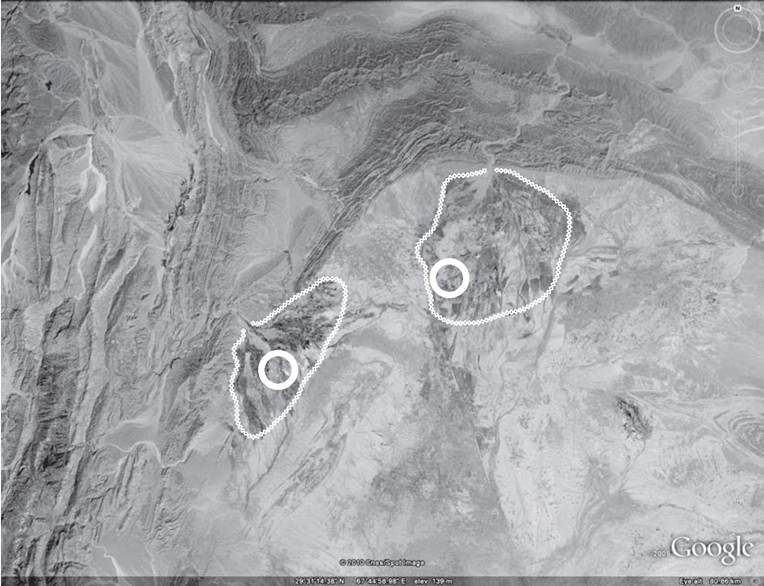
Figure 11.1 Google Earth™ image showing the location of Mehrgarh (circled to left) in relation to the location of the later Pirak (circled to right), each site lying on a separate alluvial fan.
zone between the Indus plains and the Iranian plateau, and is essentially an alluvial fan produced by the erosive action of the Bolan River (Figure ιι.ι).[574] Mehrgarh was excavated by the French Archaeological Mission to Pakistan in 1974-86, 1997, and 2000 under the direction of J.-F. and C. Jarrige. This review draws heavily on the project's publications.
Mehrgarh is perhaps best referred to as an archaeological complex, as it is comprised of several separate areas of occupation spread over a c.
4 km stretch of the right bank of the Bolan River, covering an area of 300 ha (Figure 11.2). Sedentary occupation here was displaced episodically, such that the use of individual areas appears to have been largely sequential. The occupational sequence has been divided into eight major phases (ι-vιιι), which span the period from c. 6000-2000 bce, though it has been suggested that the site was first occupied as early as c. 7000 bce. This review will outline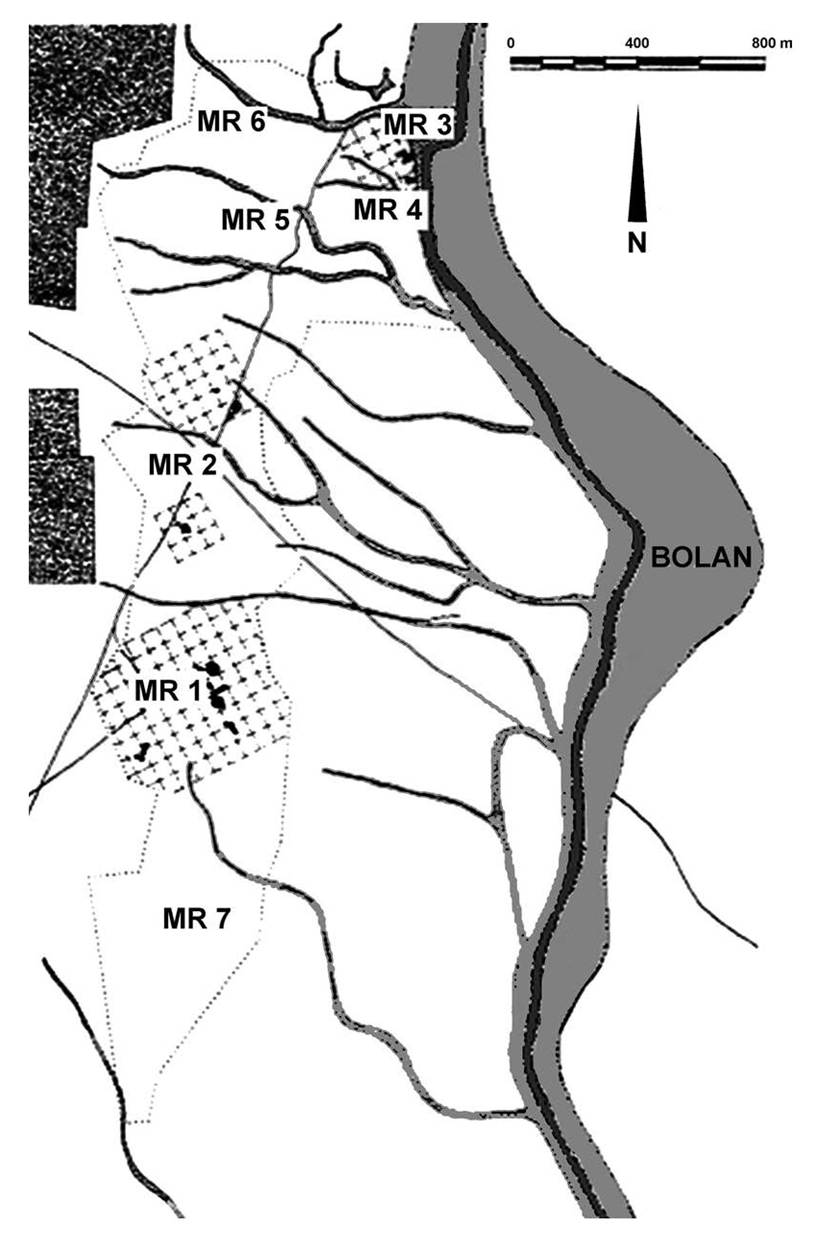
Figure 11.2 Map of Mehrgarh showing the location of excavated areas in relation to the course of the Bolan River.
the ‘Neolithic' occupation at the site, which is divided into three phases (periods ι, iia, and iib); and will also discuss the phases of ‘Chalcolithic' occupation: periods ιιι, iv, and v.[575]
Throughout its history, Mehrgarh did not exist in isolation, and material evidence demonstrates that its inhabitants interacted with populations in the hills and piedmonts of the Sulaiman Range, which form the western borderlands of the subcontinent, and populations on the Iranian plateau proper to the far west.[576] It nonetheless remains the most comprehensively investigated early village settlement in Baluchistan and the surrounding regions.
More on the topic Mehrgarh is the best-known early village site in South Asia, and presents the earliest evidence for sedentary occupation, agriculture, and pastoralism thus far discovered.[573]:
- Mehrgarh is the best-known early village site in South Asia, and presents the earliest evidence for sedentary occupation, agriculture, and pastoralism thus far discovered.[573]
- Barker Graeme, Goucher Candice (ed.). The Cambridge World History. Volume 2. A World with Agriculture, 12,000 BCE-500 CE. Cambridge University Press,2015. — 668 p., 2015