An age of environmental challenge, 22,000-12,700 bce
The onset of the peak conditions of the Last Glacial Maximum around 22,000-20,000 bce both accelerated older trends of historical change and set in motion new directions of change.
The climate across large parts of Africa, already trending drier over the previous several thousand years, became the driest it had been in tens of thousands of years. The Sahara became hyperarid, more arid than it is even today, and uninhabitable nearly everywhere. Its southern boundaries expanded several hundred kilometers south of their current locations. The rainforest belt immediately inland from the coast of West Africa broke up into several separate blocks of rainforest, surrounded by greatly expanded regions of open woodlands and savanna. The African equatorial rainforests also shrank greatly in extent, and savanna environments expanded across the heart of the Congo Basin.The African climates became cooler as well, with year-round snow on the high Atlas peaks and with the glaciers of the high peaks of eastern Africa spreading far down the slopes of those mountains. As the advance of glaciers in the northern hemisphere locked up vast amounts of water, ocean levels fell, especially in southern Africa, uncovering large new areas of land for human occupation. Unfortunately, we do not know what advantage human beings might have taken of this opportunity, because the re-expansion of the oceans since the end of the glacial age has submerged the potential evidence for that history.
Among the fully modern human communities of the continent, the climatic shifts of the Glacial Maximum led to new kinds of social formations and to new subsistence adaptations. In several parts of the continent our knowledge of the history of these developments is enhanced by a newly available kind of historical resource. From this period onward it becomes possible to propose the language affiliations of certain major cultural complexes and, from the linguistic evidence that has come down from those eras - the words of the ancient lexicons of culture - to add greatly to what the archaeology by itself can tell us.
The speakers of any living language possess words for the full range of things they do, experience, know, and believe. To show, through the application of historical linguistic methods, that an ancient root word for a particular item of culture existed at a particular earlier period in language history is to show that the people who spoke the ancestral language of that period knew of the item or practice denoted by the word.[465]For most of the remaining Middle Stone Age populations of Africa, the climate shift seems to have precipitated their final decline. In the southern, central, and northwestern regions of the continent, the onset of the Glacial Maximum nearly everywhere coincided with the disappearance of the last Middle Stone Age industries and populations. The climatic shifts may have caused just enough added stress on food resources to finally bring to an end the capacities of the archaic human populations to survive in face of the productive and social advantages of fully modern humans. Fully modern humans with Later Stone Age technology found ways, it appears, to cope; Middle Stone Age, archaic humans did not.
West Africa, 22,000-12,700 bce
In West Africa, however, the makers of the Middle Stone Age technologies did not disappear. They abandoned the newly desert areas immediately south of the expanding Sahara, leaving them uninhabited. At the same time the resulting replacement of rainforest by savanna in parts of West Africa nearer the Atlantic coast apparently opened up new favorable environments for the survival of the archaic humans and their technologies. In contrast to the outcome in most other parts of the continent, in West Africa the Middle Stone Age and its makers remained in sole possession for several thousand years longer, persisting as recently as 13,000-12,000 bce all across the better- watered areas of savanna and residual rainforest, from Senegal in the west to southern Nigeria in the east.[466] [467]
The one item of human skeletal evidence available from that era in West Africa, the skull from the Iwo Eleru archaeological site in Nigeria, dates to the very end of the period and reaffirms the late persistence of archaic humans in that part of Africa.
In the words of the investigators, the Iwo Eleru skull “possesses neurocranial morphology intermediate in shape between archaic hominins (Neanderthals and Homo erectus) and modern humans. This morphology is outside the range of modern human variability” (emphasis added). They describe the Iwo Eleru skull as being most similar to the “anatomically modern” specimens from the Levant of around 100,000 years ago - and to specimens from other Middle Stone Age sites in Africa - and entirely distinct from the fully modern humans who have occupied West Africa since 12,000 bce.17The skull morphologies, in other words, of the “anatomically modern” makers of Middle Stone Age industries - from before 100,000 years ago down to the latest Middle Stone Age, as exemplified by the Iwo Eleru skull - were not actually modern. They indeed were closer related to us than Neanderthals, but they were not people just like us. They were archaic humans, and they lacked the full suite of capacities that characterize all humans today. Their capabilities were such that they sometimes coexisted for thousands of years with nearby fully modern human populations, before finally becoming extinct. They were also of close enough genetic relationship to us to have interbred in a few cases with fully modern humans in Africa, just as happened with Neanderthals and the early modern humans who moved out of Africa into Asia after 48,000 bce.[468]
Central, eastern, and southern africa,
22,000-12,700 BCE
In eastern Africa, a new cultural complex, the Eastern African Microlithic - a Later Stone Age culture characterized especially, as this name implies, by very small stone blades and points - emerged in the aftermath of the Glacial Maximum.[469] Because the early regions of this complex lay in more arid parts of central and northern East Africa, its seems probable that the innovations in tool making and the eclectic foraging practices of the Eastern African Micro- lithic were an adaptation, and a particularly successful one, for dealing with the expansion of arid environments in that era (see Map 15.2).
The originators of the Eastern African Microlithic most probably spoke languages of the Khoesan language family. Two Khoesan languages, very distantly related to each other, Sandawe and Hadza, are spoken still today in the dry climes of central Tanzania, while other, now long-extinct languages of the family were formerly spoken in savanna, steppe, and desert areas of central and northern East Africa.[470] In keeping with the indications of the toolkit of the Eastern African Microlithic, the lexicon of culture in the earliest Khoesan languages included at least two verbs for hunting with a bow and arrows, along with nouns for two kinds of arrows and, most informatively, a noun for arrow poison, a substance that would have greatly increased the ability of hunters to take down larger animals. What is not self-evident from the archaeology, but is apparent from the ancient lexicon, is that honey collection was already an important subsistence activity for these peoples.[471] In addition, the reconstruction of the terminologies of kinship indicates that
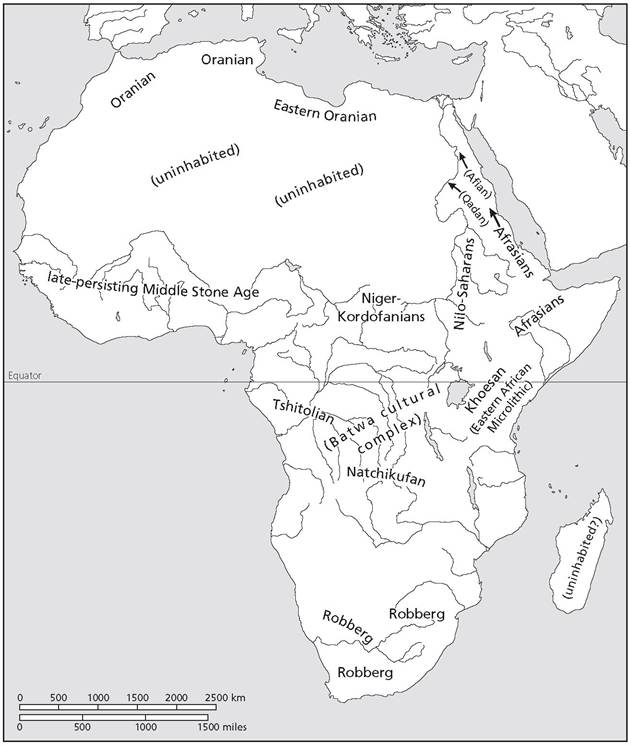
Map 15.2 Major cultural traditions of Africa, 16,000-15,000 bce.
the early Khoesan peoples probably had an Iroquois system of cousin terminology. Interestingly, they appear to have called their mother's brothers by the same term as they used for grandfather, and their father's sister by the same term as they used for grandmother.[472]
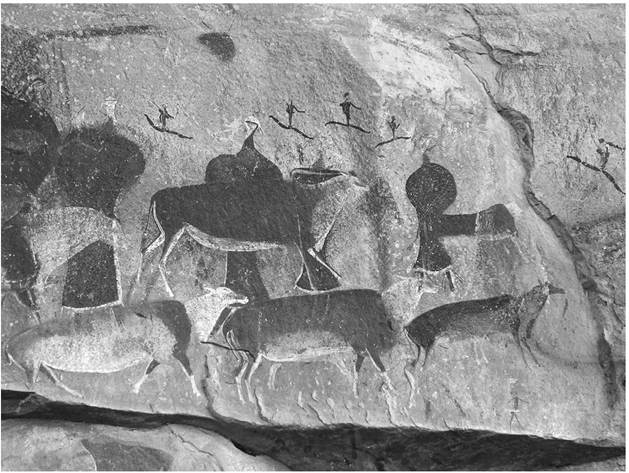
Figure 15.ι Elands, hunters, and spirit beings: Khoesan Rock art at Game Pass, South Africa (photograph by Christopher Ehret).
The early Khoesan held to a belief system in which shamans and the trance experience were central. Attesting to this religious orientation, they were the creators of a major rock art tradition.
This tradition is known from Eastern African Microlithic sites and from the sites of later Khoesan peoples in East Africa. It is known as well all across the areas of southern Africa into which Khoesan languages and the Wilton variety of the Eastern African Microlithic spread later on, during the early Holocene era. Sandawe artists in Tanzania carried on this artistic tradition as late as the twentieth century.[473] Other examples of this tradition, painted during the last several thousand years, can be viewed in the magnificent representations of animals and spirit beings at such sites as Game Pass in Kwazulu-Natal in modern-day South Africa (see Figure 15.ι).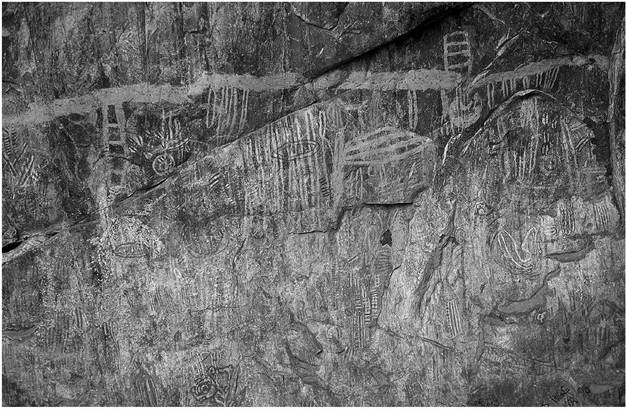
Figure 15.2 Batwa Rock Art (photograph by Benjamin Smith).
In the vast Congo Basin of the western and central equatorial parts of Africa, another long-lived and distinctive cultural tradition emerged during the Last Glacial Maximum. As with the Eastern African Microlithic, a distinctive rock art tradition marks the presence of this “Batwa” cultural complex. The equatorial art tradition of the Batwa occurs all across the Congo Basin, as well as southward into modern-day Angola and parts of Zambia, and east into the African Great Lakes region (see Map 15.2). The most characteristic figures of this tradition are geometric (see Figure 15.2). Rock art scholars have shown that many of these figures were weather signs. This symbolism would have had practical implications for religious observances. In the woodland savanna areas of the southeastern Congo Basin, the rock art sites were places at which Batwa shamans probably carried out rainmaking ritual. The latter-day non-Batwa inhabitants of those regions continue to use the sites for just that purpose down to the present.[474]
Two Later Stone Age industries of the period following the Last Glacial Maximum can be suggested to correlate with different varieties of the Batwa tradition - Tshitolian in the western and southern Congo Basin and in Angola, and Natchikufan in the southern and southeastern Congo Basin.
Because of the paucity of work on sites of this period in other areas where the Batwa artistic tradition flourished, its plausible archaeological connections elsewhere remain to be proposed. The tradition overall may go back before 18,000 bce. The Later Stone Age communities dating to around 40,000 bce at Matupi Cave in the northeastern Congo Basin, and the communities at Shum Laka of around 30,000 bce, may well have been the direct cultural forebears of the Batwa of the past 20,000 years. This is a historical question of great interest and an important one for future archaeological investigation.The peoples of the Batwa tradition since the Last Glacial Maximum have included populations of differing outward appearance. In the equatorial rainforest belt the Batwa of recent millennia have been people of particularly short stature. European outsiders in the nineteenth century, as already noted, gave them the highly inappropriate name “Pygmies,” taken from Greek mythology. Other Batwa of recent times, residing in the southeastern Congo Basin, were not especially short, however, and it may well be that the shorter stature of rainforest Batwa was not an ancient physical characteristic, but something that developed over historical time.
In southern Africa the last Middle Stone Age cultures appear to have died out during the early stages of the Glacial Maximum, and the Later Stone Age cultures of fully modern humans like ourselves came finally to predominate everywhere. Across the southern parts of the Western Cape Province and in the Eastern Cape, a new Later Stone Age industry, the Robberg, occupies the archaeological record from early in the Glacial Maximum, around 18,000 bce, down to the close of the Bolling-Allerod Interstadial in the eleventh millennium bce. Microliths, including bladelets and backed blades and other pieces struck from bipolar and bladelet cores, were typical of the Robberg industry, along with worked bone pieces and ostrich eggshell beads. In the Eastern Cape and neighboring areas, the Robberg culture superseded and replaced the final manifestations in southern Africa of the Middle Stone Age.
Northeastern Africa, 22,000-12,700 bce
Immediately north of East Africa lay another region of key significance for African history in the Last Glacial Maximum. The earliest speech territories of three major language families of Africa clustered in those areas: Nilo-Saharan between the Nile and the western edges of the Ethiopian highlands; Afrasian (also called Afroasiatic)[475] in the highlands; and Niger- Kordofanian in modern-day South Sudan, probably in areas immediately west of the Nile (see Map 15.2). The southern Ethiopian highlands were even then a land of relatively high rainfall, and South Sudan possessed large areas with both permanently and seasonally available surface water, even with the lower flow rates of the Nile in those times. The archaeologist Steven Brandt has argued that, because of these environmental advantages, animal and plant food resources were more plentiful, and so these areas became population refugia during this arid period.[476] The peoples of this region stand off in one notable respect of their social histories from the Khoesan and from the Batwa. Unlike the societies farther south in Africa, the peoples in South Sudan and the Horn of Africa all seem to have developed unilineal descent systems during the span of the Last Glacial Maximum.
The archaeological evidence for the earliest Niger-Kordofanian and Nilo- Saharan peoples is as yet scant. Nothing is known of material culture during the Glacial Maximum in South Sudan and very little about the archaeology of adjacent areas immediately north of South Sudan and south of the expanded Sahara of that period. What little information exists suggests that fishing and the exploitation of other aquatic resources may have been important for both sets of peoples and that the hunting of large herbivores may have been significant in areas away from permanent streams.[477]
From the comparative ethnographic evidence it appears probable that the proto-Niger-Kordofanian society of that period had already added a new, deeper level of kin relationship - lineages and clans characterized by matrilineal descent rules. Membership in a lineage or clan is based on the claim of its members to descent from a common ancestor who lived, in the case of a lineage, several generations ago or, in the case of a clan, many generations ago. The likely earliest form of this institution among Niger-Kordofanian peoples would have been localized lineages of relatively shallow generational depth, rather than the clans common in later historical eras. In a matrilineal system one belongs to the lineage or clan of one's mother and not one's father. Shamanism surely remained the prevailing form of religious belief and observance among the early Niger-Kordofanian communities in South Sudan, since it persisted as a living tradition down to recent times among peoples of the Kordofanian branch of the family.[478]
Among the early Nilo-Saharans, a similar religious orientation, with shamans as the spiritual mediators, continued to shape people's understanding of the world and their place in it.[479] The evidence of reconstructed ancient lexicon confirms, as well, that the proto-Nilo-Saharan society, which most probably dates to late parts of the Glacial Maximum, had begun to organize itself, too, around unilineal kin groups with matrilineal rules of descent and inheritance. There are indications in the derivations of ancient words relating to kinship that the Nilo-Saharan matrilineal clan institutions may have grown directly out of social relations that had previously revolved around coalitions of closely related women (see Chapter 14 for more on the early importance of this kind of institution). An extensive and systematic reconstruction of the kin nomenclatures of the Nilo-Saharan family, not yet possible for the Niger- Kordofanian family, shows that the proto-Nilo-Saharans had an Iroquois cousin terminology and indicates also that a preference for cross-cousin marriage was an ancient feature of their social relations.[480]
Interestingly, Nilo-Saharan and Niger-Kordofanian peoples anciently appear to have shared a particular idiom supportive of matriliny. Both among Nilo- Saharan peoples, such as the Uduk of Sudan, and among Niger-Kordofanian peoples, such as the Akan of Ghana, there has existed a belief - a probable shared inheritance going back to the South Sudan origins of both families during the Glacial Maximum - that one's blood comes from one's mother: that one is a literal “blood” descendant of one's mother but not of one's father. One may inherit other features from one's father, but not one's blood.
The Afrasian peoples of the Last Glacial Maximum operated out of a set of cultural perspectives and practices rather different from those of their Niger- Kordofanian and Nilo-Saharan contemporaries. To properly understand this history, we need first to dispel two serious misconceptions about the origins of the Afrasian language family, both of which still sometimes turn up in the historical literature.
First and foremost, the Afrasian family did not originate in the Middle East. It originated in Africa and specifically in the Horn of Africa. The linguistic evidence is unequivocal. The first and most ancient divergence in the family gave rise to the Omotic branch and to a second branch, Erythraic (“Red Sea”), to which all the non-Omotic languages of the family belong. The languages of the first-diverging branch, Omotic, are entirely restricted to the southern Ethiopian highlands. At the second period in the history of the family, the Erythraic branch diverged into two sub-branches, Cushitic and North Erythraic. The languages of the Cushitic sub-branch extend through the rest of the Horn of Africa, along with one even more southerly outlier, the Southern Cushitic languages of Kenya and Tanzania. The divergence of the proto-North Erythraic language, the common ancestor language of the three northern subgroups of the family, Berber, ancient Egyptian, and Semitic - as well as the Chadic subgroup spoken to the west in West Africa - did not take place until the third and still later period of this history.[481]
The historical implications are clear: The homeland of the Afrasian family was in the Horn of Africa, most likely in the Ethiopian highlands, and the first two periods in the history of the family played out there. Only with the emergence of the North Erythraic sub-branch at the third era of early Afrasian history did a northward spread of Afrasian-speaking peoples out of that region take place. A recent linguistic study estimates that the first two divergences in the family fell in the rough time span of 22,000-15,000 bce - coincident with the Last Glacial Maximum - and that the separation and expansion northward of the North Erythraic speakers took place in the immediately following era.[482]
The reconstruction of the ancient subsistence lexicon in the Afrasian family reveals a reliance of Afrasian peoples from the beginning on wild grains as a key food source: a goodly number of ancient root words for grains and the processing of grain go right back to the ancestral language of the family, proto-Afrasian. This evidence also reveals that, from an early period, they ground their grains into flour and made flat breads from it.33 The ability to exploit grassland environments, which expanded greatly in the Ethiopian highlands during the Glacial Maximum, may have had a lot to do with growth and spread of the early Afrasian-speaking communities.
A second misconception is that the proto-Afrasians were farmers and/or herders. This idea, which has made its way into some recent archaeological literature,34 is flatly counter-indicated by the linguistic evidence: there is no linguistic evidence of either the cultivation of crops or the raising of domestic animals by Afrasian peoples until the onset of the Holocene era. Lexicons of cultivation and herding did eventually develop among later Afrasian societies, but only separately and independently in each of the sub-branches of the family, long after the divergences and expansions that first spread Afrasian peoples from the Horn to northern Africa and the Levant.35
The earliest Afrasian peoples, besides differing from their Nilo-Saharan and Niger-Kordofanian contemporaries in being collectors of wild grains, differed also in their social organization and belief system. Already by the proto-Afrasian period, unilineal descent systems with clans, originally the
Christopher Ehret, Shiferaw Assefa, and Connie J. Mulligan, “Bayesian phylogenetic analysis of Semitic languages identifies an Early Bronze Age origin of Semitic in the Near East,” Proceedings of the Royal Society B: Biological Sciences 276 (2009), 2,703-10.
33 Christopher Ehret, “Linguistic stratigraphies and Holocene history in northeastern Africa,” in Marek Chlodnicki and Karla Kroeper (eds.), Archaeology of Early Northeastern Africa (Posnan: Posnan Archaeological Museum, 2006), pp. ι,019-55.
34 The source of this claim is Alexandr Militarev, “The prehistory of a dispersal: The Proto-Afrasian (Afroasiatic) farming lexicon,” in Peter Bellwood and Colin Renfrew (eds.), Examining the Farming/Language Dispersal Hypothesis (Cambridge: McDonald Institute, 2003), pp. 135-50. Militarev rests his claim on a set of lexical reconstructions, none of which are actually diagnostic of food production, as is shown in Christopher Ehret, “Applying the comparative method in Afroasiatic (Afrasan, Afrasisch),” in Rainer Voigt (ed.), From Beyond the Mediterranean: Akten des 7. internationalen Semitoha- mitistenkongresses (VII. ISHaK), Berlin 13. bis 15 September 2004 (Aachen: Shaker Verlag, 2007), pp. 43-70.
35 Christopher Ehret, “A linguistic history of cultivation and herding in northeastern Africa,” in Ahmed G. Fahmy, Stefanie Kahlheber, and A. Catherine D'Andrea (eds.), Windows on the African Past: Current Approaches to African Archaeobotany (Frankfurt am Main: Africa Magna Verlag, 2011), pp. 185-208; Shiferaw Assefa, “Omotic peoples and the early history of agriculture in Southern Ethiopia,” unpublished Ph.D. dissertation, University of California at Los Angeles (2011); and Christopher Ehret, “Linguistic stratigraphies.” organizing units of local communities, had become the rule among Afrasians. Whether the early Afrasian clans traced descent matrilineally or patrilineally is uncertain. Connected to these social developments, in the early Afrasian belief system each clan or alliance of related clans had its own particular deity to whom its members owed allegiance and to whom people sacrificed to seek good fortune for the individual or the community. Other gods existed, but they were the gods of clans or alliances of clans other than one's own and should not be paid homage to.
A belief system of this kind, in which people give allegiance either only or primarily to their community's or society's own god, even though they accept that other gods exist, is called henotheism. This conception of Spirit survived down to the twentieth century among peoples in southwestern Ethiopia who spoke languages of the Omotic branch of the Afrasian family.[483] It lies behind the pre-dynastic religion of the ancient Egyptians, each of whose nomes had its own god. Yahweh, the god of the ancient Hebrews, who spoke a language of the Semitic branch of Afroasiatic, was originally just such a god as well - he was the god of the allied clans (the “twelve tribes”) of the ancient Israelites, but not of other, neighboring peoples. The wording of the first commandment in the Hebrew Old Testament - "Thou shalt have no other god before me" - takes for granted the existence of other gods. It does not say that there are no other gods, but rather that Yahweh/Elohim should be the only god recognized and worshipped by the Israelites. The ancient Afrasian root word for this kind of deity was *netl'-; the ancient Egyptian word for “god,” ntr, derives from this old root word.
Northern Africa, 22,000-12,700 bce
In northern parts of Africa, human adaptations to the conditions of the Glacial Maximum took a diversity of new forms. The archaeological information, despite great gaps in coverage, is on a far better footing than it is for either South Sudan or the Horn in this era. A succession of three historical periods, different in key features of economy and tool making, occupy this historical time span.
The first of these periods began with the appearance of a new archaeological complex in Egyptian sites from around 23,000-22,000 down to around 19,000 bce. In contrast to the emphasis in the long preceding age on blade- and-burin technology, the industries of this new period possessed abundant backed bladelets and introduced a new method for refining the cutting edges of tools, called Ouchtata retouch. The new industries were essentially microlithic, although they generally lacked geometric microliths. Around 21,500 the first phase of the new technocomplex, Fakhurian, gave way to the Halfan/Kubbaniyan culture of Lower Nubia and Upper Egypt. The inhabitants of the Halfan sites of this culture in Lower Nubia hunted such animals as antelope and wild cattle, as well as fished. The communities at Wadi Kubbaniya in Upper Egypt took up an additional subsistence strategy: they combined fishing with an extensive reliance on the tubers of sedge plants, grinding them into flour on grindstones.[484]
The developments of this first era, from the beginning of the Last Glacial Maximum down to 19,000 bce, took place in areas along the Egyptian Nile. To the northwest the older Dabban tradition continued to predominate in Libya. Still farther west, in the Maghreb, human habitation may have been lacking entirely during this high period of the Glacial Maximum. The Middle Stone Age Aterian industry of those areas and its archaic human makers, in any case, had effectively disappeared from the North African archaeological record by that time.
With the easing, around 19,500-19,000 bce, of the peak aridity of the Last Glacial Maximum, the second period began, with its effects felt much more widely across North Africa. This complex is represented by the Silsilian industry in Egypt and the Oranian and the Eastern Oranian industries farther west in North Africa. The shared, defining innovation of the new technocomplex was the microburin technique. The microburin, after which the technique is named, was not itself a tool, but instead a waste product, a small piece broken off in the fashioning of the actual tool.
The establishment of the Oranian (also called “Iberomaurusian”) around 19,500-18,000 bce in the Mediterranean vegetation zones of Morocco and Algeria marks the first certain appearance of fully modern humans in those regions.[485] Around the same time, the Eastern Oranian version of this technocomplex replaced the older Dabban tradition in Libya. Oranian was a bladelet-based industry characterized by bone points and often by very high frequencies of backed bladelets and microliths, including some geometrics in the later stages, and most notably, from the beginning, by the use of the microburin technique and by one of the products of this technique, La Mouillah points. Among other strategies, the Oranian communities hunted Barbary sheep and wild cattle, and they collected both land and water mollusks. The Oranian tradition persisted for around 9,000 years, although with modifications in tool inventories and with shifts in subsistence emphasis at times of climatic shift, down through the Bolling-Allerod Interstadial and the Younger Dryas, to the beginning of the Holocene.39
In Egypt, in contrast, this second era lasted for a shorter time, down to around 15,000 bce. The last phase of the previous era, represented by the Halfan and Kubbiyan cultures, came to an end around 19,000 bce, in keeping with a history in which the new technocomplex would have taken hold in Egypt about the same time as it did in the Maghreb. But because of a gap in the Egyptian archaeological record between about 19,000 and 17,000 bce, direct supporting evidence for the new kind of tool industry is lacking until around 17,000, by that time the Egyptian counterpart of Oranian, the Silsilian, was well established in Upper Egypt. Silsilian like Oranian was characterized by various kinds of bladelets and, most notably, by abundant evidence, as for Oranian, of the new tool-making feature, the microburin technique.40
The origins of this technocomplex are uncertain, but in their high proportions of bladelets and microliths, both Silsilian and Oranian have more in
described, and it carries unwarranted implications concerning connexions between African and the Iberian peninsula.” From the point of view of a historian, Iberomaur- usian is, in addition to its misleading implication of a non-existent Iberian component, an unnecessary mouthful. Dates of 2,000-3,000 years earlier than 19,000 bce have been obtained from some sites, but A. Bouzzougar, R. N. E. Barton, S. Blockley, C. Bronk- Ramsey, S. N. Collcutt, R. Gale, T. F. G. Higham, L. T. Humphrey, S. Parfitt, E. Turner and S. Ward, “Reevaluating the age of the Iberomaurusian in Morocco,” African Archaeological Review 25 (2008), 3-19, argue that these rest on shaky ground or are otherwise suspect.
39 Angela E. Close, “The place of Haua Fteah in the late Palaeolithic of North Africa,” in Bailey and Callow (eds.), Stone Age Prehistory, pp. 169-80; Angela E. Close and Fred Wendorf, “North Africa at 18000 bp,” in Gamble and Soffer (eds.), The World at 18000 bp, vol. ιι, pp. 41-57.
40 Karl W. Butzer, “Late Quaternary problems of the Egyptian Nile: Stratigraphy, environments, prehistory,” Paleorient 23 (1997), 151-73; P. E. L. Smith, “New investigations in the late Pleistocene archaeology of the Kom Ombo Plain, Upper Egypt,” Quaternaria 9 (1967), 141-52; Wendorf and Schild, Prehistory of the Nile Valley; and Beatrix Midant-Reynes, The Prehistory of Egypt from the First Egyptians to the First Pharaohs (Oxford: Blackwell, 2000), chap. 4. common with African Later Stone Age technologies farther south in the continent than with the pre-Glacial Maximum cultures of Egypt and Libya. The Oranian peoples practiced one custom of possible more southerly inspiration as well: they excised the incisor teeth. This trait is not known earlier in North Africa, nor was it found in the contemporary Silsilian in Egypt. But it was a very old custom among Nilo-Saharan peoples farther south in the middle and upper Nile regions.[486] Together these features suggest a possible history for future testing in the archaeology - that a new population element, following the Nile north from the Middle Nile Basin around 19,000 bce, may have contributed to the origins of the new technocomplex of that period.
The third period in this sequence of historical eras began in Egypt around 15,000 bce. Some elements of the technology of the previous age, notably the microburin technique, carried over into the new era. But two key developments of the new era represent a marked departure from the previous practices. Both are new and give the appearance of having originated elsewhere. Geometric microliths of a range of shapes, uncommon before in this region of Africa, but well represented in cultures farther south in the eastern side of the continent, now became prominent in the toolkit. And, most arresting for its economic implications, patterns of tool wear on the lunate microliths of these industries show that their makers practiced a kind of subsistence new to the region - the harvesting of wild grains for food.[487]
The farthest south representative of the new era was the Qadan industry of Lower Nubia and far southern Egypt. The Qadan culture lasted for more than 6,000 years, from 15,000 bce down to the beginning of the Holocene era. It was primarily a microlithic flake industry. Its most typical tools were lunates, used for the harvesting of wild grain. Grindstones for grinding the harvested grains were also numerous in Qadan sites.
In Upper Egypt to the north of the Qadan culture, the Afian industry replaced Silsilian also around 15,000. Lasting down to around 13,000 bce, the Afian toolkit had high percentages of backed bladelets and geometric microliths, including scalene triangles as well as lunates (see Map 15.2).
Between around 13,000 and 11,400 bce, developments along the Egyptian Nile took new directions, with the emergence of numerous relatively large, semi-sedentary sites of wild-grain-collecting people, notably in the Isnan culture of Middle Egypt. Around 15 percent of the retouched tools found in these sites show the sheen of grain harvesting. Endscrapers, denticulates, and notches were very common in their toolkits, as were grindstones, while bladelets became rare. As well, the microburin technique, innovated in the earlier period from 19,000 to 15,000 bcb, continued to be applied throughout this period.[488]
Industries belonging to this technocomplex apparently spread also to Lower Egypt, because the makers of another facies of this complex, the Mushabian, carried technological features, such as the microburin technique and La Mouillah points, north into Sinai and the Negev before 13,500 bcb. North of Sinai the microburin technique in particular spread via Mushabian to the Natufian culture of Israel and Palestine. Some scholars have recently claimed the Mushabian as an indigenous Levantine tradition without connections farther south in Africa, but their analyses do not take account of the fuller toolkit evidence connecting Mushabian to the other cultures of Egypt in that era and, more generally, to the key technological developments in northern Africa over the previous 6,000 years.[489]
There are strong reasons for viewing the conjoined cultural changeovers of the third era, beginning around 15,000 bcb, as the material signature of the arrival of Afrasian people, speakers of dialects of the proto-North Ery- thraic language, in the region. The shifts in technology and economy fall within the estimated time span, according to linguistic arguments, in which the spread of the ancestral North Erythraic people northward toward Egypt most likely took place. Geometric microliths have an earlier pedigree farther south in Africa. And the newly attested food resource of the period from 15,000 onward, wild grains, were an old feature specifically of the earliest Afrasian economies.
The Mushabian communities in particular seem the most likely people to have carried into the Levant the distant ancestor language of Semitic, the sole subgroup of the family found outside Africa today. No other population movement that might account for the presence of Semitic in Asia took place in later periods, and the earlier movements of human beings out of Africa were far too early in time.[490]
Attributing the developments of the third era to early Afrasian speakers accords with genetic findings as well. Y-chromosome evidence in particular places the movement of people from the Horn of Africa - from the early Afrasian-speaking regions - into Egypt during the same general time frame. Offshoots of this migration then spread from Egypt into the Levant and, in later times, westward across northern parts of Africa. The genetic markers of this succession of movements occur today in Egyptians as well as in Semiticspeaking peoples in the Levant and in the later Afrasian-speaking Berber peoples of North Africa.[491]
The genetic indications are also clear that wholesale population replacement did not take place. The incoming populations were a minority, although significant enough in numbers to leave a lasting genetic imprint, who settled among and intermarried with the existing populations. This blending of populations seems mirrored in the blending of old and new technological and economic features, in particular, combining the key innovation of the period before 15,000 bce, the microburin technique, with new kinds of geometric microliths, and adding a productive new food source, wild grains, to the existing subsistence resources.
Out of these interactions, it can be proposed, new social allegiances would have emerged, accompanied by the adoption of the Afrasian language of the incoming people and, presumably, the Afrasian henotheistic religion, since this kind of religion persisted in later times in pre-dynastic Egypt. The ability of incoming groups to incorporate existing communities into new social formations often rests on whether or not the newcomers' ways of life give them a material or social advantage in their cross-cultural encounters with previous populations. A prime factor in this particular case may have been the introduction by the immigrants of a new suite of subsistence practices that would have added greatly to subsistence productivity - namely, wildgrain collecting. And because humans tend to interpret material success as an indicator of spiritual favor, the henotheistic religion of the incoming groups could have been seen as therefore efficacious and worthy of adoption.
The most direct route for the proposed spread of Afrasian speakers from the Horn of Africa to Egypt around 15,000 bcb would have followed the chain of mountains and hills connecting the two regions, along the African side of the Red Sea. From around 15,500 bcb an uneven trend toward warmer and somewhat wetter climate seems to have taken place at the northern end of the Red Sea and adjacent parts of the Levant and Arabia. Climate in the Red Sea hills zone has historically been more tied to these areas than to African areas to the west, making it possible that the effects of this rainfall increase extended to the Red Sea hills as well. If so, grassland areas, suited to wild-grain collection, would have expanded along that hilly and mountainous zone. The spread of grasslands would in turn have opened up an environmental pathway for the spread of Afrasian wild-grass collectors from Eritrea to Upper Egypt and for the establishment along the Nile, in the centuries around 15,000 bcb, of the new Afian and Qadan cultures, which practiced this kind of economy.