Technology and economy in Africa, 48,000-22,000 bce
SOUTHERN AFRICA, 48,000-22,000 BCE
In southern Africa in the period following 63,000 bce, as we have already seen (in Chapter 14), makers of the incipient Later Stone Age Howiesons Poort culture had gained a foothold across many parts of southern Africa.
But that cultural and technological intrusion from East Africa came to an end by around 58,000 bce, and Middle Stone Age industries became once again universal across those regions.Then, from around 46,000 bce or possibly somewhat earlier, a new movement of fully modern humans south into southern Africa began (see Map 15.1). Possessing a developed Later Stone Age toolkit - with backed bladelets, crescents, backed points, becs, burins, awls, and drills - these communities established themselves first in northern Botswana. By 43,000 bce these Later Stone Age communities had extended their lands another 1,600 kilometers to the south, as far as Elands Bay in the modern-day Western Cape Province of South Africa. Almost as early, and certainly before 37,000 bce, still other Later
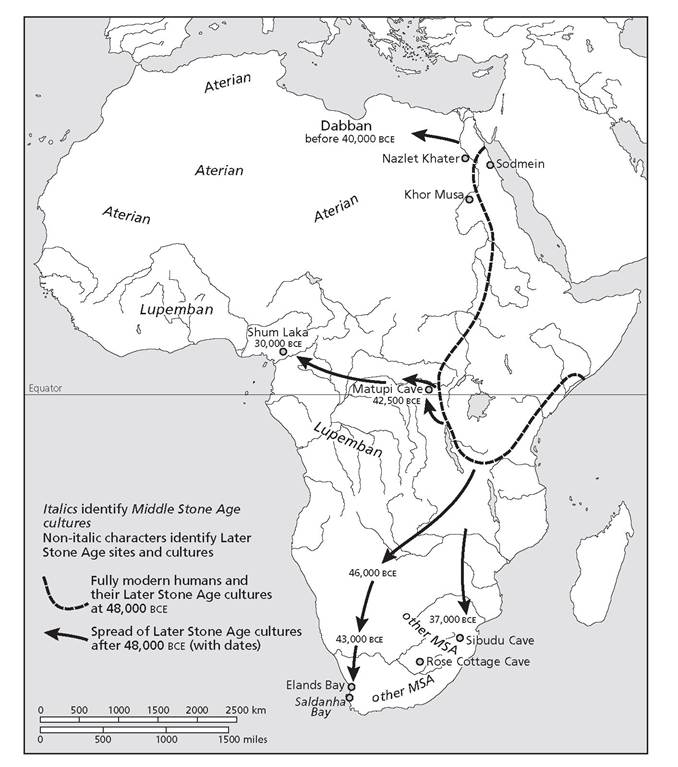
Map 15.i Dispersals of fully modern humans with Later Stone Age technology across Africa, 48,000-30,000 bce.
Stone Age communities spread to the eastern side of southern Africa, as far south as Swaziland and northeastern Kwazulu-Natal.[453] By no later than this period, the Later Stone Age peoples in southern Africa, and in East Africa as well, had begun to enhance the effectiveness of their hunting of animals, especially large herbivores, by applying poison to their arrows.2
The existing Middle Stone Age populations of southern Africa did not simply disappear, however. As in Europe and other parts of Eurasia, so also in southern Africa it is apparent that the earlier hominins - in this case, archaic humans - continued for thousands of years to persist in areas nearby to those occupied by the incoming fully modern humans.
Through much of the Later Stone Age sequence from 43,000 down to 18,000 bce at Elands Bay, for example, a very different Middle Stone Age industry, with a different subsistence focus, on shellfish, persisted only 50 kilometers away, at Saldanha Bay.3 Two populations, it appears, one archaic human and one fully modern human, shared this region for up to 20,000 years. Only around 18,000 bce did the Middle Stone Age tradition finally disappear from the archaeological record, with only Later Stone Age industries continuing on into more recent eras.Farther east, often in the mountainous interior areas of South Africa, Middle Stone Age populations also maintained their ways of subsistence and their technology as late as the inception of the last Glacial Maximum, around 22,000 bce. At Sibudu Cave in Kwazulu-Natal, the latest Middle Stone Age level dates to that time. In the Eastern Cape foothills of the Drakensberg escarpment, Middle Stone Age industries lasted somewhat longer, to 20,000 bce, while across the Drakensburg range, in Lesotho, the final Middle Stone Age finds date to 19,000-18,000 bce. In the Swartburg range in the western parts of the Eastern Cape, the Later Stone Age began around 20,000 bce, and so the Middle Stone Age industry may also have endured in that area down to the onset of the Glacial Maximum. To the northeast, in the Caledon Valley of the Free State Province, the Middle Stone Age industry at Rose Cottage Cave prevailed until at least 26,000 bce. Other materials at this site, dating to
before, during, and after the Last Glacial Maximum,” in Clive Gamble and Olga Soffer (eds.), The World at 18,000 bp (London: Unwin Hyman, 1990), vol. ii, pp. 214-28; and M. I. Bird, L. K. Fifield, G. M. Santos, P. B. Beaumont, Y. Zhou, M. I. di Tada, and P. A. Hausladen, “Radiocarbon dating from 40 to 60 ka bp at Border Cave, South Africa,” Quaternary Science Reviews 2 (2003), 943-7.
2 Lawrence H. Robbins, Alec C. Campbell, George A. Brook, Michael L.
Murphy, and Robert K. Hitchcock, “The antiquity of the bow and arrow in the Kalahari Desert: Bone points from White Paintings Rock Shelter, Botswana,” Journal of African Archaeology 10 (2012), 7-20.3 Deano D. Stynder, Jacopo Moggi-Cecchi, and Lee R. Berger, “Human mandibular incisors from the late Middle Pleistocene locality of Hoedjiespunt 1, South Africa,” Journal of Human Evolution 41 (2001), 369-83.
around 19,000 bce, provide an example oflate Middle Stone Age populations adopting some of the tool-making techniques from contemporary Later Stone Age peoples and adding them to their otherwise Middle Stone Age technology.[454]
The establishment of Later Stone Age populations in northern Botswana by 46,000 bce, and their extension southward to the Cape by 43,000 bce, and to Swaziland almost as early, make it probable that the forebears of these peoples passed through Zimbabwe and eastern Zambia no later than 46,000 bce on their way farther south. These two countries, after all, lay athwart the lines of cultural dispersal southward from the origin areas of the Later Stone Age in East Africa. The latest dates for the last Middle Stone Age industry in Zimbabwe, Bambata, are earlier than 40,000 bce, in keeping with this expectation. Later Stone Age cultures certainly predominated across Zimbabwe and much of Zambia by the close of the period, 22,000-20,000 bce, but the history of cultural and technological change of the intervening eras between 48,000 and 22,000 bce remains poorly understood.[455]
Central and West Africa, 48,000-22,000 bce
The spread of modern humans with Later Stone Age industries westward from East Africa probably began soon after 48,000 bce as well. The earliest Later Stone Age level from Matupi Cave in the Ituri region of the northeastern Congo Basin - characterized, among other things, by true microliths, small notched points for hafting, and burins - dates to before 42,500 bce, although just how much earlier is uncertain.[456] By around 30,000 bce, fully modern humans with a similar Later Stone Age technology had reached the other side of the Congo Basin.
The earliest occurrence as yet identified from those areas is at Shum Laka rock shelter in western Cameroon (see Map 15. ι).[457]To the south of Cameroon, in the Congo Basin, just as in southern Africa, archaic humans with Middle Stone Age technologies did not simply disappear before the advance of fully human Later Stone Age people, but persisted for thousands of years. In southern Cameroon and Equatorial Guinea, for example, late versions of the Middle Stone Age Lupemban tradition survived down to the beginning of the Last Glacial Maximum. In those areas fully modern Later Stone Age people finally replaced them probably only as the climatic transformations of the Glacial Maximum took hold. In the eastern Congo Basin, as well, a late Lupemban population may have existed down even into the Glacial Maximum, perhaps exploiting different ecological niches than Later Stone Age modern humans, who themselves had been present in the region from before 40,000 bce.[458]
But farther west in Africa, beyond the mountains that mark the western boundary of the modern-day country of Cameroon, the spread of Later Stone Age technology seemingly came entirely to a halt. West Africa from Nigeria to Mali and Senegal, for reasons not understood, remained a place solely of Middle Stone Age industries not just as late as 22,000 bce, but down through the Last Glacial Maximum. The spread of Later Stone Age industries may have reached the mountains of western Cameroon by 30,000 bce, but there the advance of fully modern humans halted for another 18,000 years.
Northern Africa, 48,000-22,000 bce
In North Africa at 48,000 bce two different histories played out. The arrival of fully modern humans in Sinai and the adjacent Levant by 48,000 bce suggests that, before spreading to Sinai, their immediate ancestors should already have reached Egypt by 50,000-48,000 bce - a proposal, as we have seen, that the archaeology cannot yet confirm or disconfirm.
West of Egypt, however, the Middle Stone Age industries remained unchallenged for several thousand years after 48,000 bce. The Dabban culture, which finally replaced the Middle Stone Age in northern Libya no later than 40,000 bce, possessed predominantly blade-and-burin toolkits, akin to the industries of the same period in nearby Egypt and the Red Sea hills and to those of the Upper Palaeolithic peoples in the adjacent regions of the Levant. The toolkit resemblances across this span of lands are not surprising. After all, the earliest fully modern human populations who moved out of Africa around 48,000 bce, and brought the Upper Palaeolithic versions of the early Later Stone Age into the Levant, most probably emerged out of this corner of Africa.The Dabban industry is the best-studied facies of this North African cultural complex (see Map 15.1). The arrival of the makers of this industry in Libya a bit before 40,000 bce, brought an abrupt end to the last North African Mousterian industry, in existence previously for more than 100,000 years[459] and, presumably, the extinction of the archaic hominin makers of that earlier industry. For a Later Stone Age/Upper Palaeolithic culture, Dabban was especially long-lived, persisting down to around 19,000 bce. Established first in the eastern parts of present-day Libya, it spread sometime after 40,000 bce as far west as Jebel Nefusa in western Libya.[460]
The Egyptian facies of the wider cultural complex to which Dabban belonged are poorly known, and in fact the whole period in Egypt between 48,000 bce and the inception of the Last Glacial Maximum is poorly served in the available archaeology. Nevertheless, the temporal and geographical spread of the few known sites - at Khor Musa, from around 42,000 to 36,000 bce in southern Upper Egypt; at Nazlet Khater in Middle Egypt, dating to around 37,000 to 34,000 bce; and at Sodmein Cave near the Red Sea, at around the same time or earlier11 - show that industries similar to Dabban prevailed far south in Egypt in the same broad period and may have lasted in those areas down nearly to the Last Glacial Maximum (see Map 15.1).
The site at Nazlet Khater is solely Upper Palaeolithic in technology. The materials at Khor Musa are less clear in their historical implications. They prominently include burins and polished bone implements,[461] [462] both features diagnostic of the presence of Upper Palaeolithic tool-making techniques in far southern Egypt by 42,000 bce. But other tools, made with Middle Stone Age, prepared-core techniques, are also present in the Khor Musa sites. Two possibilities obtain here. Either the last Middle Stone Age peoples of far southern Egypt adopted new tool types from nearby Upper Palaeolithic humans, or an intrusion of Middle Stone Age implements into an overlying Upper Palaeolithic level took place, as happened with the Chatelperronian sites in Europe.[463] Either way, the presence of the Upper Palaeolithic tool types places the bearers of this technology in far southern Egypt no later than around 42,000 bce.
In the Mahgreb west of Libya fully modern humans did not arrive until much later. The Middle Stone Age Aterian industry continued to prevail for another 15,000-20,000 years after 40,000 bce. This industry had first spread out across much of the Sahara by 70,000 bce, and possibly as early as 90,000 years ago. At its farthest south it reached to the southern edges of the Sahara, around 19 south latitude; its northern territories included the whole of the Maghreb. Increasingly arid conditions after about 30,000 bce led to the abandonment of most of the Sahara, although there are indications that some Aterian populations may have lasted for several thousand years longer in parts of the Maghreb, possibly down to the onset of the Glacial Maximum.[464] Overall, by 22,000 bce fully modern human beings inhabited nearly all of eastern and northeastern Africa and large areas of southern and Central Africa. They pursued a variety of gathering and hunting strategies, adapted to the variety of environments they had mastered. Nevertheless, archaic humans with Middle Stone Age industries still found ways to subsist and survive alongside fully modern humans in several parts of southern and Central Africa, although probably in declining numbers. Interestingly, archaic humans apparently continued to be the sole inhabitants of West Africa.