Basic patterns in human migration
The basic patterns of human migration have doubtless changed somewhat over the years, but the underlying logic of human migration is remarkably consistent. The common pattern of human migration is for the migrants - dominantly young adult males and females though a minority of that age- group - to leave home and move away to a destination where the landscape, culture, and language are different.
Some migrants move to sparsely settled frontiers and others to centers of population; some return home, while others remain at their destination or even move further. Migrations are initiated by human decision but also by natural disasters that can force whole communities to move. The motivations of migrants include adventure, escape, expulsion, commerce, war, and a search for resources to bring back to their home community. Such migration is a recurring yet fluctuating process: for instance, migration has sometimes been principally along water routes and at other times along land routes.Comparisons among species help to clarify certain unique characteristics in human migration. The general meaning of migration is movement of an individual organism from one habitat to another, where a habitat is a contiguous environment with resources enabling the organism to thrive. There is thus a difference between local mobility and cross-habitat migration. Migration generally serves a function in the life cycle of the individual and the species. Seasonal migration, commonly of whole communities, is thus important in reproduction and food supply for many species. In addition, species commonly migrate by diffusion as they gradually expand or contract their range. Thus Homo erectus spread, beginning a million years ago, from East Africa to various parts of the Old World, and gave rise to successor species in Asia, Europe, and Africa.
Our own species, Homo sapiens, succeeded in settling the whole world.
The process for this migratory expansion was that of cross-community migration, in which young adults moved from one habitat to another. Habitat, however, must be redefined for human purposes to depend on the social as well as natural environment: that is, an environment with a given language and culture. The ancestral African habitat of Homo sapiens centered on tropical savannas, including locations at water's edge, and also including highlands - it was best to have a variegated habitat, which reinforced omnivorous eating habits. Humans hunted and gathered, but also ate plants and animals from the waters, swam, and created watercraft. These elements - the ancient migratory practices of mammals, the new practice of cross-community migration, and the reliance of humans on movement across water - provided a basis for modern Homo sapiens to occupy all the territories of the earth.Human migrants, in entering new ecologies, transformed them as well as accommodated to them, making each into a new habitat. With each human colonization of a new continent, a great die-off of megafauna followed - for Australia (giant kangaroos), then in temperate Eurasia (mammoths), and later in the Americas (sloths). This was destructive behavior at one level, but also showed the potential of human migration for bringing about change. The social function of cross-community migration was to create and spread innovations from habitat to habitat, so that it has been a significantly adaptive behavior. The function of creating innovations - added to the benefits brought by sharing of the genome, technology, and culture - is important in explaining how learning got to be passed from generation to generation.
The early days of human history brought two big changes in migratory patterns that have been with us ever since. The first was determined by environment and climate, the second by biological and social evolution. First is the rise of an expanded pattern of migration within the homeland of modern humanity.
Homo sapiens first emerged on the East African savannas some 200,000 years ago. Then a long, cool, dry period in East Africa, from 190,000 to 130,000 years ago, encouraged human communities to move south across the equator to the similar lands of southeastern Africa, which were relatively warm and wet at that time. Indeed, the annual and longer-term shifts of the monsoons (bringing precipitation alternately to northeast Africa and southeast Africa) may well have built up a pattern of migration back and forth among those regions, along with social networks to facilitate these movements. The result was to favor the expansion of the human gene pool and to build in social habits encouraging migration. The results show up in studies of the early human genome. This process facilitated migration, specialization, and broad sharing among communities (see Map 12.1).The second step was the rise of syntactic language. At some point, certainly before 70,000 years ago, our ancestors gained improved vocal articulation and with it the beginnings of fully articulated speech. At least four types of change overlapped to bring about the rise of syntactic language. Desire for communication put selective pressure on devices to facilitate it. Physical evolution of the larynx, selected by this demand, enabled more precise articulation of sound. Other genetic mutations created the logic to facilitate the syntactic conventions by which children form sentences. Then generations of practice with language turned it into a device for communicating, categorizing, and storing learning. This revolutionary transformation appears to have taken place within communities totaling several thousand people in Northeast Africa. Development of speech built language communities - groups of several hundred people sharing common speech practice. With the rise of language, individual human communities expanded in size, as they became united by language and no longer simply by co-residence. Further, various communities gained distinctive identities because of the gradual separation of their language and customs.
Those who migrated from one community to another had to learn new languages and customs: this pattern emphasized learning in individuals, the exchange of customs and technologies among groups, and innovations in assembling old ideas and new. Consequently, migration facilitated an acceleration of social evolution that began to account for most of the change in human societies. Such “cross-community migration” remains the basic style of human migration. The same underlying logic of crossing community boundaries and generating social innovations continues to this day, but has transformed human society almost beyond recognition.28i
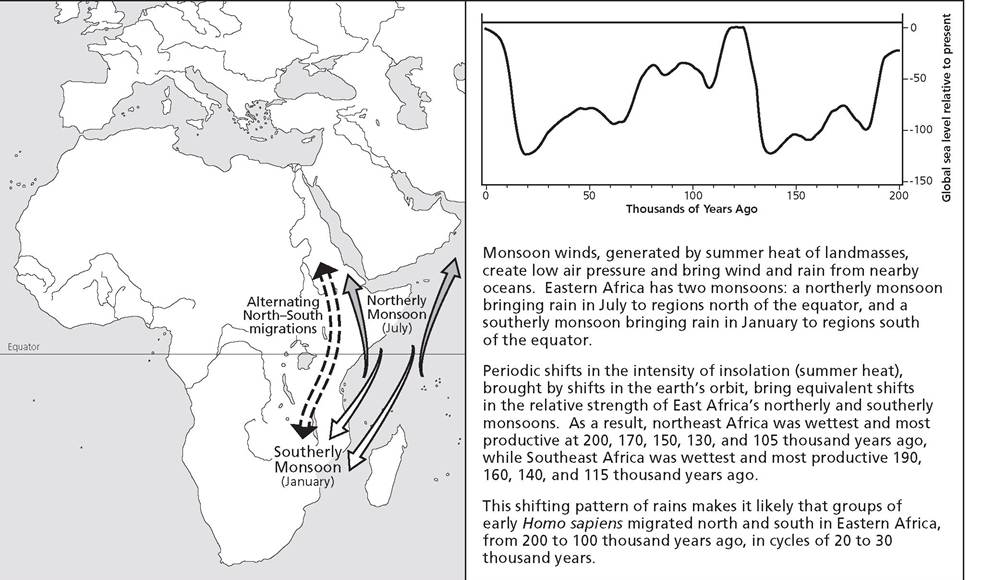
Map i2.i Shifting climate and migration in Africa, 200,000 to 100,000 years ago.
Downloaded from Cambridge Histories Online by IP 165.123.34.86 on Tue Jan 19 20:52:34 GMT 2016.
Migration patterns of today rely on the same social processes. Modern communications technology has allowed language communities to grow to many millions of members and to extend over immense geographic spaces, so that the meanings of “community,” "cross-community migration,” and “habitat” have changed greatly. In a world of literacy and schooling, learning now takes place through mechanisms other than migration - although migration remains important in learning, as any migrant can testify. The risks in migration are now much lower than before, and the number of migrants can expand without great cost in human life. With the passage of time, diaspora communities (migrants and their descendants who maintain a sense of common identity with their homeland) have been able to grow and play a distinctive historical role. In current research, we have learned to distinguish among individual migrants, their communities, gendered patterns in migration, recruiters, dispatchers, members of the networks facilitating migration, gatekeepers restricting migrants, methods of maintaining family contacts, and the shifts in identity accompanying migration. Because of the basic continuity in migration, the details we have learned about migration in contemporary society can be helpful in reconstructing parallel details in early times.
More on the topic Basic patterns in human migration:
- Wiesner-Hanks Merry E., Bentley Jerry H., Subrahmanyam Sanjay. (Eds). The Cambridge World History. Volume 6. The Construction of a Global World, 1400-1800 ce. Part 2: Patterns of Change. Cambridge University Press,2015. — 510 p., 2015
- Wiesner-Hanks Merry E., McNeill John, Pomeranz Kenneth. (Eds). The Cambridge World History. Volume 7. Production, Destruction, and Connection, 1750-Present. Part 2: Shared Transformations? Cambridge University Press,2015. — 569 p., 2015