Occupying the planet: from 100,000 to 15,000 years ago
In very early human migrations, the principal movements were to territories ecologically similar to the grasslands and waterways of eastern Africa. Within Africa it was easiest for humans to occupy similar ecologies such as the grasslands and watersides of southern and western Africa.
More difficult to occupy were the forested areas of Central and West Africa. Meanwhile, shifts in climate brought changes in vegetation and habitat. A warm and wet time from 110,000 years ago to 90,000 years ago made the Sahara inhabitable rather than desert, and it is known that populations of humans settled as far afield as the Qafzeh cave in Israel, dated at 100,000 years ago. But as the climate again became colder and drier, these settlements did not survive.The emergence of syntactic language, some 70,000 years ago in northeastern Africa, developed the communities that spread throughout the planet, incorporating or displacing all other hominids and imposing their dominance on all other species. Christopher Ehret, elsewhere in this volume, draws on archaeological and linguistic evidence to trace the expansion of technically advanced and populous communities - almost certainly those with syntactic language - into region after region of the African continent from 70,000 to 20,000 years ago, progressively incorporating populations that were physically similar but had simpler technologies and may have lacked language. This was the early expansion of modern humanity by land.
At much the same time, modern humans who left Africa went primarily by watercraft across the mouth of the Red Sea to South Arabia and beyond. With early watercraft and newly polished languages, these adventurers were able to cross the few kilometers from Somalia to South Arabia and remain within a relatively constant environment. (Sea levels were then much lower than now.) Somewhere in the time between 70,000 years ago and 50,000 years ago, human populations worked their way eastward along the Indian Ocean coastline, presumably on both land and sea (see Map 12.2).
The migrants were able to find animal and vegetable resources, from land and water, similar to those known to their ancestors in Africa. Beyond the coastline they were able to explore and settle river valleys - the largest included the Indus, Godavari, Ganges, Irrawaddy, and Mekong. Moving upriver within these valleys, the migrants would eventually have come to mountainous areas - tropical and sub-tropical highlands parallel to those in East Africa, which held the advantage of being well-watered and sustaining a wide variety of plant and animal life at varying altitudes. The evidence of language groups suggests that some of these Asian highland areas - above the Irrawaddy, Brahmaputra, and Red River Valleys - developed concentrations of human population.
Along the coastline, the migrants continued their expansion through the tropics, settling on both mainland and islands. They settled the archipelago that is now Indonesia and was then the much larger continent of Sunda, as the low sea level revealed lands linking many of the islands. At the end of Sunda, the migrants found ways to reach still more distant lands: Australia (dated to 50,000 years ago), New Guinea (then joined to Australia as part of the continent of Sahul), and the Philippines. Each lay across a great oceanic strait, so that the migrants crossed open water of 100 kilometers, and did so on multiple occasions, as the genetic record attests. Similarly, humans followed the coast of the South China Sea, eventually reaching more northerly and even temperate zones.
Human migrants, having mastered the tropics, did not automatically move north to temperate zones, since the colder climate and the sharply different flora and fauna required new technology. Humans may have remained settled throughout the Old World tropics for as much as 20,000 years (that is, from 65,000 to 45,000 bp) before moving into the temperate zone. From well-dated European remains, we know that Homo sapiens (known locally as Cro- Magnon) reached Europe as early as 45,000 years ago and Central Asia and Mongolia at roughly the same time.
What is not certain is the route by which284
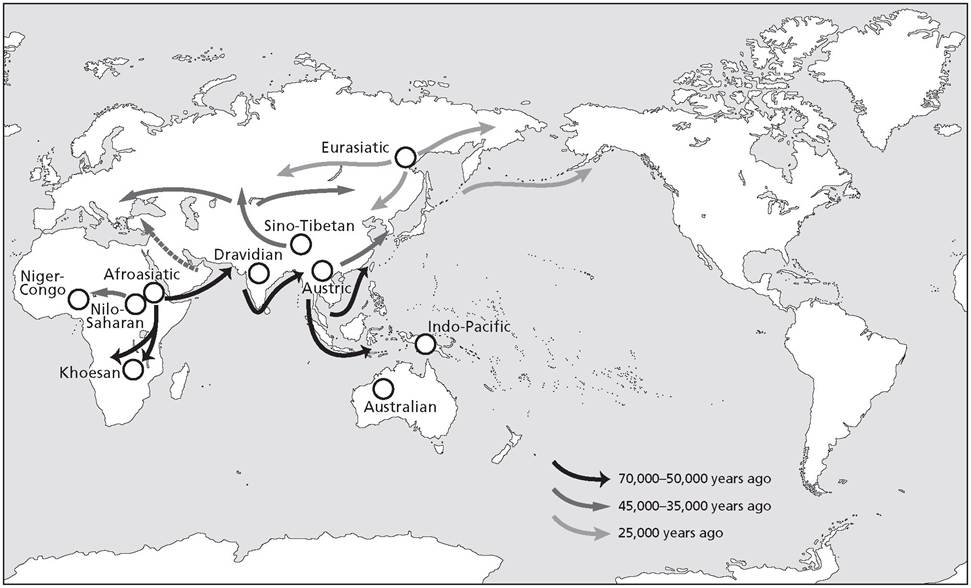
Map 12.2 Occupying the planet, 70,000 to 25,000 years ago.
they moved from south to north. Potential routes include the Nile-Fertile Crescent corridor, the Persian Gulf-Caucasus corridor, routes north from India, and the Pacific coast of China. One route appears from present evidence to have had particular advantages - a corridor along the Ganges Valley and the slopes south and west of the Himalayas, to the grasslands in today's Kazakhstan. Along one or more of these routes, humans reached and learned to live with the sharply varying temperatures and rapidly running rivers of the temperate zone. With this achievement, they gained the ability to range east and west across the Eurasian grasslands along routes that have been used ever since.
While this narrative has focused on migratory occupation of new lands, there was much more to human history in this era than frontier expansion. At each stage, changes took place in social structure, technology, and even in human biology. Occupying each region required learning to live in its microecologies and becoming acquainted with its flora and fauna - for instance, learning to take advantage of bamboo in eastern Asia. Changes in clothing accompanied new techniques in hunting and fishing. Meanwhile, entirely unconsciously, as communities occupied regions for thousands of years, their bodies underwent pressures that affected their stature, body type, skin, hair, and facial features. We can say, therefore, that these superficial physical differences that we use to identify “race” exist because of migration, and that they mostly emerged between 40,000 and 10,000 years ago.
Further, early human migration was not only and not principally to settle “empty” territories. According to the interpretation developed here, most migration was back and forth among existing human communities, rather than for the creation of new communities. Inter-communal migration in the era of human expansion may be characterized especially through the spread of the major language groups or phyla. For instance, the Afroasiatic and Nilo- Saharan language groups appear to have had their ancestry in the western half of Ethiopia. Yet members of the two groups have clearly undergone migrations at various times in their long histories, so that speakers of the two language groups have become widely dispersed.