Community change during the Glacial Maximum and Holocene Epoch
The era from 25,000 years ago to 5,000 years ago brought what was probably the most extreme set of climate changes that humans have ever experienced. Recent research shows that climate change, while regionally specific, has been chronologically united, so that no part of the earth escaped the sudden and repeated shifts in temperature and precipitation during these twenty millennia.
First came the cold. From 25,000 to 15,000 years ago the Glacial Maximum brought a cold and dry time that reached its worst about 18,000 years ago, when the expansion of polar glaciers had lowered sea level, temperature, and humidity worldwide to the lowest levels of the preceding 100,000 years. Then came the warmth. The great fluctuations in climate continued with a warming period that melted glaciers, thus raising sea levels, temperatures, and precipitation. Within 4,000 years, the seas rose by nearly 100 meters, inundating coastlines everywhere. Even more remarkably, as of about 6,000 years ago this Holocene Epoch brought a suddenly stable climate, in contrast to the fluctuations that had long preceded. Geologists have drawn a line to specify the end of the Pleistocene Epoch and the beginning of the Holocene Epoch at about 12,000 years ago (see Map 12.3).In this difficult time humans somehow accelerated a process of innovation that ultimately gave them increasing mastery over nature, even as nature provided the most severe of tests. Cross-community migration continued, and helped to provoke and disseminate the new ideas. The greatest attention in innovation has gone to the rise of agriculture during the first half of the Holocene Epoch. It is appropriate, however, to affirm a more general appreciation of human technological and social innovation over a somewhat longer era: the Glacial Maximum and the Holocene combined to bring the era of production. That is, in this era of turbulent environmental change, human innovation turned increasingly away from collecting and toward producing resources.
While continuing to rely on hunting, gathering, and fishing, many types of community began to emphasize several new types of production - permanent homes, ceramics, new and increasingly precise sorts of tools, new forms of art, and experimentation with control of animals and plants. The new techniques appear in the record of the Glacial Maximum for Africa and Eurasia. Artisanal work persisted (as indicated by the art work, clothing, and watercraft on which humans had long relied), but the scope and skill of artisanal work expanded. Pottery began to appear, for instance in the Jomon ceramics of Japan beginning over 12,000 years ago. Archaeologists have long classified an aspect of this shift as the “Neolithic” era, referring to the “new” stone work that centered on very small and finely crafted stone implements. Social changes took place in this same era of innovation: for instance, unilineal descent systems appear to have arisen among African speakers of Nilo-Saharan and Afroasiatic languages.The final great stage in occupying the continents was human settlement of the Americas. Migrants succeeded in moving further north and east in
2.87
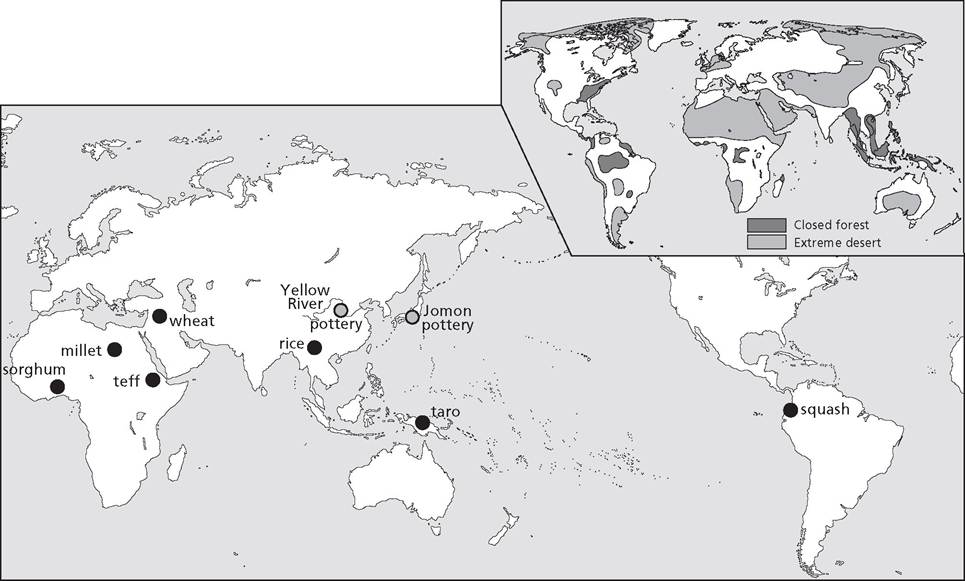
Map 12.3 Glacial Maximum and Holocene eras, 25,000 to 5,000 years ago.
Eurasia, into North America, at times estimated as early as 30,000 years ago and as late as 15,000 years ago. This advance, though not yet known in detail, may ultimately reveal much about the cross-community patterns of early human migration. Both land and sea migrations to North America are known to have taken place in later times, so that either mode of transportation could have worked for the first entry. Travel by sea may have been more feasible in this cool and ice-ridden era: the Pacific kelp beds provided offshore nourishment in a great arc along the coast from the South China Sea to South America. Ultimately, migrants entered Arctic tundra, temperate forests, grasslands, desert regions, tropical forests, and further ecologies, with migration spreading innovations.
The Clovis culture, with its focus on finely honed points for knives and harpoons dated to 13,500 years ago, was long thought to represent the first arrival of humans in North America. It is now understood to reflect the spread, among populations already in place, of an innovation in technology that found wide use.The agricultural chapter in the story of expanding production seems to have been provoked by sharp climatic change. Several privileged regions (including at least one in South America) shared variety in botanical species and physical relief, thus enabling experimentation with numerous plants. When temperatures began to rise after the low-temperature trough of the Ice Age 18,000 years ago, vegetation flourished and humans began to depend on gathering expanding food supplies. But a thousand-year cold snap starting some 12,000 years ago (known as the Younger Dryas) brought a severe decline in food supplies and an impetus to discover ways to produce rather than just gather food. Further, the response to climate change was most productive in mountainous areas: it played out over several thousand years to bring the production of wheat in the Fertile Crescent, taro in New Guinea, rice in Southeast Asia, millet in Ethiopia, squash in South America, and sorghum in the Sahara.
As the Holocene era took form, the developing system of production began to influence patterns of migration. In some ways, developing productive activities tied communities to particular places, restricting their nomadic patterns of old. In other ways, productive skills meant that humans could forge a living wherever they wished to go, relying on their own resources rather than simply on those available in nature. Agriculture brought higher population density, development of new diseases, and migration of both humans and disease vectors. Debate continues as to whether the agricultural populations expanded systematically in number and in territory in contrast to their neighbors or whether the techniques of agriculture spread more rapidly than the initial farming populations.
While the full results are not yet in, the evidence is strong for a patchwork of particular cases. Rice may have spread through Southeast Asia through the expansion of farming communities, while wheat may have expanded through Western Asia through its adoption by different existing communities.Growing populations tended both to concentrate and disperse. In concentrating, they created village communities, including several hundred or even more inhabitants. In a sense they can be seen as the initial stage of urban life. Equally important, villages established a style of life that thrives today throughout the world. With the greater concentration of labor power, it was possible for communities to undertake control of water flows and other public works: canals, dams, aqueducts, reservoirs, and ritual structures arose in many parts of the world.
In dispersing - and whether relying on agriculture, pastoralism, fishing, or hunting - populations entered and contested lands occupied by previous communities. Traces of recurrent or sustained migrations survive in the languages that are spoken today in regions far from where their ancestral languages can be shown to have originated. Thus, in times of the early Holocene before agriculture became well established, several important migrations left traces in the language groups of today (see Map 12.4). Migrants speaking Afroasiatic languages moved north along the Nile River as conditions became wetter, and formed four major language communities: the speakers of Ancient Egyptian languages in the lower Nile, the speakers of Semitic languages in what became the Fertile Crescent and the Arabian Peninsula, the speakers of Berber languages in Northwest Africa, and the speakers of Chadic languages in the region surrounding Lake Chad. At much the same time speakers of Indo-European languages moved westward to settle in the area north of the Black Sea; from this homeland they spread in multiple directions. Somewhat later, speakers of Pama-Nyungan languages in north-central Australia began to expand, and over several thousand years their languages became dominant in all the southern and central portions of Australia. It will take further research to establish the time frame and the sequence of these important movements of population and language, but the language patterns confirm that great migrations stopped and started periodically over the millennia.