Case study: prehistoric steppe pastoralism in Kazakhstan
This chapter has, so far, principally discussed the herding of various ruminant animals, but non-ruminant horses are also exceptionally important to many pastoral economies, particularly those in the Eurasian steppes and plains.[310] The following section of this chapter is dedicated to discussing the origins and development of pastoralism in one particular region, as a case study.
The region in question is Kazakhstan, where horses play a major role in the story throughout prehistory. There are three major ecological zones within the vast territory of Kazakhstan (Map 6.ι). In the north, which borders with southern Siberia, there is ‘forest steppe', which is made up of a patchwork of grassland with stands of birch and pine trees. While summers are hot, this region tends not to suffer from drought, and plants remain green for most of the year. It is now home to vast wheat fields that do not generally require irrigation. The central portion of the country is semi-arid steppe, which is relatively treeless. The south is desert steppe, which tends to be treeless and parched in summer. Camels are herded today in this region, as well as cattle, sheep, and goats. The whole of Kazakhstan is subject to a strongly continental climate involving hot summers and long, cold, snowy winters. Large-scale agriculture appears not to have been practised in the country until after the area fell under Soviet control. We do, however, know from ethnographies that Kazakh pastoralists, particularly in the south of the country, did occasionally grow small amounts of millet. The production of millet can be compatible with a fairly mobile lifestyle, and certainly a transhumant one, because it grows and provides a crop so quickly,[311] within a single season.Millet is also still popular as a crop with some Mongolian pastoralists.
Recent work has shown that broomcorn millet was present in southeast Kazakhstan by the end of the third millennium bce at a site called Begash, in the foothills of the Tian Shan, where transhumance may well have been practised.[312]In different archaeological traditions, the word ‘Neolithic' can refer either to the earliest farming societies, or to societies that used ceramics. In former Soviet countries, it tends to mean the latter. This is the case for the Neolithic of Kazakhstan, where conical-bottomed pots were used, but, as far as one can tell based upon current evidence, the economy was one of hunting, gathering, and fishing, and the stone tool tradition consisted mainly of microblade technology, more akin to the Mesolithic in many regions of Europe. With a few exceptions, settlements are rather ephemeral, and many comprise little more than scatters of material. In the fourth millennium bce, late phases of Neolithic cultures like the Atbasar of northern Kazakhstan hint at the possible presence of horse, cattle, sheep, and goat at sites, but the remains are fragmentary and not clearly domestic.[313] There remains the possibility of incipient pastoralism, but sample sizes are very low and dating resolution is poor.
North Kazakhstan, in particular, sees a major new phenomenon at around 3500 bce.[314] Two sister cultures, the Botai and Tersek, see major changes in economic focus, settlement structure, and material culture.[315] Pottery use becomes much more widespread and lithic technologies change totally, shifting from microblades to bifacial flaking and the creation of ground stone tools. A wide range of new bone tool types appears too, mainly made from horse bones. The Botai and Tersek cultures develop sizeable settlements that can have more than one hundred semi-subterranean pit-houses, which represent a significant investment in what must have been, at least, semi-sedentary residences.
While metal usage is still very rare, the use of copper is occasionally seen in the region, leading to these cultures being termed Eneolithic. In terms of discussions of pastoralism, however, the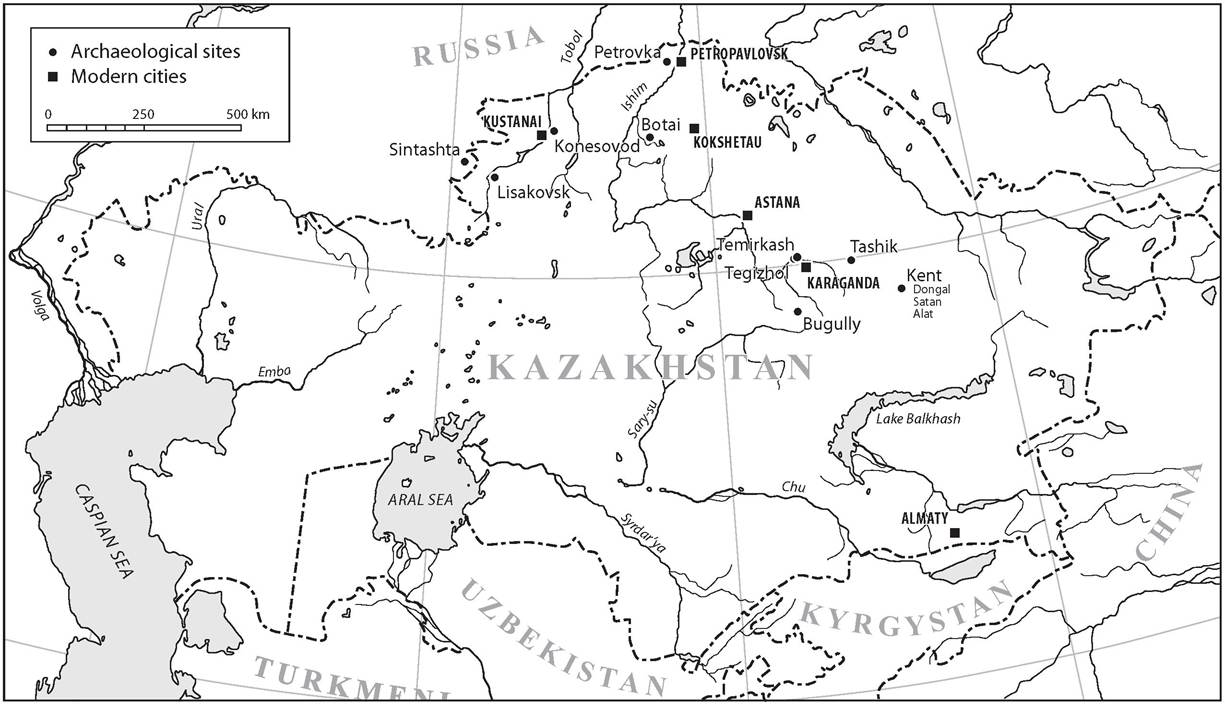
Map 6.ι Central Asia, showing archaeological sites in Kazakhstan.
most significant change is a sudden and extreme focus on the exploitation of horses. Horse bones represent the vast majority of faunal assemblages at all Botai and Tersek sites, and at Botai itself reach 99 per cent.[316] The steppes of Central Asia had a substantial population of wild horses that were also available to earlier prehistoric groups in the region as a prey animal. With Botai, however, one sees a sudden focus on that animal, in conjunction with the arrival of large semi-sedentary villages and significant changes in material culture.
Since Botai was discovered in the early 1980s, there has been considerable academic discussion over whether the horses were being hunted or herded, and whether they were biologically domestic or still wild. Some have argued that there was no clear size change in the animals,[317] and that there was not a clearly managed herd structure for meat production.[318] However, others have argued that the semi-sedentary nature of the settlements and the low frequency of hunting material culture suggests more control of the animal populations.[319] There is no reason to assume the herd was managed specifically for meat, and quite a mixed herd will have been maintained if the animals were used for riding, meat, and even milking. There is also the possibility of the simultaneous exploitation of both wild and domestic stock. This seems like a strange notion, but in fact we know that aurochs (wild cattle) were hunted regularly well into the Bronze Age in much of Eurasia, including Kazakhstan, despite the presence of many domestic cattle that were being exploited for milk (and see also comments on reindeer, p.
165).It is now becoming increasingly clear that the Botai horses were herded, and probably domestic. Two studies, using different methodologies that examine bone and dental pathologies, have indicated that at least some of the Botai horses were bitted and harnessed for labour or riding.[320] In 2009 further research indicated that Botai horses had developed more slender legs, like later domestic horses from the region, and, most interestingly, Botai pottery appeared to contain the lipid residues of mare's milk.[321] Mare's milk is not a familiar commodity in most societies, but is still regularly exploited throughout Central Asia and Mongolia, usually consumed as a fermented drink. Furthermore, ancient DNA evidence has also suggested that the date and general region of Botai fit relatively well with genetic evidence for horse domestication.[322] As such, it seems that early pastoralism in Central Asia may have started with the horse, and may have encompassed secondary products as well as primary ones.
It seems likely that by 3500 bce the people at Botai had some contact with societies closer to the Near East who already had domestic ruminants, so why would this localized development in pastoralism have focused upon horses? Horses were, of course, plentiful in the region, but also, and more importantly, adapted to cold winters. Horses are able to stay out all winter long and are able to clear the ground of snow so that they can continue to graze.[323] There is no need to provide either fodder or shelter. This may well explain the development of this unusually specialized pastoral society, and is also an important factor in understanding later mixed pastoralist regimes in the region. Domestic horses appear to spread across Eurasia during the Bronze Age. While Botai currently represents the earliest clear archaeological evidence for the use of domestic horses, it may not be the earliest or only locus of horse domestication.
Mitochondrial DNA studies on modern horse populations seem to suggest that there are quite a number of mares from which domestic horses are descended, which may suggest multiple, independent domestication events. However, Y-chromosome studies in stallions suggest far more restricted lineages in the male line. This hints at a possible trade in domestic stallions from one region of early domestication, which were then bred with local wild mares, either deliberately or by accident.[324]The Botai and Tersek cultures end at the start of the third millennium bce. There is then very limited settlement evidence until the Bronze Age establishes itself firmly in the region in the very late third millennium. The sites of Sergeevka and Balandino, dating to the mid third millennium, possibly represent transitions from the horse-dominated Eneolithic to a Bronze Age economy more heavily based upon ruminants.[325] There remains a worrying lack of evidence for human use of the steppes during the best part of a thousand years, however. We must ask ourselves whether this is real, or caused by the nature of the archaeological record. It is clear that the Eneolithic cultures were semi-sedentary, and, as such, they left substantial settlements with a palimpsest of domestic debris. If later cultures became truly nomadic, and did not possess any form of monumental culture (the Botai people did not build funerary monuments), then they would be very hard to spot.[326] The absolute dating of even large sites in most of the region is limited, never mind ephemeral scatters of material that might represent nomadic camps. Is this gap real? This example highlights some of the archaeological uncertainties that surround the study of certain possible types of pastoral society.
The next significant development is the Bronze Age Sintashta culture, which dates from about 2100-1800 bce and is located in the steppe territory between the Ural mountains and the Tobol River.
Settlements of this culture, perhaps best represented by the Arkaim settlement, consisted of subcircular fortresses with concentric walls, and spoke-like subdivisions. In the settlement middens of Sintashta and Arkaim the refuse consisted of 60 per cent cattle, 26 per cent sheep/goat, and 13 per cent horse, showing a significant economic shift at this time towards domestic ruminants. However, horse sacrifice was a key component of high-status burials at this time and the richest Sintashta graves contain the remains of chariots. In northern Kazakhstan the Sintashta culture devolved into the Petrovka culture, dating to the first part of the second millennium bce. Petrovka burials also contain horse sacrifices, horse tack, and chariots, but the number of such burials declines through the period.[327]The later part of the Bronze Age in central and northern Kazakhstan is dominated by the Andronovo culture. During this period, in the mid second millennium bce, the economic focus upon the pastoral exploitation of domestic ruminants continues,[328] but Andronovo graves are simpler and are typified by both inhumations and cremations accompanied by ceramics with geometric designs. Animal sacrifices continue, but include a number of different species, particularly dogs, with animals frequently represented by only their heads and feet. The final phase of the Bronze Age (c. 1300-900 bce ) in Kazakhstan consists of the Sargary and Begazy-Dandybaevsky cultures. Once again, mixed domestic ruminants dominate in the faunal assemblages, while funerary rites now involve inhumations with relatively modest grave goods comprising ceramics and occasional ornaments.[329]
It is clear that the proportion of horses in assemblages declines in the later part of the Bronze Age, and this pattern is generally maintained in later periods too. However, their proportions remain quite significant, albeit highly variable from one site to another. Lipid residues from ceramics seem to indicate very frequent use of ruminant milk and meat, and much less horse, while herd structures at some sites indicate that cattle might have been the principal source of milk, with sheep and goats managed more for meat supply.[330] This way slaughter for meat can be smaller in scale, producing more convenient meat packages, and maximum dairying productivity can be maintained from cattle. Surveys of faunal records from across Europe and Central Asia indicate that proportions of cattle decrease generally with increased aridity of environments, and this most likely represents a simple issue of ecological adaptation.[331] Horses remain significant for transport and riding to assist in the control of herds, but their adaptation to snow-covered landscapes is still significant because horses not only clear snow for themselves to reach grass but leave clearings in their wake for ruminants that are less adapted to grazing through snow. They reduce risk in hard winters, and their addition to the usual triad of ruminants is therefore much more than cosmetic. The great value of horses to Sintashta and Petrovka cultures is expressed in the way they are buried in kurgans (earth mounds). While this practice does not continue into the later Bronze Age, a study has shown that funerary deposits still contain many more horse bones than settlements do, and that funerary pots contain a much higher proportion of horse residues.[332] Horses perhaps maintained their relevance to social status and were the food of special feasts. The proportion of horses in assemblages does not vary predictably across this region in the same way as cattle/caprine ratios do.[333] Perhaps numbers of horses relate more to wealth and social standing than to climate?
One of the most significant sites of the final Bronze Age is called Kent, in the central-east region of Kazakhstan. It is an impressively large settlement, with many satellite settlements and associated funerary monuments. Much stone is used in construction, and the settlement has a clear layout and possible piazzas. Despite the general assumption that pastoralists have high levels of mobility, it seems likely that this, and the more significant settlements from the Sintashta, Petrovka, and Andronovo cultures, were transhumant at their most mobile. It will be interesting to see what isotopic studies, of the type outlined above, will reveal about these cultures in the future. Are archaeologists assuming too much about the mobility of past pastoralists from recent ethnographic examples? Are we correctly identifying the traces of truly nomadic peoples?
More on the topic Case study: prehistoric steppe pastoralism in Kazakhstan:
- Case study: prehistoric steppe pastoralism in Kazakhstan
- Barker Graeme, Goucher Candice (ed.). The Cambridge World History. Volume 2. A World with Agriculture, 12,000 BCE-500 CE. Cambridge University Press,2015. — 668 p., 2015