Chronology
'Ain Ghazal was not founded until almost a thousand years after the onset of agriculture, but because of the local ecological combinations and the persistent presence of water (the permanent stream of the Zarqa River and the copious spring of 'Ain Ghazal itself), it continued to exist as a permanent settlement until around 5750 bce[466] or perhaps even later.[467] This long duration of constant occupation - approximately 2,500 years - is one of the most important aspects of 'Ain Ghazal's archaeology, for it reveals how the residents of 'Ain Ghazal adapted themselves to the changing environment, changes that were strongly driven by the unwitting actions of the people of 'Ain Ghazal themselves.
This long period of time witnessed four major developments in how the inhabitants of 'Ain Ghazal lived their daily lives and can be broken down into the following periods:• Middle Pre-Pottery Neolithic B (MPPNB) 8500-7500 bce
• Late Pre-Pottery Neolithic B (LPPNB) 7500-6900 bce
• Pre-Pottery Neolithic C (PPNC) 6900-6400 bce
• Yarmoukian Pottery Neolithic 6400-5500 bce
Site size and setting
The oldest layers occur atop sterile red clay, and it appears that 'Ain Ghazal began as a small village about 2 ha in area (Figure 9.1). The lucrative
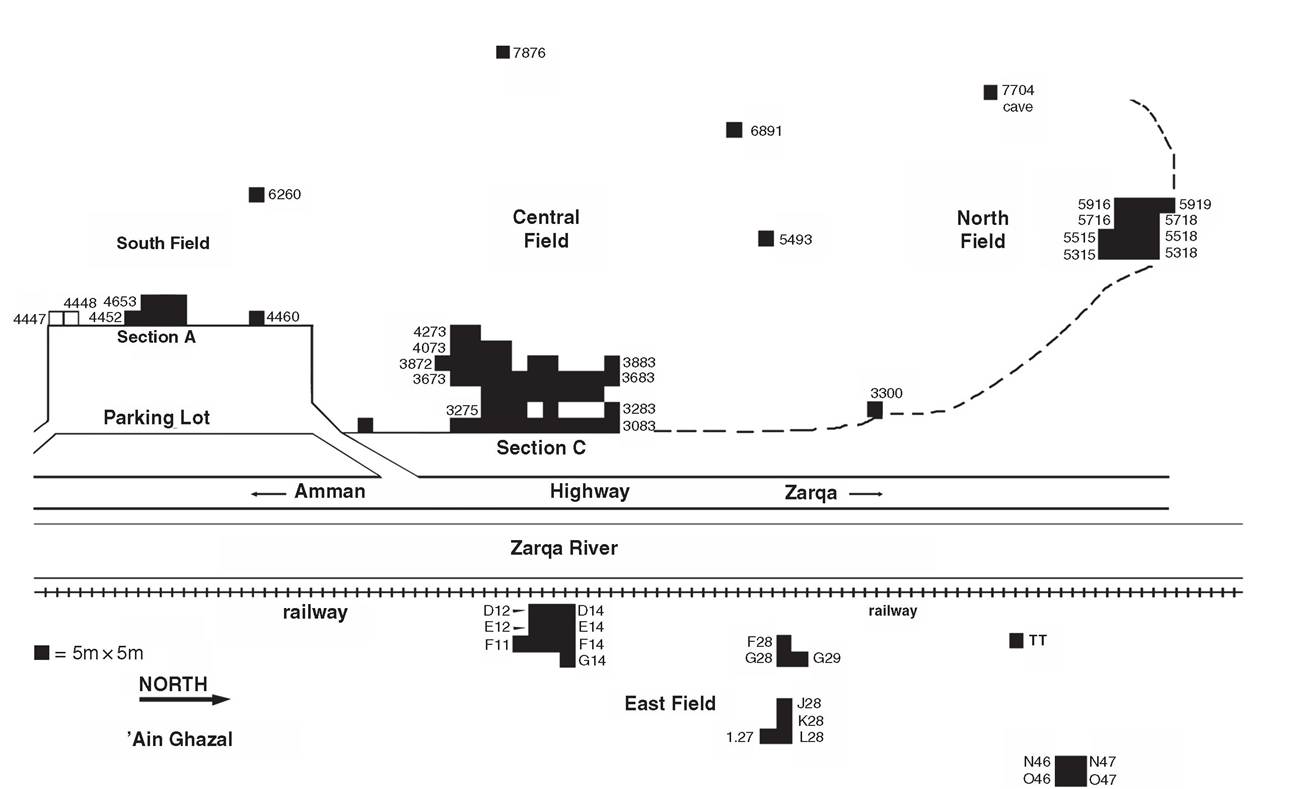
Figure 9.1 Schematic plan of excavated units at 'Ain Ghazal on the western (top) and eastern banks of the Wadi Zarqa (Zarqa River).
combination of environmental conditions allowed a rapid MPPNB population growth, and within a thousand years as many as 600-750 people lived together in a compact community that covered 5 ha.
The end of the MPPNB in the southern Levant was a tumultuous one, and there were severe disturbances in the settlement pattern of the region.[468] Wholesale abandonment of farming villages in Israel and the Jordan valley began around this time, and many of the dislocated populations sought refuge elsewhere, probably often in highland Jordan.
Near the beginning of the LPPNB, 'Ain Ghazal underwent a virtual population explosion, altogether doubling in size within a couple of generations to c. 10 ha and reaching almost 15 ha on both the eastern and western sides of the Zarqa River by 7000 bce ;[469] by this time more than 2,500 people lived at 'Ain Ghazal. Other huge PPNB ‘mega-sites' were founded in Jordan and southern Syria.[470] During this period of rapid population growth, social and economic organization changed dramatically, and while not reaching ‘urban' status, 'Ain Ghazal and its neighbours left the simple egalitarian village behind.After the constant pressure on the land around 'Ain Ghazal during the MPPNB and LPPNB periods, it is not surprising that the quality of life for the townspeople began to decline. The East Field appears to have been deserted as a residential area by the beginning of the PPNC, and on the western side of the Zarqa housing density fell dramatically at the beginning of the seventh millennium. With the onset of the Yarmoukian Pottery Neolithic, the size of 'Ain Ghazal continued to contract; furthermore, houses were very far apart, and it is likely that the population fell to levels of the early MPPNB. Eventually, the fields around 'Ain Ghazal had simply played out, and farming was no longer a reliable means to support a family. The last vestiges of Neolithic presence at 'Ain Ghazal are some circular tent foundations of pastoral nomads of the late Yarmoukian period (Figure 9.2).
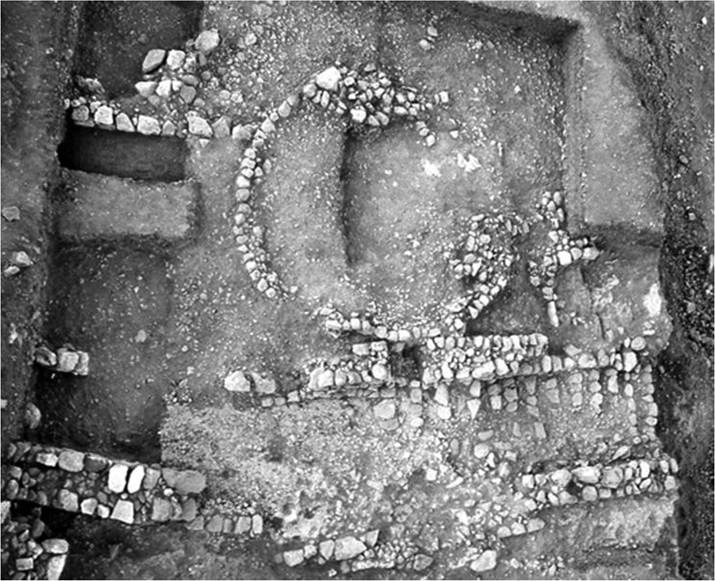
Figure 9.2 The circular structure at the top of the photo is a late Yarmoukian tent foundation, a remnant of a visit to 'Ain Ghazal by sheep/goat pastoralists; the stone feature at the centre of the photo is a walled ‘street', originally constructed by LPPNB or PPNC residents, but used into the Yarmoukian period as well.
The changing environment at 'Ain Ghazal
The fragility of the ecosystem in the southern Levant is well documented for the past fifteen millennia,[471] and the area around 'Ain Ghazal never recovered from an environmental calamity that began around 9,500 years ago while the settlement was enjoying its greatest florescence: unending overgrazing and deforestation for construction and fuel turned the surrounding countryside into a virtual extension of the steppe immediately to the east.[472]
The environmental evidence comes principally from faunal remains.
Animal bones give us our best indication of the local vegetational zones and how this mosaic of plant communities changed through time. In the MPPNB period more than fifty species show that the immediate area surrounding 'Ain Ghazal included woodland, steppe, riverine forest gallery, wooded parkland, desert ecological zones, and even standing water.[473] Of all of the animal species, one provided approximately half of the remains: the goat, which was domesticated in the MPPNB.[474]By the LPPNB the great diversity of animals had declined considerably, and in the PPNC the number of species had dwindled to around fifteen, testimony to the degraded environment around the settlement.[475] [476] Gone were the woodland-related animals and most of the birds, and it is clear that by the beginning of the seventh millennium hunting had declined in its importance: 50 per cent of the meat had been procured this way in the MPPNB, and at only around 10 per cent, meat from wild animals probably served more as a source of variety in the diet than as a principal component of meals in the Yarmoukian period.11 The people at 'Ain Ghazal compensated for the loss of protein from wild animals by widening the range of domesticated animals, with sheep in the LPPNB, pigs in the PPNC, and cattle by the beginning of the Yarmoukian, if not earlier.
Social organization
The relationships among people in the 'Ain Ghazal settlement (and with other communities in the area) changed dramatically during the town's existence. Much of our information comes from the kinds of structures that the people built, but symbolic behaviour and post-mortem treatment of the town's residents are also important sources.
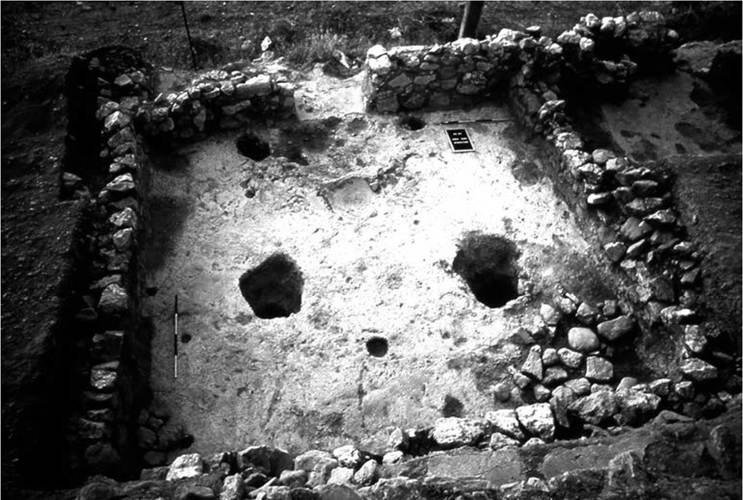
Figure 9.3 The western room of an MPPNB house from the Central Field at 'Ain Ghazal; the eastern room (at the top) was almost completely removed by bulldozers during the construction of the highway in the 1970s.
The remains of twelve individuals were buried beneath the floors of this structure.Architectural inferences
In the earliest part of 'Ain Ghazal's development, the village was compactly organized, with houses built in very close proximity to each other along the west bank of the Zarqa River. The ‘nearest neighbour' distribution of the houses suggests that closeness of the dwellings was probably associated with kinship: some houses were built so near to each other that a person could not walk between them, but such groups of houses were separated from other clusters by several metres.
MPPNB house sizes throughout the Levant, including 'Ain Ghazal, indicate that the dwellings were occupied by single-family units of parents and unmarried children, a common arrangement in current subsistence agricultural societies (Figure 9.3). The clumping of houses suggests that, although these families were independent in terms of economic production and consumption, the practice of familial sharing was the norm in times of shortfall, and the possibility certainly can't be excluded that contributing to households outside the cognate group was a normal practice during calamitous periods for some single families or a cluster of related families.
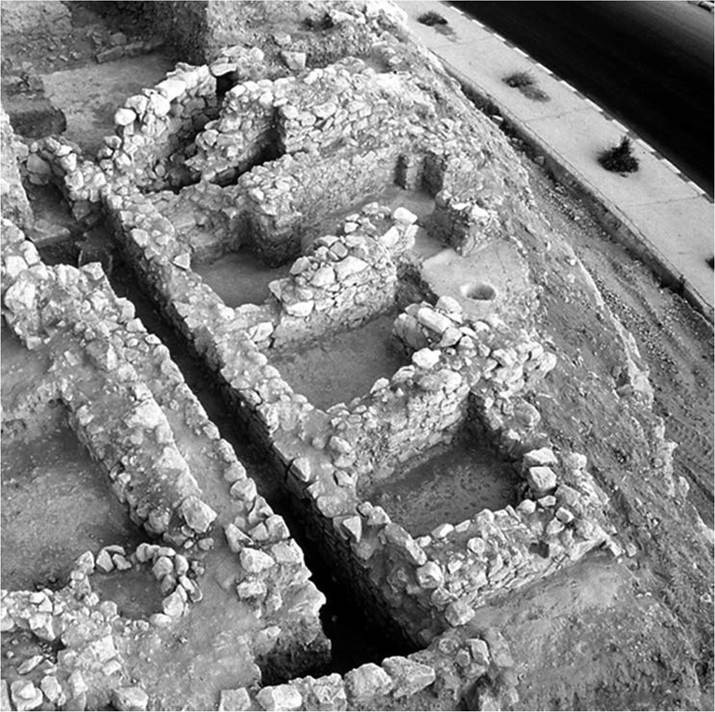
Figure 9.4 The badly damaged building in the upper right third of the photo represents the ground floor of a two-storey building that caught fire and was thoroughly destroyed in the later LPPNB period. Reconstruction of the floor plan suggests that three or four families probably inhabited the structure. The circular feature in the plaster floor at upper right is a hearth.
After some 1,000 years of environmental degradation, many of the farming villages in the Jordan Valley and Israel were abandoned, and those families that emigrated to 'Ain Ghazal precipitated an eruptive expansion on the western bank of the Zarqa River as well as the establishment of a new neighbourhood across the river, straining 'Ain Ghazal's social system.
During the LPPNB phase a new social order evolved: two-storeyed buildings of considerable size (up to twice the floor plan of the MPPNB for the ground floor alone) are clearly documented (Figure 9.4). The importance of these two-storey buildings is that the common nuclear family household of the MPPNB had developed, in some cases at least, into extended family units during the LPPNB.[477] Instead of the independent economic units of the MPPNB, by the latter half of the eighth millennium closely related families had consolidated, whereby nuclear family units pooled their labour and consequent resources into a common store to be shared by the participating cognates and their spouses.1[478]Shortly after the beginning of the seventh millennium, sociocultural alterations caused major changes in social structure, especially visible in architectural forms. For the first time two distinct versions of domestic buildings appeared, and the functional probabilities are telling. The first, or ‘normal', building reverted to the nuclear family situation, with parents and unmarried children living in a small single-room house of c. 15 m2, although the associated walled courtyard was the scene of important daily activities.[479] Notably, the walled courtyard around a domestic house made its first appearance during the PPNC period at 'Ain Ghazal, although walled courtyards were associated with the LPPNB ‘shrines' (see below).
The new architectural phenomenon was the ‘corridor building', a semisubterranean storage feature that was probably associated with families who lived at 'Ain Ghazal only during a part of the yearly round (Figure 9.5a). During the rainy season in the autumn/winter until the end of the harvest in May/June, these families would have been in the steppe and desert areas with the herds of sheep and goats, returning to 'Ain Ghazal when the water and vegetation in the eastern regions had disappeared.[480]
By the beginning of the Yarmoukian period, the PPNC partial separation of the 'Ain Ghazal population into permanently settled farming and mobile pastoral groups was evidently concluded.
The earlier phases of the Yarmoukian presence are once again uniform in terms of the kinds of dwelling, suggesting that the pastoral element was no longer an integral part of the 'Ain Ghazal community. Single-family structures dominated again (Figure 9.5b), and nuclear family independence is emphasized by the relative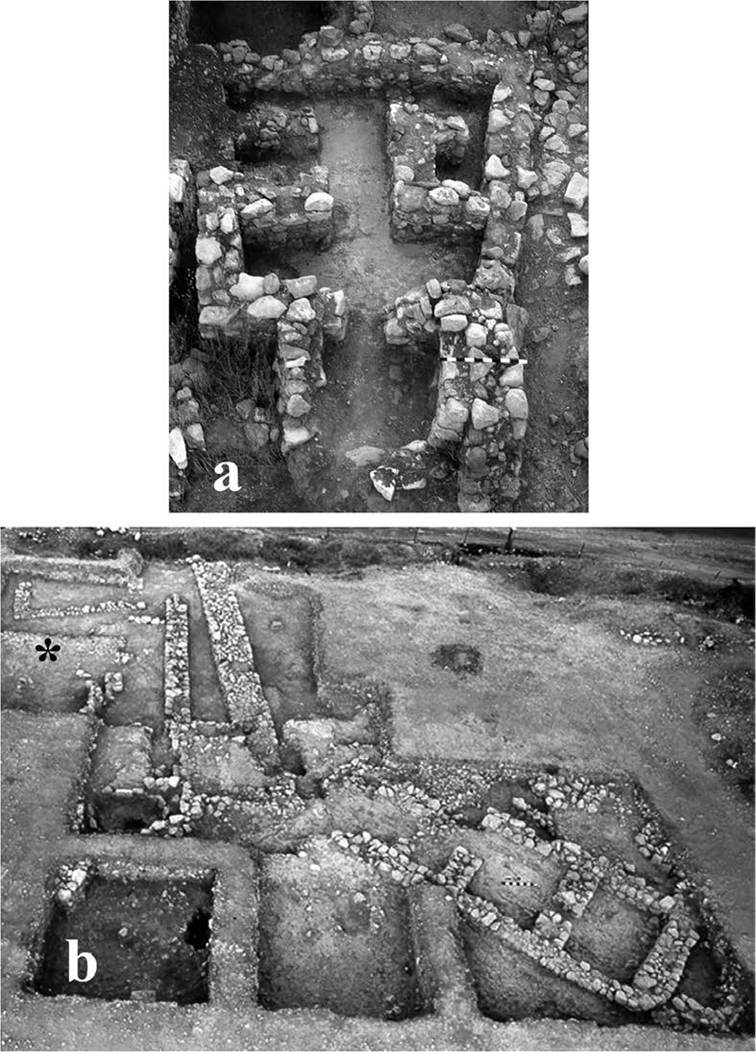
Figure 9.5 (a) A PPNC ‘corridor building', with the entrance at bottom centre; a flagstone ramp leading down (from top towards the bottom) is at left. (b) At lower right is a Yarmoukian ‘longhouse' with at least three rooms, measuring c. 4 ? 9 m. A small oval ‘kitchen' outhouse occurs at left centre; just above the asterisk at upper left is a PPNC house.
isolation of houses in the extensive courtyards, where neighbours were probably at least 15 m away.[481]
Ritual inferences
But it is in the ritual sphere that social differences within families and larger kinship units, and in the community in general, are most emphatically demonstrated. Burials, for example, argue for at least three different ‘sorts' of people:
1. ‘Special' people. Although they were once considered ‘typical burials' for the MPPNB,1[482] it is now indisputable that the people buried beneath house floors were anything but ‘typical'.[483] A good example of this is the situation for one house, where the remains of twelve individuals were found beneath the complex sequence of floor replacements, renovations, and remodelling (Figure 9.3) that took place over some four hundred years. This reflects a burial about every thirty-three years. If we assume that families consisted of the parents and three to four children who lived to maturity, we are missing at least four to five (80 per cent or more) of the burials for each generation, which is a strong argument that the subfloor burials represent people with extraordinary status (Figure 9.6a). The age of the people buried beneath house floors ranges from juvenile to more than fifty years, and since there are both males and females, the selection rules for this post-mortem distinction remain unknown.[484]
2. The second group of people consists of those family members who were not buried beneath house floors. What happened to them is simply not known; one might surmise a ‘cemetery' outside of the settlement, but after more than a century of Neolithic excavations, no such PPNB burial ground has been found anywhere in the Levant.
3. The third disposal method is the ‘trash burial', named after the circumstances that suggest some people were actually ‘discarded' in refuse dumps. These interments invariably included the skull intact with the skeleton, and the presence of rubbish in the burial, as well as the postures of the skeletons, indicates that these people received the least respect of all
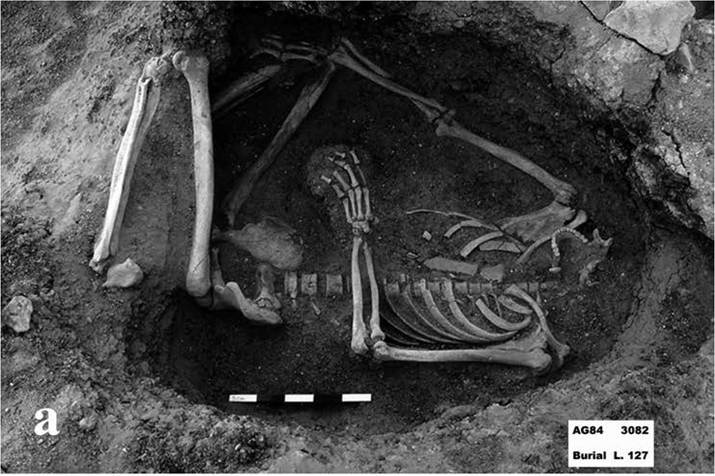
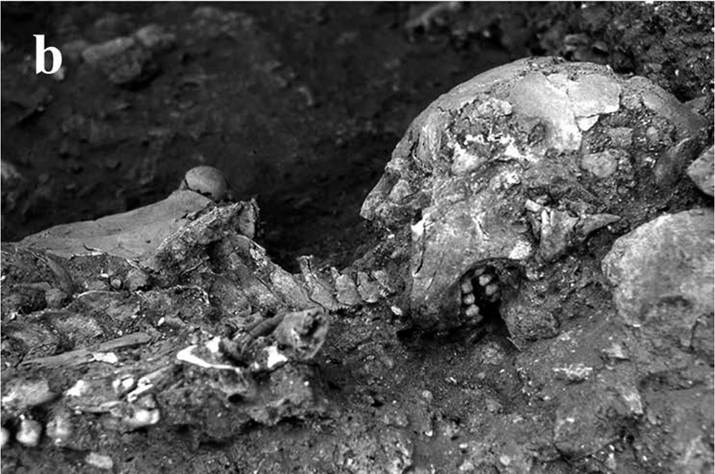
Figure 9.6 (a) An MPPNB subfloor burial whose skull was removed, and the body then re-covered with dirt and a new plaster floor; (b) a ‘trash burial' from the later MPPNB period. Contrast the ‘cleanliness' of the soil in (a) with the inclusions of charcoal, stony rubble, and broken animal bones around the skeleton in (b).
at death, a possible reflection of their social status when they were alive (Figure 9.6b).[485]
If being buried beneath a house was a signal of primary social distinction, there was still another difference that set some family members apart from others. This involves the intriguing concentration on the skull. All subfloor burials were decapitated in the sense that the body was placed beneath the floor, and after a suitable time for the flesh to decay, the burial pit was re-opened in order to remove the head, leaving the lower jaw behind (Figure 9.7; cf. Figure 9.6a). What happened to the skulls afterwards was variable, for reasons that we don't understand at present. The practice of skull separation and special treatment certainly did not carry over into the PPNC period, and there are some reasons to think that perhaps this practice was already abandoned before the end of the LPPNB in the southern Levant. We have no certain evidence of special skull treatment from 'Ain Ghazal during the LPPNB, but the frequent presence of burials with intact skulls at LPPNB Basta suggests that in southern Jordan, at least, skull removal had come to an end by the last quarter of the eighth millennium.[486] Nevertheless, skull removal seems to have enjoyed continued and vigorous celebration in the Damascus area at sites such as Tell Ramad and Tell Aswad.[487]
For the Yarmoukian period, we have only one burial from 'Ain Ghazal, placed in the corner of an abandoned house, suggesting that burial within the community limits had lost all social distinctions.[488]