Conclusion
While the debate about the nature of Jomon cultivation is set to continue, fuelled by the increasing though still limited use of flotation and associated archaeobotanical techniques, it is clear that the introduction of paddy rice farming in the Japanese archipelago brought about significant change.
This included a major restructuring of annual and everyday subsistence practices and investment in permanent facilities, namely the paddies themselves, whose construction, management, and maintenance took on monumental proportions and accompanying social significance. Both the introduction of wet rice farming in the early first millennium bce and the subsequent spread of the Yayoi ‘package' through western Honshu and Shikoku, and then into eastern Honshu, involved the movement of people and the spread of the Japonic language, the precursor of modern Japanese. But rice farming was not spreading into unoccupied territories, and from the early farming hamlets of northern Kyushu to the pioneering agricultural settlements of northern Honshu there is evidence for a mixing of incoming traits with native practices rather than any straightforward replacement.Rice farming was not, however, the only subsistence activity in which Japanese people from the Yayoi period onwards engaged. Hunting and gathering continued to be important activities. The relationships with animals changed over time as hunting became an elite pastime, represented in sets of haniwa figures on burial mounds in the fifth and sixth centuries. The matagi hunters of northern Japan have maintained the tradition of hunting large mammals.[798] And the exploitation of wild plant resources continues to the present day. Dry-field cultivation of grains such as wheat and millet has continued to provide an important component of the Japanese diet.
Domesticated animals did not play an important role in early agricultural societies in Japan.
From the Yayoi period, horse and cattle were probably used mainly for cultivation and transportation as a means of supplementing labour, not for meat and milk or other secondary products as elsewhere in Eurasia. Domesticated pigs were kept from the Yayoi period, but their contribution to the Yayoi diet was limited.This chapter has reviewed how changes in subsistence activities can be understood in the context of social and cultural developments in the archipelago during the Jomon, Yayoi, and Kofun periods. This long span of time witnessed many changes in subsistence practices. Broad-based foraging economies replaced large-game hunting in the early stages of the Jomon, which supported the development of relatively sedentary village communities, some of which, notably those in southern Kyushu, are remarkably early. By the middle Jomon, large regional centres were developing, mainly in eastern and northern Japan, acting as foci for regional exchange networks of commodities such as greenstones and obsidian. Along the Pacific coast, in particular, large shell middens appeared, indicating the intensive exploitation of marine resources, leading to pressure on those resources. Debate still surrounds the possibility of cultivation during the Jomon, and the limited evidence that does exist suggests that we need to redefine what is understood by cultivation among temperate foragers.
Although there are tantalizing finds of rice grains in the fabric of pottery vessels and some very early AMS dates for carbonized rice grains from northern Honshu,[799] there is widespread acceptance that paddy rice farming first became established in northwestern Kyushu in the first centuries of the first millennium bce, introduced either from the Korean peninsula or direct from southern China. Rice farming appears to have spread out of this initial foothold only after several centuries, and there is now good evidence for paddy landscapes with associated irrigation systems from across the archipelago with the exception of Hokkaido. Rice agriculture appears with metallurgy (bronze and iron) and weaving, and the complex processes of which the introduction of these new technologies was part also saw a degree of population change, with migrants coming into Japan from the continent, and the formation of what was to become the Japanese language.
Agriculture came to support the establishment of regional hierarchical societies controlled by a new class of elite leaders, who legitimated their power through a series of ritualized practices drawing on a new symbolic code based on agriculture, hunting, and warfare.Rice farming is and was by no means the only subsistence practice in Japan. Continuing through the Yayoi period, hunting, gathering, and fishing and cultivation of a variety of crops sustained village communities. As regional societies became increasingly centralized, however, and population densities increased, so did the intensification of paddy agriculture. By the fifth century ce, centrally controlled large-scale land development was being undertaken by the authorities in the emerging central capital area. The remarkable discoveries of the well-preserved farming village at Kuroimine and the elite residential compound at Mitsudera in Gunma prefecture dating from the middle sixth century ce provide a vivid snapshot of the nature of rural settlement in central Japan, sealed by a catastrophic volcanic eruption. In eastern and northern Japan, outside the control of the emerging early Japanese state, different trajectories were followed in which a range of horticultural and agricultural activities were practised.[800] [801]
Conrad Totman divides the narrative for the pre-industrial sections of his History of Japan into discussions of what he terms dispersed and intensive agriculturalists, with the transition during the medieval period, around 1250 ce, preceded by early and later foragers.71 The archaeological record now demonstrates that there was an intensity to paddy rice farming in the Yayoi
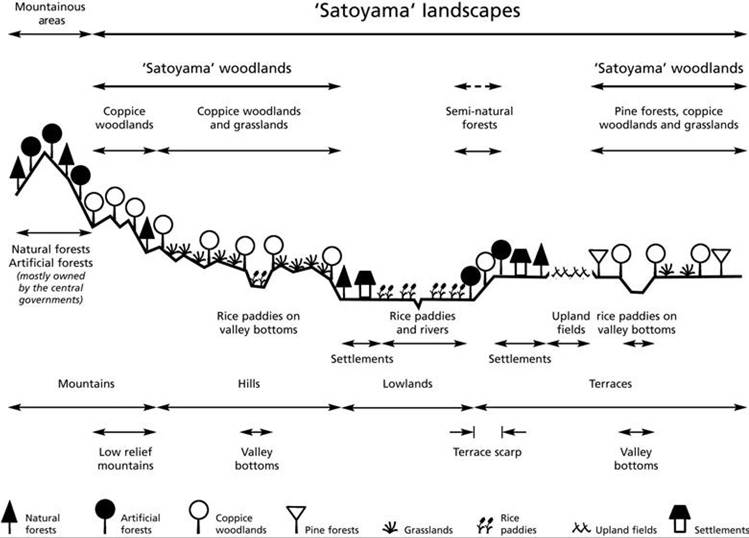
Figure 14.8 Model of the satoyama landscape.
and Kofun periods prior to 500 ce that reshaped the lives of the inhabitants of much of the archipelago. In the late nineteenth century, at the beginning of Japan's industrialization, over 80 per cent of the population were engaged in farming.
By 1985 this proportion had dropped to 3.5 per cent, and is today even lower.[802] Rice-related rituals continue to be central to imperial ceremonial, and rice continues to be regarded as the staple Japanese foodstuff. And the range of subsistence practices accompanying paddy rice farming informs how Japanese people understand their own rural landscapes, now expressed in terms of satoyama, ‘Japan's traditional and fragile landscape system... comprising carefully managed coppice woodlands, villages strung along the base of hills and carefully tended paddy fields... that made possible the sustainable interaction of humans and nature' (Figure 14.8).[803] Our understanding of the processes leading to agrarian societies increasingly draws on sophisticated understanding of human intellect, motivations, and practices in conjunction with climatic episodes, historical contingencies, and chance coincidences of events.[804] The Japanese record can doubtless contribute to those debates.For all of these reasons, the study of the archaeology of early agriculture in Japan merits attention on a global stage. Very few regions can boast the intensity of archaeological activity and the high-resolution archaeological record that Japan has developed from the later twentieth century.