Crops of the Americas and the geography of domestication
At the time of European contact in the fifteenth century ce, millions of people throughout the Americas lived in agriculturally based societies. Some practices and foods were millennia old; others coalesced late in prehistory.
Domestication and agriculture did not arise everywhere, however, nor did all societies take an agricultural route. Distributions of wild ancestors, genetic studies of American crops, and archaeology give us snapshots of the geography of plant domestication (Figure 20.1) and of the diversity of crops grown (Table 20.1).Today our understanding of the ancestry and areas of origin of a few crops is quite good, while for others little has changed since the 1970s, when one of the first comprehensive overviews, Crops and Man, was written by Jack Harlan.1 Economically important crops are more likely to have been studied by agronomists and plant geneticists. For example, decades of debate and study of the only widespread American grain, maize, and its related wild species leave little doubt that wild Zea mays subsp. parviglumis, Balsas teo- sinte, gave rise to maize in a single domestication.[1131] [1132] Balsas teosinte grows today in the deciduous tropical forests of southern and western Mexico, making this region the likely area of origin. How early Native farmers achieved the dramatic transformation of teosinte to maize is still being studied, but it was likely a process of a few thousand years that combined conscious and unconscious selection targeting seed dispersal, seed size,
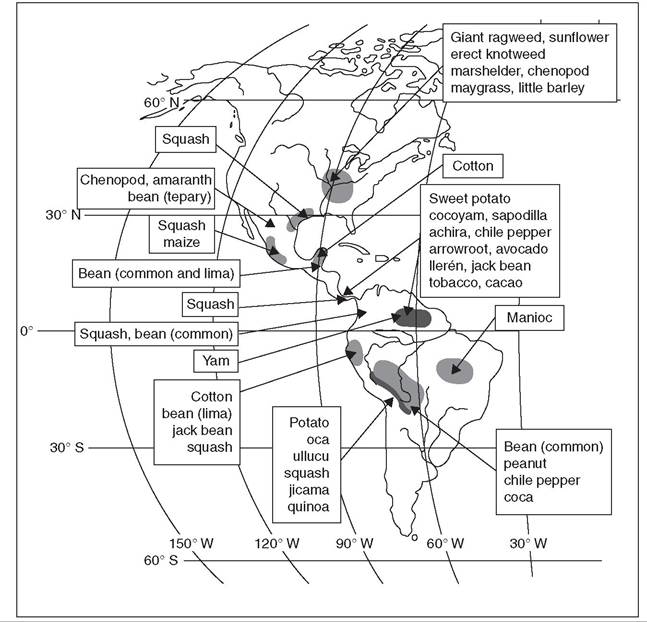
Figure 20.ι Likely areas of origin for selected crops of the Americas.
photoperiod, and starch production. Of the lowland root and tuber crops (arrowroot, cocoyam, lleren, manioc, sweet potato, yam), only productive and undemanding manioc is well studied.
The primary stable crop for millions of people worldwide, mostly the poor of tropical countries, manioc was domesticated from Manihot esculenta subsp. flabellifolia on the southern border of the Amazon basin.[1133] For many other crops, from fruit trees to roots and tubers to pseudocereals, we know only the broad geographic range of their likely area of origin. Seasonal environments, especially forests and forest fringes, were key habitats for domestication in the Americas.[1134]Table 20. ι A short list of crops of the Americas.
‘Pseudocereals’, grains, oil seeds
| amaranth canahua chenopod | Amaranthus caudatus (Andes), A. cruentus (Mexico) Chenopodium pallidicaule Chenopodium berlandieri var. jonesianum (North America), C. berlandieri subsp. nuttaliae (Mexico) |
| erect knotweed giant ragweed little barley maize marshelder maygrass quinoa sunflower Legumes (pulses) bean, common bean, lima bean, tepary bean, runner jack bean lupine peanut Squashes and gourd bottle gourd squash | Polygonum erectum Ambrosia trifida Hordeum pusillum Zea mays Iva annua var. macrocarpa Phalaris caroliniana Chenopodium quinoa Helianthus annuus var. macrocarpus Phaseolus vulgaris Phaseolus lunatus Phaseolus acutifolius Phaseolus coccineus Canavalia ensiformis, C. plagiosperma Lupinus mutabilis Arachis hypogaea Lagenaria siceraria Cucurbita pepo, C. argyrosperma (=C. mixta), C. moschata, C. maxima, C. ficifolia |
| Roots and tubers Achira arrowroot cocoyam jicama lleren manioc oca potato sweet potato ullucu yam Fruit trees achiote avocado black sapote cacao | Canna edulis Maranta arundinacea Xanthosoma sagittifolium Pachyrrhizus ahipa Calathea allouia Manihot esculenta Oxalis tuberosa Solanum tuberosum Ipomoea batatas Ullucus tuberosus Dioscorea trifida Bixa orellana Persea americana Diospyros digyna Theobroma cacao |
Table 20.ι (cont.)
| ciruela de fraile | Bunchosia armeniaca |
| guava | Psidium guajava |
| lucuma | Pouteria lucuma |
| pacae | Inga species |
| papaya | Carica papaya |
| peach palm | Bactris gasipaes |
| pepino | Solanum muricatum |
| sapodilla | Manilkara achras |
| soursop, custard apple | Annona sp. |
| tree tomato | Cyphomandra betacea |
| yellow sapote | Pouteria campechianum |
| yellow, red mombin | Spondias sp. |
| Spices, stimulants, fibre | |
| chile peppers | Capsicum annuum, C. baccatum, C. frutescens/C. chinense, |
| C. pubescens | |
| coca | Erythroxylum coca, E. novogranatense |
| cotton | Gossypium barbadense, G. hirsutum |
| tobacco | Nicotiana rustica, N. tabacum |
More basic research, especially collection of wild related species and traditional crop varieties, is needed to understand the ancestry of many crops, and the pace of extinction, habitat loss, and loss of indigenous knowledge is accelerating. Based on available data, plant domestication in the Americas was characterized by multiple, independent domestications of species in useful genera in North, Central, and South America.[1135] We see this pattern for pseudocereals, legumes, chiles, squashes, tobacco, cotton, and a number of fruit trees. Plants needed for nutritionally balanced meals were domesticated multiple times in diverse settings. For example, where land can be farmed in the Americas, there is a domesticated legume or pulse to thrive there, from peanuts, adapted to moist lowland environments, to the cold- tolerant lupine and the versatile common bean.
Tracing the domestication of root and tuber foods is especially challenging, since only manioc and potato are well studied. Each of those crops emerged in a single region/centre. Whether this pattern characterizes root and tuber domestication in general is unknown; archaeological data hint at multiple domestications (or the very early spread) of some root and tuber crops. Better understanding of the geography of plant domestication could
DEBORAH m. PEARSALL provide valuable insights into the nature of early social networks in the Americas.