The early history of domestication
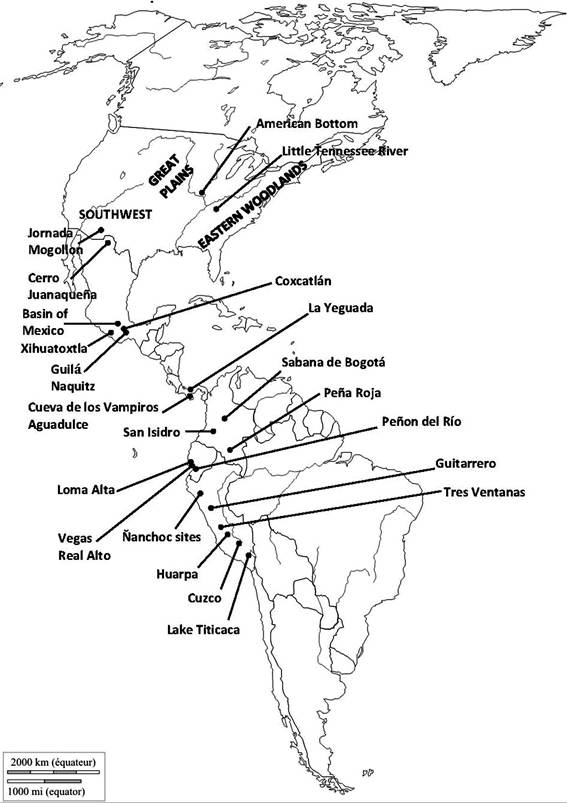
The early history of plant domestication begins in lower Central America and northwestern South America (Map 20.1), and is known in large part from microfossil evidence (phytoliths, starch grains, pollen).
Human occupation of the neotropics began in the late Pleistocene, and by 10,900-9400 bce people occupied diverse environments and in some cases modified them by fire.[1136] Burning of forests and small-scale land clearance is dated to 11050 bce* at Lake La Yeguada in Panama, for example. Arrowroot was the earliest domesticate there, dating to 7800 bce* at the Cueva de los Vampiros site and 5800 bce* at Aguadulce. By 5800 bce* maize and gourd were introduced to Panama and lleren and squash were present, and manioc was introduced shortly thereafter.Plant domestication began before 8500 bce in southwest coastal Ecuador. Squash phytoliths were recovered from terminal Pleistocene and early Holocene strata at Vegas sites.[1137] Phytoliths recovered from the earliest levels are from wild squash, with domesticated-size squash phytoliths directly dated to 9840-8555 bce.[1138] Other Vegas crops included gourd and lleren, and maize was introduced just before 5800 bce*. Maize continued to be grown at Real Alto and Loma Alta, two Valdivia tradition farming villages (4500-2250 bce), along with cotton, jack bean, achira, manioc, chile pepper, lleren, and arrowroot.[1139] Agriculture in coastal Ecuador remained broad-based for many millennia, incorporating wild/ managed tree fruits as well as annual crops.[1140] [1141] Domesticated arrowroot dates back to 9250-8500 bce* at the San Isidro site in the Colombian Andes, where starch was identified on a pounding tool.11 Palms and avocado were also present, but whether domesticated or Map 20.i Earlly agricultural sites and regions in the Americas. wild/managed is unknown. Pollen records documented maize in association with forest clearance and disturbance beginning at 7250 bce* in one core, and in several sequences from 5500 bce* and after. Palm and domesticated squash, lleren, and gourd were directly dated to 8250-6500 bce* at the Pena Roja site in eastern Colombia. At sites in the Nanchoc valley of northern Peru, initial direct dates on domesticates with primitive morphologies, including manioc and peanut, were modern, but new direct dates document squash at 8283 bce, peanut at 6538 bce, and cotton at 4113 bce, and confirm early occurrence of manioc.[1142] Starch from bean and pacae seeds, squash flesh, and peanut was recovered from dental calculus of teeth dating from 7163-5744 bce.[1143] Domestication may be equally ancient in the central Peruvian sierra, but dating ambiguities exist for important sites. Oca, chile pepper, lucuma, and common and lima beans were recovered from Guitarrero Cave in strata dated 9250-8500 bce*, but beans were directly dated as much younger.[1144] Several root crops were recovered from Tres Ventanas Cave in equally ancient strata, but one was directly dated to 5800 bce*. Domestication of a diverse array of local Andean tubers, pulses, and quinoa was likely underway before 5800 bce*.[1145] The best-known data on early domestication in Mesoamerica come from two caves, Coxcatlan and Guila Naquitz, each located in the semi-arid highlands of central Mexico. The excellent preservation of crop remains in these dry sites, and in the case of Coxcatlan, its historically early excavation and thorough publication, have long influenced perceptions of the history of plant domestication. Maize, squash, and bottle gourd first appear at Coxcatlan during the Coxcatlan phase, 5800-4400 bce*; by the end of the phase, tree fruits were present whose dispersal and maintenance depended on humans.[1146] Another squash, common bean, tepary bean, and chile pepper appeared over the next 2,000 years. Recent research at Xihuatoxtla shelter in the central Balsas River valley, southwest Mexico, has now documented early maize in the dry tropical forest setting of its wild ancestor.[1150] Maize phytoliths were recovered from site sediments, and maize starch and phytoliths from grinding stones, dating to 6700 bce. Domesticated squash was also present. From the Balsas region maize spread first through the lowlands; it is documented, for example, at 5100-5000 bce in a sediment core on the Gulf Coast, and maize pollen and/or phytoliths document the crop in southern Pacific coastal Mexico, Pacific coastal Guatemala, northern Belize, and Honduras by 3500 bce.[1151] Maize was carried south through the tropical lowlands prior to this time, however, as it is documented earlier in Panama, Colombia, and Ecuador. Early domestication in the Americas took place in the context of changing climatic conditions, namely increasing warmth and moisture.[1152] The earliest crop records in the northern tropics fall within the northern thermal maximum (8500-3400 bce), a period wetter than present, some prior to a reversal to colder, drier conditions (6300-5800 bce: maize, arrowroot), others at the end or shortly after that reversal (squash, lleren, manioc). Domestication was earlier in the southern tropics, with arrowroot, lleren, squash, and gourd present before the southern thermal maximum (8000-5500 bce). The history of plant domestication begins in temperate North America between 3200 and 1785 bce, when native squash, chenopod, marshelder, and sunflower were domesticated in the Eastern Woodlands, and maygrass, erect knotweed, little barley, and giant ragweed were grown and moved outside their native ranges.[1153] Variation exists in the relative importance of native crops and wild plants, with American Bottom populations (Mississippi floodplain near St Louis) producing the largest quantities of native crops over the longest time period. Acorn use was often higher in regions with less reliance on native crops.[1154] Maize was incorporated into indigenous crop husbandry in the Eastern Woodlands around 300 bce.[1155] For the better part of a millennium maize was one food in a broad diet, until its transformation into a staple crop between 800 and 1200 ce. Directly dated maize macroremains and cooking residues place the crop in the Midwest and Northeast at about the same time.[1156] Maize was introduced from Mexico into the Southwest by 1600 bce or somewhat earlier, just prior to the late Archaic or early Agricultural period (1500 bce to 0-500 ce), and by the end of the period had transformed foodways based on native plants.[1157] With the widespread adoption of maize came substantial habitations with storage features. In the Great Plains, during the Archaic (3500-500 bce) plant foods included native annuals, fleshy fruits, nuts, roots, and grasses.[1159] The earliest directly dated domesticates are squash (2218-2142 bce), marshelder (628-609 bce), and maize (813-878 ce), which was likely introduced earlier. Woodland populations (500 bce to 800-900 ce) were more sedentary, ceramics were introduced, and cultivated plants were increasingly used. The maize-based Plains Village tradition (900-1600 ce) developed out of this foundation. Maize was also a widespread component of diet from 700-1600 ce in the eastern Canadian prairies and adjacent boreal forests.[1160]