Early food-producing societies
What was life like in early mid-Holocene food-producing societies of the Americas? Several examples illustrate the range of variation that existed and also commonalities, such as reduction in mobility and emergence of villages.
At Real Alto, Ecuador, one of the earliest American agricultural villages, inferences can be drawn concerning social organization, ritual activities, and emerging political complexity. Other examples of early food-producing societies will be drawn from Mesoamerica and the desert borderlands of the southwest United States and northwest Mexico.There are many ethnographically documented combinations of domesticated, managed, and wild plants used by non-agricultural societies, i.e. those that do not depend on domesticates for a substantial part of their diet.[1161] The length of time between the appearance of domesticates and agriculture is variable, with cases of a long period of low-level food production, such as in Eastern North America (4,000-year separation between domestication of native crops and dependence on maize). But it can be difficult to gauge the contribution of domesticated plants to past diet.[1162] Presence of domesticates is not the same as dependence on domesticates; different kinds of food may
become incorporated into the archaeological record in different ways (e.g. foods with robust inedible parts survive as charred macro-remains, tubers as starch or phytolith residues on tools). There is a tendency to assume that roots and tubers, squashes, legumes, and tree fruits were not staples in early food-producing systems, and to equate agriculture with maize as a staple crop.[1163] But many root and tuber crops are equal to or exceed maize in caloric production, and when such resources are available, agriculture may follow quickly after domestication.
In southwest coastal Ecuador, domesticated plants are first documented during the early mid-Holocene Vegas tradition.[1164] All Vegas sites but one are very small - dense scatters of lithic debris, likely associated with ephemeral structures. Site 80 is distinctively different: covering an area of over 2,000 m2, it served as a base camp for the seasonally mobile population, who buried their dead there.[1165] Thus, prior to the appearance of villages in coastal Ecuador, a dispersed community began to link themselves to place via ancestors. One burial is distinctive: a female burial in a small structure, suggesting an early, central role for women in community and ceremonial life. Site locations - along seasonal streams - indicate that plant cultivation had already begun to shape the interactions of people and landscape.
Following a brief hiatus, life in southwest Ecuador was transformed during the Valdivia period (4400-1400 bce).[1166] Valdivia is one of the earliest ceramic traditions of the Americas; the earliest Valdivia sites are among the first villages of the Americas; by the time of the middle Valdivia, the Real Alto site had grown to be a town, one of the earliest in the Americas.
Household and community structure at Real Alto provide insights into Valdivia society.[1167] The earliest village was small (150 m across), and circular or
U-shaped, with 12-15 houses. Houses were small (8.4 m2) single-family dwellings, giving a total population of 50-60 people. The village grew until by the end of the early Valdivia it had doubled in size, and was occupied by 150-250 people. The village plan continued to reflect a division of space into domestic (outer ring of houses) and public (interior plaza) domains; no structures for public ritual were present.
In the middle Valdivia, Real Alto grew into a town, 400 m across and U- shaped or rectangular.
Average house size increased to 102 m2 extended- family dwellings, and population grew to 1,800. Community structure also changed, with the construction of two ceremonial mounds (Fiesta and Charnal House mounds) facing each other across the central plaza. The mounds divided the plaza into two segments, creating several levels of potential segmentation/opposition within the community. While there is no direct evidence of who participated in and who led ceremonies, most researchers argue that ritual life at Real Alto included shamanism.38 Shamanic practices of tropical forest agriculturalists include rituals focused on life-cycle issues of women (puberty, pregnancy), curing, and divination. Shamans also keep a community's ceremonial calendar, and provide leadership in both the domestic and sacred realms.Over time at Real Alto, distinctive rituals became formalized within structures built on platform mounds, two to four social groups existed in the town, and family structure changed to extended families, with house clusters suggesting increased emphasis on descent group.39 Two sizes of extended-family house existed, indicating differences in relative social standing of households, but there was no evidence of differential access to resources. Neither were there differences in grave goods, but some individuals were treated differently after death.40 Most individuals were buried next to or in wall trenches of domestic structures. The Charnal House mound had a concentration of burials in a very different context: an adult female was buried in a tomb under the threshold, with nearby male and juvenile burials
of Illinois at Urbana-Champaign, 1984); Stothert, ‘Expression of ideology'; Marcos, ‘Reassessment of the Ecuadorian Formative'.
38 D.W. Lathrap et al., Ancient Ecuador: Culture, Clay and Creativity, 3000-300 bc (Chicago: Field Museum of Natural History, 1975); J.G. Marcos, Real Alto: la historia de un centro ceremonial Valdivia (Guayaquil: Escuela Superior Politecnica del Litoral; Quito: Corporacion Editora Nacional, 1988); P.W.
Stahl, ‘Hallucinatory imagery and the origin of early South American figurine art', World Archaeology, 18 (1986), 134-50; Stothert, ‘Expression of ideology'.39 Zeidler, ‘Social space in Valdivia'.
40 Marcos, ‘Ceremonial precinct at Real Alto'; Marcos, ‘Reassessment of the Ecuadorian Formative'.
within the structure. The inference is burial of a woman in the apical role for a corporate kin group. The Fiesta mound also represented a distinctive context: large pits within a series of paired structures contained evidence of feasting activities, such as broken drinking vessels and exotic sea food. The inference is social competition through feasting: ritual to attract and retain group members.
The transformation of Real Alto from village to town during the middle Valdivia period represented significant changes in social relationships, and ritual feasting, led perhaps by shamans, helped create and maintain the new social order. While there are hints of differences in social standing, access to more labour (acquired by attracting followers through feasting), rather than prestige goods, seems to be the key element of status differences: labour to put more fields into production, to water long-growing root crops during the dry season, or to grow an extra maize crop in an albarrada (water catchment feature).
The first farmers of western Mexico were small groups of cultivators who likely shifted settlements seasonally.[1168] Xihautoxtla shelter, where early maize was identified, was repeatedly visited by small groups who stayed for several weeks or more. They used unmodified river cobbles and stone slabs as grinding tools, and manufactured chipped stone tools. Two contemporary sites in the region lack grinding stones, suggesting that different sets of activities were carried out there. Palaeoenvironmental data from nearby lakes indicate that lacustrine environments were used by Archaic period inhabitants of the region, including, perhaps, for cultivating plants on the lake edge.
Population mobility appears to decline over time with the emergence of food production in Mexico. In the highland Tehuacan valley, for example, researchers argue on the basis of site locations, numbers, and sizes that semi-sedentary camps (i.e. occupied for two or three seasons) appear in the Riego phase (7500-6000 bce*) and small sedentary sites by the Abejas phase (4500-2750 bce*).[1169] By 2000 bce, sedentary villages appear widely in Mesoamerica, marking the beginning of the Formative period (2000 bce to 250 ce), which represents the time when agriculture, village life, and ceramic production came together.[1170]The late Archaic through early Formative was a period of change in Mesoamerica, from sparse populations of low-level food producers to settled agriculturalists and growing populations.[1171] The southwest Pacific coasts of Mexico and Guatemala provide contrasting views of life during this transition. Large shell mounds, dating to 5500-1800 bce, are highly visible Archaic sites in coastal Mexico. These sites have been interpreted as seasonal occupations of foragers who harvested estuarine resources, and perhaps used some domesticated plants. Pollen, phytolith, and charcoal data from environmental cores adjacent to sites now document that sustained slash-and-burn farming, incorporating maize, took place between 2700 and 1800 bce.[1172] Farming settlements were likely located inland, away from saline and seasonally inundated soils, and now buried beneath stream alluvium. The inference is that populations of farmer-foragers with reduced mobility lived in base camps near the best agricultural land, with seasonal settlements near rich estuarine resources.
This rich coastal environment extends into Pacific coastal Guatemala, where there is a 6,000-year palaeoenvironmental record of human occupation.[1173] Evidence for anthropogenic fire survives from the late Archaic, and microfossil evidence indicates that maize, squash, and cotton were cultivated and arboreal species managed by non-sedentary peoples before the appearance of the first permanent villages.
The lack of late Archaic sites indicates that populations were more mobile than those of coastal Mexico; the overall scarcity of crop remains suggests a low level of food production, with fire used to encourage useful wild plants and to attract animals.Recent research in the desert borderlands of northwest Mexico and the southwest United States indicates that Archaic populations who grew domesticated plants were less mobile than previously thought.[1174] Early farming systems were very diverse in this region, incorporating flood, water-table, run-off, irrigated, dry, and rain-fed farming systems, with nearly all early systems focused on alluvial lands with naturally replenished soils.[1175] In southeast Arizona, for example, maize, bean, cotton, and amaranth were grown before evidence of canals, terraces, and larger and more permanent settlements appears.[1176] Eventually there is large labour investment in canals and terraces, suggesting reduced mobility and increased territoriality.
There were differences in the rates at which foraging populations in the desert borderlands were transformed into farming ones. For example, the population of the Cerro Juanaquena site in Chihuahua, Mexico, made significant investments in agriculture by 1200 bce, while the nearby Jornada Mogollon region did not undergo this transition until 1000 ce.[1177] Cerro Juanaquena is the earliest known cerros de trincheras site (complex of hilltop terraces, rock rings, and stone walls). The terraces served as living surfaces, while farming took place in the floodplain of the Rio Casas, below the site. Maize was found in 60 per cent of features, suggesting it was a dietary staple; there were also large numbers of worn grinding stones, possible domesticated amaranth, and wild chenopod and other seeds. This suggests a population that was relatively sedentary: the Rio Casas floodplain offered a lower risk and higher return rate for maize agriculture than was possible in the Jornada Mogollon region, where more mobile populations relied on productive wild resources (especially shrubs and mesquite).
Agricultural practices and domestication of landscapes
Agriculture led to landscape transformations in the Americas, the scale of which varied across time and place. Fire was an important, early management tool. Other practices that changed landscapes include management of water (through irrigation, water catchment features, construction of raised and ditched fields) and soil (through terracing, formation of black earths, fallow regimes).
By the time of European contact, anthropogenic landscapes existed throughout the Americas. For example, the Gulf Coast and piedmont of Mesoamerica, where Cortes came inland, was a productive patchwork of cultivation interspersed with managed forests and scrublands.[1178] Well-drained lands (hill slopes and constructed terraces) were cultivated in the rainy season, and in the dry season margins of wetlands were farmed as water receded or was drained away. Tree crops such as cacao were cultivated in special plots as well as being part of managed forests and house gardens. In the semi-arid basins of the central highlands, the upper slopes remained in forest, while rain-fed agriculture was practised on lower slopes, constructed terraces and floodwater and irrigation cultivation along watercourses and terraced basin floors, and wetland cultivation on poorly drained basin soils.
Landscapes were also significantly transformed in Southwest and Eastern North America, and intensive practices (i.e. those requiring high labour inputs) were used in both regions.[1179] In the Southwest both stream floodplains and upland slopes were farmed. Irrigation systems that supplemented summer rainfall and sometimes permitted a second crop were found in many river valleys. Slopes were modified for agriculture by construction of terraces (to increase soil depth and water retention) and check dams (to slow and spread water run-off).
Historical accounts of farming in the Eastern Woodlands suggest that selective burning and clearance had created a productive mosaic of cultivated fields, successional growth, semi-permanent open areas, and open forests.[1180] There are accounts of cropping for extended periods of time, with brief fallows and localized burns to control weeds (in-field burning).[1181] Fields varied in size, including very large fields, and systems that approached annual cropping. Raised fields, ridged fields, and hilled fields were known and house gardens were common, but slope modification has not been identified. The first farmers of the Eastern Woodlands appear to have targeted floodplain environments. In the lower Little Tennessee River valley, for example, human impact on bottomland forests, as shown by increases in disturbance- favoured species, increased after the appearance of squash and gourd.[1182] Over time, lower terraces as well as active floodplains were farmed. Minimal forest clearance occurred in upland forests until nearly the time of Euro-American settlement.
Prior to European contact, farming throughout the Americas was carried out exclusively by hand tools and human labour; draught animals and the traction plough are post-contact. There were two broad classes of farming tool: digging or planting sticks and spade-like implements, with a blade in the same plane as the handle; and hoes or mattocks, with a blade set at an angle to the handle.[1183] The wooden digging or planting stick was wedgeshaped and used to make planting holes or to turn the soil. The tip was fire- hardened or sometimes the tool was tipped with stone. In the Andes the foot-plough or chaqui-taclla brought the foot of the cultivator into use to turn heavy sod (Figure 20.2). Hoes or mattocks were used for cultivating around crops; blades were made of wood, stone, or bone scapulas. In Mesoamerica and western South America tools were sometimes tipped with copper or bronze. The steel machete is used today for clearing brush and felling trees; prehistorically, wooden and stone tools were used for cutting and clearing.[1184] Stone axes, made by hafting a shaped, sharpened stone to a wooden handle, smashed wood fibres, more rarely cutting through them. Cutting was supplemented by girdling and firing, with the largest trees often left standing. Clubs or ‘swords' made of hard wood were used to remove undergrowth and for weeding. Other traditional approaches to weed control included mulching, shading out weeds with cover crops, and in-field burning.
While examples of the ‘hard technologies' of agriculture (i.e. permanent field features, discussed below) are well preserved in the Americas, ‘soft technologies', the essential practices for manipulating the field environment, leave little to no archaeological evidence.[1185] Adding organic fertilizer to soil (i.e. bird guano, fish, animal dung, mucking, composting) was likely a prehistoric practice, as was planting on anthropogenic soils (‘black earths', former settlement sites). Fire was an important agricultural technology.59 Traditional farmers use fire in combination with forest clearing to create and maintain openings for sun-demanding crops; fire removes debris, kills pests, and returns nutrients to the soil via ash deposition. Cropping patterns are
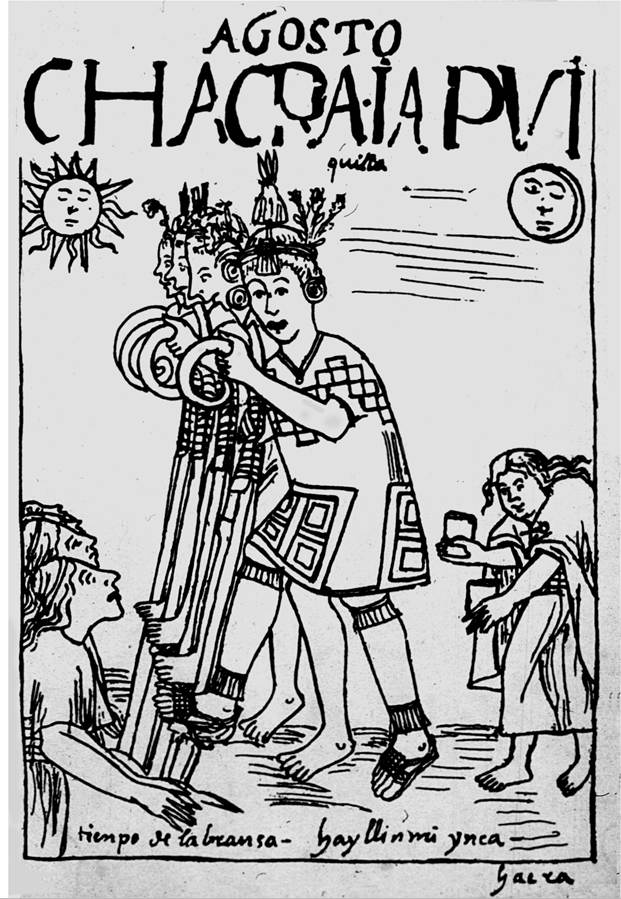
Figure 20.2 Drawing of a foot-plough by Felipe Guaman Poma from his El Primer Nueva Coronica y Buen Gobierno.
known from ethnographic accounts and some historical records.[1186] The literature gives the impression that mixed cropping (polyculture) dominates traditional farming, but there are many variations, including companion planting (e.g. corn-beans-squash: each crop provides benefits to the others), agroforestry (combining annual and perennial crops with tree crops), zonation (different species in blocks or rings within fields), and planting that is nearly monocropping (fields dominated by one crop, with a few individuals of others). There are many examples of environmental zonation, where fields are dispersed across microhabitats, for example the verticality that characterizes traditional Andean agriculture, and planting the floodplains of major rivers, where crops are matched to microrelief, soil, and differential flooding. Native agriculturalists in the Americas also practise crop rotation (changing crops year to year in a field), sequential planting (one crop after another in a field), and fallowing (allowing land to rest, to restore fertility and combat weeds and pests).
Water management was essential to prehistoric agriculture in many parts of the Americas, and transformed landscapes. In desert coastal Peru, for example, early farmers cultivated self-watering alluvial lands along rivers and their outflows, and locations where short ditches or embankments could guide water.[1187] Intensification and expansion of agriculture depended on irrigation. Canal irrigation was practised in South America from southern coastal Ecuador to central Chile, in intermontane Andean valleys, the Altiplano of southern Peru/northern Bolivia, and some valleys along the Caribbean. In Peru, canal irrigation is documented in twenty-five to thirty coastal valleys, with the largest system and area irrigated on the north coast, dating to 1000 ce.[1188] Small-ditch irrigation began by 4500-3400 cal bce in the Nanchoc valley.[1189]
Irrigation was also critical to agriculture in the Southwest United States.[1190] Early farmers planted well-watered alluvial lands; rain-fed farming was practised only rarely in the region, in higher elevations with sufficient rainfall. Historical accounts indicate that stone and brush weirs and earthen berms were built to slow and divert water from streams, springs, and flood run-off. Rock terraces built on hillsides slow run-off, trap sediment, and create planting surfaces. Canal irrigation dates back to 1250-400 bce* in the southern and central parts of the Southwest. Irrigated farming likely required shifting field locations/fallow cycles to replenish nutrients and to avoid salinization. The roughly contemporaneous dates from the American Southwest and Mesoamerica (see below) suggest independent development of water management systems.
Development of water management technology began during the Formative in Mesoamerica.[1191] Practices included use of floodwater and runoff, springs, and upland and valley-bottom perennial stream systems. Floodwater and run-off systems were the most common, dating to 1200 bce and later in numerous locations. Features include dams, canals, ditches, drains, artificial ponds and reservoirs, raised fields, terraced fields, and ridged fields. Much less common were spring-fed systems (770 bce), upland perennial stream systems (300 bce), and valley-bottom systems (1050 bce). A deepwater well dated to 7900 bce, possibly used for hand irrigation, has been identified at a site in the Tehuacan valley. Most of the familiar kinds of water control system were developed along with the emergence of villages throughout Mesoamerica between 1200 and 1000 bce. There is considerable variability in the scale of early systems, but horizontal, kin-based organization is inferred.
The development of agriculture in the Andean highlands was linked to the creation of productive agricultural lands through landscape modification. The basic forms were irrigation, terracing, and raised fields.[1192] Irrigation supplemented rainfall, and was practised in many inter-Andean valleys, with extensive systems in larger basins with expanses of land. Irrigation canals are common in the Lake Titicaca basin, where canals associated with raised fields carried water away from the lake. Irrigated bench terraces at Huarpa near Ayacucho date from 200 bce to 600 ce.
Terraces, flat planting surfaces created on slopes, are mostly found in arid and semi-arid highlands in the Americas, and in the driest areas are associated with irrigation.67 The most northerly zone of terracing stretches from southwestern Colorado through to the Sierra Madre of western Mexico. The distribution is quite dispersed, and consists of cross-channel terraces across narrow drainages. There are discontinuous zones of terracing in Mesoamerica, including the basins of central and southern Mexico and western Guatemala, with few terraces south of Guatemala until the Andes. Forms include crosschannel terraces, contour terraces, and valley-floor terraces. In higher elevations frost hazard is alleviated in part by terracing, since crops can be grown above frost-prone valley bottoms.
Terracing extended discontinuously in South America from Venezuela to Chile and northwest Argentina, with heavy concentrations of irrigated terraces in southern Peru, including around the Inca capital Cuzco and northern Bolivia.[1193] Expanses of rain-fed terraces occur in the eastern Peruvian Andes and southern Ecuador. Sloping-field terraces, in which retaining walls running across a slope accumulated soil and controlled run-off, were the most common type. Bench or staircase terraces were long, narrow expanses of level, deep soil held by high stone retaining walls. Terraces altered field microclimates, optimizing production, reducing risk, and permitting cropping in unfavourable settings. Both unirrigated and irrigated terraces have been dated as early as 2400 bce in Peru, with large terracing systems dating to 600 ce and later.
Raised fields are artificially elevated earthworks that improve drainage and provide planting surfaces in wetlands.[1194] Such fields, called chinampas, were an important component of agriculture on the fringes of lakes in the Basin of Mexico, for example. Formed of lake mud, aquatic vegetation, and domestic refuse, chinampas did not float, but some seed beds were in the form of movable rafts. Chinampa fields were usually narrow, but could be quite long, and were often planted along the edges with trees.[1195] Some 12,000 ha of chinampas helped feed the population of the Aztec capital. Earlier, buried chinampa systems have been documented by remote sensing in the northern Basin of Mexico. Raised-field systems occur elsewhere in highland Mexico, as well as in the lowlands of the Mexican Gulf Coast, northern Belize, and Guatemala. Swampy land can also be cultivated by digging ditches to drain away water, rather than building up soil.
The largest expanses of raised fields in the Andean highlands are in the Sabana de Bogota (Colombia), northern Ecuador, and the Lake Titicaca basin.[1196] In the Lake Titicaca region, from 600-1200 ce the Tiwanaku state supported dense populations in a region marginal for agriculture through raised-field technology and selection of nutritious local crops like potato, quinoa, and lupine.[1197] Approximately 25,000 ha of raised fields were built on flat or gently sloping land. Fields functioned for thermal protection, provided higher fertility through mucking, and retained water in droughts and drained it in floods. Earlier, smaller field systems date to 1500-200 bce in the region.[1198]
In the South American lowlands, large expanses of raised fields are located in northern Colombia (earliest 800 bce), the coast of French Guiana (1000 ce), and the Guayas basin (southwest Ecuador).[1199] In Ecuador, research at the Penon del Rio complex discovered buried fields dating from 500 bce to 500 ce beneath larger, visible fields constructed after 500 ce. Maize phytoliths were identified from both early and late fields.[1200] Raised fields supported intensive agriculture in this region of large-scale flooding and tidal influx.
Areas of the Amazon basin preserve evidence of intentional and non- intentional farming practices that transformed environments into productive, domesticated landscapes.[1201] In addition to anthropogenic burning, already discussed, other elements of transformation included human settlements and their associated gardens; creation of mounds (domestic, ceremonial, burial), forest islands in savannas and wetlands, ring ditch sites, and raised fields; creation of black earths (resulting from domestic debris and large quantities of charcoal that may have been deliberately added); creation of paths, trails, and roads, including extensive systems of raised causeways; fisheries management; and agroforestry (culling non-economic species and replacing them with useful ones). Many of these practices were ancient and persistent in the Amazon.