Domesticity and biopolitics in the construction of the modern world
Family relations were intrinsic to ancient dynastic systems of rule; so too were they at play in modernizing revolutions that brought dynastic rule to an end in many regions of the world in modern times.
And, with the intensification of communications that emerged in the first years of globalization, political challenges in the household and the state could spread from one world region to others.The French Revolution is a clear illustration. During the Enlightenment era, political critiques of absolute monarchy in France often involved family metaphors and reimagined domestic relations. For example, Montesquieu's Persian Letters (1721), a political treatise disguised as a novel, compared the French monarchy to a Persian harem. The portrayal of gender oppression within the harem was meant to stand for the political oppression suffered by the French under the Bourbon dynasty. The French philosopher Jean-Jacques Rousseau also saw a more “natural” domestic order as the basis for a new social and political order. In his works and those of others, virtuous heroines drew their moral superiority from their domesticity, in contrast with decadent women of the aristocracy and royal court.
During the Revolution itself, the rebellion against and execution of the king raised urgent questions about citizenship in the new political system. As Lynn Hunt has argued, family metaphors had to be rethought - fraternity displaced paternal authority as the key metaphor, at least temporarily.[317] And new laws also undermined the long-established rule of the father (until many of the Revolutionary changes were undone by Napoleonic restoration of patriarchalism). For example, Revolutionary law codes eliminated primogeniture and gave daughters equal right to inherit; divorce was legalized on equal grounds for men and women.[318]
To offer a different example, the May Fourth Movement that followed in the wake of the overthrow of the Qing dynasty in 1911 - the last dynasty to rule in China - drew on critiques of the traditional Chinese family to further the cause of political modernization.
Some of these critiques drew on an awareness of alternate political and family traditions in other parts of the world, even as they searched for appropriately Chinese models of modernization. Chen Duxiu, one of the leaders of the movement, saw the traditional Confucian elevation of the father as the core of China's problems: “When people are bound by the Confucian teachings of filial piety and obedience to the point of the son not deviating from the father's way even three years after his death and the woman obeying not only her husband and her father but her son, how can they form their own political party and make their own choice?”[319] Moreover, the May Fourth Movement was a young movement and the prominence of youth (young men and women, many of whom were students) embodied the overthrow of patriarchal authority.Modern forms of governance have brought the realms of the domestic and the political ever closer together. State authorities of the modern era began to intervene more forcefully and directly in the household and in family matters as they increasingly conceived of the inhabitants of their realms as “populations” whose condition was their responsibility. An official government census taken every five or ten years that records details about every inhabitant at the level of the household is one example of the modern project of imagining and managing a population. Many state programs aimed at improving the condition of the state's population involved measures to
Family history: from domestication to biopolitics improve health and well-being (as well as staving off political threats arising from grievances) - for example, health insurance programs launched in Germany in the 1880s or the infant milk programs that could be found in European and American cities by around 1900. Biopolitics - that is, the routine state surveillance, measurement, and management of human life - had by the twentieth century become a hallmark of governing throughout the world.
European empires were also sites of biopolitical interventions, often of a far less benign character. Some programs aimed to lure white settlers into the colonies with the aim of stabilizing political control in the colonies while addressing the perception of “surplus” populations in the metropole. Colonial laws also regulated who could marry whom, and outlined citizenship rules that hardened the lines both between racial groups and between European settlers and indigenous populations. Colonial population management practices often turned brutal, notoriously, for example, in the forced relocations of Herero and Nama people in German Southwest Africa, which resulted in the first genocide of the twentieth century.[320]
Biopolitics of the more brutal sort were also intrinsic features of fascist regimes in early twentieth-century Europe. Fascist movements exalted nation or race above all else and advocated a political program of economic, political and social regimentation on behalf of the race or nation - and were in Foucauldian terms, then, explicitly biopolitical. Fascist movements that came to power in Italy in the 1920s and in Germany in the 1930s sought to reconfigure family law and policy to encourage the reproduction and flourishing of those segments of the population deemed desirable and to discourage reproduction among those whom the state deemed undesirable.
Such policies were exemplified by a series of Racial Hygiene Laws passed by the Nazi regime between 1933 and 1939. The Law for the Encouragement of Marriage passed in 1933 granted racially appropriate newlywed couples a government loan of 1,000 marks; a portion of the loan was forgiven for each child born to the couple. In contrast, a sterilization program was begun in the same year to keep people deemed genetically inferior from reproducing. This early eugenic sterilization program was a precedent for the explicitly racist sterilization later carried out in concentration camps.
Other laws were passed that prohibited marriages between Jews and Germans of “Aryan” racial stock.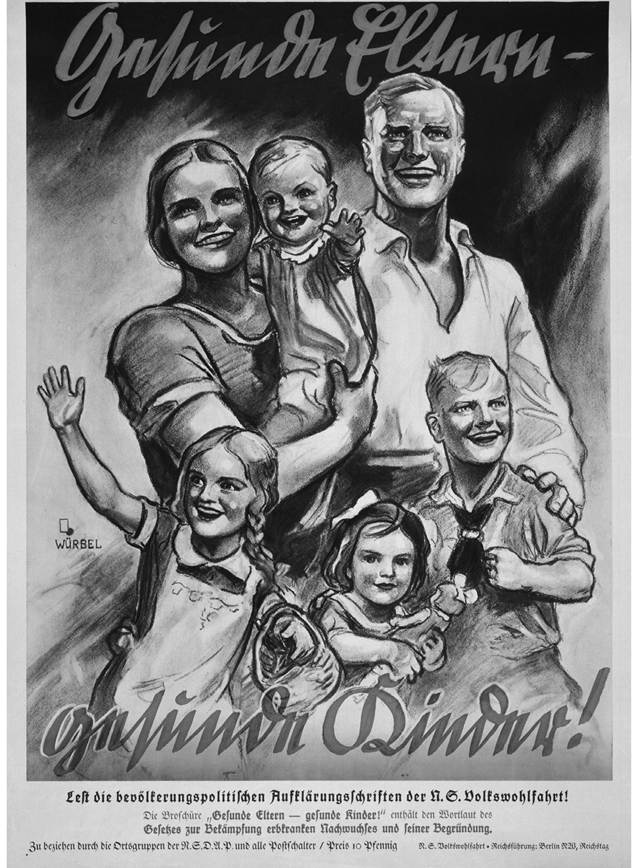
Figure 9.5 Advertisement for a German public information brochure titled “Healthy Parents - Healthy Children!”, 1934 (color litho) (Deutsches Historisches Museum, Berlin, Germany/DHM/Bridgeman Images).
The Nazi regime was extreme in its pursuit of racist forms of biopolitics, but less extreme versions of these programs were put in place elsewhere in the first half of the twentieth century. Some American eugenicists had helped to pass state sterilization laws even before those of the Nazis; in his 1934 book The Casefor Sterilization, American eugenicist Leon Whitney openly expressed his admiration for Nazi policies; he wrote “[m]any farsighted men and women in both England and America have long been working earnestly toward something very like what Hitler has now made compulsory.”[321]
During the Depression, sterilization gained support beyond eugenic circles in some American states, when it was seen as a means of reducing costs for institutional care and poor relief. US sterilization rates climbed during the Depression. New laws were also passed in Finland, Norway, and Sweden during the same period, although the numbers of persons sterilized never came close to the mass scale of the Nazi program. Shortly after the Second World War, in South Africa, the white supremacist Nationalist Party passed laws that codified the racist system of apartheid. The Prohibition of Mixed Marriages Act of 1949 prohibited marriages between white people and people of other races. The Immorality Amendment Act of 1950 outlawed sexual relations across racial lines. These laws remained in effect in South Africa until the overthrow of the apartheid regime in 1994.
The postwar era also saw the politicization of exemplary families, gender relations, and domestic life and their enshrinement as a tool of foreign policy during the Cold War.
Efforts to “normalize” life in the United States after the war involved government programs designed to encourage marriage and home purchase. The promotion of the “male breadwinner” model reflected the concern that the “traditional” family order had been disrupted during the Depression and the Second World War.The model was given a government stamp of approval through such programs as the GI Bill for veterans' education, which supported veterans - overwhelmingly men - to pursue higher education and professional careers. Meanwhile, the government supports for “Rosie the Riveter" - women who entered the labor force during the war - disappeared. These policies contrasted sharply with those followed in the USSR and Eastern Europe, where the emphasis was on creating institutional supports to allow women to
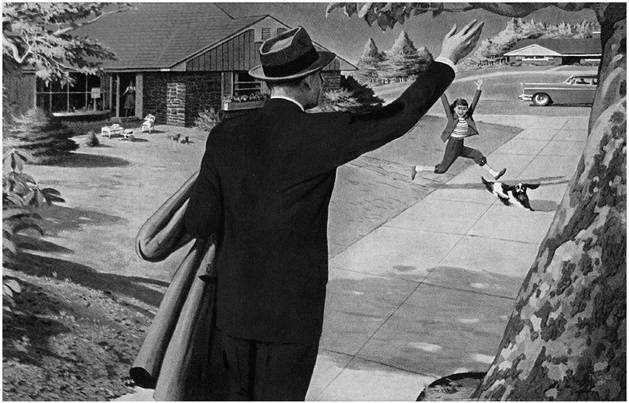
Figure 9.6 US advertisement showing a man returning from work to a suburban home, greeted by his family in the front yard, 1956 (© GraphicaArtis/Corbis).
combine labor force participation with housework and childrearing. These two dueling models were put on the world stage in the 1959 “kitchen debates” between then US vice president Richard Nixon and Soviet premier Nikita Khrushchev, which pitted the virtues of American full-time housewives against those of Soviet working women.[322]
Toward the turn of the twenty-first century, new biopolitical intersections between the state and the family/domestic realm are evident in the arenas of sexuality, reproductive technologies, the management of elder care, and global migration including international adoptions. For example, US states such as Illinois have passed legislation regulating contracts between surrogate mothers and adoptive parents, although in most of the United States and much of the world these relationships remain unregulated. The situation leaves bioethicists concerned that children so produced are reduced to commodities.
Not all biopolitical policies are racist or anti-democratic. As Edward Dickinson has argued, biopolitical measures are an accepted realm of governance in virtually all modern states, however democratic or authoritarian.[323] Democratic regimes can, arguably, engage in more democratic forms of biopolitics. For example, governments can establish clinics or school lunch programs in the interest of improving the health of the population. Or, for that matter, they can take actions such as the 1967 US Supreme Court decision to call on the federal government to protect the individual's right to marry a partner of choice regardless of race. The larger point here is that whatever their specific politics, biopolitical calculations are now routine aspects of governance in most regions of the world thus bringing family history and political history - at the household and the global scales - ever closer together.