Family connections in early modern cross-cultural encounters
In the early modern era, marriage and kinship systems were organized in a variety of ways across the globe. Some marriage systems recognized only monogamous unions as legitimate, whereas others included polygamous families.
In some regions, such as Europe and China, marriage was conceptualized as permanent, and divorce was difficult and rare. In other regions, including areas of Southeast Asia, marriages were easily terminated. In some settings, marriages needed to be formally registered; in others, they did not. For example, beginning in the sixteenth century, European Catholic marriages were supposed to be registered in the local parish; marriages in China, on the other hand, while highly ritualized, took place entirely within the domestic realm. No registration with either religious or state authorities was required, though this in no way implies that the state was not interested in marriage.Other differences pertained to the very notions of what constituted kinship and how it was transmitted - notions often revealed in rules about who could marry whom.[306] Chinese kinship, for example, posited that your father's kin were more closely related to you than your mother's; therefore it was acceptable to marry your first cousins on your mother's side, but it was not permitted to marry persons of the same (patrilineally transmitted) surname. European marriage rules did not distinguish between the mother's and the father's lines; they prohibited marriages among close cousins bilaterally.[307]
Variations across the globe in how kinship and family relations were conceptualized and practiced took on new significance in the context of cross-cultural encounters that multiplied in the era of early modern global travel and empire building. One of the first things voyagers noticed when they traveled to other parts of the world was the variety of marriage systems and gender relations they encountered.
Kinship systems and domestic life were typically experienced as “natural.” This naturalization was exposed and became problematic when cultures came into contact with one another. This is clear even in ancient travelers' accounts. When Herodotus visited Egypt in the fifth century bce, for example, he noted that Egyptians seemed to have “reversed the ordinary practices of mankind. For instance, women attend to market and are employed in trade, while men stay at home and do the weaving.”29 Accounts like this convey a strong sense that proper domestic life is associated with a degree of civilization.Trans-oceanic explorations of the fifteenth century widened the range of cross-cultural encounters. Sometimes this exposure caused moments of selfreflection, but more often it precipitated condemnations or attacks upon family systems perceived to be unnatural or barbaric.
For example, when the Omani traveler Ibn Majid (b. 1421) visited Melaka on the Malay Peninsula in the mid-fifteenth century he wrote of the residents: “They have no culture at all. The infidel marries Muslim women while the Muslim takes pagans to wife... They drink wine in the market place and do not treat divorce as a religious act.”30 If the world that Ibn Majid encountered held some familiarity (Islam had been practiced in Melaka since the twelfth century), Europeans going to the New World later in the century encountered hitherto completely unknown peoples. In a letter written in 1493, Christopher Columbus noted the dress of the locals in the place he called Hispana (clothing of both sexes was minimal); he
1550-1620 (Kirksville: Northeast Missouri State University, 1984); Lucia Ferrante, “Marriage and women's subjectivity in a patrilineal system: The case of early modern Bologna,” in Maynes, et al. (eds.), Gender, pp. 115-29; Merry E. Wiesner-Hanks, Christianity and Sexuality in the Early Modern World: Regulating Desire, Reforming Practice (London: Routledge, 2000); and John Witte, Jr., From Sacrament to Contract: Marriage, Religion, and Law in the Western Tradition, 2nd edn.
(Louisville, KY: John Knox Press, 2012).29 Herodotus, The Histories: Second Book: An Account of Egypt, G. C. Macaulay (trans.), accessed on Feb. 27, 2013, www.gutenberg.org/files/2131/2131-h/2131-h.htm.
30 Luis Filipe Ferrera Reiz Thomasz, “The Malay Sultinate of Melaka,” in Anthony Reid (ed.), Southeast Asia in the Early Modern Era (Ithaca, NY: Cornell University Press, 1993), p. 79. added that most marriages were monogamous (kings were excepted from this rule), and that “women appear to work more than the men.”[308]
Early modern European projects of colonization and conversion involved relations in the intimate domestic sphere as well as in military, political, and ecclesiastical domains. New Spain provides a concrete example. The political and military elites of New Spain were comprised of men who had come from Spain, usually without wives and without landed property. They often married local women from among the landed indigenous elites; differences between the marriage systems quickly became apparent. Historical research suggests that marriage systems in much of Mesoamerica at the time of first contact with the Europeans in the sixteenth century did not demand monogamy; moreover, divorce was possible and cross-cousin marriages were common. Furthermore, there was no state or church entity that registered and formalized marriages.[309]
While some early marriage ceremonies uniting Spanish men and indigenous women combined both indigenous and Spanish customs, Christian missionaries to the Mesoamerican colony of New Spain regarded the reform of indigenous kinship systems and marriage practices as an integral part of their missionary work. Proper family life was essential to proper religious practice. The form of Catholic belief and practice that was introduced to New Spain reflected Reformation era debates and contests, including contests over marriage. Patricia Seed has shown ways in which this reformed Catholic vision of marriage was carried to New Spain.
Her research shows that Catholic marriage made significant inroads among the colonial urban elite classes, even if older practices continued in rural and popular milieus.[310]Marriages and other types of sexual unions between travelers and indigenous partners in the early modern era were of critical importance in the construction of colonial rule, the development of commercial networks, and the emergence of ideas about racial difference. Again, New Spain offers a case in point. By the eighteenth century, Mexicans produced paintings known as casta paintings that depicted in great detail the ways in which the mixed marriages of various combinations were seen as producing distinctive
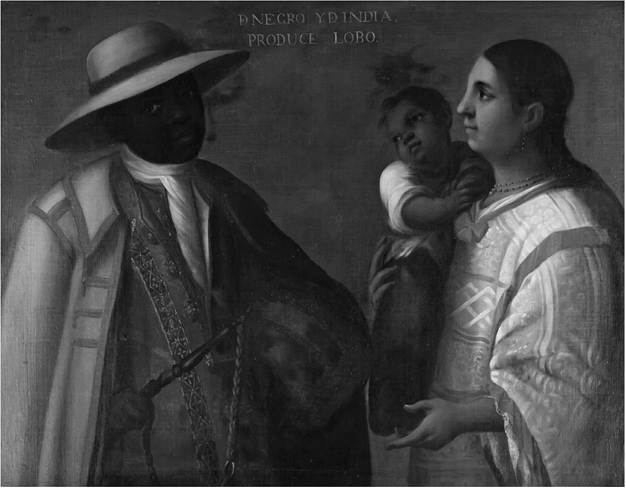
Figure 9.4 “Black and Indian Produce a Wolf,” c. 1715 (oil on canvas), Juarez, Juan Rodriguez (1675-1728). In the title of this casta painting, the term “wolf refers to one of the fanciful names for a racial category (Breamore House, Hampshire, UK/Bridgeman Images).
categories of offspring each with its particular form of appearance, dress, and character traits. The casta paintings thus document the ideological role played by colonial marriage in emergent ideas about racial mixture, and the ways in which this ideology served to privilege Spanish ancestry over other lineages.[311] It was in this colonial domestic context that racial categories were first clearly expressed culturally. These ideological conceptualizations of difference were important even before modern scientific concepts of race emerged.
A different kind of colonial encounter occurred in Southeast Asia. Both Europeans and Chinese traders in early modern Southeast Asia were shocked by Southeast Asian marriage practices. As Barbara Andaya has shown, marriage in early modern Southeast Asia could be temporary; women were not restricted to the domestic sphere but freely occupied public spaces as traders, and exercised substantial economic agency.[312] In the early modern era, children born of mixed unions played an important role as brokers between the two cultures, but as time went on and outsiders' notions about family, kinship, and sexuality became more prevalent, there emerged an increasing suspicion of what were called “half-castes” in both colonial and indigenous courts.[313] In both the New World and Southeast Asia, then, offspring of the intimate encounters of colonialism played a pivotal role in the history of ideas about race and difference, anticipating the emergence of race as a critical category in modern biopolitical thinking.[314]
The early modern movement of peoples that redefined, disrupted, and reinscribed kinship relations was of course not always voluntary.
The African slave trade had a profound impact on family structure and practices in both Africa and in the New World; the institution of slavery also served as a site for the further development of notions of racial difference and connections between ideas about race and family. Young men were disproportionately taken as slaves, which had a disruptive impact on West African family history. Reproduction of the labor force was a concern shared by plantation owners throughout the New World, but approaches varied in different regions. In the North American South, as Damian Pargas and others have argued, many plantation owners made the decision to allow slaves to form families, even if these were not legally recognized. Owners calculated that it was more economical to raise a slave child than to purchase a slave; moreover, slaves with families were often felt to be more tractable than isolates. But the decision to allow slaves to form families did not mean that slave holders guaranteed slave family stability, for family members were often separated for sale.[315] On the sugar plantations of the Caribbean and in Latin America, where mortality rates among the enslaved African populations were even higher than in North America, slave holders made the opposite calculation: they decided that it was cheaper for them to continually buy enslaved Africans than to encourage reproduction through family for- mation.[316] Slave owners were quite calculating in their management of slave populations; slaves throughout the New World encountered enormous obstacles in their efforts to form and maintain family and kin ties.Domestic intimacies and family reorganization resulted from and helped to build early modern commercial networks and empires. Whether in the form of voluntary sexual unions between foreign traders or colonizers and indigenous people, or the coerced family formation (or prohibition thereof) among the enslaved, early modern encounters restructured family life around the globe and also brought family more explicitly into the realm of global politics and emergent ideologies of difference and inequality.