The family and the state
Early states presumed family life and kinship as models according to which political power was practiced and transmitted. Kingship, a common form of rule in early state societies, typically rested on the transmission of authority through kin lines, often from father to son.
A Sumerian king list from the early second millennium bce recounts the descent of kings from a mythical ancestor, Alulim, and serves to legitimate political power by mapping the genealogical connections from one ruler to the next across the millennia. To offer another example, even though Chinese dynastic histories begin with tales of several sage kings who did not have worthy sons, these tales nevertheless culminate in the legitimation of the principle of dynastic succession. When Yu passed the throne on to his son, he founded the Xia dynasty (traditionally dated as beginning in 2070 bce); thereafter, the normative transmission of power within a Chinese dynasty, until the overthrow of the last dynasty in 1911, was from father to son (or other male relative). In certain exceptional cases, like that of pharaonic Egypt, women played an important role in dynastic transmission. According to Lana Troy, “[w]hile remaining a gendered domain, the political and cosmic power of the ancient Egyptian kingship required the interaction of male and female components, and could take feminine, as well as masculine, form and reflect the self-20 A good introduction to this story is Stephen Teiser, The Ghost Festival in Medieval China (Princeton, NJ: Princeton University Press, 1988).
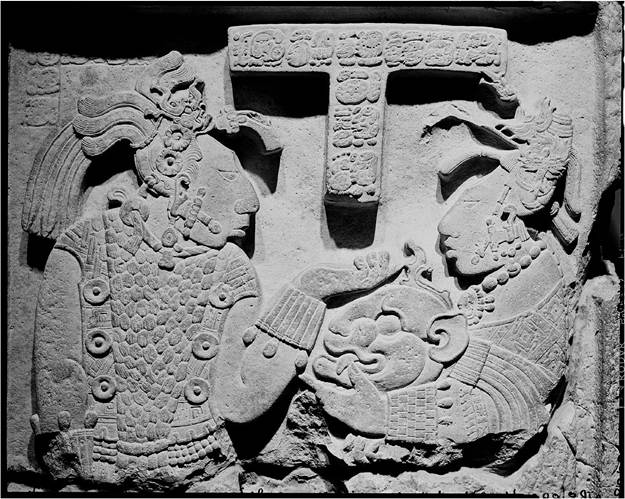
Figure 9.3 Stela depicting a woman presenting a jaguar mask to a priest, from Yaxchilan (stone), Maya (Museo Nacional de Antropologia, Mexico City, Mexico/Bridgeman Images).
generating dynamic of the organization of the universe.”[300] In ancient Maya societies, too, queens could play an important role in the transmission of political power, as is evidenced by the lady Zac kuk, who crowned her son, the powerful king Pakal.[301] But even these deviations from patrilineal transmission of political authority underscore the importance of family ties to the transmission of power in ancient kingship.
The analogy between the power of the king in the realm of the state and the father in the family was mutually reinforcing; likening the power of the king to that of the father naturalized both masculine political power and masculine authority in the household. Presumptions about kinship were thus at the very root of beliefs about the exercise of political power. Chinese political thought provides a good example of one specific variant of how politics and kinship are intertwined. Chinese rulers and philosophers suggested that a well-regulated state began with a well-regulated family. Kinship metaphors abounded: the emperor was the son of heaven; local officials were known as father and mother officials. Family provided a key template for thinking about authority in a way which naturalized authority.[302]
Another significant connection between family history and the origins of the state lies in the realm of law. In early legal systems, such as the Code of Hammurabi (dating from about 1750 bce), regulation of family is one of the key concerns of the code, occupying nearly one-third of its provisions. As Gerda Lerner notes, “what is remarkable about these laws is the increasing authority given to the state (king) in regard to the regulation of sexual matters.”[303] Early Chinese ritual codes also demonstrate a concern with defining family relationships, for example through marriage; codes spelled out the rituals appropriate to marrying and also defined appropriate marriage partners. Those of the same surname are not appropriate spouses, no matter whether or not descent can be traced to a known common ancestor. So we can see that the domestic is, from the era of origins of state societies, never merely domestic. The intervention of state authorities in the regulation of sexual and family matters can be seen as at least partly reflecting a concern with reproduction - an interest on the part of the state in the creation of future generations, which might be seen as a precursor to modern biopolitics.
Laws such as those found in the Code of Hammurabi are concerned with the transmission of property, but they are also concerned that sexual relations create appropriate offspring and families.Early political communities were typically constructed through kin relations. Ancient Greek and Roman citizenship laws, for example, were built around family ties although not always in the same way; parentage was very important in determining citizenship. At the time of the legislation of Pericles (451-450 bce), for example, it was necessary for both parents to be citizens in order for their child to claim Athenian citizenship. In other times, when there was concern about declining numbers of citizens, the children of Athenian fathers and foreign mothers could be citizens.[304] In the case of ancient Rome, the citizenship of the father was usually more important in determining the citizenship of the offspring than that of the mother.[305] While these rules may seem to be a far cry from modern biopolitics, they do suggest ways in which marriage and reproduction have long been at the core of many legal and political systems.