Families and cosmologies
Domestic life and family relations provided the setting in which individuals located themselves in time as well as space. Family life-cyclical practices such as burial produced material reminders of connections between ancestors and descendants, and thus past, present, and future, providing a link between family life and the production of cosmologies and eventually religious systems of thought.
The earliest known symbolic objects - flat pieces of ochre carved with geometric designs - date from about 75,000 years ago and were discovered in
caves in southern Africa.[296] For more recent eras, burial sites suggest explicit connections between family and the emergence of religious practices. Cat- alhoyuk offers pertinent evidence here as well; one interesting aspect of the Turkish site is that ritual objects and graves are found in special areas of domestic spaces. One domestic gravesite contained a reburied male skull that archaeologists believe might have belonged to a revered ancestor or relative of members of the household where it was found. It had been sculpted and painted; at some later point a woman died and the skull was buried along with her body. To offer just one additional example, Qiang Gao and Yun Kuen Lee argue that Yangshao burial sites also suggest that family relationships persisted beyond death in the form of an ancestral cult. They too find evidence of reburials, suggesting a ritual treatment of the dead, perhaps indicating the transformation of the dead into ancestors.[297]
Domestic life has played an important role in many of the world's cosmologies - in origin stories as well as in accounts of the lives of deities. Egyptian cosmologies feature the couple Isis and Osiris, deities who, among other things, introduced agriculture: in some version of the creation story Isis discovered seeds and Osiris taught the Egyptian people how to plant them.
The origin stories of Judaism, Christianity, and Islam look quite different from those of Egypt. The biblical book of Genesis introduces a male monotheistic god, who alone creates Adam in his image, and, from that man, creates Eve to be his wife. Contrasting these stories with origin stories such as the Egyptian one with its multiple gods and goddesses and complex family dynamics, feminist historians have associated the emergence of major monotheistic religious traditions with the “origins of patriarchy” in ancient Mesopotamia.[298]Religious traditions can also reflect anxieties about or tensions with family or domestic life. For example, divine births often seem to circumvent normal family relations. Christ, as the son of the Judeo-Christian God, had no human father. The Buddha was born from the side of his mother. He was thus spared from the pollution of ordinary birth, though the unusual birth resulted in the death of his mother. Rather than simply positing deities as living in families akin to those of humans, these extraordinary births place
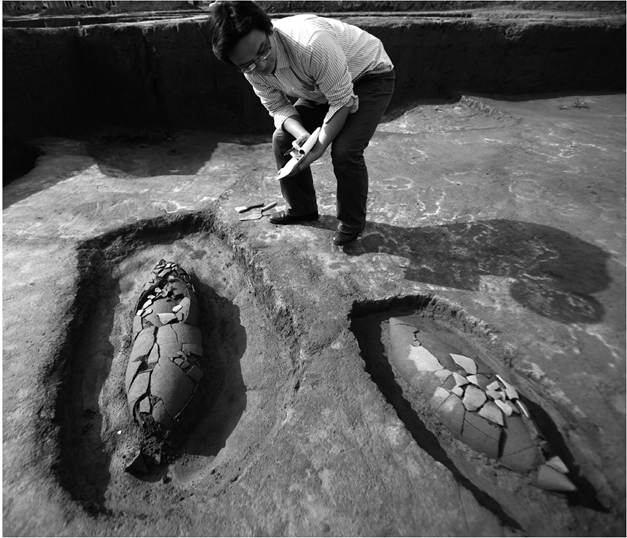
Figure 9.2 Coffins of children unearthed at a Yangshao burial site at Luoyang, in China's central Henan province (© Imaginechina/Corbis).
the gods beyond the realm of the ordinary mortal even where “birth” is still conceptually crucial.[299]
And there are other kinds of tensions between religious and domestic life apparent in the development of world religious traditions. Many early Christian theologians were suspicious of the family and sexual relations as a distraction from the spiritual life, if not downright sinful, and so posited celibacy as the best form of existence for the Christian. The Buddha, born into a princely household in north India, left home as a young father to investigate the nature of suffering. Monastic contemplation, away from family, was thus established as the highest form of devotion in Buddhist practice in many of the regions to which it spread. Buddhists developed important monastic institutions that usually demanded celibacy. Indeed, when Buddhism was first introduced into China, critics were concerned that celibate monks would cut off the line of descent stretching back generations and deprive that line of ancestors of the sacrifices that were essential to a happy afterlife. Advocates of Buddhism countered that conversion would benefit ancestors; to reconcile skeptics, Chinese ideas such as filial piety became an important part of Chinese Buddhism. The Chinese Buddhist story of Mulian, a man who goes through myriad hells to save his mother, is one example of how Buddhists reconciled Chinese beliefs about the duties a person owes his parents with the demands of the religious life.