Family, domestication, and human origins
Family relations have long played a role in accounts of human origins, but those accounts have been changing over the last several decades. Until the 1970s, most scholarly and popular accounts of early human society featured “Man the Hunter”: according to this view, relationships among men - both cooperative and competitive - drove human development.
Men organized the hunt and the production of the stone weapons it required; relationships around hunting and tool making contributed to the evolution of human social organization and culture. Men also competed - for territory and for mates. Heterosexual pair bonding was the basis of a tacit exchange: men supplied most of the food that allowed women to focus on bearing and nurturing children. According to this theory, the role of women was largely restricted to reproduction and reproduction was understood primarily in biological rather than cultural terms. Domestic life was not the focus of much scholarly concern since crucial evolutionary developments happened elsewhere.Beginning in the 1970s, the feminist revision of the “Man the Hunter” thesis opened up new possibilities for thinking about family, gender relations, and the role of domestic life in human evolution. It has now become clear that archaeological evidence can support a very different view of human origins. Newer views agree that early human societies relied on gender divisions of labor but women were involved in production (especially foraging for food) as well as reproduction. Family or household dynamics figured into processes of transition from nomadic hunting and gathering to settled agrarian societies. Although the evidence is sketchy, it seems possible that a transition to agriculture may have been facilitated in some areas by intermarriages between groups who based their livelihoods on different ecologies. In Neolithic East Africa there is evidence of complementary cross-marriages between nomadic men and hunter-gatherer women, although other patterns of gender complementarity can also be found.[286] Similarly, Ruth Whitehouse argues that bone analysis of Bronze Age sites in Italy suggests gender-specific patterns of migration possibly related to intermarriage between “colonizing male farmers and indigenous hunter-gatherer women.”[287] Moreover, apparently cooperative divisions of labor, often organized along gender lines and based around small co-residential groups, are reflected in evidence about diet at some early settlement sites.
For example, the distribution of artifacts at sites in the valley of the Nile dating from around the ninth millennium bce suggests that women in particular were involved with specific activities linked to agriculture and pottery making (useful for storage vessels at permanent domestic sites).[288] Specific family or kinship relations in co-resident groups can only be surmised on the basis of such evidence, but now DNA analysis promises to illuminate the role of kinship in early human settlement with somewhat more precision.Moreover, recent investigations have been more attuned to the household and kin group as sites of human development and to women’s domestic activities - including child socialization - as essential to human evolution. The manifestation of complex cognitive abilities is a hallmark of human evolution. Daniel Smail has argued that the human brain “did not evolve to solve the relatively simple problem associated with tool use, much less the problems posed by the hunt. Instead, the large human brain evolved over the past 1.7 million years to allow individuals to negotiate the escalating complexities posed by human social living.”[289] However, archaeological evidence of this gradual evolution in the deep past is elusive; the traces that survive require new approaches to interpretation. Feminist archaeologist Diane Bolger points to “innovative research on the use of art and symbolism in the construction of early human social identities.” Bolger identifies two quite different and widely separated periods when there is evidence of accelerated development of symbolic expression - the first beginning around 80,000 or more years ago - which saw what she terms a “creative explosion” among early sapient populations during the Upper Paleolithic period, and, the second, associated with post-Ice Age domestication, about 9
12,000 years ago.
The focus of recent work by social archaeologists on early child nurtur- ance is of special interest for making connections between family history and the development of early human societies.
Evidence about the material, social, and cultural environment of the domestic setting can be read for its implications about cognitive abilities. These interpretations in turn are suggestive of the early childhood experiences that are key to the acquisition of cognitive skills and also to the construction of social relationships. In Origins and Revolutions: Human Identity in Earliest Prehistory, Clive Gamble tracks the gradual and long history during which hominid social and cognitive potentials were manifested. He begins his account in the remote hominid past, long before the invention of language. His tactics rely much on inferences around the concept of the “childscape” - “[t]he material project of growing children needs to be investigated at two interlocking scales, the locale and the landscape that together I refer to as the childscape: the environment for growth.”[290] [291] [292] His focus is on the learning of social skills and cognitive maps by children. He calls for a way to make children “visible” that parallels the way that gender analysis made women visible to archaeologists.Gamble argues that childscapes developed over a series of slow transformations of hominid spaces that structured the environment for growth. Very early on, around 100,000 bce, Homo sapien societies show evidence of significant human cognitive developments rooted in early childhood nurtur- ance and cultural transmission.11 Child nurturance takes on a new prominence during the epoch of domestication (in Gamble's scheme c. 20,000 to 6,000 years ago). Gamble argues that domestication changed the world most significantly not in the usual sense of villages, crops, and gods and goddesses, but rather in terms of a new emphasis on the domestic nurturance of children.12
Ian Hodder uses the concept of “childscape” in his interpretation of evidence at Qatalhoyuk, in Turkey, an unusually well-preserved early agricultural settlement that housed between 3,000 and 8,000 people around 7000 bce.
In Qatalhoyuk kinship and household served as important organizing principles in the transition to agricultural settlement. Everyday life centered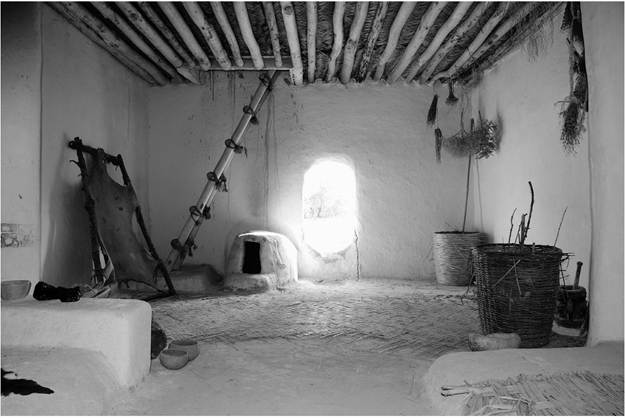
Figure 9.1 Reconstruction of a house at Qatalhoyuk (© Mauricio Abreu/JAI/Corbis).
on the household. Residential buildings, which were filled in and rebuilt periodically, housed a domestic group of five to ten people. As Hodder explains:
A child growing up in such a household would soon learn how the space was organized - where to bury the dead and where to make beads, where to find the obsidian cache and where to place offerings. Eventually, he or she would learn how to rebuild the house itself. Thus the rules of this complex urban society were transferred without centralized control, through the daily practices of the household. All those practices were carried out in the presence of dead ancestors and within a symbolic world immediately at hand, conveyed through rich artistic representation.[293]
Expanding domestication to include social and cultural processes that characterized early human societies has sparked exciting new research questions and findings. Going beyond what's “written in stone” has allowed feminist and social archaeologists to examine questions about the evolution of human skills, especially cognitive skills, beyond organizing the hunt. Early human
settlement sites like Qatalhoyuk are important for making visible the household dynamics and domestic activities critical for early agricultural societies. At Qatalhoyuk the household was the unit of social organization; there is no evidence of a central government or higher political authority in the complex settlement.
To offer a second example of early domestication in the absence of larger political structures, the Yangshao culture (5000-3000 bcb) consisted of a series of small agricultural villages in river valleys in northern China.
Yang- shao farmers grew grains and domesticated animals such as pigs. The villages were built around a central plaza; residential buildings clustered around the plaza; and workspaces and burial grounds were located further from the center. Archaeologists deduce notions about kinship and social organization from the evidence of burial sites. Farm tools such as hoes or plow discs are normally not found in the same graves as grinding tools or spinning whorls. Although it is not always possible to determine the sex of grave occupants, the evidence does point to a gender division of labor that linked certain farm tasks to men and cooking and textile production to women.[294] Analysis of skeletal remains suggests that women in Yangshao villages married out; these marriages may have provided connections among these villages.[295] As in Qatalhoyuk, important elements of social organization - cooperative production following a division of labor, settlement building, and kinship rules - all emerged without any form of the state. Social complexity here too focused on the locale and the household.