Geographic Distribution
A low incidence and sporadically occurring disease, botulism has been well documented in many parts of the world, as indicated in Table VHL 19.2. Although completeness of official reporting varies among countries, hence preventing reliable estimates of true distribution and incidence, it is clear that botulism is a disease with significant case fatality rates wherever reported.
Table VIII.19.2. Reports of botulism from various countries in recent years
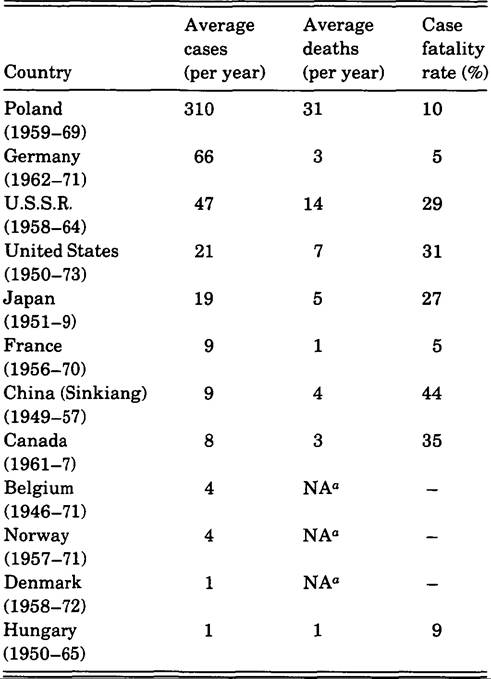
Source: Smith (1977), Botulism: The Organism, Its Toxins, the Disease. By courtesy of Charles C. Thomas, Publisher, Springfield, Ill.
αNA = not available.
Foods primarily responsible for botulism vary considerably among countries, reflecting differing dietary and food preservation practices. In Poland, Germany, and France, canned meats have accounted for the vast majority of outbreaks, whereas in Japan and Russia home-preserved and pickled fish have been most commonly incriminated. In the United States, low-acid canned vegetables, particularly beans, peppers, and mushrooms, have been the most common sources of botulism, with relatively few outbreaks traced to meat or fish. Most instances in all parts of the world are associated with improper home canning or pickling, though the far more serious public health problem of botulism associated with faulty commercial canning does continue to occur.
William H. Barker