Lower Palaeolithic: the initial peopling of Europe
The earliest prehistory of Europe also may be divided into two phases. The first phase took place before three-quarters of a million years ago, and is characterized by what appears to be limited and sporadic occupation of Southern Europe by several forms of earlier Homo.
Their artefacts are confined to pebble and flake tools, similar to those of the earliest known Lower Palaeolithic artefacts in Africa. The second phase began after 600,000 years ago with the invasion of a large-brained later Homo (often referred to as Homo heidelbergensis), who made large bifacial tools or hand axes and left relatively substantial traces of settlement in Western and Central Europe, including as far as latitude 52° North in Britain.Evidence for humans in Europe before ι million years ago has only recently been confirmed with the dating of early Homo skeletal remains to 1.2-1.1 million years ago at the Sierra de Atapuerca in northern Spain (roughly 42° North).[505] The remains, which comprise a jaw bone and teeth, are associated with stone flakes and large mammal bones that exhibit traces of butchery (see Figure 16. ι). The early Homo fossils at Atapuerca appear to represent the same general expansion out of Africa - which probably involved multiple migrations over some period of time - into the temperate zone of Eurasia that began after 2 million years ago.
Another recent discovery is a hand axe or large bifacial artefact dated to about 0.9 million years ago, which was recovered from Estrecho del Quipar in southeastern Spain.[506] The hand axe was found together with other stone artefacts and two isolated human teeth. It may represent a later movement of early humans out of Africa that seems to have taken place about 1.4 million years ago. At that time, crude-looking hand axes - which were made as early as 1.76 million years ago in sub-Saharan Africa - appeared in the Levant.[507] The discovery in southeastern Spain suggests that this migration also reached Europe.
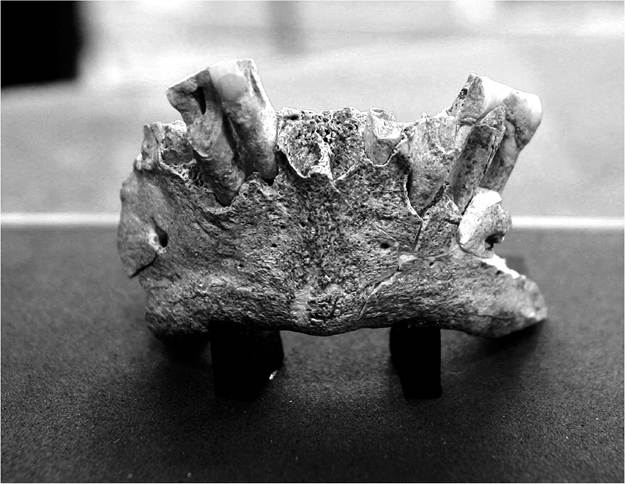
Figure 16.1 Jaw and teeth dated from 1.2 to ι.ι million years ago, found at Atapuerca in northern Spain (© Sani Otero/epa/Corbis).
Atapuerca has yielded somewhat younger human fossils (estimated at roughly 0.8 million years old) that are classified as a separate species (Homo antecessor) unique to Europe. Although no hand axes have been found in association with the fossils, this might be a sampling problem. In central Italy, at the site of Ceprano, a fossil skullcap is dated to between 1.0 and 0.7 million years ago. It may represent yet another expansion out of Africa, by a larger- brained form of Homo similar to Homo erectus.
The initial peopling of Europe seems to reflect a fundamental shift in human ecology and behaviour that took place in Africa after 2.5 million years ago, and permitted early Homo to occupy a much wider range of habitat and climate than its australopithecine predecessors. The shift entailed production of modified pebble and stone flake tools, which - although simple and essentially reductive in character - nevertheless lie outside the capacity of living apes. This development reflected the long-term consequences of bipedalism, which had led to increased forelimb specialization (that is, the evolution of the human hand) among the australopithecines. At least one of the functions of the tools was the killing and/or butchering of large mammals, reflecting the expanded role of meat in the human diet. The increased consumption of meat must have been a critical component of the changes in behaviour that facilitated the expansion into the temperate zone and into Europe.
Roughly three-quarters of a million years ago, a new large-brained form of Homo migrated out of Africa into western Eurasia. It is often referred to as Homo heidelbergensis, and represents the common ancestor of the Neanderthals and modern humans. Cranial volume averages more than 1,100 cubic centimetres and overlaps with that of living humans.
In contrast to earlier forms of Homo - for which the evidence remains problematic - Homo heidelbergensis had mastered the control of fire. And in contrast to the earlier inhabitants of Europe, it manufactured a refined form of the hand axe or large bifacial tool. Production of the latter was not reductive, but rather required a preconceived design and several hierarchically organized steps. The steps included: (ι) production of a very large flake from a stone cobble or core, (2) more or less complete flaking of both sides into an ovate shape in three dimensions; (3) careful trimming of the edges to yield a more finely shaped ovate form. The completed biface often was converted into a ‘cleaver' by striking a tranchet blow across the pointed end.Approximately 600,000 years ago, Homo heidelbergensis invaded Europe, most probably via the Bosporus, and its remains are well represented in a younger occupation at Atapuerca. The oldest hand axes in Italy date to about 600,000 years ago. Traces of Homo heidelbergensis are only slightly younger in southern Britain, where they are dated to a very warm interval roughly half a million years ago. A tibia or lower leg bone from Boxgrove, a Palaeolithic site in southern England, is rather massive and long, suggesting that the anatomical adaptations to cooler climates that eventually became typical of the Neanderthals had yet to evolve.
Boxgrove actually contains an entire ‘landscape' of early human sites, and probably reveals more about the pre-Neanderthal inhabitants of Europe than any other site or group of sites known to date. Half a million years ago, Boxgrove was warmer than today, but otherwise similar - a low-lying coastal plain covered with grass. Small groups of Homo heidelbergensis moved across this landscape, killing and/or scavenging horses and other large mammals. At one location, they repeatedly gathered around what was probably a spring or waterhole, where hand axes often were discarded. At other locations, they sharpened their tools and used them to butcher a horse carcass.[508]
Another highly revealing site is Schoningen in northern Germany, which is dated to roughly 400,000 years ago. Climate conditions were somewhat cooler than at Boxgrove, and the habitat was a mixture of meadow and forest steppe. Horses were butchered here as well, but unlike Boxgrove, there are traces of hearths. Most unusual and a consequence of exceptional preservation conditions, Schoningen yielded wooden artefacts, including several long spears of pine or spruce. Detailed analysis of the multiple steps involved in their production demonstrated a surprisingly complex process. The pointed ends were carefully shaped and polished from the hardest wood, which occurs at the base of the tree.8