Mesoamerica and the Southwest
Mesoamerica
Research in the Mexican highlands has established that cultivation of maize and other crops including beans and squashes was combined with diverse foraging practices for several thousand years before sedentary village life developed.[257] As in West Asia and East Asia, therefore, there was a long period during which cultivation was integrated with continued hunting and gathering (see also Deborah Pearsall, Chapter 20).
Sedentary village life emerged in the second millennium cal bce, the Formative period, and appears to be linked with increased dependence on maize agriculture. In the Oaxaca valley, Tierras Largas and SanJose Mogote provide examples of Flannery's village type with rectangular houses and private storage, which he likens to the Levantine PPNB villages of West Asia. At this and other Formative sites, ‘household clusters' consisted of wattle-and-daub dwellings, ovens, hearths, and storage pits over an area of around 300 m2. These are more dispersed spatially than many PPNB villages and recall varying degrees of household dispersal documented in Neolithic Europe and East Asia. In some cases ‘courtyard groups' of houses are apparent, arranged around open activity areas. The implication is that households insulated themselves from risk by sharing it with close neighbours/kin. A more formal version of this arrangement, in the extended family household, developed in the later Formative.
Recent archaeobotanical investigation at Formative sites in lowland Mesoamerica sheds light on how agricultural practice articulated with the development of farming households and sedentary villages. VanDerwarker's analysis of charred plant assemblages from LaJoya and Bezuapan on the Gulf Coast of Mexico suggests increasingly intensive infield cultivation of maize through the Formative period, and ridged plots preserved by volcanic ash fall in the terminal Formative directly attest to intensive management.[258] Infield cultivation was accompanied by shifting outfield plots that were increasingly given over to permanent fruit tree arboriculture.
The emergence of fields and tree plots as fixed, permanent ‘assets' of particular households or groups increased the potential for differential production and wealth. Extreme inequalities were ultimately expressed in the rich burials, monumental architecture, and iconography of later Olmec sites in the region.Several levels of ‘community' are apparent in early agricultural Mesoamerica, from the co-residential household to the courtyard group and the wider village. Mechanisms for maintaining cohesion at the village level apparently involved special or ‘public' buildings, attested from the early Formative period onwards. San Jose Mogote provides a well-known example, with a sequence of buildings on a different orientation to contemporary houses and with crushed bedrock foundations and lime-plastered floors and walls (Figure 5.9). Though their specific function(s) are unknown, they may plausibly have housed ritual activities that served to bind the community together. By analogy with later periods, the powdered lime stored in central pits in these structures was mixed with a sacred plant such as wild
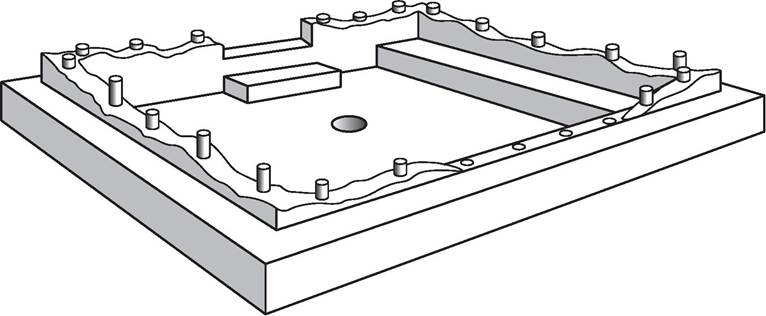
Figure 5.9 Reconstruction of the ‘public building' (Structure 6) at SanJose Mogote, Oaxaca, Mexico.
tobacco, believed to increase male strength.[259] Broader social networks are also evident at San Jose Mogote: the villagers made magnetite mirrors traded up to 250 km away, and obtained turtle drums, stingray spines, conch shell horns, and armadillo shell for costumes from the coastal lowlands.
Evidence for specialized craft production alongside intensive farming raises questions of labour organization. Attempts have been made to distinguish ‘male' and ‘female' toolkits and tasks in burial and domestic contexts. While the distributions of features and artefacts on house floors at Tierras Largas, for example, suggest that activities such as cooking and various crafts were spatially distinct, the extent to which these activities were gendered is unclear.
As noted above, ethnographic observation of small-scale farming societies suggests that men and women often work alongside each other (e.g. at harvest time), though men may be more closely associated with clearance and women with daily tending, weeding, etc. The grouping of some houses around ‘courtyard' areas suggests that inter-household work parties formed around food processing and preparation outdoors. While women arguably presided over such work parties, the ‘public' buildings at San Jose Mogote have been interpreted as ‘Men's Houses', where fully initiated men assembled to plan hunting or raiding expeditions, carry out specific rituals, smoke or ingest sacred plants, etc.The Southwest
The agricultural sequence in Arizona, New Mexico, Colorado, and Utah centres around the northward spread of maize, beans, and squash from Mesoamerica. From the first occurrences of maize at around 2000 cal bce, a long phase ensued during which cultivation formed part of a largely huntergatherer way of life.[260] An increase in sedentary behaviour and agricultural commitment is evident in the first millennium C e, by which time beans had joined maize and squash. Stable isotope analysis of human remains suggests that maize may have been a dietary staple from as early as 500 bce in some regions, increasing further in the late first to second millennia ce, but the differential presence of maize remains across sites in different regions of the Southwest suggests that the pace and degree of uptake were variable.[261]
Pit-house settlements of the mid first millennium ce in New Mexico exemplify contrasting social adjustments to farming. At the SU site, in the Mogollon mountains, large pit-houses (on average 40 m2) contained internal storage pits that could accommodate enough staple food to feed a resident family for over a year (Figure 5.10a). The settlement also contained a large number of burials, many of them associated with abandoned houses.
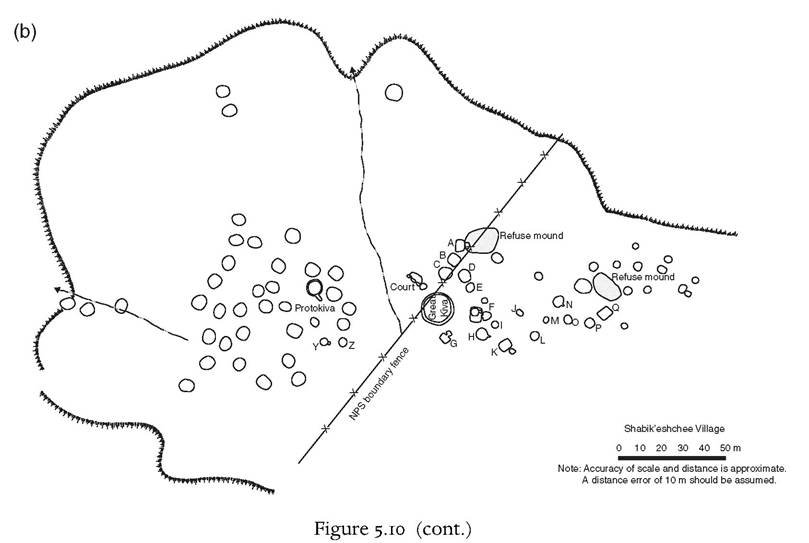
All of this evidence suggests year-round occupation and a household mode of production. Many other contemporary sites, however, more closely resemble Flannery's ‘communal compound'. At Shabik'eshchee Village in Chaco Canyon, pithouses are much smaller (averaging 17.8 m2) and storage pits were located in outdoor ‘public' areas rather than internally (Figure 5.10b). Wills argues that the inhabitants of the SU site enjoyed greater resource security in a region of higher precipitation, enabling them to pursue the riskier strategy of household production, while those at the Shabik'eshchee Village site adapted their strategies to a drier landscape with more sparsely distributed resources, and so opted for more communal living. Not all resources, however, would be equally susceptible to sharing; ethnographically, meat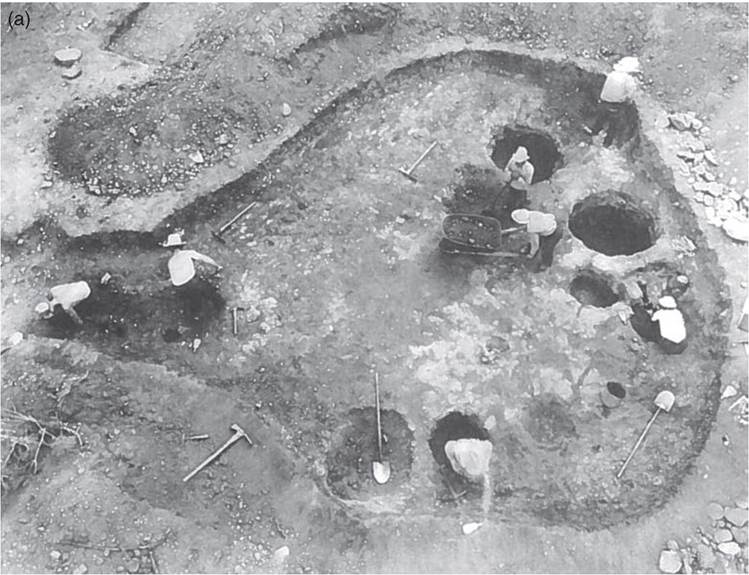
Figure 5.10 (a) Plan of the SU site, Mogollon mountains; (b) plan of Shabik'eshchee Village, Chaco Canyon, New Mexico.
from large hunted game is more likely to be shared out than storable plant foods that can be consumed piecemeal.
Archaeobotanical evidence indicates that cultivation took place in a range of lowland and upland contexts, using high-water-table, floodwater, mesa top run-off, or rain-fed techniques. Evidence at some early agricultural sites indicates that maize was grown in an intensive horticultural system. For example, grid-gardens of the ceramic period at the Chama Alcove site in New Mexico used run-off from the mesa top. The swollen state of first-millennium ce maize kernels found in the rock shelter suggests that they were charred soon after harvest, and hence locally cultivated.[262]
Both the mid-first-millennium ce SU site and Shabik'eshchee Village, mentioned above, included unusual buildings interpreted as communal religious or ‘public' buildings. Such early examples arguably foreshadow the kivas (circular, masonry-lined subterranean rooms) that played a key role in supra-household ritual integration in later, Pueblo period agricultural communities. As in other
regions reviewed above, the atomization of society into productive households was accompanied by new mechanisms for maintaining community cohesion, and regular group rituals likely played a key role.