Migrations
DIRK HOERDER
Human mobility balances the supply of and demand for human capital over small and large distances connected by information flows and means of transportation. Migration involves costs, so people who move are generally seeking options, not necessarily “unlimited opportunities.” Regions and societies of departure lost (and, in the present, lose) human capital - the capabilities of young working-age men and women into whom families and states had invested training and education - while societies and economies of destination gained (and gain) productive and tax-paying input.
Although scholars and political leaders generally pay more attention to long-distance migration, usually undercounting women and thus providing a skewed data set, much migration is short- or medium-distance. Migration internal to empires and countries is far more extensive than is migration that crosses international boundaries. Migration systems are empirically observable patterns of large-scale movement over extended periods of time. They may be region-specific or they may be transcontinental or transoceanic. Analysis of patterns requires an integrated perspective on short- and long-distance, men's and women's, single and family migrations. It requires distinguishing among types of migration - temporary labor, permanent urban, permanent rural settlement, refugee or deportation - but also being aware that the types may intermesh. Finally, it requires combining attention to economic frames in the societies of departure and arrival and state-imposed legal frames with consideration of migrants' life-course perspectives and actual decision-making.1 [1]Patterns and directions of migrations changed, and during this era there were four distinct periods: from the 1770s to the 1830s, from the 1830s to the 1930s, from the early 1950s to the 1990s, and finally the beginning of the twenty-first century.
Region-specific political and economic developments, changing borders and power hierarchies between empires and states, shifting relative importance of medium or small economic regions, and war, revolution, or natural disasters all impacted individuals' and families' migration decisions. Aware of the local problems in eking out bare subsistence in rural or urban economies and having information about better working and living conditions elsewhere, individuals and families decided in the context of systems of norms and values - Confucianism, Islam, Christianity, or other. Migration in turn had an impact on families, gender relations, intergenera- tional hierarchies and on society-wide economic and social relations. Quantitatively, those making decisions - the world population - grew from just under 1 billion in 1800 to around 7 billion in 2010. Accordingly, in absolute terms the number of migrants grew, but relatively - number of migrants per 1000 population - the ratio depended on socio-economic factors. Increasing nearby options with relatively low costs for a move, like urban development and industrialization, increased mobility. So did imperial expansion - the ratio of mobility among the Dutch, for example, was highest during the country's seventeenth-century colonizing expansion. Quantitative data about actual migrations are often lacking or skewed, since assumptions about the sedentariness of “common” people initially prevented an interest in data collection, and when data began to be collected in the nineteenth century, the emphasis on the state and nation meant they were collected only at interstate borders, and then in a gendered mental framework that relegated women and children to “associational” status to male migrants.In the first of the four periods, the 1770s to the 1830s, macro-regionally distinct patterns of migrations were connected, in that a small number of heavily armed and powerful colonizer migrants imposed their rule and established export economies in many places.
But, as yet, vast regions like China remained practically untouched. From the 1830s to the 1930s hemispheric migration systems may be discerned: the continued forced migrations of the Africa-Plantation Belt-Americas slave regime; the massive expansion of the transatlantic migration system and of the Russian- Siberian one; the imposition of a British India and Southern China Plantation Belt system of indentured servitude (replacing the usage of African slave labor); and late in the nineteenth century a North China-to- Manchuria system. After a kind of intermission due to the Global Depression of the 1930s and World War II, new macro-regional systems developed in the early 1950s that lasted until the 1990s. These were changed in the early twenty-first century with the emergence of new, powerful economies in some of the formerly colonized societies, although this new pattern was interrupted by the financial crisis of 2008.Migrations from the 1770s to the 1830s
In the so-called Age of Revolution in the Atlantic World, British and continental European anti-revolutionary warfare made migration perilous. Although vast numbers of hired or drafted soldiers were moved, and refugees, uprooted people, and return migrants crisscrossed zones of fighting, survivors were often left stranded somewhere. In the hinge region of the Mediterranean-European and Indian Ocean-Asian Worlds the power struggle of the Tsarist and Habsburg Empires against the Ottoman Empire sent soldiers moving and Muslim peasant families fleeing. Thus vast territories north of the Black Sea were opened for resettlement by immigrant peasant families of other faiths, mostly from the smaller states of southwestern Germany. In the Balkans, the Habsburgs' re-imposition of feudal exactions, like their earlier re-catholicization in Hungary, increased out-migration. In the process the ethno-culturally and religiously pluralist structures of the Ottoman Empire - a model for Europe at the time - weakened. In the Tsarist Empire, the administration made Siberia's climatically harsh regions (long part of the global fur trade economy) a destination for political and criminal deportees, but unauthorized peasant migrants who lacked land and who preferred distance to state control and government tax collectors made its fertile southern belt their destination in the eighteenth century.
In the Chinese Empire, economic growth and innovation in specific economic sectors drew migrants in search of better investment options for their human capital. Imperial expansion involved uprooting, a change of culture, and resettlement migrations. As regards the global plantation belt, which had developed with the Iberian powers' acquisition of the Caribbean in the early sixteenth century and the accompanying forced slave migrations, human rights concepts and economic change brought an outlawing of the slave trade in 1807/1808 in areas controlled by signatories to the Vienna Congress, but not in Brazil for example. In defiance of their countries' laws, however, slavers from Europe and the Americas continued the trade to the 1870s. In Latin America as in the emerging USA, trans-European warfare with its transatlantic corollaries from the 1760s to 1815 resulted in a decline of colonizer power and the emergence of independent states by the 1820s. Involuntary mobility was part of the warfare as soldiers, slaves, and refugees moved, as was voluntary mobility with the flight of Spanish-Creole elites. In contrast to North America, no immigrant-attracting economies developed in Latin America in the first half of the nineteenth century.Internal migrations and hemispheric migration systems from the 1830s to the 1930s
The nineteenth century saw the development of systemic frames of mobility: the gradual abolition of the slave trade and slavery in the global plantation belt and mining regions as well as imposition of colonizers' forced labor regimes in Asia and Africa; stepwise state-by-state ending of servitude in Europe; and migration of rural surplus populations into fertile regions (thinly) inhabited by other peoples and to industrial wage work in all segments of the globe. At the same time imperial penetration extended into China, Japan, and sub-Saharan Africa's interior. With the expansion of rail networks from the 1830s and the introduction of steamships on transoceanic routes from the 1870s, mobility increased and transport costs plummeted.
Products from the colonies, too, could be transported more cheaply, demand increased, and the plantation and extraction system relying on local forced and free migratory labor expanded.Within this global frame, hemisphere-wide migrations systems emerged of men and women moving independently, in family units, or sequentially as families or siblings. Best-known is the Atlantic one, resuming after 1815, mainly to North America but including South America from the second half of the nineteenth century (55-58 million) and, in small numbers of almost exclusively men, to the European powers' worldwide colonized realm (ι million). This included the forced migrations of enslaved African men and women, profitable to African slave-catching states, White trading and shipping interests, and White and Metis plantation owners, which involved about 2 million in the nineteenth century, ending in the 1870s. A second was the Indian Ocean-Southeast Asian-South China system developed from the 1830s, continuing earlier patterns but influenced by European colonizer interests. It extended to the Caribbean, Brazil, and - during World War I - to Europe (48-52 million). A third was a North China-to-Manchuria System from the 1880s, in which impoverished rural residents headed for agricultural and industrial frontier regions (c. 40 million). A fourth was the Russian- Siberian System, in which an estimated 10-12 million men and women moved
Downloaded from https:Zwww.cambridge.org/core. University of Sussex Library, on 10 Jan 2017 at 23:54:03, subject to the Cambridge C of use, available at https:/www.cambridge.org/core/terms. http://dx.doi.org/10.1017/CBO9781316182789.002
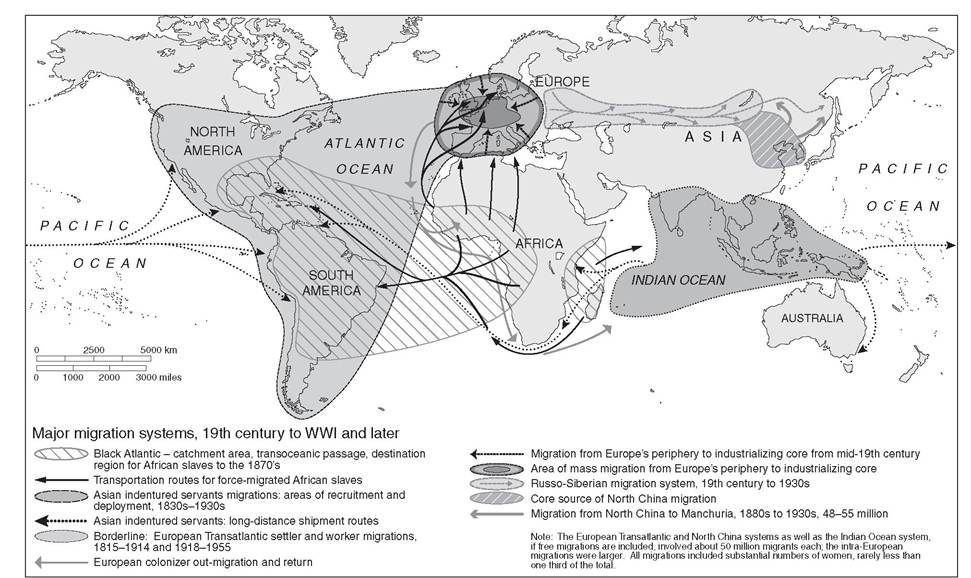
Map 1.1 Major migration systems
east to southern Siberia's fertile lands as far as the Amur River. In South America's newly independent societies numerous regional patterns of migration developed. In North Africa from the 1830s and sub-Saharan Africa from the 1880s massive military colonization of European powers caused refugee movements, regional forced labor migrations, and other migrations in which individuals or families themselves made the decision to move.
Earlier Eurocentric scholarship on migration has ignored some of these, however, such as the North China-Manchuria ones, and reduced others to racialized cliches, such as free (white) versus bound (brown and yellow) “coolie” migrations, or free transatlantic migrations versus absolutist bureaucracy- imposed Siberian exile.Abolition of serfdom in Europe and of slavery in the Plantation Belt and the Americas should have increased self-directed mobility, but those emancipated in many cases had to compensate their former owners for the loss of property rather than being compensated for their unpaid labor. Resulting further impoverishment might force people to move, but new restraints might also impose further immobility. Where demand for labor remained high, official structural violence of new laws or private lynch violence regimes (as in the US South) prevented freed Black men and women from gaining liberty of movement. In other sections of the Plantation Belt, Haiti and Brazil for example, those liberated from bondage migrated to wage labor or to marginal regions where they engaged in independent subsistence farming. In Europe, liberated serfs escaped from extreme constraints, but they were not completely “free” migrants as their destination was often not self-willed.
In India, South China, and some South East Asian islands, indenture or “second slavery” bound men and women for five years. Reasons for indentures included individual shortcomings, poverty, and unfortunate circumstances, and also the new British - as well as Dutch and French - tax and labor impositions. Coercion to purchase food in plantation stores and employer refusal to pay return fare could result in forced re-indenture or permanent enslavement. All systems of bondage involved forced mobilization and, at the destination, forced immobilization. However, when the location of production changed, secondary forced migrations ensued, as with exhaustion of soils or shifts to new crops in the USA and Brazil.
Gender ideologies “bound” women and sometimes reduced their mobility. In China, for example, Confucian prescripts of women as dependent, even servant-like members of families severely restrained their options to migrate. The traditional equation of migrants with men, however, is as
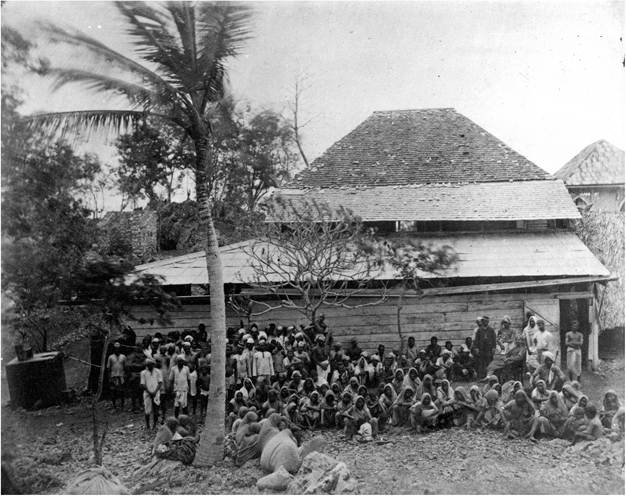
Figure 1.1 Plantation workers on arrival from India, mustered at Depot, c.1891 (Royal Commonwealth Society, London, UK / Bridgeman Images)
wrong as the data collected by male-staffed state bureaucracies was. In nineteenth-century intra-European migrations about 50 percent of the migrants were women, and in the transatlantic ones 40 percent, although this varied by group and stage of a migration process. Under indentured servitude about 20-35 percent of the migrants were women. Without presence of women neither community formation nor inter-generational continuity was possible.[2] Women often migrated (and migrate) to service positions, but rather than remaining in “their” sphere they crossed two borders: that between rural and urban lifeways and that between the laboring and employing classes. In some places gender systems actually increased women's mobility in comparison with men's. In Africa, for example, regional forms of rights-in-person dependency of debtors to creditors were feminized, and mainly women and children migrated short-distance to serve or work for creditors.
Globally, with fast population growth, in all rural regions with family subsistence plots all but the first two surviving children had to out-migrate. Destinations involved (and involve) thinly settled rural areas (from New England to the Ohio Valley, from the Yangzi's plains to ever steeper hillsides), labor markets in infra-structural, usually earth-moving tasks such as the building of canals, roads, railroads, and urban labor markets. At the peak of transatlantic emigration from the Habsburg Empire around 1910, 95 per cent of those leaving their land or small towns migrated internally, so absolute numbers and ratios have to be reconstructed from local vital records. Given the high mortality in all cities with poor sanitation systems, even maintenance of population levels depended on continuous in-migration. Ritual washing, prescribed in Islamic societies, improved public hygiene. Traditionally, people in some rural regions generated non-agricultural income by gendered specialized craftwork in the home, such as cloth in most regions of the world, pottery in some regions of China and among West African Mande, cutlery in the German Palatinate, or lace in Swiss mountain valleys. Nineteenth-century concentration of production in manufactories and, subsequently, machine-driven ones, as well as railway-mediated import of mass-produced goods, reduced such local sources of income and forced single young men and women or whole families to depart. Studies of village as well as pastoral populations indicate high mobility and contradict the imagery of immobile countrysides. People were aware that urban agglomerations provided and provide more job and training options as well as recreational and marriage choices. From the 1880s to World War One, patterns of migration changed because of regionally specific job-providing industrialization and option-increasing urbanization.
The Atlantic migration system
While in the nineteenth century the world's population grew by about 60 per cent, Europe's doubled, which contributed to the development of an Atlantic migration system. Moves in this system, often called a “proletarian mass migration,” were proletarianizing ones for rural migrants from Eastern and Southern Europe: skilled agriculturalists became unskilled factory workers. Migration accelerated in Britain and Ireland under the concentration of landholding, early industrialization, and colonialism; in post-revolutionary continental Europe when the reactionary trans-European regime at the Congress of Vienna in 1815 re-imposed high taxes and tithes, rigorous social hierarchies, and the oppression of the underclasses; and with slow industrial growth everywhere with the exceptions of England and Saxony. The seventeenth- and eighteenth-century system of poor people's self-indenture for three to seven years to defray the cross-Atlantic cost of passage ended in the 1820s, as did migrations from southwestern Germany via the Danube to the South Russian Plains opened by Catherine II in 1763. In addition to the vast intra-European movements, transatlantic migration became the choice of western, then northern, and finally eastern and southern Europeans. Far fewer targeted agricultural colonies elsewhere like Algeria (French from 1830), South Africa (Dutch and English), Kenya, and Australia and even smaller numbers went to plantation colonies in the subtropics and tropics.
About 35 million selected the North Atlantic route. After 1776, the new rulers had expelled Native peoples and (white) settler advance caused (red) refugee migrations. By the 1830s, the lands east of the Mississippi were almost “clean” of Natives - a term not used at the time, but developed in the twentieth century for the deporting of racially or ethnically unwanted
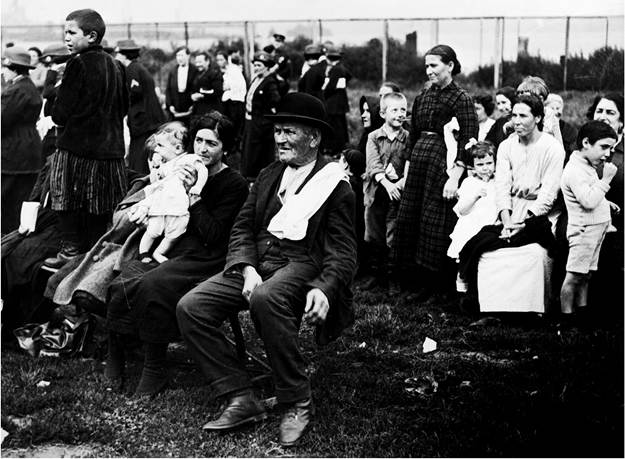
Figure 1.2 An Irish immigrant sits on a chair and waits next to an Italian immigrant and her children, Ellis Island, early twentieth century
(FPG/Getty Images)
peoples (judenrein, ethnic cleansing). In the 1840s about one third of the Europeans who came to the USA settled farm lands, and two thirds became urban workers; from the 1890s 95 percent worked in industries. Without their labor the fast transition to urban-industrial production could not have been achieved, nor could they have found jobs without the simplification of production processes generally known as “Taylorization.” Millions moved to Canada, and a few to Mexico. In the latter the liberalist government of the 1850s had deprived “Indios” of their land and thus forced them to migrate internally. Eight million romance-language speakers from the Iberian and Italian peninsulas moved to South America's frontier societies, Brazil and Argentina in particular. Most became plantation or urban laborers. By the 1890s, migrating Italians integrated the southern and northern transatlantic routes by choosing destinations from Buenos Aires to Montreal.
Labeled “immigrants,” about one third to one half of the migrants, sojourners, or “guest workers” returned to Europe. Rural Italian laborers even seasonally circulated intercontinentally to earn their livelihood in the northern and southern hemispheres' harvests. At the same time, working men and women migrated from Europe's periphery, Ireland-Scandinavia- Eastern Europe-Mediterranean Europe, to its industrializing core, Great Britain-France-Germany-Switzerland-Bohemia-Lower Austria. In the 1880s most of the core's city population consisted of more than 50 percent of in-migrants often speaking the same language but in a different dialect. Residents and migrants could often not understand each other.[3]
The “Black Atlantic” was complementary as well as juxtaposed to the “White Atlantic.” The labor of Africans who had been forcibly migrated in the “factories in fields” produced sugar, cotton, and other crops for export to the colonizers' markets. To the 1830s, more African than European men and women reached the Americas. However, the African-origin share of the population hardly increased. In what has been called a “second genocide" - after the deaths during capture, march to the coast, and Middle Passage - many were worked to death, and most prevented from having children. Re-creation of culture and political agency varied widely. In Brazil, where enslaved men and women shared cultures, vibrant African- background everyday practices emerged. In the Caribbean, slaves in Haiti joined the Atlantic World's revolutions but on the other islands they
remained bound to - mainly - Creole elites. In the US South - in terms of economy and race hierarchies closer to the circum-Caribbean societies than to New York or Boston - migration via a “breaking-in” period in the Caribbean and rigorous planter control reduced cultural re-creation but encouraged procreation - though not family stability - to ensure successive generations of slave labor. Slavery was abolished in the Republican US in 1863/65, later than serfdom in Tsarist Russia, and, by 1888, ended in Brazil and Cuba as well.[4]
The Indian Ocean-Southeast Asian-South China migration
system
The Indian Ocean - Southeast Asian - South China migration system - earlier often termed a “coolie” system, though that word is now seen as a racial slur - in fact dated back two millennia, and began as coastal and trans-sea voyaging. When the British Empire, influenced by the white and black abolitionist movement, slaveholder calculations, and considerations on the part of the state ended slavery in the 1830s, consumer demand for tropical foods and other tropical products kept demand for labor high. To supply cheap and coerced labor, the British and, subsequently, the French Empire established labor regimes of “indentured servitude” in British India, French Indochina, and southern China. Indentured workers could be found in Burma, the Indonesian islands, Mauritius, Natal, and elsewhere, where British and other imperial governments did little to ameliorate their brutal working conditions. Such bound working men and women, however, accounted for only about 10 percent of over-the-seas migrations. More, especially Chinese people, were self-willed “credit-ticket” migrants working off the cost of passage in a year or less. Most were free “passenger” migrants. Some followed routes of long standing, others the new transshipment routes for plantation crops and indentured workers. With European and US moves to open Asian societies' markets, including the military-commercial opening of China (British “opium wars,” 1840s), of Japan (US fleet, early 1850s), and replacement of the private East Indian Company's by Crown rule in India (1857-58), migration intensified. In India, British-appointed zamindars, a kind of tax farmers, impoverished peasant families; in China the British Empire's support for opium imports achieved the same effect; in Japan the Meiji Era's industrial modernization, funded through heavy taxation of the peasantry, forced rural young people to migrate.
Wherever free, credit-ticket, or bound migrants arrived or were unloaded, demand for everyday necessities arose, and merchant family and trader migrations also increased. Mass production of rice for the indentured workers in British Burma, for example, required additional migrant labor. Migrants traveled as far away as Hawai'i and the Caribbean islands. In Caribbean societies, indentured workers and “passenger” migrants became part of ethno-culturally (“racially”) mixed societies. Immigrant families and communities entered politics in societies from South and East Africa to Hawai'i. During World War I between one and two million Chinese, Indochinese, and Indian “colonial auxiliaries” were transported to Europe for war-related work - some settled, others joined anti-colonizer struggles, and India's nationalist elite negotiated the end of the indenture system. Self-willed migration continued unabated.[5]
North China-Manchuria migrations
From the 1880s, migrations from North China to Manchuria complemented the outbound migrations of southern Chinese and the vast internal longdistance migrations from coastal provinces to the inner provinces of Yunnan and Guizhou. Seasonally migrating single men but also whole families left the densely populated and extremely impoverished agricultural provinces of Shandong, Zhili, and Henan in northern China, crossed the Bohai Sea, and continued with the South Manchuria Railway, built beginning in 1896 with investments by newly imperial Japan. In rural regions of Manchuria immigrants became the majority. Others became industrial wage workers: Russia was developing its eastern cities and Japan had mining and industrial investments in Manchuria as well, which after 1932 became the Japanese-controlled province of Manchukuo. China's policymakers and educated elites showed no regard for migrants in general and the Japanese colonizers exploited them, although the railroad company hired social scientists to study both the conditions that forced rural families to leave and the demand for labor in Manchuria. A rural pioneer as well as newly industrialized society emerged.[6]
The Russian-Siberian system
Along the Amur River, Chinese in-migrants jostled with others traveling east via the Trans-Siberian Railway. The Russian-Siberian system began with fur traders and the deportation of criminals and political opponents, continued with large-scale peasant migrations to southern Siberia, and - in the context of competition with China - the dispatching of troops and administrators to develop Russia's Far East. Peasant families migrated “unofficially” to land, entrepreneurs to the fast growing cities. In European Russia, the communal character of village organization kept individual out-migrants to urban jobs tied to family and community, but after emancipation (1861) 13 million migrated within a decade, usually seasonally, to the “Central Industrial Region” of Moscow and St. Petersburg and to the mining and industrial centers of southern Donbass and the Urals. By 1900, more than 70 percent of the inhabitants of Moscow and St. Petersburg were in-migrants. While this migration system remained largely separate from the transatlantic one, small numbers of West and Central European experts, entrepreneurs, and skilled craftsmen migrated eastward to opportunities in Russia. From the 1880s, economic oppression of and pogroms against Jews, ethnic oppression of Ukrainians, and withdrawal of privileges once granted to Mennonite and other German-speaking agricultural immigrants forced large numbers to migrate westward to Europe and North America.[7]
In addition to these five large systems, a small Pacific migration system, from East Asia since the 1840s and from South Asia since the early 1900s, brought about one million people to the Pacific Coast of the Americas by the 1920s. The impact was sizeable because railroad projects and extractive industries as well as California and British Columbia agriculture depended on Chinese and, later Japanese, Philippine, and Sikh workers. Chinese merchants were irreplaceable mediators of the trade with Asia and visiting Chinese students were expected to spread US ideas and consumer practices after their return home. Like Germans and Irish before them, all faced racism.[8]
In all of these migrations, the search for minimum subsistence or better options was the motivating factor for individual and family decisions; from these large migration systems based on information flows and top-down investment strategies emerged. Several of Europe's dynastic states had had exit restrictions, but they dropped these in the mid nineteenth century, and Russia somewhat later; and free exit had, to some degree, been forced on India, China, and Japan. Only from the end of the nineteenth century did nation-states begin to channel or exclude migrants, however.
Exclusion regulations
The exclusion of certain groups of migrants was motivated in part by mass departures from Europe's new nation-states, which led to a questioning of constructions of essentialized national identities, and by the development of ideas about racial and ethnic hierarchies. Exclusion regulations based on race are usually seen as originating with the US prohibition of entry of Chinese laborers in 1882, although Chinese women had been singled out already in the 1875 Page Act since - in the opinion of male lawmakers - they might engage in prostitution. Such ideas made entry difficult for any woman traveling alone, as single women arriving from Europe were to experience as well.[9] Racist and ethnocentric restrictions were everywhere, however: Prussia/ Germany attempted to exclude Polish laborers from the Partition zones of the Tsarist and Habsburg Empires (1885); France reacted negatively to migrants from Italy (1880s); Australia (1901) and South Africa (1911) excluded “Asians” from immigration. Since each state's economy required migrant labor, shipping companies and industries evaded the respective laws or had them changed. Step by step, however, such restrictions ended the so-called “open door"-period of immigration. To the early 1900s, US entry restrictions for Europeans remained few. However, fears of “the passing of the great - white Anglo-Saxon - race," as commentators put it at the time, through the arrival of (and even worse, marriage to) “olive" or “swarthy" southern Europeans, “dark" Slavic “stock," and Jews (no further label required), led to a mandatory literacy test in 1917. World War I largely halted migration, but when it resumed after the war, the quota laws of 1921 and 1924 rigorously restricted the entry of South and East Europeans. The land borders, however, remained almost uncontrolled - British Canadians were Anglo- Saxon, Mexicans were low-paid and needed workers, and French Canadians had become part of New England society in some areas. Canada, through the 1920s, continued to recruit farming families and labor migrants came on their own initiative.
The grid of regulations and complex new paperwork led to the invention or imposition of the passport system, and its circumvention by those who claimed to be children of residents, known as “paper children.”[10] From 1929, the Great Depression slowed migration and increased return migration, because in times of need family networks provided better support than did immigration states. Thus the social cost of unemployment was borne by the societies of origin. In the Plantation Belt, indenture, formally abolished in 1917, in practice ended in the 1930s.
Nationalism, assimilation, and population transfers, 1880s-1950s
The colonizer empires in Europe and, as new powers, the USA and - at first little noticed - Japan had achieved their largest extent and impact at the beginning of World War I. In the late nineteenth century, these states of numerous peoples ideologically reconstructed themselves as monocultural “nations.” Under earlier dynastic systems, permanent immigrants and temporary in-migrants, if economically valued, had been admitted into many-cultured populations on the sole condition that they professed allegiance to the ruler. As “subjects” they could then continue their cultural practices, speak their language, and practice their religion if they did this discretely. Such incorporation of difference became impossible once ideology postulated peoples defined by one culture as a state's constituent element. In the Western World, the concept of one inclusive “nation” began to evolve into practices that scholars now term “othering”: the regulation of in-migration, the complete exclusion of certain groups, and discrimination after arrival. None of the states had ethno- culturally homogeneous populations, but once the strongest group had appropriated to itself the status of nation, it labeled smaller resident groups of different cultural practices “minorities.” Discrimination followed and, without equal access to societal resources, members of such groups felt pressured to emigrate, although their very lack of resources made this difficult. For inmigrants the space to negotiate their status or engage in diverse cultural practices contracted: Americanization, Germanization, Germanization in its Habsburg-Austrian variant, Russification, and the like demanded unconditional assimilation. A culture marked as somehow “ethnic” became a reason for segregation, as religion had been earlier and continued to be in colonizer- colonized hierarchies. Christian policies and personnel continued to view peoples of Hindu, Buddhist, or other faiths as inferior, and in colonial areas Christianity coincided, largely, with Whiteness. As Western polities developed republican or democratic forms of government, in which each and every person was to be equal before the law, the parallel adoption of the ideology of nationhood made “minorities” and immigrant “aliens” persons of lesser rights.11
To this discrimination against resident minorities and to enforced assimilation male state bureaucracies added a new type of forced migration motivated by nationalism. They decided who could belong and who was different, expelled or deported unwanted people, and imported others designated as co-nationals. Under the proto-typical if numerically small British Empire Settlement program, poor orphans, unwed women, and disabled veterans of colonial wars were to be sent to the White Dominions of South Africa, Australia, and New Zealand, where, it was assumed, they would find employment and not be a burden on public resources.[11] [12] This targeting of nationals was supplemented by the targeting of “aliens.” Many of these were Jews who had escaped pogroms in Tsarist Russia, and were increasingly defined as a race rather than a religion in this period. In the Habsburg Empire, self-defined as a state of many peoples, Austrian bureaucrats still marginalized non-German speakers. In the Ottoman Empire, the protected status of non-Muslim peoples eroded, and “Turkishness” became the badge of belonging, a nationalist idea picked up from other European nations. In the 1920s, with assent of the League of Nations, “Greeks” were deported from Turkey, “Turks” expelled from Greece and Bulgaria. In the USA fears of working-class radicalism also led to deportation of those identified as “anarchists” or “Reds.” A nation had to be “clean,” and thus “ethnic cleansing” was imposed on all those deemed of another culture or group.
From the Balkan wars of the 1880s through World Wars I and II to the late 1940s, Europe's political elites turned Europe into a region of refugees and migrants. The 1918/19 peace treaties drew new borders across culturally mixed regions and moved existing ones over people resident for generations. Those of different culture suddenly found themselves designated “foreigners” and the new (male) “national” bureaucracies pressured them to depart or flee “home” to “their” (equally new) nation-state. These borders fragmented the many-cultured Central Europe and cut through the German-Romance languages borderlands. In the new nations, one group occupied the institutions of rule, while the others became minorities of lesser rights who lived on the margins. “The growth of the modern nation-state implied not only the naming of certain peoples as enemies of the nation, but also the expulsion of significant groups for whom the state would or could not assume responsibility... The war itself schooled the new masters of the state apparatus” how to eject unwanted groups.[13]
Economic readjustment after World War I and global depression from 1929 reduced labor migrations, but such deportations were repeated under fascism and Stalinism. Poles were shifted around by both German and Russian occupation forces, Ukrainians degraded by their Aryan masters to a subservient labor force. The most powerful of Europe's (nation-)states became refugee-generating apparatuses; their democratic neighbors refugee-refusing states. On the other side of the globe, Japan's elites (in some cases Western-educated) developed similar “nationalist imperialist” policies, conceptually a contradiction in terms, which also led to the generation of refugees in what Japan labeled the Greater Asia Co-Prosperity Sphere. Japanese aggression in China in 1937, for example, forced one hundred million Chinese to flee in a single year.
In this era of regimentation, military and government officials, themselves often migrants, imposed labor regimes in the globe's annexed segments; forced men, and sometimes women, into corvee labor or migration; labeled some cultural groups a reservoir of workers, and others “effeminate.” Practices of forced labor, imposed on colonized peoples, were brought home: labor regimentation in the Netherlands; the import of Korean workers to Japan; internal passports and labor camps in the Soviet Union; involuntary labor from Jews or people identified as such, political opponents, “Gypsies,” homosexuals, and whole subjected peoples in Fascist Germany and its occupied territories. “Cleansing” by deportation was pushed to a worse level, and became “cleansing” by annihilation in the Holocaust. At the war's end, “Displaced Persons” or DPs, survivors of the extermination and labor camps, were as stateless as many expellees had been after World War I.
Europe became the world's largest refugee-generating region, because its nation-state ideology led to forced migrations, and because it exported this nationalist ideology to other parts of the world, first to the Ottoman Empire and from the 1950s to the decolonizing world. When, after Europe's selfweakening 1914-18 and 1938-45, colonized peoples declared - or struggled for - independence, indigenous elites adopted and implemented monocul- turalist nation-state ideology, sometimes with the advice of Western political scientists and politicians. This led to the partition of British India in 1947 along religious lines with tens of millions of refugees, the establishment of states in West Africa that brought together the traditional spaces of residence of many peoples or divided such spaces into several states, and the establishment of Indonesia as a nation-state out of the remnants of the Dutch multi-ethnic empire. Under racial hierarchies, White-ruled South Africa imposed residential segregation and forced labor, imposing large forced migrations on the indigenous Black population.[14]
From the 1950s, refugee generation shifted to decolonizing states, later called the “Global South,” and labor migrations to industrializing, jobproviding regions diversified globally.
Decolonization, guestworkers, and global apartheid from the 1950s to the 1990s
At mid-century major new macro-regional migration systems emerged. From 1942, wartime demand induced the USA to negotiate with Mexico an inter-governmental “bracero” program. “Braceros” - that is “arms,” or in British usage “hands”- implies a “body-parts” approach to labor migrants: Muscles count while emotions, spirituality, and everyday needs of reproduction do not.[15] Countries recruiting labor sequentialized in-migration: workers worked for a specified period, then were required to depart, and then a new cohort of rotatory labor migrants were brought in. Around 1900 Prussia regimented Polish labor in this way, bringing in 1.3 million workers annually around 1910, and around 2000 Arab oil-producing economies did so as well, bringing in about 9.6 million workers.[16] In Prussia, fear of “agitation” for an independent Poland among workers was a reason for this system, and in the oil-wealth countries fear of being overwhelmed by foreigners given the high ratio of migrants to residents - ranging from 70.4 percent of the total populating in Qatar to 23.7 percent in Saudi Arabia. This imported labor force is essential to keeping the economy functioning in importing states, although both democratic and authoritarian states make them an underclass with lesser rights and limited access to the resources of the society to which they contribute labor and taxes. They become “denizens” rather than citizens, without political rights, equality before the law, and, sometimes, schooling for their children, which in democracies subverts the fundamental equality of citizens. In societies with social security provisions, opponents of “foreign labor” have posited that such workers deplete social resources. On the sending side, by the end of the twentieth century, states like the Philippines and Bangladesh had become export organizations for human labor. Such systems could also be internal. In the People's Republic of China, for example, the underserviced and undersupplied countryside delivered labor without rights and residence to the metropoles, a migration involving an estimated 200 million in 2010.
The wartime uprooting of the 1940s - which lasted longer in Africa, with France's war to prevent the independence of Algeria in 1962 and Portugal's to prevent the independence of Angola in 1974 - transformed millions of economically active people into displaced individuals, truncated families, and deportees. Such DPs - about ιι million in Germany alone in 1945 - needed to be resettled and (re-)integrated. Most desperately wanted (and want) to get on with lives disrupted by destructive states or intrastate rebel groups. After 1945 many helped rebuild housing and whole economies out of the rubble produced by military aggression. For some this meant settlement where the powers-that-were had deposited them; for others a further, selfdecided migration to better options in a less destroyed country, if admission regimes permitted entry. Neither states nor international institutions have solved the contradiction between the human rights-principle of freedom to move and leave an oppressive state and the state sovereignty-principle of preventing people from in-migrating. This regulation was costly for individuals' and families' life projects, and the border guarding apparatus was costly for states' budgets. By the mid 1950s, however, the economic booms in Western Europe and, subsequently, in oil-producing regions and newly industrializing states, like South Korea or Singapore, provided chances for immigrants if they could gain entry. Entry controls of the 1920s, which had had limited impact during the 1930s Depression when there was little migration, showed their full force, but air transport also accelerated migrant travel.
In the Atlantic Migration System, most countries had refused entry to Jews fleeing Fascism, but a short early 1950s surge brought migrants, who saw little
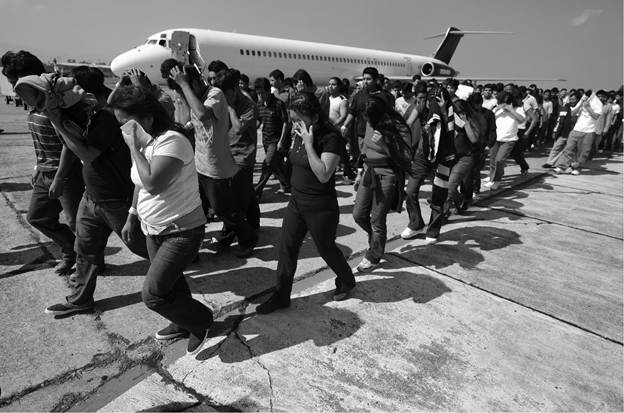
Figure 1.3 Guatemalan illegal immigrants deported from the United States walk along the tarmac upon their arrival back to Guatemala (EITAN ABRAMOVICH/AFP/Getty Images)
future in Europe's ruins, to the classic immigration states. No migrants from destroyed Japan were admitted. With economic recovery by the mid 1950s, the transatlantic connection ended and two separate south-north systems emerged. The first was in Europe, where “guest workers” - the new term for rotatory labor - moved from the Mediterranean to West and North Europe. The recruitment region expanded to socialist Yugoslavia and to Istanbul and (Muslim) Anatolia. While recruitment agreements with North African states were not operationalized after the crisis of rising oil prices in 1973, France became the destination for individual labor migrants and families from its former colonies and protectorates. The second system was in the Americas. While the inter-governmental bracero program was not renewed in 1964, workers from Mexico and refugees from Central America's right-wing dictatorships migrated, often temporarily, to the United States. Migration from the Caribbean, which - as in Mexico in the 1880s - had begun with US investments, had accelerated since the 1930s. Intellectual refugees from Latin America's - often US-supported - dictatorships sought asylum in Europe, and others left Cuba for the USA The continuity of flight from dictatorships, of remittance and information flows, as well as displacement through anti-drug campaigns and internal conflict, made northbound migration self-sustaining. While small numbers have gone to Canada, the ever tighter US control of its southern border has forced many transmigrants to remain in Mexico. Depending on economic development or decline and on conflict-related displacement, distinct intra-South American migration regions have emerged. They, too, achieve continuity through relay of information or quickly subside when economic conditions at the destination deteriorate.
In another post World War II system of state control of populations, the Socialist and Communist countries prohibited emigration and cut themselves off from other migration systems. Internal unequal regional and statewide development induced migrations within states and across borders. Large migrations from rural and peripheral regions expanded towns and cities. In Russia, investments in southern Siberia mobilized young people. In China, the Cultural Revolution involved deportation of “bourgeois” intellectuals to rural hinterlands, and the so-called Great Leap Forward resulted in mass flight from starvation. Since then, industrial and urban growth combined with a policy of underservicing of rural populations generated vast migrations to new industrial zones. These workers, labeled “floating population,” were indispensable for the economy, but received neither equal rights nor permanent urban residence permits nor schooling for their children.
In Southeast Asia, the fight against re-imposed Dutch rule in Indonesia (to 1949) and against re-imposed French rule in Vietnam (to 1954, extended by US intervention to 1975) involved vast population displacement and, after warfare's end, resettlement and urbanization migrations. Indonesian Chinese, resident for generations, were expelled (or massacred) in 1965 under an allegation of communist allegiance. Singapore, totally dependent on an in-migrant labor force, made access to citizenship near impossible. Japan, globally a singularly nationalist case, rejected any in-migration and refused refugee admission. The state still discriminates against “foreigners” of long presence, especially Koreans who came or had been forced to come under Japan's occupation of Korea, 1910-1945. In South Asia, state and nation-formation, the separation of East from West Pakistan to form independent Bangladesh, and civil war in Sri Lanka between the Sinhalese majority's postcolonial self-assertion and South Indian Tamils resident for generations, involved large-scale displacement. Economic growth and fast urbanization, however, explain the vast majority of internal migrations in much of Asia.
In two further postcolonial regions, North and sub-Saharan Africa, colonizer-induced retarded development and inequalities as well as some post-independence governments' economic mismanagement and clique networking induced temporary and permanent out-migration. Migrants from the Mediterranean littoral's Maghreb, still partially French-speaking, select France, and Egypt's underemployed, the neighboring oil-economies. Given the regions' young population, some demographers and policymakers in the early 1970s projected the societies as a labor reservoir for Europe, but the 1973 crisis, racialization, and growing Islamophobia precluded even discussion of such plans. In sub-Saharan Africa, ecologically and culturally multiply divided, economically vibrant and warlord-destroyed regions attract and send migrants. Ghana and Kenya, post-apartheid South Africa, and metropoles in general attract large numbers of culturally heterogeneous migrants. Civil and factional wars, elite enrichment and warlordism (with migrant white mercenaries), often supported and funded by outside economic and political interests, have caused mass flight. Most refugees remain in camps rather than being resettled or admitted to states in safer and wealthier countries of the world. Some states with little development have become permanent suppliers of human beings/working men and women - mostly to other economically growing states in the region. Urban migrants, by keeping ties to their places of origin - as did Europe-to-North America migrants - fund developmental or prestige-yielding projects, thus contributing to economic development of regions of out-migration. Such investment may mobilize further migrants or reduce emigration through new infrastructures and jobs. The impact of development on staying or moving needs to be determined for each specific region.
Like Europe's post-imperial states, the postcolonial ones are not ethno- culturally homogeneous. In fact, around 1990 only one fifth of the world's states claimed that one ethno-national group amounted to more than 90 per cent of the population; in one third official statistics placed its share at 75-89 per cent, and in the rest it amounted to less than half.[17] Negotiated inter- cultural accommodation, a concept neglected for a century in political theory and the practices of nation-states, has reduced conflict and the resulting push to depart in some places, while imposed monoculturalism, along with de-facto ethno- or religio-cultural hierarchization, has been an important reason for emigration.
During the post-imperial and postcolonial reorganization of state structures, displacement involved the exchange of administrative personnel and the relocation of intellectuals and other elites; economic growth or collapse induced working- and middle-classes migrations. Wherever elites - schoolteachers for example - departed, in-migration of similarly qualified personnel (often of other ethnic or religious culture) was encouraged. Young migrants from any developing country are the population cohort “in the best years,” who, at their destinations, are highly productive and require comparatively little health care and other services. They provide a free bonus to developed societies since their - often low-GDP - countries of birth have paid for their upbringing and education. Receiving states, France or Singapore for example, expect them to return before reaching a life-cycle stage in which demands on social security would become costly. Global inequalities are exacerbated by migration of cohorts in the most active lifecycle phase.
Two further socio-ecological macro-regions, a better unit of analysis than continents defined by physical geography, demand attention: the Eastern Mediterranean-Western Asian-Gulf of Hormuz region and the Pacific's two rims. In West Asia's north, since the 1960s Turkey experienced massive labor out-migration to Western Europe as well as the flight and exile of Kurds, who, like Armenians, rather than being granted a state of their own after 1918 had been parceled out into several states. In the 1990s Turkey's economic growth attracted migrants from post-1989 Eastern Europe as well as from unemployed second-generation Western European Turkish- background residents. Palestine as a region became the arena of (Jewish) refugee arrival which, in turn, generated (Palestinian) refugees. Even before Israel's statehood in 1948, European-cultured Holocaust survivors arrived, and subsequently - with ethnic hierarchization - Arab-cultured and Soviet Union-socialized refugees and emigrants came as well. In the process, resident Arab-Muslim Palestinians fled, were expelled, or discriminated against. These refugees were never resettled: many remained in camps, and by 2000, over three generations, many became migrant laborers in oil-producing economies, while others migrated to universities and became a cosmopolitan academic elite, just as people ofJewish faith had been in late nineteenth century and interwar Europe. Since the increase in the price of oil and in investment that began in the late 1970s, the oil states of the Gulf of Hormuz and West Asia have rigorously enforced a rotatory dual migrant labor regime, with Western technical personnel and Palestinian-Egyptian- Asian male workers and female domestics. Around 2000, with the training of local experts and in-migration of personnel from China, migration has culturally diversified. All migrants retain ties to their multiple, oilconsuming, states of origin.
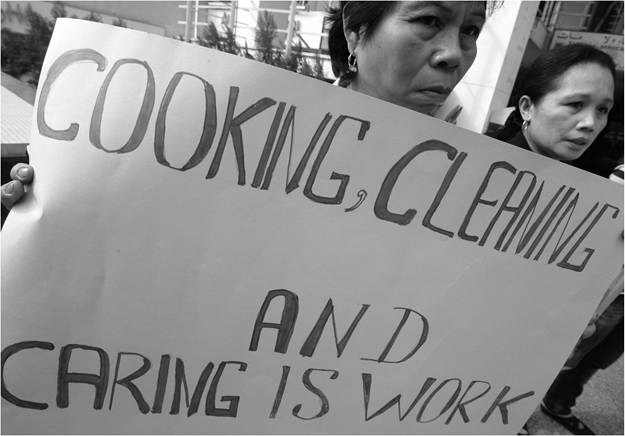
Figure 1.4 Migrant workers hold banners during a protest to support the rights of migrant domestic workers in Lebanon, on the occasion of International Women's Day in Beirut
(© Str/Reuters/Corbis)
Finally and paralleling the decline of Atlantic migrations, a new Pacific Migration System emerged. In the 1940s, when China was the major ally against Japan, exclusion of “Orientals” was cautiously questioned in the USA and Canada and, though legally abolished, was maintained by minuscule quotas. In the 1950s, Cold-War and racist dogmas kept the 1920s restrictions in place. In the 1960s, decolonization, new markets, intensifying economic relations, and new alignments led to major revisions of immigration policies first in Canada, then in the USA, and then in Australia. The Global North adjusted its color-coded entry barriers to professedly less racialized and intentionally economically more advantageous procedures. It was tacitly assumed that the “points system,” privileging the highly qualified, would ensure that the ethnic composition of immigrants would remain unchanged. The assumption was not completely fulfilled, for not only did white societies have highly developed education systems, but so did several of Asia's societies. Within a decade transpacific migration was a major supplier of newcomers to the USA and Canada, joining the migrations of unskilled Mexicans and other Latinos/as.
All of these macro-regional and transpacific migrations are, on close analysis, as localized as all other self-decided migrations: People depart from some locales (but not from others), use the best-known and most reasonable routes, and target a locale with a personal anchor-point, such as kin, friends, acquaintances, a foreign student office, or a business partner. Policy consultants analyze macro-patterns and scholars focus on international migrants, but each and every migrant assesses local options at home and at the destination. Decisions are local-to-local within regional frames of options to earn one's living and exit and entry regulations of various states. Given the possibility of migrants' choice between multiple anchor-points, moves at the turn of the twenty-first century have been called “glocal,” a far more precise empirical-analytical conceptualization than generalizations like “from China to America” or “from Bangladesh to Saudi Arabia.” Migrants target societies with better chances and standards of living - and television makes standards of living in Buenos Aires or Shanghai visible to the shantytowns of the impoverished across the world. Given the selectivity of TV images, viewers may not be aware of the glittering metropoles' sprawling favelas, although information from earlier migrants can inform them of working conditions and entry barriers.[18]
Migration issues in the early twenty-first century
From the 1990s, the capital-induced macro-regional shift of production north-south and west-east to low-wage countries, as well as the demand for services in the north, changed migrant directions and gender composition. “Global apartheid,” dividing South and North, extreme exploitation of many migrant workers, displacement by environmental deterioration and developmental projects, an assumed “feminization” and globalization of migration all characterize migration in the early twenty-first century, and form the major themes of research on the present.
In the decades after the White World ended official racial exclusion, “global apartheid” has divided a Global North from a Global South with the North's high living standards based on the South's low wages. “Globalization" - in its nth version since the integration of “old” world and “new” - links both through flows of capital and goods, but stymies the flow of people through the construction of barriers to human movement such as “fortress Europe” and a new Iron Curtain along the USA's southern border. Decolonization, a political-societal project, has been counteracted by re-colonization as an economic strategy of capital (and capitalists) and also, it needs to be emphasized, as a household-economy strategy of consumers. Present global inequalities, like the nineteenth-century Atlantic ones, push people to cross the borderlines etched by admission-exclusion regimes into human lives. In terms of life-chances and aspirations, the post-/re-colonial division of labor sets in motion vast local and regional migrations to quickly constructed (and as quickly abandoned) production complexes in many low-wage localities across the globe. Fenced in as free trade zones, they are free exploitation zones since within their perimeter laws regulating working hours and safety conditions do not apply.
Men and women migrate to such jobs pushed by the extreme constraints of their inhospitable “home” locales and regions. “Home,” the place where accident of birth has placed people, may by unjust, unsupportable, and unsafe. At the other end, export of production facilities, called “delocalization,” forces those workers whose jobs are exported to move. Since the establishment of the global plantation belt in the sixteenth century, any global transfer of investment capital forces or induces male, female, and child workers to move. Across fortified and heavily guarded borders, images of cosmopolitan centers from Dubai and Hong Kong to Moscow and Amsterdam are beamed, although these are countered by others of African migrants drowned in the Mediterranean, along with reports of inhuman conditions in Chinese factories and English sweatshops and of mass deportations of undocumented migrants. The global South's poorly remunerated working men and women, called “new helots” or “new untouchables” by some analysts, observe wage differentials from their front doors whether in the maquiladora along the Mexico-USA border or in Hong Kong's impoverished working-class neighborhoods. Women crossing without papers from Myanmar to Thailand to take jobs in one of the quick-to-move textile factories along the border know, from the stylish garments they sew, what consumers in wealthy countries can afford. Why not try to join them, even if the trip is fraught with dangers and requires funding by loan sharks? One risk involves the promise of (well-) paying jobs by facilitators-smugglers-entrepreneurs but, in fact being trafficked into sex work - another “body-parts” approach to migrant labor - or into slavery-like working conditions, which has been documented for oil- and western economies alike. While the cost of moving in relation to possible gains has dropped so that by the turn of the twenty-first century air travel has become affordable even to low-income migrants, and while it is now often possible to stay in touch with families in an instant - compared to the weeks or months that the millions of transatlantic letters of earlier migrants took - only some take the risks, because these have also massively increased because of the imposition of border regimes. Research, unfortunately, has not paid much attention to those who stay and to their motivations except for some psychologizing generalizations.[19]
Huge infrastructural development projects and environmental deterioration are additional migration-imposing factors. Inundation of peasant lands by dams to generate hydro-electricity and other “development displacement” displaces millions, which has been analyzed by the World Bank. Even if compensation is promised for such displacement, funds often do not reach those who are actually displaced because of their low social position. People have always fled natural disaster like volcano eruptions or famine-generating droughts but, increasingly, environmental displacement may be traced to human activity: toxic debris and emissions, global warming, urban sprawl, and rising sea-levels. Mass departure occurs from newly barren, stormy, or inundation-threatened regions, such as the Sahel's decennial drought, tropical storms as in New Orleans, or flooding rivers in Pakistan, Mississippi, or Thailand. The tsunami on the coast of Japan was a natural disaster, but the nuclear plant in the region's fissure zone was man-made.
Admission, exclusion, and discrimination regimes are gendered. Even environmental impact may be: men may depart more easily than women who, according to both ascription and self-perception, are responsible for home and children. Women have entered and are entering wage labor in large numbers. They migrate to factories, whether in China, the Philippines, or some other location where vagrant capital temporarily settles before moving on: textiles, electronics, toys, and other. Women from low-wage societies have also become sought-after domestic workers in high-income countries where resident women have gained access to labor markets and have entered better-paying echelons and most men do not share housework; domestic chores, childcare, support for the elder - all of the reproductive aspects of work - are delegated to them. In popular cliches and economic theory this is viewed as “unskilled work,” but it often involves preparing high-standard meals, helping children learn, and providing “emotional labor.” Since such service jobs, with no analytical but heavily ideological grounding, are gendered female, wealthy states admit women from low- wage “colored” societies who thus may cross global apartheid's color-of-skin exclusion line in Italy or Singapore, Great Britain, or Japan. Labor in the unregulated sphere of private homes may be highly exploitative and, in some societies, also highly abusive, but it may also be rewarding.[20]
These processes have been labeled a “feminization” of migration, but women have always participated in global migrations. What is new is their visibility: they work and often live in middle-class residential neighborhoods rather than remaining “invisible” in ethnic quarters close to the factories employing them. What is also new is that women leave first, that (married) women leave their children in the care of female relatives, and that they become the main providers for families. Across time, single-gender migration, whether of men or women, results in skewed marriage markets. Whereas in the past men migrated first, and women established routes of their own, in the present, women from low-income societies are being recruited through international agencies as marriage partners for men, some of whom remain in the agricultural sector of high-income highly urbanized societies and others who do a variety of other types of work. Although such marriages are often described as exploitation for household and farm labor as well as for sex and emotional labor, they may be a valid strategy for women, who view them as the only possible way to escape poverty. Under prevailing exclusion regimes, women use marriage in their own or their family's interest, as a way to enter societies with more options, to gain a foothold in the labor market, and a trajectory to better occupations. Law and public opinion about such betterment strategies varies; in Canada and Sweden they are generally accepted, while in Muslim countries they are not. Analyses of such marriages combine labor/marriage market structures with discussion of migrant women's goals of supporting families, helping sustain marginal agriculture or crafts, and providing for their children's education.[21]
At the beginning of the twenty-first century patterns of migration are changing, but over the centuries men and women have always adapted life-course prospects to region-specific, continent-wide, transoceanic, and global inequalities and options. Entrepreneurs and financiers in demand of labor have always recruited working men and women or whole families from where a supply was available. Uneven economic, social, and political development results in migration - casual and skilled labor, student, entrepreneurial, elite - to increase individual or family options and to reduce labor shortages in societies of destination. Settlement and acculturation varied by culture and the economic structures at the destination. Reducing migration, if considered desirable, requires a relative equalization of chances across the globe. While the speed of information relay has increased, nineteenthcentury telecommunication - letters via the mail - was sufficient to adjust migrant decisions to the availability of options at destination. Migrants, who carefully assess costs and rewards of their moves, are entrepreneurs in their own lives, trying to make the most of their human capital. Societies that provide for the easy entry of such individuals gained and gain the most.
Further reading
Anderson, Bridget. Doing the Dirty Work? The Global Politics of Domestic Labour. London: Zed Books, 2000.
Bilsborrow, Richard E. and Hania Zlotnik. “Preliminary report of the United Nations expert group on the feminization of internal migration,” International Migration Review 26/1 (1992), 138-161.
Boyd, Monica and Elizabeth Grieco. “Women and migration: incorporating gender into international migration theory,” Migration Information Source ι March 2003, www.migrationinfromationsourse.org/Feature/display/cfm?ID=io6 (accessed January 14, 2007).
Bryder, Linda. “Sex, race, and colonialism: an historiographic review,” International History Review 20 (i998), 806-822.
Chaney, Elsa, Mary Garcia Castro, and Margo L. Smith, eds. Muchachas no More: Household Workers in Latin America and the Caribbean. Philadelphia: Temple, i989.
Castles, Stephen and MarkJ. Miller. The Age of Migration: International Population Movements in the Modern World. New York: Guilford Press, i993.
Cohen, Robin. The New Helots: Migrants in the International Division of Labour. Aldershot: Gower, i987.
Curto, Jose C. and Renee Soulodre-La France, eds. Africa and the Americas: Interconnections during the Slave Trade. Trenton, nj, and Asmara: Africa World Press, 2005.
Gabaccia, Donna and Dirk Hoerder, eds. Connecting Seas and Connected Ocean Rims: Indian, Atlantic, and Pacific Oceans and China Seas Migrationsfrom the 1830s to the 1930s. Leiden: Brill, 20ii.
Harris, Nigel. The New Untouchables: Immigration and the New World Worker. London: Tauris, i995.
Harzig, Christiane. “Women migrants as global and local agents: new research strategies on Gender and Migration,” in Pamela Sharpe (ed.), Women, Gender and Labour Migration: Historical and Global Perspectives. London: Routledge, 200i, pp. i5-28.
Harzig, Christiane, Dirk Hoerder with Donna Gabaccia. What is Migration History? Cambridge: Polity, 2009.
Hoerder, Dirk. Cultures in Contact: World Migrations in the Second Millennium. Durham: Duke University Press, 2002.
Isajiw, Wsevolod W. Understanding Diversity: Ethnicity and Race in the Canadian Context. Toronto: Thompson, 1999.
Kaur, Amarjit. Wage Labour in Southeast Asia since 1840: Globalisation, the International Division of Labour and Labour Transformations. Basingstoke: Palgrave Macmillan, 2004.
Kuhn, Philip A. Chinese among Others: Emigration in Modern Times. Lanham, md: Rowland and Littlefield, 2008.
Markovits, Claude, Jacques Pouchepadass, and Sanjay Subrahmanyam, eds. Society and Circulation: Mobile People and Itinerant Cultures in South Asia 1750-1950. Delhi: Permanent Black, 2003.
Marrus, Michael R. The Unwanted: European Refugees in the Twentieth Century. Oxford University Press, 1985.
McKeown, Adam M. “Global migration, 1846-1940,” Journal of World History 15/2 (2005), 155-189.
Melancholy Order: Asian Migration and the Globalization of Borders. New York: Columbia University Press, 2008.
“Chinese emigration in global context, 1850-1940,” Journal of Global History 5 (2010), 1-30.
Midgley, Clare, ed. Gender and Imperialism. Manchester University Press, 1998.
Morokvasic, Mirjana, ed. Women in Migration, topical issue of International Migration Review 18, no.68 (1984).
Moya, Jose C. “A continent of immigrants: postcolonial shifts in the western hemisphere,” Hispanic American Historical Review 86/1 (2006), 1-28.
Moya, Jose and Adam McKeown. “World migration in the long twentieth century,” in Michael Adas (ed.), Essays on Twentieth-Century History. Philadelphia: Temple University Press, 2010, pp. 9-52.
Nugent, Walter. Crossings: The Great Transatlantic Migrations, 1870-1914. Bloomington: Indiana University Press, 1992.
Parrenas, Rhacel Salazar. Children of Global Migration: Transnational Families and Gendered Woes. Stanford University Press, 2005.
Servants of Globalization: Women, Migration, and Domestic Work. Stanford University Press, 2001.
Phizacklea, Annie. “Migration and globalization: a feminist perspective,” in Khalid Koser and Helma Lutz (eds.), The New Migration in Europe: Social Constructions and Social Realities. London: Macmillan, 1998.
Queiros Mattoso, Katia M. de. To Be A Slave in Brazil, 1550-1880. Fourth edn. New Brunswick: Rutgers, 1994.
Richmond, Anthony H. Global Apartheid: Refugees, Racism, and the New World Order. Oxford University Press, 1994.
Sassen, Saskia. Guests and Aliens. New York: New Press, 1999.
Simon, Rita James and Caroline Brettell. International Migration: The Female Experience. Totowa, nj: Rowman & Allanheld, 1986.
Stoler, Ann L. Race and the Education of Desire: Foucault’s History of Sexuality and the Colonial Order of Things. Durham, nc: Duke, 1995.
Strobel, Margaret. Gender, Sex, and Empire. Washington, dc: American Historical Association, 1993.
Torpey, John. The Invention of the Passport: Surveillance, Citizenship and the State. Cambridge University Press, 2000.
Treadgold, Donald W. The Great Siberian Migration: Government and Peasant in Resettlement from Emancipation to the First World War. Princeton University Press, 1957.