World urbanization, 1750 to the present
LYNN HOLLEN LEES
Today over half the total world population lives in cities, but in 1750, fewer than five percent did. The change from a predominantly rural society, dominated by villages, fields, and forests, to one of giant cities and urbanized regions is observable from the river valleys of East Asia to the plains of North America, from Scandinavia south through sub-Saharan Africa.
During the past 250 years, New York City grew from a tiny port on the southern tip of Manhattan Island into the core of a metropolitan area with more than 16 million inhabitants. In a relatively brief period, urbanization has transformed the way that most of us work and live. We have become urban. This chapter examines city growth in the modern period, comparing patterns of change over time in different regions, to show how cities have come to dominate economic, social, and cultural life in every part of the world. It focuses on urbanization as a process, organized through city systems, not on the histories of individual cities.Exploring the consequences of urbanization is a second focus. The shift into cities has changed the scale and types of typical human interactions and has altered natural environments as well. The green of fields and forests has given way to grey concrete, brown stone, and black asphalt. Endless strings of houses and businesses line roads that guide and multiply contacts among residents. Cities are necessarily social spaces, and their spatial organization and modes of transportation help to define social styles. Debates over the impact of city living raged during the nineteenth century and continue today. In 1870, Thomas Baines, former editor of The Liverpool Times, argued “Great cities and towns have always been nurseries of intelligence, from the time of Tyre, Athens, and Florence, which were seats of knowledge and the fine arts, as well as of trade and commerce.” He claimed the same virtues for factory towns in Yorkshire.
But where Baines saw progress, others found dirt, degradation, and moral as well as physical danger. Alexis de Tocqueville called Manchester, England, “this new Hades.”1 In the modern period, industrial cities triggered widespread fear, sharpened by moral disapproval.What does urban living have to offer the millions of newcomers who move each year into cities? The answer, while heavily dependent upon public policies and the local economies, is also shaped by the normal constants and constraints of urban environments. While there are certainly differences between the cities of Algeria and those of Australia, there are also many similarities. One impact of contemporary globalization has been an increasing convergence worldwide of urban technologies, housing patterns, institutions, and consumer goods. The nature of this convergence and its limitations will shape urban societies in this century.
Definitions and proportions
Cities and towns are permanent settlements of substantial size and density, which have economic, cultural, and, sometimes, political functions that distinguish them from villages and hamlets. The essential basis of city creation is economic. Urban populations depend on imported resources, since their inhabitants do not grow enough food to support themselves. This requires the production of a food surplus elsewhere that can be gathered and brought into the towns. The resulting exchange of manufactures and services for food in markets serves both urban and the rural residents. The clarity of this distinction between urban and rural ought not to be exaggerated, however. Cities rarely have clear spatial boundaries. Even cities in the ancient world had suburbs - inhabited areas outside city walls, whose residents were part of regional economies and social systems. Moreover, there is no single size threshold for a city. In the ancient world, a settlement of several hundred people could qualify as urban, but today that limit is far too low.
The United States and Mexico currently use a standard of 2,500 inhabitants, while India and Lebanon require a concentration of 5,000 people. Many countries - among them China, Brazil, and Belgium - define cities in legal or administrative terms.[22] [23] Cities and towns are those places labeled as such by governments. Standards for what constitutes “urban,” therefore, vary from country to country.Table 2.1 World urbanization rates, 1700-2000
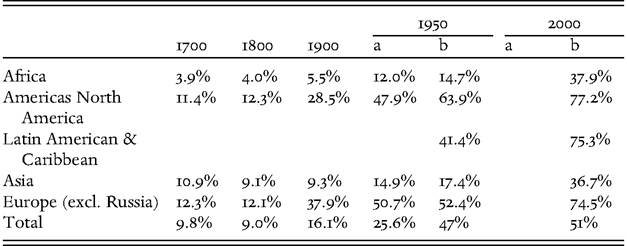
a= settlements of 5,000+
Source: Bairoch, pp. 284, 587, 634.
b= all urban settlements, national definitions
Source: United Nations, World Urbanization Prospects, 1999, p. 32.
The growth of urban populations depends on two processes: migration and natural increase, whose relationship sets the rate at which cities expand over time. Geographic mobility is normal, particularly among young adults, and industrialization and agricultural modernization increase pressures, as well as the opportunities, to move. Heavy immigration swells the size of a town and the ranks of those in their reproductive years, although many immigrants leave soon after arrival, and others die young, marry late, or not at all. Before 1850, cities were relatively unhealthy places with higher infant mortality and lower life expectancy than the countryside. Therefore most urban growth in Europe resulted from immigration, rather than natural increase.
Urbanization is most easily defined demographically. As a region urbanizes, a larger and larger proportion of its people live in cities and towns, rather than rural areas. As Table 2.1 indicates, only about nine percent of total world population lived in settlements larger than 5,000 in 1800, but that percentage swelled to about sixteen percent in 1900 and then to about twenty-six percent in 1950. Urbanization levels have varied from region to region, however, being much higher in the modern period in Europe and in the Americas than elsewhere.
In these two areas, around half of the total population lived in cities and towns in 1950, while the proportion reached only about fifteen percent in Asia and twelve percent in Africa. In the second half of the twentieth century, levels of urbanization rose in Asia and Africa too, as their states gained independence from colonial rule and the world economy recovered from the impact of the world wars and the Depression. Today the absolute number of urban dwellers in Asia is much higher than in Europe and North America, and Asian urbanization levels are climbing. Since 1950, the relationship between the rate of urbanization and the level of urbanization has been inverse: movement into cities has been fastest in areas with the fewest cities - Africa, Polynesia, Southeastern and East Asia. It has been much slower in regions with more advanced economies, such as Europe, North America, Australia, and New Zealand.[24] Higher fertility and declining mortality, combined with sustained movement out of rural areas, continue to fuel the intensified urbanization of poorer states.Urbanization, however, is not just a matter of numbers. It must also be measured in structural terms: as activities located in space. Towns are centers where specialized services are offered and where those who deliver those services reside. For example, trade, large-scale manufacturing, governance, and education are most efficiently carried out or provided in central places, where there are markets, factories, and offices. Cities are multi-functional, diverse communities. If we look at a mid-nineteenth-century census of Paris, we can see the many different trades that constituted the economy of a capital city early in the industrial era. Its citizens administered, arrested, brewed, cleaned, carried, constructed, cooked, cured, danced, drove, and dug, trained in hundreds of different crafts and services. These activities not only produced goods for sale, but also helped to create and spread an urban way of life.
Immigrants learned city habits in urban taverns, shops, theaters, and workplaces. Conversely, urban communities developed ways to integrate or segregate newcomers, who might speak another language or have a different religion. Formal organizations, such as police forces, schools, and neighborhood groups, communicated local standards and set limits on behavior. Today, given the ease of commuting and telecommunicating, urban models of behaving and consuming have spread far beyond city borders. Seeingurban and rural areas as separate, bounded entities is no longer possible.[25]Cities as systems
Cities are not isolated units. They are tightly integrated into the territories surrounding them, importing food and other products and exporting services and manufactures. In any given area, urbanization creates a hierarchy of central places, which house a range of political, economic, and cultural institutions, distributing them in space according to levels of demand. In such systems, diversity is positively correlated with size. Small market towns of a region are linked via roads to larger, more complex towns, which offer a wider range of products and services, ones that people are willing to travel longer distances to obtain. While even the smallest towns have primary schools and markets or food stores, they normally lack secondary schools, hospitals, and theaters, which are located in larger centers. To find a university, a government office, or an opera house, a rural person must travel farther, perhaps to the largest city in a county or a country. City systems also include specialized towns - ports, manufacturing centers, university towns, or holiday resorts, for example.
Local overland connections constitute, however, only part of the linkages that cities foster. Technologies of transport and communications have gone global, and cities are major relay stations in the journeys of people and information. Cities are the nodes from which long-distance travelers depart, from which television programs are transmitted, and in which cultural standards are set.
Hollywood, Bollywood, and Nollywood movies flow from Los Angeles, Mumbai, and Lagos to global consumers. The music industries and audiences of Dakar, Paris, and the Caribbean are interlinked, as are those of Kingston, London, and New York. Cities operate within both Central Place and Network Systems, increasing their adaptability and their diversity through multiple linkages and exchanges. Cities are spaces of flows, in and out.[26]Urban networks, reinforced by current technologies of transportation, also shape long-distance travel and emigration. The hub-and-spoke designs for trains and air travel point travelers to the larger towns and cities. In the early twentieth century, shipping lines based in Hamburg, London, New York, and Yokohama ran regular services to ports in the Americas, Africa, and East Asia, as well as the coastal cities of Europe. Map 2.1 shows the routes of the Hamburg America line in 1914. Thinking about urbanization requires examining cities in terms of their spatial and functional relationships to one another. Some of these relationships are economic, reflecting geographies of production and exchange. Others are cultural, deriving from the circulation of ideas, art, and ideologies. Political power also operates through
Downloaded from https:Zwww.cambridge.org/core. University of Sussex Library, on 12 Jan 2017 at 21:23:07, subject to the Cambridge C of use, available at https:/www.cambridge.org/core/terms. https://doi.org/10.1017/CBO9781316182789.003
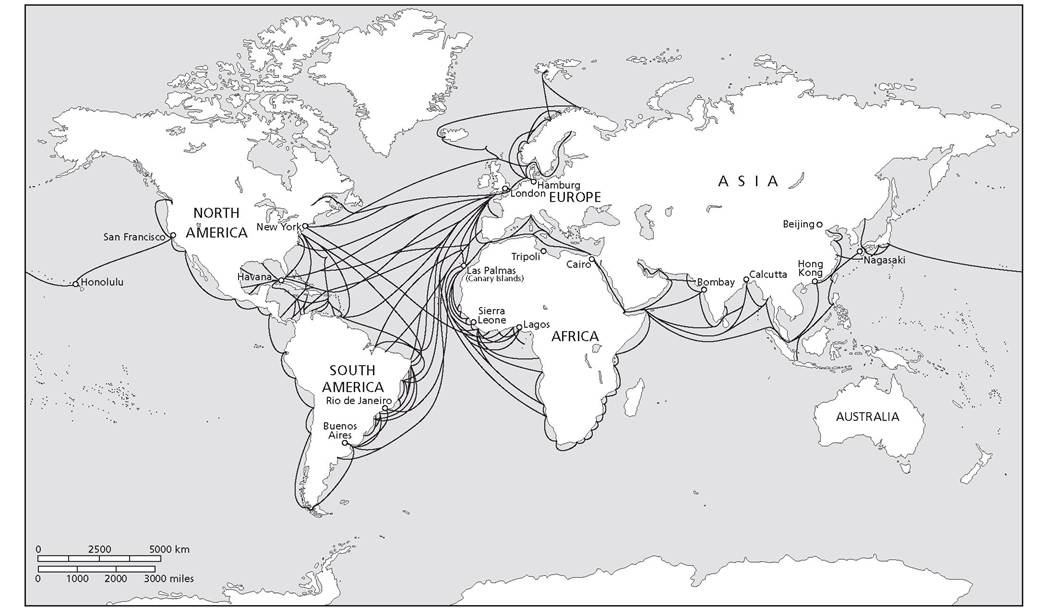
Map 2.i Hamburg America line routes in 1914
systems of cities. Most states, for example France after the Revolution of 1789, have functioned through institutions located in a hierarchy of cities. Mayors of towns or communes have answered to prefects, who then have reported from their offices in the chief city of each department to the central government in Paris via letters, telegraph, telephone, or, now, the Internet.
The largest cities in many national systems have tended to be political capitals: Moscow, Jakarta, Cairo, and Buenos Aires, for example, each of which also serves as a national commercial and cultural center. Where the attractive power of a central city far outshines the appeal of regional capitals and it becomes disproportionately large, it is called a primate city because of its huge size and influence. Today almost 70 percent of the Lebanese population lives in Beirut, and Port-au-Prince houses 60 percent of the Haitian population. Small, highly urbanized countries have the most concentrated populations. Although London and Tokyo are also primate cities, both Britain and Japan have lively regional capitals and complex distributions of urban functions among a large array of towns. Their degree of urban concentration is comparatively less. Economic development fosters more balanced urban hierarchies within national boundaries.
Scholars of globalization have suggested that the growing interaction of national economies has created an international urban hierarchy. Saskia Sassen argues that New York, London, and Tokyo have become “global cities,” because of their dominant role in providing financial services for the rest of the planet.[27] Although some types of manufacturing have become more decentralized, the opposite has taken place at the level of international finance, which benefits from a critical mass of firms, specialized services, and heavy investment in advanced telecommunications. London, Tokyo, New York, and, more recently, Hong Kong have acquired new centrality in the global economy because of their roles as receivers, processors, and dispensers of finance capital.
Regional differences
Urbanization is a global process, but it has not taken place evenly over time or in space. Although the earliest cities developed in the river valleys of present day Iraq, Egypt, Pakistan, and north China, urban systems could be found in many regions by the first century CE. These networks of towns proved
World urbanization, 1750 to the present fragile, declining along with the political powers that offered them protection. Extensive deurbanization of Western Europe followed the collapse of the Roman Empire in the fifth century CE. When population and agricultural productivity both increased after 800 CE, urban development accelerated again in much of Eurasia and northern Africa. This wave of urbanization slowed in the fourteenth and fifteen centuries when epidemics and the collapse of major empires hampered the flows of people and goods that sustained the towns. Where effective governments established themselves, urban growth continued, for example in the Aztec-dominated lands of central Mexico and the Yangzi delta towns in China under Yuan rule.[28]
Another spurt of urban growth took place between 1500 and 1700, pushed by rising agricultural productivity, trade, and political consolidation. Between 1580 and 1700, Japan became one of the most heavily urbanized territories in the world, when the new military ruler of the country Tokugawa Ieyasu founded Edo (the forerunner of Tokyo), and his samurai warrior allies administered their domains from fast-growing castle towns. In the Middle East, cities as diverse as Isfahan, Istanbul, Damascus, and Mecca thrived under Ottoman and Safavid control, linked by secure routes to other centers of Muslim power from the shores of the Mediterranean to Malacca. Urbanization expanded in the Americas, as the Spanish founded new towns through which they administered their vast empire. As states expanded their power, the larger administrative cities and ports grew rapidly. The largest and most dynamic cities in the world during the early modern period were, for the most part, located in Asia, although urban growth had slowed in the Mughal Empire and in China by the later eighteenth century.[29] In contrast, urbanization was limited in North America and sub-Saharan Africa.
In 1750, the most densely urbanized regions of the world (defined as proportion of total populations living in cities) could be found in the Netherlands, England, Brabant, Northern and Central Italy, and Japan, all heavily commercialized areas with integrated networks of multiple market towns and administrative centers.[30] These districts of high urbanization were located in economically advanced zones with prosperous agriculture, thriving merchant communities, and active ports and markets. London and Edo
(Tokyo) were huge, metropolitan districts, their populations spilling over formal boundaries. Even if its overall level of urbanization was comparatively low, China had well-developed urban hierarchies in regions organized around the drainage basins of major rivers. Growing commerce supported the rise of market towns. During the eighteenth century, the most advanced regions of Western Europe and China had similar levels of agrarian productivity, population growth, standards of living, and commercial development.
What Kenneth Pomeranz calls “the Great Divergence” in the economic organization and wealth of the most developed areas of Europe and China took place after 1800, and it had definite urban implications.[31] In England, the “Industrial Revolution" - the shift of textile manufacturing into factories and the use of steam engines and coal to provide cheap, continuous power - led to city creation, first in Britain, and somewhat later in Belgium, France, and New England. Rural sites of production attracted enough workers to transform villages into towns, and railways moved migrants and materials faster and farther to central places. Coal-burning steam engines freed textile manufacturing from its dependence on water power, permitting production sites in older cities. The combination of mining and metallurgy helped after 1870 to urbanize large areas near coal deposits in Poland, western Germany, and Pennsylvania. A second wave of industrialization based on the internal combustion engine, steel, oil, and chemicals reinvigorated economies in Western Europe in the late nineteenth century and stimulated both industrial and urban growth in Central Europe, North America, and Russia. Because technology is relatively “footloose,” available for installation anywhere, entrepreneurs on several continents bought the new machinery, building factories in towns and refineries in ports. Not only industrial production, but also expanded transportation, trade, and services provided new jobs in many cities, thereby attracting migrants. During the nineteenth century, cities grew, albeit at different rates, throughout Europe, North America, Australia, New Zealand, and South Africa.
The early impact of industrialization in Europe and North America on Asia, Eastern Europe, and Latin America was uneven. Port towns that exported raw materials to the developed countries and imported manufactured goods could thrive whatever their setting. Witness the rapid growth of Manaus in Brazil during the rubber boom and Baku in the Russian Empire after the discovery of oil in its hinterland. Urban populations in Mexico, Brazil, and Argentina expanded along with their export and manufacturing sectors, while cities in the Andean regions stagnated. India experienced almost a century of deurbanization, as town artisans found their markets shrinking because of British competition, although ports such as Bombay and Calcutta thrived. In China, no single pattern dominated. Small market towns continued to grow during the later decades of the Qing empire, and after 1850, treaty ports expanded, but declining rates of population growth and political turmoil from the mid nineteenth century onward probably dampened urban expansion in the lower Yangzi region.
The absolute number of cities has also risen strikingly since 1800 in both industrialized and developing countries. In Europe, the number of towns with more than 10,000 inhabitants doubled between 1700 and 1800, and more than doubled again by 1870.11 Planned towns multiplied in South Australia and New Zealand during the early years of European colonization. In 1883, surveyors laid out over 1200 new townships along the route of the Canadian Pacific Railway. After Latin America became independent, the number of centers with more than 20,000 inhabitants grew from 41 in 1800 to 207 in 1920.12 Colonial governments and merchants founded new ports along coastlines. Singapore, Hong Kong, Rangoon, and Surabaya soon became important centers of export and transshipment. By the later nineteenth century, Durban, begun as a trading station by merchants from Cape Colony, developed into one of the world's largest sugar terminals. Expanding maritime empires generated international trade, which produced new cities and towns.
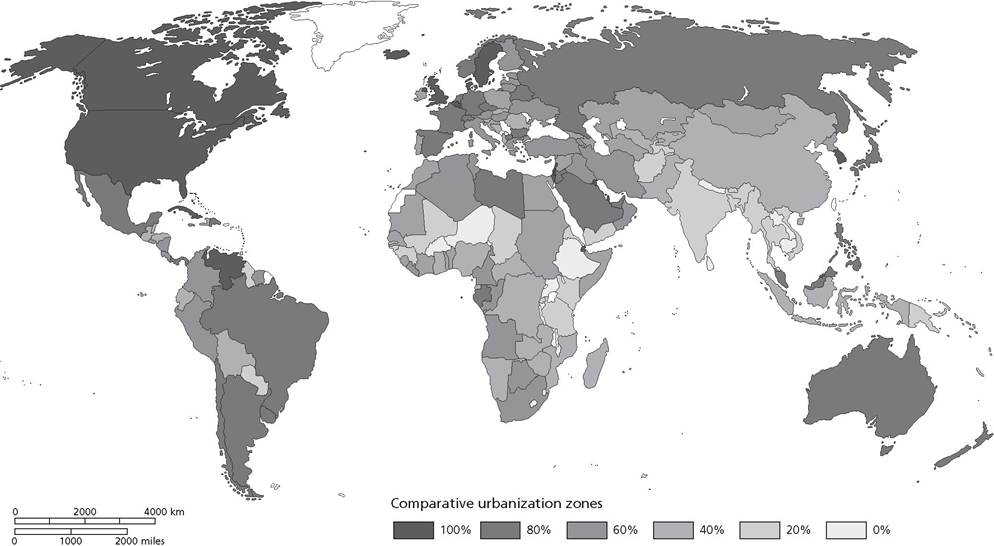
Urbanization during the early and mid twentieth century was uneven. World wars and economic depression hindered growth in much of the industrialized world. Not only did bombs and retreating armies level towns, but the list of urban casualties stretching from Coventry through Dresden, Warsaw, and Hiroshima was depressingly long. Meanwhile, Latin American cities, well outside the conflict zones, expanded rapidly, especially where protective tariffs encouraged industrial development. Then after 1945, rebuilding combined with the postwar economic boom fostered city growth in Europe, North America, and much of Asia. Expanding at twice the rate of towns in the industrialized regions, cities throughout the Third World exploded in size. The spatial distribution of that population within cities [32] [33] changed too. Although central cities in many regions lost population, suburban settlements attracted immigrants. Urbanization responds to political attitudes and policies as well as economic rhythms. Wars can destroy towns and force their populations to flee, at least temporarily. Where command economies replaced market systems, governments monitored urban residence and shaped urban design and growth. The Soviet state used passports and resident permits to block the rural population from moving into Russian cities. In 1958, the Chinese government instituted a system of household registration linked to place (hukou) that it used to limit migration from countryside into the towns. Then during the Cultural Revolution of the 1960s and early 1970s, the Maoist government exiled young people from the cities into the countryside for political reeducation. The determination of the Khmer Rouge to build an agrarian-based Communist society led them to virtually empty Cambodian towns during the later 1970s. Governments can also champion and finance urbanization. Governments have built new towns and revamped older ones according to prevailing views of a “good society.” In Eastern Europe and the USSR, over 1000 new towns were built after World War II to ease housing shortages and jump-start the new socialist economies. Neighborhood units organized around large concrete apartment blocks and minimal sets of social services multiplied around industrial sites. After 1945, new towns, designed as garden cities, multiplied in the British Isles, the Netherlands, and Scandinavia, offering their residents artfully designed greenspace and modernist housing. During the later twentieth century, the once-powerful link between manufacturing and urban growth broke in many areas, when much of Western Europe and North America deindustrialized. Formerly prosperous factory towns, such as Belfast, Liege, and Detroit, lost population and economic dynamism. Others turned with relative degrees of success to the production of culture or services. Today, the main drivers of the Philadelphia economy are education and health care. Lyon, once the leading producer of fine silks, now thrives on the combination of biotechnology, research, tourism, and transportation. While adaptation has served some major cities, others have not developed either a manufacturing sector or substitute trades able to employ their populations. The movement out of rural areas into towns has increased in Africa, Latin America, and the Middle East, far beyond the level at which migrants can be employed in manufacturing jobs. Yet the relative attraction of cities, where newcomers can find better schools, health care, entertainment, and perhaps a poorly paying job, remains strong. In cities such as Nairobi, Jakarta, and La Paz, thousands of men and women arrive yearly with many moving into shanty towns and decayed housing. While some find employment in established businesses or government offices, others can get work only in the informal economy, perhaps as street vendors or trash pickers. Demographic growth therefore continues, but on a relatively fragile economic base in the absence of industrialization. Low-level political conflict has resulted between newcomers and local governments over rights to land and city services. In multiple countries today, over two-thirds of the total population lives in cities and towns. Levels are highest in North and South America, Australia, Japan, Western Europe, North Africa and the Gulf region. Map 2.2 allows easy comparison of urbanization levels in 1990 in large regions, although it gives a misleading impression of urban populations spread evenly throughout nation-states. Few countries today have less than a quarter of their population living in cities, and these tend to be small, relatively isolated states such as Rwanda, Cambodia, Nepal, and Papua New Guinea. Coping with urban growth New towns without adequate housing, sufficient clean water, and effective sanitation shocked contemporary observers. The stinks, the dirt, the noise were overwhelming, and the infrastructures were primitive. Local transportation was primarily on foot, and citizens could access few city services. Horses, which did much of the hauling and carrying, added to the cacophony of sounds with their clomping hooves and whinnies, while dropping manure on the streets. In the early nineteenth century, medical doctors and radical politicians compared cities to sewers, to “foul holes” that produced “poverty, plague, and disease.”[34] Both conservatives who disliked change and progressives who demanded a better outcome became vocal critics of industrial cities, which they saw as death traps because of their physical conditions, and they were right. During the early and mid nineteenth centuries, not only did cities have higher death rates than rural areas, but those rates rose along with industrial urbanization.[35] On the ecological level, cities change environments because of the pollution they create and the land that they use. John McNeill uses the term “urban Downloaded from https:Zwww.cambridge.org/core. UniversityofSussex Library, on 12 Jan 2017 at 21:23:07, subject to the Cambridge C of use, available at https:Zwww.cambridge.org/core/terms. https://doi.org/10.1017/CB09781316182789.003 Map 2.2 World map of comparative urbanization rates, 2005 metabolism” to describe how cities every day take in enormous amounts of oxygen, water, food, fuel, building materials, and other products, and simultaneously send out carbon dioxide and monoxide, sulfur and nitrogen oxides, dirty water, sewage, and dust.[36] Concentrations of people produce concentrations of harmful waste products. The burning of coal by factories, home furnaces or hearths, and power plants sent skyward daily hundreds of tons of soot, gases, and toxic metals to darken skies and harm lungs. Supplying cities with sufficient, clean water became more difficult during the rapid urbanization of the nineteenth and twentieth centuries. Most cities drew their drinking water from local rivers, despite the fact that they also dumped untreated sewage into the same streams. In the mid nineteenth century, thousands of city dwellers died from cholera and other water-borne diseases. Industrialization, which had initially worsened urban conditions, soon, however, produced the technologies and higher incomes that led to lower mortality. During the second half of the nineteenth century, urban death rates declined in most of Europe and in the United States, as inhabitants gained access to cleaner water, better sanitation, and improved housing. In 1849 a British doctor, John Snow, suggested that sewage-laden water carried cholera, and he later provided epidemiological evidence of the linkage between cholera deaths and polluted water. As his ideas gained support, the larger, richer cities in Western Europe built underground pipes and tunnels to divert sewage away from water sources, and they brought more clean water into the towns from distant springs and rivers via aqueducts. Engineers designed pumping stations, filtration plants, and piping systems to deliver the water to homes and businesses. By 1900, the larger cities in Britain, France, and Germany had waterworks and sewage treatment plants, and these technologies spread to other countries. Where these were introduced, cholera ceased to be an urban problem. Sanitizing cities became a central part of modernizing them, and urban administrators not only shared information on projects, but they competed with one another to introduce improvements. By 1900, urban death rates fell decisively in the larger cities of Western Europe and North America. By the early twentieth century, infant mortality rates began to decline not only in Europe but also in colonial towns such as Cairo, Calcutta, and Singapore. Authorities funded increased water supplies, sewage systems, and public health services for at least part of the urban population. As antibiotics, DDT, and better urban sanitation spread widely after World War II, death rates both ofinfants and of adults declined sharply throughout developing regions. Natural increase now fuels urban growth, even where economic development lags. Nevertheless, this pattern has proved reversible, for example during wars, famines, or epidemics. The spread of HIV/AIDS has produced rising death rates in many cities throughout subSaharan Africa, and low-income urban populations remain at high risk from TB and malaria. The sanitation and modernization of cities was neither automatic nor cheap. In Europe, governments commonly used tax money to make these investments, or they sold monopoly rights to a private company, requiring it to provide good service at reasonable prices. By 1900, the major cities of the German empire all had waterworks and gasworks, tramways and electricity plants.[37] Their inhabitants could use public baths, health clinics, and hospitals, with the result that they lived longer, healthier lives. These investments did not take place where towns lacked effective governance and a strong economic base. Engineers, inventors, and entrepreneurs worked in tandem to redesign urban services, communications, and construction. Steam engines pumped water into elevated reservoirs to permit wide distribution. Gasworks and underground pipes permitted the lighting of town streets and homes. Cast iron could be turned into rails for horse-drawn trolleys and railway lines, while glass panels brought new light into railway terminals. Portland cement, patented in 1824, produced cheap sidewalks and sewer pipes. In the later nineteenth century, electricity powered trolleys and elevators. Cheap steel and reinforced concrete made possible skyscrapers and prefabricated housing. In the early twentieth century, the internal combustion engine revolutionized urban transport, permitting buses and, later, automobiles to swarm onto city streets, with the result that tailpipe emissions added waste gases and lead to the air. Cars have multiplied faster than roads, freeways, and garages can be constructed, slowing traffic and poisoning the air in cities around the world. Introducing new technologies in cities has not been a story of linear and uniform progress.[38] What has brought greater convenience to individuals can also bring high costs to communities and deepen inequalities. Inequalities in the city Debates about the consequences of urban life have continued throughout the twentieth century as analysts from many political and disciplinary camps have weighed in. Stressing the positive results of urbanization, Edward Glaeser, an American economist, argues that cities make us “richer, smarter, greener, healthier, and happier.” Yet where Glaeser sees “human progress,” Mike Davis, an urban theorist, finds “increasing inequality” and the “reproduction of poverty.”[39] In his view, the negative results of contemporary urbanization for the many outweigh the positive implications for the few. Some of the debate arises from differences in values: should cities be measured against an index of prosperity or one of equality, against a yardstick of individual freedoms or one measuring communal well-being? Both of these men can be right. Market-driven economies work through inequality, which can be extreme, but they also concentrate wealth and other resources in the larger cities, where they encourage investment. The evidence is clear that cities are engines of economic development and innovation. They offer inhabitants higher standards of living and higher wages than do rural areas. Moreover, people living in predominantly urbanized countries are richer and healthier on average than those living in states where more than 50 percent of the population lives in the countryside. However poor a developing country might be today, the share of its population living in poverty is significantly lower in its cities than in rural areas of those states.[40] Nevertheless, inequality is built into the social and spatial organization of cities. Today the absolute numbers of the urban poor are growing because of migration of unemployed, disadvantaged people to major cities who settle in wherever they can find space and are tolerated by city governments. Mike Davis estimates on the basis of United Nations investigations that 78.2 percent of city populations in the “least-developed countries” (Nigeria, Nepal, Bangladesh, Sudan, for example) reside in slums.[41] He calculates that in India, slum dwellers constitute 55.5 percent of the urban population. The absolute amount of poverty to be found in many contemporary cities is striking because of its sheer magnitude, concentration, and contrast with nearby affluence. Skyscrapers and shopping malls look out over shanty towns, where inhabitants lack legal titles to their property and battle authorities for access to services and the right to remain. Low-level conflict between newcomers and officials contributes to the problems of crime and violence in slum communities. Inequality has grown in tandem with the development of an informational economy, which has changed occupational structures in the cities of the industrialized world as well as those of developing areas. Growth of labor forces in the “global cities” at the top of the international hierarchy has resulted in high-paying jobs in finance and information technology and in low-paying service work, which is taken on disproportionately by minorities and foreign immigrants in the informal economy.[42] In combination with decreases in unionized manufacturing jobs, these changes have produced increased economic inequality and social segregation in London, New York, and Tokyo, the centers of the global economy. Urban spaces and their allocations signal social values and shape everyday life for ordinary citizens. Cities are systems within their own boundaries, organizing their internal spaces around particular functions and settlement patterns that influence circuits of exchange and communication. City walls marked boundaries, separating insiders from outsiders. From ancient times, cities were split into areas of higher and lower status, in which residence was linked to religion, kinship, social class, and occupation. Governments and religious authorities usually pre-empted central spaces. The wealthy tended to live nearby, gaining status and visibility by being close to the loci of power, while the poorest citizens found housing in outer areas or in back streets. Rulers often forced foreign merchants to live in separate districts, and some European towns confined Jewish residents to enclosed ghettos. Segregation could also be vertical, as it was during the early nineteenth century in central Paris, where servants and other workers lived on upper floors, or it could be by occupation, as it was in Hanoi, where particular trades from specific villages settled on the same street. As long as most people moved around cities on foot, and the wealthy needed servants and supplies close at hand, different social classes lived in reasonably close proximity. Industrialization and economic development then made possible extensive rearrangements of urban spaces. Homes and workplaces became separate places for more and more people. An expanding middle class who could afford newer housing and mass transit fares fostered suburban growth. Soon commuting became relatively easy as railroads, trolleys, and buses tied outer districts to central areas. Moving out let others move into what became Central Business Districts organized around banks, department stores, and office buildings. Manufacturing often located in, or was moved to, peripheral areas where land was cheaper and where noise, smoke, and stink would be less annoying. In the twentieth century, planners in many countries embraced functional zoning, which mandated housing separated from commerce and production. Segregation by social class increased as rapid transit and private automobiles made it even easier to move to newer quarters, where higher prices and rents kept out the poor. By the early twentieth century, large middle-class suburbs organized around single-family houses had appeared outside cities as diverse as Manchester, Munich, Chicago, Capetown, and Sydney. After World War II, similar housing estates could be seen all over the world, wherever rising incomes and improved transportation permitted the wealthier to isolate themselves from the less fortunate. In very recent decades, substantial numbers of the affluent have moved back into city centers, where luxury apartments and town houses provide relief from the inconveniences of commuting, while still offering sufficient distance from the poor. Social segregation on the basis of ethnicity and culture became much more explicit in the modern period when the languages of color and race became intertwined with allocations of urban space. Carl Nightingale identifies empire building, land markets, and sanitary reform as the processes through which urban segregation deepened in the eighteenth and nineteenth centuries. The British organized the area of Madras into two walled settlements, White Town and Black Town, and Stamford Raffles' 1819 plan for Singapore centered on an administrative district and European quarters, flanked by separate sections reserved for Chinese, Malay, Arabs, South Asians, and Bugis. As town-building expanded throughout British India in the nineteenth century, British civilians lived in cantonments, self-contained, quasi suburban communities protected by the army and culturally insulated from local populations. In Morocco, the French added modern sections to Casablanca, Rabat, Meknes, and Marrakesh, which separated the rulers and their institutions from “traditional” neighborhoods. After the outbreak of the bubonic plague in 1894 in large Asian cities, doctors and public health officials redoubled efforts to segregate Europeans from “native” populations blamed for transmitting diseases. Several mechanisms - among them, relative land prices, zoning regulations, and restrictive covenants - reinforced racist assumptions about the need for segregation of populations. In the most extreme case, the Native Urban Areas Act of 1923 permitted South African towns to restrict districts to “whites only” and to remove others to separate locations.[43] Although anti-colonial and democratic governments dismantled the legal bases of urban racial segregation in the late twentieth century, differences in land and housing prices combined with income inequality permits de facto segregation to survive in many cities. Although the political ideology of democracy promises equal rights to citizens, inequality of outcomes is built into free market economies, which is often justified in terms of religious and ethnic differences. Cities as economic and cultural centers exemplify the tensions between legal rights and social realities. Their diversity and multi-functionality hinders progress toward the broader social equality promised in the ideal of an urban “community.” The megalopolis One of the most striking changes produced by the rapid urbanization of the planet during the past 250 years is the exploding size and diversity of the world's largest cities. Cities of more than a half million people were not unknown in the ancient world, but they were rare and generally lasted only as long as their political base remained strong. In modern times, the largest cities have not only remained large and retained their political importance, but they have continued to expand, in many cases faster than their national populations. In 1750, most of the ten largest cities in the world were located in China, Japan, or the Ottoman Empire, reflecting the long-term dominance of Asia in the world economy. Each had fewer than 900,000 people. The increasing sizes of London and Paris signaled, however, the growing strength of northwestern European states and the expanding Atlantic economy (see Table 2.2). By 1850 London had leaped to the top of the list with 3,320,000, and New York City had broken the half million mark. By 1950, four of the top ten cities - New York, Buenos Aires, Chicago, and Los Angeles - were in the Americas, but Moscow and Calcutta had also become urban giants. Each claimed more than 3,000,000 residents. Only half of the cities on the list were capitals. The others relied on industrial growth and trade to draw in immigrants by the tens of thousands. Downloaded from https:Zwww.cambridge.org/core. University of Sussex Library, on 12 Jan 2017 at 21:23:07, subject to the Cambridge C of use, available at https:/www.cambridge.org/core/terms. https://doi.org/10.1017/CBO9781316182789.003 Table 2.2 World's ten largest cities Source: Tertius Chandler and Gerald Fox, 3000 Years of Urban Growth (New York: Academic Press, 1974), pp. 322, 328, 337. These sprawling, crowded places have proved hard to understand and easy to fear. Fritz Lang's 1927 film Metropolis identified the city of the future with looming skyscrapers, oppressive technology, deep economic inequality, and class conflict. Lewis Mumford, one of the twentieth century's most influential commentators on cities, thought that modern cities threatened social cohesion and the natural environment. He accused them of spreading conformism and mindless patriotism, while curbing individual liberty. Their size and mobility defeated attempts to maintain a sense of community or a coherent space.[44] During the next fifty years, cities continued to multiply in size as well as in numbers. While only one city, metropolitan New York, had broken the 10,000,000 mark in 1950, nineteen had done so by 2000 (see Table 2.3). Of the world's largest cities in 1750, only three (Beijing, Edo now Tokyo, and Osaka) retained that rank in 2000, and they are all in Asia, as are a majority of the other mega-cities that have emerged. Neither “city” nor “metropolis” seems an adequate description of these urban giants. In 1961, Jean Gottmann coined the term “megalopolis” to describe the area from Boston to Washington, DC, which he argued had become one urbanized area, unified by transportation and communications.[45] City region seems an even better description of these gigantic, urbanized areas. The Greek city planner Constantinos Doxiadis predicted the creation of one worldwide city, “ecu- menopolis,” which would grow dynamically along transportation routes to link major settlements everywhere.[46] Planners, he hoped, would “build the frame” of this universal city, channeling urbanization into carefully designed, human-scale communities, while preserving greenspace and the natural environment. Some of Dioxiadis's predictions about runaway urban growth have come true. Today, the Japan Statistics Bureau recognizes a Tokyo metropolitan area of 13 million people, embedded in a National Capital Region of over 43 million inhabitants, which comprises not only Tokyo but three adjoining, urbanized prefectures - Chiba, Kanagawa, and Saitama - each of which includes multiple cities with their own boundaries, and the urban sprawl continues south along the coast to the Osaka conurbation. In extreme cases, urbanized regions have overleapt the boundaries of nationstates. French geographers identified as early as 1989 a European urban core Table 2.3 Population of cities with 10 million inhabitants or more, 1950-2000 (* in millions) Source: United Nations, World Urbanization Prospects: The 2003 Revision, Table 1.7, p. 11. extending from northwest England through Belgium, the Netherlands, and the Rhineland area into northern Italy. Nicknamed the “Blue Banana,” for its curved shape and the color originally used for it by mapmakers, it depicts an area of dense settlement linked by high-speed rail, freeways, and airports, within which London functions as a financial capital and the Brussels bureaucracy exercises powers delegated to the European Union.[47] The different parts of these sprawling urban regions while unified by transport remain divided in many other respects. The question of how to govern these urban giants has not been solved effectively anywhere. Solutions lie along a continuum ranging from extreme decentralization, such as that followed in much of the United States, where multiple independent local governments run their particular slices of the larger agglomeration, to centralized forms of regional governance, such as exist in Bangkok, Tokyo, and Shanghai.[48] But even where one authority has power over a designated metropolitan region, there are usually competing authorities who run particular services, and official boundaries rarely coincide with settlement patterns on the ground. Growing cities expand outward, faster than government can recognize and cope with changes. Even in the twenty-first century, urban sprawl outruns the capacity of city governments to provide needed infrastructures and services. Suburban shanty towns lacking electricity, sewers, and clean water have multiplied in parts of Latin America, Asia, and Africa, but metropolitan regions in Europe and North America also have neglected territory outside formal jurisdictions. Office buildings, shopping malls, and apartments, in clusters sometimes called “edge cities,” have sprouted around the world near freeway exits or airports.[49] With no separate governing structures or clear identity, these neighborhoods sit uneasily among older town centers and overlapping administrative jurisdictions. Parasitic on the services and populations of other neighborhoods, they survive uneasily where transit systems intersect and commuting patterns converge. The United Nations estimated that in 2003 the world urban population reached 3.04 billion people, a large majority of whom lived in the cities and towns of developing countries.[50] Urbanization has become the norm, rather than the exception. In the next two decades, virtually all of the the world's population growth will flow into the cities of less developed regions, many of which lack the resources to offer most newcomers decent housing, good education, and employment at a living wage. Although globalization has lessened differences among cities, which share technologies, cultural styles, and consumer goods, rising levels of social and economic inequality limit access to the benefits of urban modernity. Cities in the twenty-first century, as in earlier times, need to translate the benefits of higher incomes into improvements in the quality of life and widened opportunities for all of their citizens. Further reading Bairoch, Paul. Cities and Economic Development, trans. Christopher Braider. University of Chicago Press, 1988. Castells, Manuel. The Informational City. Oxford: Basil Blackwell, 1989. Clark, David. Urban World/Global City. London: Routledge, 2003. Clark, Peter, ed. The Oxford Handbook of Cities in World History. Oxford University Press, 2013. Davis, Mike. Planet of Slums. London: Verso, 2006. de Vries, Jan. European Urbanization, 1500-1800. Cambridge, ma: Harvard University Press, 1984. Driver, Felix. Imperial Cities: Landscape, Display, and Identity. Manchester University Press, 2003. Freund, Bill. The African City: A History. Cambridge University Press, 2007. Garreau, Joel. Edge City: Life on the New Frontier. New York: Doubleday, 1991. Glaeser, Edward. The Triumph of the City: How Our Greatest Invention Makes Us Richer, Smarter, Greener, Healthier, and Happier. New York: The Penguin Press, 2011. Goodman, David and Colin Chant, eds. European Cities and Technology: Industrial to PostIndustrial City. London: Routledge, 1999. Hall, Peter. Cities of Tomorrow: An Intellectual History of Urban Planning and Design Since 1880. 4th edn. OxfordWiley-Blackwell, 2014. Hietalla, Marjatta. Services and Urbanization at the Turn of the Century: The Diffusion of Innovations. Helsinki: Finnish Historical Society, 1987. Hohenberg, Paul M. and Lynn Hollen Lees. The Making of Urban Europe, 1000-1994, rev. edn. Cambridge, ma: Harvard University Press, 1995. Jacobs, Jane. The Economy of Cities. New York: Vintage, 1970. Laquian, Aprodicio A. Beyond Metropolis: The Planning and Governance of Asia's Mega-Urban Regions. Washington, do: Woodrow Wilson Center Press, 2005. Lees, Andrew. Cities Perceived.: Urban Society in European and American Thought, 1820-1940. New York: Columbia University Press, 1985. Lees, Andrew and Lynn Hollen Lees. Cities and. the Making of Europe, 1750-1914. Cambridge University Press, 2008. Nightingale, Carl H. Segregation: A Global History of Divided Cities. University of Chicago Press, 2012. Ren, Xuefei. Urban China. London: Polity Press, 2013. Sassen, Saskia. The Global City: New York, London, and Tokyo. Princeton University Press, 1991. United Nations Department of Economic and Social Affairs, Population Division. World Urbanization Prospects: The 1999 Revision (New York: United Nations, 2001) and World Urbanization Prospects: The 2003 Revision (New York: United Nations, 2004).
1750 1850 1950 Peking 900,000 London 2,320,000 New York 12,300,000 London 676,000 Peking 1,648,000 London 8,860,000 Constantinople 666,000 Paris 1,314,000 Tokyo 7,547,000 Paris 560,000 Canton 800,000 Paris 5,900,000 Edo (Tokyo) 509,000 Constantinople 785,000 Shanghai 5,406,000 Canton 500,000 Hangchow 700,000 Moscow 5,100,000 Osaka 375,000 New York 682,000 Buenos Aires 5,000,000 Kyoto bgcolor=white>362,000 Bombay 575,000 Chicago 4,806,000 Hangchow 350,000 Edo (Tokyo) 567,000 Calcutta 4,800,000 Naples 324,000 Soochow 550,000 Los Angeles 3,900,000
City 1950 City 1975 City 2000 New York 12.3 Tokyo 26.6 Tokyo 35.0 Tokyo 11.3 New York 15.9 Mexico City 18.7 Shanghai 11.4 New York 18.3 Mexico City 11.4 Sao Paulo 17.9 Sao Paulo 10.7 Mumbai 17.4 Delhi 14.1 Calcutta 13.8 Buenos Aires 13.0 Shanghai 12.8 Jakarta 12.3 Los Angeles 12.0 Dhaka 11.6 Osaka-Kobe 11.2 Rio de Janeiro 11.2 Karachi 11.1 Beijing 10.8 Cairo 10.8 Moscow 10.5 Manila 10.4 Lagos 10.1